
Blog – An Alzheimer’s Cabaret
As the last day of AAIC drew to a close, and most people headed home with tired heads and a sigh of relief after an incredibly busy week, I headed to Bloomsbury theatre for the final Alzheimer’s related event of my week. This time not a talk, or a networking reception, but a night at the cabaret. I had been lucky to grab the final ticket to that night’s performance of “Unforgettable”, an Alzheimer’s Cabaret.
Ten years ago, Tamara lost her father to familial young-onset Alzheimer’s disease. He was diagnosed at just 45 years of age. She and her siblings have a 50% chance of carrying the same disease-causing mutation. For carriers of familial autosomal dominant Alzheimer’s disease mutations, the age at which cognitive decline will begin is similar from parent to child. Not the most traditional topic for a one-woman cabaret show – but one of the most authentic, relatable, comedic and moving shows I have seen.
The story and experiences are told through performing an interwoven cast of characters that surrounded her father’s dementia journey. A care home nurse, her father, her mother, herself as a child and now, a care home resident, and even her beloved family horse.
What I didn’t expect going in, with tissues in my bag in preparation for tears, was how funny the cabaret would be.
Some of the best stand-up shows I have seen are centred around a tragic event, and this was no different. The observations and depictions of the characters she embodied reflected a dark humour and sometimes out and out comedy; like the well-meaning but ill-timed comments from care home staff – “any issue, Jane’s got a tissue”. The cabaret was dynamic too, involving audience members and using a simple set and home-style pyrotechnics (think bubble machine, and a lit up hula hoop) to explore the characters and their feelings of desperation, grief and an unknown future. Beautiful vocals and music carried the story to each new destination.
And of course, the piece was, at times, incredibly sad. The light joyful moments were shrouded with a sense of knowing that in a short while, we would once again be faced with the heartbreak of watching a loved one decline and forget who you are. And the burden of caring for someone with dementia and the difficult feelings from devastation and anxiety to bitterness and resentment, and the guilt that comes hand in hand with those feelings.
I hadn’t expected to relate so much to the cabaret beyond my role as an Alzheimer’s researcher. But my family too carries a mutation for an autosomal dominant syndrome with no cure. Despite working with brain tissue from people with familial Alzheimer’s disease, I’d never really stopped to compare my personal experience to these families. As Tamara performed the internal debate surrounding whether or not to get genetic testing and find out if you carry the same mutation as your parent, she beautifully described the conflicting emotions and rationale. On one hand, does knowing you carry the disease allow you to live your life in the now more fully. Or does knowing mean you’ll constantly be waiting; every time you forget where you put your phone, do you think the disease has caught up with you. But on the other hand, if you don’t know, can you really live fully, or are you just assuming you are a carrier the whole time. And finding out that you do not carry the mutation is not itself without a toll. I myself am a non-carrier in my family, and what spoke to me most was the depiction of the irrational guilt when your sibling has the disease and how you manage in that situation. Tamara beautifully performed the weight of the decision of genetic testing, again finding the comedy in that darkness.
I cannot stress the importance and value of listening to people whose experiences so closely align with your research topic.
It’s not just for inspiration to keep going, but to form a true meaningful, even soulful, connection to why you do what you do. I am a big advocate for public engagement and telling the public about my research. But I, like others, often forget that it is a two-way street. You cannot dictate to someone what you are doing without hearing their story, their why. After a week of getting into the nitty gritty of new discoveries at AAIC, and focusing deeply on the minutia, this performance brought me back to the reality. It reminded me of the weight of responsibility that lies on the shoulders of researchers. Although we know all the statistics, it can be uncomfortable to be faced with the personal tragedy of someone with an Alzheimer’s story. Ultimately, we are in this field because we inherently want to help people. To do that we must be uncomfortable and we must listen and engage in two-way conversation.
As the cabaret came to an end, and we stood there as a crowd, singing together the final lines of the last song of the cabaret “Non, je ne regrette rien”, I felt an immense sense of connection and reinvigoration at the end of a long conference week. Without a doubt, I would highly recommend following the Unforgettable team and try to catch this beautiful cabaret the next time it is performed.
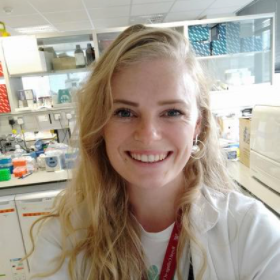
Dr Clíona Farrell
Author
Dr Clíona Farrell is a Postdoctoral Researcher in the UK Dementia Research Institute at University College London. Her work focuses on understanding neuroinflammation in Down syndrome, both prior to, and in response to, Alzheimer’s disease pathology. Originally from Dublin, Ireland, Clíona completed her undergraduate degree in Neuroscience in Trinity College, and then worked as a research assistant in the Royal College of Surgeons studying ALS and Parkinson’s disease. She also knows the secret behind scopping the perfect 99 ice-cream cone.