One of the most important roles we have as Dementia Researchers is to educate and inspire the next generation of scientists. I was somewhat dismayed when I started teaching Neuroscience to second year Oxford medics that the part of the syllabus that deals with dementia hasn’t really changed since I was at Medical School a long, long time ago. And the basic fact is that while the central theories hold, almost everything swirling around them has changed. So when I was given the opportunity to increase my teaching portfolio by teaching a new lecture course to second year biomedical scientists, I should have said, “absolutely not, I’m completely overwhelmed,” but instead, I said, “sounds amazing, sign me up.”
It had been a LOT of work. But three students from the course have just finished their first short research projects in the lab, and it has been a really positive culmination to a really good teaching year. Running a course really forces you to ask the super basic questions in our field, such as; “do we really know that?”, “how do we know that?”, “who figured it out”, and “are there any big gaps” in a way that you simply don’t have the bandwidth to consider when you’re rushing from grant to grant. I firmly believe it improves my grasp of the field, and gives me far better context for what we’re doing in the lab. But it is a lot. And so in this blog, I’m going to run through a few of the guiding principles I used when creating this course from scratch, in a hope to inspire more of you to step forwards and teach students the up to date scientific knowledge they need to push the field forwards.
My first piece of advice would be to teach mostly what you know, alongside a small handful of things that you always wished you’d had time to figure out. My course is called “The Molecular Basis of Neurodegenerative Disease and Dementia,” which means for most of the lectures, the study techniques and the foundational experiments are firmly in my wheelhouse. But we don’t cover only RNA and proteins. Much to the chagrin of a young man who came to the first lecture and then was never seen again, we start with clinical diagnosis; the huge amount of variability clinicians see in people with dementia and the difficulties this poses for diagnosis. In my mind this is essential information for understanding the leading edge of molecular discovery in neurodegeneration, and starts the course with a clear rationale for continued advances in biomarkers and deeper understanding of molecular mechanism. The look of shock on the student’s faces as we went through the current dementia diagnosis toolkit suggested it was a really important lesson in understanding where our biosamples arise from, and the tough decisions clinicians make in limited time to categorise people. Of course, it’s then instantly obvious why having a biochemical marker of a disease state might help this diagnosis. With the exception of the young gentleman above with an aversion to “just more psychology stuff,” the students were hooked.
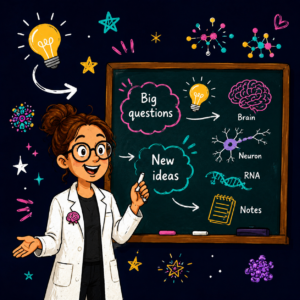
From big questions to bright ideas, teaching can shape the next generation of dementia researchers.
From there on in we explored both the history and current status of molecular dementia research, starting with insoluble proteins and disease models, moving through recent big papers in single-cell RNA seq and proteomics, and using these to launch three themed lectures; metabolism, neuroinflammation, and EI balance. The final lecture took three clinical trials that had either recently completed or were currently underway, looked at their scientific rationale, clinical trial design and inclusion criteria, and finished by discussing how biomarkers might inform rationale trial design. At each stage students were expected to build their knowledge of the scientific techniques employed to achieve the discovery, to consider the relevance of the models and samples used, and to embrace the complexity and uncertainty thrown up by deep molecular characterization of these complex disorders.
In small group tutorials we argued for and against hypotheses; amyloid, prion, the utility of mouse models, and students learnt how to use primary evidence to formulate scientific arguments. I had an absolute blast teaching the course, and the reviews from the students were mostly very positive. Many commented on how unusual it was to see papers from the last two years in a lecture, despite the fact that when they become practicing scientists in a few years’ time, putting brand new papers in context of the historical literature is one of the most important skill sets they will require. Those of you who know me will know that my public persona is somewhat energetic, and I think the students appreciated the genuine enthusiasm of not knowing something, and enjoyed the prompts to get them to plot out ways to try to figure it out.
A few things to consider along the way. If your students are in the first part of their academic journey, they have probably received pretty basic teaching on many of the systems you’re going to cover, and so you’ll have to ensure you cover some of those bases first. Metabolism is a great example, where the students hadn’t heard about some of the glial neuronal shuttles, and why different cells might use different fuels under different conditions. Make sure you check out the syllabus for what they’ve already covered in their courses, and that you proactively plug any gaps in the teaching that you might need for them to understand a disease state. Similarly, most lectures are online these days, so make sure you’re not repeating material they’ve already heard too frequently.
Be clear on what you want students to take away from your lectures, and that you give opportunities for students of all strengths to succeed.
A big part of this is providing good handouts with direct links to the reviews and primary literature that you quote, which gives the top students the opportunity to go and check out full papers and further contextualise their learning. I’ve kind of given up summarizing things with bullets for some of my scientific talks, but these summaries are essential for the weaker students to ensure they have understood the drive of the argument, and will enable them to revisit the material and further their understanding outside of the rapid-fire lecture format. Still, don’t give away absolutely everything in the handouts – keep some things as discussed in the lecture only, so that the students who attend and fully engage will benefit more widely from the experience.
When it comes to examining, set your questions with these different levels of students in mind. A question such as; “Outline the key arguments against the amyloid hypothesis of Alzheimer’s Disease” allows the weaker student to pass by bulking out your bullet summaries, the stronger students to use primary evidence to make their argument, and the best to write a well-rounded appraisal which takes in alternative hypotheses and highlights key experimental evidence across the board. In this scenario everyone who understands the broad argument passes, and the top students gets to show they are thinking deeply in creative ways about the topic.
When you’re marking their exams, be self-reflective. For example, I noticed a few students put a lot of weight on one of the clinical trials we covered in a final lecture as a competing mechanism to amyloid, and this arises from the fact that I hadn’t made it clear that I’d essentially picked trials at random from different sub-categories to highlight – I didn’t necessarily believe that evidence for this mechanism was particularly strong. There were a few occasions like that where I realized that even though you say this science is open for discussion every lecture, your word really is taken as ground truth by a subset of students, and it’s important to recognise this when you’re talking. I will be taking this reflection and others forwards to next year, where the slides and the flow will stay generally the same, but I will tweak the way I introduce certain ideas.
Three easy final things. 1) Of course, always check the work, but I found that ChatGPT was really good for identifying to first person to do a certain thing. Especially when it comes to the major evidence along the amyloid pathway, much of this was accepted knowledge when I started to think about dementia, and so the path of discovery was not always clear to me. 2) Related to this, it’s really quite common that lots of people were working on the same thing at the same time, and you can’t cover it all. You can therefore make a choice to highlight the work of specific people who may come from under-represented groups, or who are known to be an all-round good egg. For example, we had a brief aside in the neuroinflammation lecture to talk about Ben Barres and their article on “How to Pick a Graduate Advisor [1]” before we moved on to their work on reactive astrocytes. 3) At the end of each lecture, I highlighted Oxford based researchers and highly-rated supervisors working on this aspect of neurodegeneration, giving the students links to labs they may want to join for future research projects and internships. I hope this also proves valuable for colleagues in departments without undergraduate teaching portfolios.
It’s a serious job to be educating the scientists of the future, and one not to be taken lightly.
I’m of the firm belief that courses like this early on their careers will inspire students to join to fight against dementia, or to equip them with reasoning skills and practices that will benefit them whatever field of research they choose. Lecturing makes it more likely you’ll inspire excellent students to come and work in your lab, and raises your profile amongst the research community as your students ripple out to other labs. I’m pretty hopeful that I’m starting to create excellent PhD students who may come eventually to work in my lab, and if they don’t, then hopefully you’ll see some of them in yours. The students are awesome, and I’m excited to see how far they’ll go.
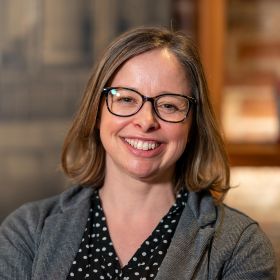
Dr Becky Carlyle
Author
Dr Becky Carlyle [2] is an Alzheimer’s Research UK Senior Research Fellow at University of Oxford, and has previously worked in the USA. Becky writes about her experiences of starting up a research lab and progressing into a more senior research role. Becky’s research uses mass-spectrometry to quantify thousands of proteins in the brains and biofluids of people with dementia. Her lab is working on various projects, including work to compare brain tissue from people with dementia from Alzheimer’s Disease, to tissue from people who have similar levels of Alzheimer’s Disease pathology but no memory problems. Becky is also a mum, she runs, drinks herbal tea’s and reads lots of books.