In March 2026 researchers from the Health and Social Care Workforce Research Unit at King’s College London and the Edinburgh Centre for Research in Dementia, dementia.ed and the Advanced Care Research Centre, University of Edinburgh, won a small seed fund to help build a new and exciting collaboration. We wanted to share our experience here to encourage others to reach out beyond familiar networks.
When we began developing this collaboration our first task was to map out our shared interests. Bringing together two teams of colleagues from King’s College London and the University of Edinburgh who had never worked together and worked across a wide range of specialisms including social care, workforce research, lived experience research, clinical practice and research, charity sector, arts-based methods and policy engagement. This felt both exciting and, also daunting.
We started with a very broad shared question: how could research be mobilised to better explore and understand the emotional challenges experienced within the caring dynamic, by both people living with dementia and the dementia care workforce. Individually, many of us had been working on different aspects of this issue. We recognised that capturing its complexity required perspectives and methods that extended beyond our individual teams and institutional expertise. While both teams had expertise in policy engagement and lived experience research, King’s brought extensive experience in workforce research, while Edinburgh brought a rich experience in co-production, participatory research and arts-based methods.
We began with an in-person meeting in London to explore the policy landscapes of the two regions with their distinct approaches to dementia care. This enabled us to map out our different strengths (person-based approaches in Scotland and system-wide approaches in England) as a backdrop to the collaboration. We also shared our individual research interests through open, discussion driven presentations – a ‘getting-to-know-you’ approach.
At the outset, building these connections was iterative, requiring time and an exploratory mindset.
Our differences in approach, although subtle, pushed us to think more critically about our work and to consider perspectives we might otherwise have overlooked.
Through a series of meetings, workshops and discussions the collaboration began to take shape.
As part of the collaboration the Edinburgh team trialled an arts-based method with over 150 NHS staff, family carers and people living with dementia at ‘Celebrating Scottish Research’ a dementia research conference hosted by the Scottish Dementia Research Consortium (SDRC), the Brain Health ARC, and the NHS Research Scotland Neuroprogressive and Dementia Network in Stirling in May 2026. Using a participatory approach, the team facilitated an ekphrastic poetry workshop to explore the emotional and relational dynamics of care. The King’s team have since been awarded additional funding to reproduce the Stirling workshop in London with care workforce participants. The Edinburgh team won further funds to produce a poetry anthology in partnership with the Scottish Poetry Library to showcase the participatory poems.
During the London visit, when the Edinburgh team visited King’s, we undertook a site visit to explore Two Temple Place, a gallery which had curated an exhibition exploring mental health and caring. Inspired by the visit, the Edinburgh team secured funding from the Advanced Care Research Centre (ACRC) to undertake an exhibition, tying in work from previous arts-based research on ‘Images of Care’ carried out by both teams developing emerging themes from our collaboration.
What interdisciplinary collaboration made possible
Overall, our collaboration has helped to explore a new methodology through which out of sight spaces in dementia care can be explored and exhibited publicly, supporting further social impact and debate. This comes at a critical time of transition in dementia, health and social care policy in England and Scotland when policymakers are keen to better understand and support sustainable, community-based care. Creative approaches, such as the one piloted in Stirling, might help us explore forms of caring experience and workforce wellbeing that are often difficult to articulate, and bring lived experience into the public domain to encourage awareness and debate.
The two teams have identified and begun to explore three further themes for future grant applications relating to the use of arts-based methods to explore and facilitate public debate around emotional wellbeing and mental health in dementia care (post diagnosis, in advanced dementia and in young onset dementia).
Looking back, one of the key benefits of stepping outside familiar networks was the way it expanded what felt possible.
Ideas developed more quickly, connections multiplied (not just between the two units but individuals within and outside the units), and new directions for research began to emerge that would not have been achievable within a single discipline or setting in such a short space of time.
At the same time, we recognised that building these collaborations required effort. It involved putting in time, navigating different expectations, managing logistics across locations, and creating openness and space for meaningful dialogue. For others considering similar collaborations, it is worth acknowledging that the process can feel uncertain at first—but that with time it can be the seed for new and rewarding opportunities.
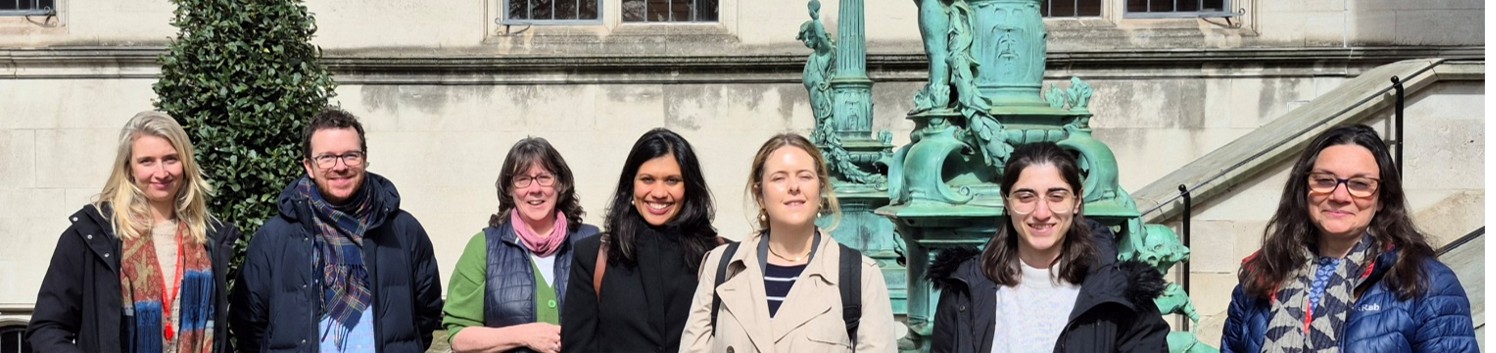
(Left to right) Olivia Luijnenburg, Tom Russ, Heather Wilkinson, Kritika Samsi, Jean Stafford, Katey Warran and Fauzia Knight.
Who was involved in the collaboration
University of Edinburgh
- Professor Heather Wilkinson, ECRED and Advanced Care Research Centre (ACRC)
- Dr Tom Russ, Old Age Psychiatrist. Director of SDRC. Network lead for NRS Neuroprogressive and Dementia Network
- Dr Katey Warran, Director ECRED. Leverhulme Fellowship in dementia and arts-based methods
- Dr Olivia Turner, Deputy Director ECRED. Research Fellow in participatory and creative arts in dementia
- Dr Jean Stafford, early career fellowship with Alzheimer’s Society. Research Fellow with ACRC
- Angel Garmpi, coordinator
King’s College London
- Dr Fauzia Knight, Research Fellow, NIHR Health and Social Care Workforce Research Unit, Policy Institute
- Dr Kritika Samsi, Senior Research Fellow, NIHR Health and Social Care Workforce Research Unit, Policy Institute
- Dr Olivia Luijnenburg, Lecturer, NIHR Health and Social Care Workforce Research Unit, Policy Institute
- Dr Monica Leverton, Research Fellow, NIHR Health and Social Care Workforce Research Unit, Policy Institute. Chair Home Care Research Forum
- Ruby Lyons, Dementia Advisor at Alzheimer’s Society. Intern at Policy Institute.
Invitee
- Sergi Blancafort Alias, Associate Lecturer, Faculty of Health, Department of Social Sciences and Community Health, Central University of Catalonia, Spain.

Professor Heather Wilkinson
Authors
Professor Heather Wilkinson recently retired as Professor of Dementia Participation and Practice and Director of the Edinburgh Centre for Research on the Experience of Dementia (ECRED) at the University of Edinburgh, and was part of the leadership team of the Advanced Care Research Centre. Since 1998 her work has centred on increasing the involvement of people living with dementia in research, with a focus on co-production, inclusion and quality of life, including for people with learning disabilities and dementia. She remains actively involved in developing creative methods for including people living with dementia in research and policy.

Dr Fauzia Knight
Dr Fauzia Knight is a Research Fellow at the NIHR Health and Social Care Workforce Research Unit, in the Policy Institute at King’s College London. She uses co-creation and creative methods to understand and improve support for people living with dementia, with a focus on care workforce wellbeing, self-management for people with mild dementia, and the support needs of family members, including those caring from a distance.

 Dementia Researcher
 Adam Smith

 Beccy Owen
 Nature Careers Blog