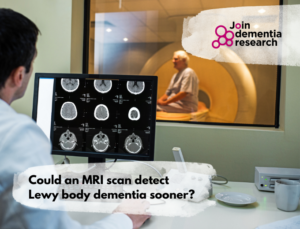
#image_title
In the UK, around 100,000 people have Lewy body dementia. This means for every 20 people who have dementia, between 3 and 4 will have dementia with Lewy bodies. Now, a new study will be using brain scans to potentially detect areas of the brain that are affected by Lewy body dementia to help spot the disease sooner.
John O’Brien [1], a Professor of Old Age Psychiatry at Cambridge and Elena Herrero, a Research Assistant in the Department of Psychiatry at the University of Cambridge explain how they hope to improve diagnosis of the condition.
Lewy body dementia (LBD) is caused by a build up of clumps of protein called Lewy bodies in the brain. They lead to a combination of symptoms which includes visual hallucinations, REM Sleep Behaviour disorder, features of Parkinson’s disease, and fluctuations in cognition. Additionally, patients experience problems with thinking and memory and often.
Professor John O’Brien says: “I’d say it’s a common cause of dementia. It’s not as common as Alzheimer’s, which is the most common cause. It’s responsible for around 10% to 15% of dementia cases, but it’s often not recognised or diagnosed.”
Lewy body dementia is a degenerative dementia that causes brain cells to die off. This is due to the abnormal build up of protein called alpha-synuclein. This protein build up in nerve cells in the brain causes them not to work properly, and eventually die, affecting thinking, cognition and brain function.
Professor John O’Brien continues: “Lewy body dementia is certainly underdiagnosed. We know that for most people who have a diagnosis of Lewy body dementia are not diagnosed with it initially. In at least half of cases, they’re given another diagnosis first. Most usually Alzheimer’s disease or a mixed dementia or sometimes vascular dementia. It’s only recognised later that they have Lewy body dementia.”
Professor John O’Brien explains how further challenges in diagnosis include a lack of awareness of diagnosing the condition outside of hospital settings. Symptoms can be mistaken for other conditions.
What is Neuromelanin Magnetic Resonance Imaging (NM-MRI) and how could it be used to diagnose Lewy body Dementia fast?
The Neuromelanin Magnetic Resonance Imaging (NM-MRI) looks at certain brain cells that contain a dark colour called neuromelanin. Neuromelanin is found in two areas of the brain, the substantia nigra and locus coeruleus. Both of these areas are affected in people with Lewy body dementia.
Elena Herrero explains: “Neuromelanin is a specific pigment in the brain that we can actually see. When we’re pulling up a brain scan, we can see in certain brain regions this darker pigment and that’s what neuromelanin looks like on the screen. What it actually is, is a bit more complex.
“It’s associated with dopamine in the brain. It captures oxidised dopamine and turns it into something neutral. This pigment builds up as people age. Neuromelanin MRI simply means we’re looking at this pigment using an MRI machine in particular.”
What is the study hoping to achieve?
The study is hoping to diagnose dementia sooner. It is hoping to increase the understanding of how brain changes relate to symptoms experienced by patients. This technique could lead to early diagnosis and a new target for future treatments.
Professor John O’Brien explains: “The research builds on studies in Parkinson’s disease that showed Neuromelanin MRI can detect the loss of dopamine cells. Since those same cells are lost in Lewy body dementia, it seemed likely the loss would be visible using Neuromelanin MRI.
“The two main reasons for the study are to help with diagnosis. If this specific MRI were available, people wouldn’t need further investigations. This could also help inform new staging systems that will redefine neurodegenerative disorders by detecting underlying biology, requiring biomarkers like this.”
Elena Herrero adds that current neuromelanin research often focuses on Parkinson’s disease. There is little known about how neuromelanin levels in Lewy body dementia correspond with symptoms.
This is why taking part in research through Join Dementia Research is so important. Professor John O’Brien stresses that without participation, we will not advance research to lead to better ways of diagnosing and managing the condition.
Elena Herrero also explains: “Participants describe it as empowering, allowing them to take back control from a diagnosis that feels very out of your control. It offers a way to help future individuals. Furthermore, it provides people time with researchers who really know the disease so they better understand their condition.”
If you are interested in taking part in this study or similar studies, log in to your Join Dementia Research account [2] to check whether you have been invited to take part in a study. Or, if you are not already registered, sign up today [3].