The email arrives with a subject line like “Decision on your manuscript”, and your pulse is racing before you've even opened it. Inside are pages of reviewer comments, a deadline, and a request to respond to reviewers “point by point”. Nobody trained you for this. Most of us learn by trial and error on our first paper, while a busy supervisor rewrites our draft response without ever explaining why.
This is the guide we wish someone had given us when we first had to respond to reviewers. One thing we can't promise is that any of this guarantees acceptance. Editors weigh plenty that's out of your hands. What a good response does is give your paper its best chance, and leave it stronger wherever it ends up. If you have just submitted your first paper and you are waiting for the response, this is the guide for you.
In brief
This guide explains how to respond to reviewers, from the moment the decision arrives to the moment you resubmit. It's for researchers in any field, with notes on issues that often come up in dementia research. It opens with the personal side of getting critique. The eight steps start with your first reaction and reading the decision, then making sense of the comments. They move on to agreeing a plan with your co-authors and revising the manuscript itself. Then come writing the point-by-point response, disagreeing with a reviewer and dealing with difficult reviews. The last step covers checking your work, resubmitting and handling the next round. Five worked examples, drawn from laboratory, clinical, qualitative and secondary-data research, compare weak and useful responses. The guide ends with a response letter template, a final checklist, further reading and answers to common questions.

Revisions are normal (and usually good news)
Journals accept very few papers as submitted. The American Journal of Neuroradiology looked at five years of its own data. It had accepted just 3.6% of 7,328 submissions at the first decision. A request to revise is the ordinary route to publication, not a sign that you've failed. And that journal went on to accept about 99% of the papers it sent back for minor or major revision.
Don't lean too hard on that last figure. It comes from one journal, and others reject more papers after revision. But the general point holds. A revise decision means the editor can see a publishable paper in there, provided you fix the problems. Your job when you respond to reviewers is to show that you have.
It also takes longer than people expect. Across 3,500 review experiences reported to the SciRev website, papers went through an average of two rounds of review. Authors spent an average of 39 days on their revisions. Plan for that, and block out proper time to respond to reviewers. A major revision is a project, not an evening's work.
And it tends to help. When Sense About Science surveyed around 4,000 researchers, 91% said peer review had improved their last paper. The section that improved most often was the discussion. That doesn't make every comment right. It means the process, handled well, usually leaves you with a better paper than the one you sent.
The personal side of getting critique
Before the practical steps, a word about the part most guides skip: how it feels. You've spent months, maybe years, on a piece of work, and a stranger has picked holes in it. Feeling flat, angry, embarrassed or anxious after reading reviews is normal, and it happens to senior researchers too. They've just had more practice.
Researchers have studied this. Sierk Horn surveyed 411 researchers in international business, almost all of whom had had a paper rejected. They described the experience as a blow to their identity, not just to their paper. They talked about shock, shame and anxiety, and many feared being found out. Senior researchers were the least shaken, and keeping rejection to yourself made the stress worse. The key thing here is to not take it personally (which we know is easier said than done). Step 1 below starts with what to do about that first reaction.
You're not the only one
Dementia Researcher and ISTAART surveyed 283 early career dementia researchers in 31 countries. Nearly 60% reported a mental health condition, most often anxiety or depression. Imposter feelings had the strongest link with poorer mental health, and peers, mentors, friends and family were the support people relied on most. Read our summary of the study on mental health challenges in dementia researchers. If imposter feelings are part of the picture for you, try our post on how to overcome imposter phenomenon.
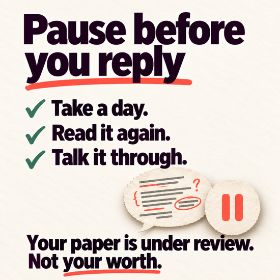
A difficult review can sting. Give yourself a day, read it again and talk it through with a colleague before drafting your response. Your paper is under review, not your worth.
Step 1: Give it a day, then read the decision
Your first reaction to a set of reviews is rarely your best one. So start by letting it settle, then read the decision letter properly.
Give yourself a buffer
Read the reviews once, then put them away for a day or two before you respond to reviewers. If you need to get something off your chest, write it down and don't send it. William Noble's widely shared ten simple rules for writing a response to reviewers end with a practical suggestion. Write the response twice if you need to: once to vent and once for the editor. The European Association of Science Editors suggests a “venting version” for your co-authors' eyes only, before the real one (but don't mix them up). Pat Thomson describes writing an unsent “Dear Reviewer” letter to get the first shock out of your system. She's honest that it won't turn a harsh review into a gift. But it does help you take back some control.
Read it again with someone else
When you're ready, read the reviews again, ideally with a co-author, supervisor or trusted colleague. Someone less invested will often see a review you found crushing as tough but fixable. If you can't be in a room together, get into an online meeting, and screen share. They'll also spot the praise you skimmed past. Most reviews say something good about the work. Find it, and hold on to it when you sit down to respond to reviewers.
It's the paper under review, not you
A review is a judgement on a draft, written by someone who doesn't know you and is often short of time. It isn't a verdict on your ability or your future. Reviewers aren't always right, either. In one study of nearly 1,500 sets of reviewer comments, 41% included at least one criticism that was incomplete, inaccurate or unsupported. Take the fair points seriously, and don't give the rest more room in your head than it deserves. Remember, too, that criticism of the paper is criticism of everyone's paper. You're not facing it alone, even if you're the one doing most of the revising.
Talk about it
Tell your supervisor or a peer how the reviews landed, not just how you plan to respond to reviewers. Ask senior colleagues about their worst ever review; most have a story, and hearing it helps. Our posts on when peer review feels personal, self-worth versus Reviewer Two and using peer support to improve wellbeing are good company on a bad day.
Know when it's more than a bad day
For most people the sting fades within a few days, especially once there's a plan. If it doesn't, talk to someone. The same goes if the reviews are piling onto other pressures and affecting your sleep, mood or confidence. Try your supervisor or mentor, your university's wellbeing or counselling service, your employer's employee assistance programme or your GP. Asking for help is a sensible response to a demanding job, not a sign you aren't cut out for it.
What kind of decision is it?
Once the first sting has passed, go back to the decision letter and read it slowly. Before you respond to reviewers, work out what exactly the journal wants, and who is asking. The wording varies between journals, but most decisions fall into one of these:
- Minor revision. The editor expects to accept once you've made some smaller changes. The revised paper may not go back to the reviewers at all.
- Major revision. There are substantive problems, but the editor thinks you can fix them. The revised paper usually goes back to some or all of the same reviewers, and there's no guarantee of acceptance.
- Reject and resubmit. The editor likes the work but thinks it needs more than a revision. Journals usually treat a resubmission as a new submission, though it may go to the same reviewers.
- Reject with an offer to transfer. The paper might suit a sister journal, and the reviews can sometimes travel with it.
- Reject. Don't fire back an angry email. If you think the journal has made a serious mistake, there's a section on appeals in step 8.
Separate what the editor requires from what reviewers suggest
The editor's letter matters more than any single review. Some editors simply paste the reviews in. Others tell you exactly what counts: “please pay particular attention to Reviewer 2's comments on the statistical analysis”, or “the additional experiments suggested by Reviewer 3 are not required for this paper”. That steer outranks any individual reviewer.
It helps to remember who decides. Reviewers advise, editors decide, and they don't do it by counting votes. The Nature Portfolio peer review policy is a good example. Editors there weigh the strength of each reviewer's arguments, and the authors' too, and may go against the majority. Make a note of anything the editor flags as essential, anything they say is optional, and any comments they've added themselves. Those are easy to miss when they sit above several pages of reviews.
Find the deadline first
Scroll to the bottom of the decision email. That's where the deadline tends to sit, under several pages of reviews. The list of files the journal wants back is usually there too, with the link you'll need to resubmit. Say a reviewer has asked for an experiment that takes six weeks, and the journal has given you four. Email the editor this week, not the week it's due. Most editors will happily give you more time to respond to reviewers if you ask early. They're less keen on the author who goes quiet for a month and then asks for another one. Hitting the deadline can matter for another reason, too. Nature Communications lets a revision that comes back on time keep its original submission date. That's worth having if a similar paper turns up in the meantime.
Check the journal's guidance: journals differ far more than you'd expect, and their author instructions are worth ten minutes of your time. Age and Ageing gives you four weeks, won't reassess your paper without its “Revision Sheet”, and wants line numbering switched off. Nature Communications usually allows two months but won't consider more than two resubmissions. At EMBO Press you generally get one round of revision and three months to do it. If your journal's rules contradict anything in this guide, follow the journal.
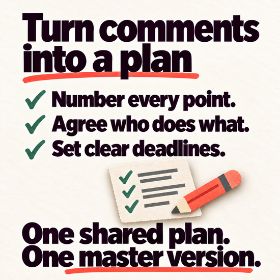
Turn reviewer feedback into a shared revision plan. Number each point, agree who will handle it and set deadlines. Keep one master version so everyone works towards the same response.
Step 2: Make sense of the reviewer comments
Before you change a word of the manuscript, turn the reviews into a list you can actually work from. It's the most useful hour you'll spend on the whole revision, and the one most people skip.
Build a revision table
Number everything. Use E1, E2 for the editor's points and R1.1, R1.2, R2.1 and so on for each reviewer. If one comment makes three points, split it into three items so nothing slips through. Then put them in a table, or a spreadsheet if there are dozens, with a column for each of these:
- the comment, copied word for word
- what kind of comment it is (see the five piles below)
- what you plan to do about it
- who is doing it, and by when
- where the change will go in the manuscript
- whether it's done
Raul Pacheco-Vega shares a version of this matrix on his blog, and it earns its keep twice. It organises the work while you revise, and it becomes the skeleton of your response letter at the end. It also means you can respond to reviewers point by point without missing a comment.
Sort the reviewer comments into five piles
- Substantive concerns. Problems with the design, analysis or interpretation that affect whether your conclusions hold. These are your priority, and they usually need real work.
- Misunderstandings. The reviewer has misread something. Treat these as information: if an expert misread it, other readers will too. The fix almost always belongs in the manuscript, not just the letter.
- Conflicting requests. Two reviewers want opposite things. Flag them now and decide how to handle them later (step 7 covers this).
- Straightforward fixes. Typos, a missing reference, an unclear figure label, a missing item from a reporting checklist. Do them, list them and move on.
- Out of scope or optional. Interesting ideas that belong in a different paper, or requests the editor has said aren't needed.
Some comments will sit in two piles, and that's fine. The point is to see the shape of the job before you respond to reviewers.
Why your reviewers don't agree with each other
If your reviewers seem to have read different papers, you're not imagining it. A meta-analysis of 48 studies covering more than 19,000 manuscripts found that agreement between reviewers was only slight. The average kappa was 0.17, where 1 means perfect agreement and 0 means no better than chance. Editors often pick reviewers for different expertise on purpose: one for the statistics, one for the clinical relevance, one for the methods. Disagreement is part of how the system works. What matters is that you handle it openly when you respond to reviewers.
Look for what the reviewers liked, too. Praise tells you what to protect when you revise. It's easy to fix one reviewer's concern by cutting the very thing another reviewer valued.
Comments to expect in dementia research
Some requests come up again and again in our field. It pays to have the answer ready before you submit, rather than scrambling when you respond to reviewers.
- Reverse causation. Sleep, activity, weight and mood can change years before a dementia diagnosis. Expect a reviewer to ask whether your exposure is a cause or an early symptom. Lag analyses that exclude the early years of follow-up are the standard reply. Take one large analysis of physical inactivity. When researchers measured activity less than ten years before diagnosis, the link with dementia was clear (hazard ratio 1.40). When they measured it ten or more years before, the link disappeared (1.01).
- Identifying dementia. Expect questions about diagnostic criteria and, in record-based studies, about how accurate the codes are. A UK Biobank validation study confirmed dementia in 82.5% of people with an all-cause dementia code. For vascular dementia codes, the figure was only 43.8%.
- Who took part. Reviewers increasingly ask about the diversity of your sample, and funders are pushing the same way. Read our news on inclusion becoming a key condition for NIHR funding.
- Sex as a variable. In preclinical work, expect reviewers to ask whether you studied both sexes. There's background in our piece on a new framework to eliminate sex bias in preclinical research.
- Language. Reviewers will pick up stigmatising terms such as “sufferers” or “demented”. There's an example of how to handle this in the worked examples below.
Step 3: Agree a plan with your co-authors
A response letter goes out in every author's name. So everyone needs to agree how to respond to reviewers before anyone writes the letter, not after. This is where a lot of revisions go wrong, and it's the part most guides barely mention.
Send your co-authors the reviews, all of them
Plenty of journals only email the corresponding author, so it's quite possible your co-authors don't know the decision has landed. The ICMJE recommendations suggest editors copy correspondence to every author, but don't count on it. Send everyone the whole lot, the decision letter and every review, exactly as you received them. A summary of “the main points” tells people what you thought mattered, which isn't the same thing. Put the deadline in the first line of the email, and don't book the meeting for the next morning. People need a few days to get over the reviews before they can talk about them sensibly.
Decide who's doing what
Usually the first author drafts the revision and the response, and the corresponding author submits them. Early in your career you may well be first author on a paper where your PI is the corresponding author. That's normal. Just agree early on who has the final say, who talks to the editor and how drafts go round. Having one person clearly in charge when you respond to reviewers saves weeks.
Share the revision table and put a name against every item. Then set internal deadlines that leave at least a week at the end for checking. If a comment needs a statistician, an analyst who has since left, or a collaborator eight time zones away, find out now how long they'll need.
Run the revision from one place
Revisions fall apart when five people edit five copies of the manuscript. Keep one master version of the manuscript and one of the response letter, with one person, usually the first author, merging everyone's changes. We recommend using Google Drive, or MS Documents or similar. Ask for comments by a set date, and ask specific questions rather than “any thoughts?”. “Can you check the reworded limitation on page 12 and draft a reply to R2.4 by Friday?” gets an answer. “Any comments on the attached?” gets silence, or a rewrite of the introduction.
Use the revision table as the agenda for a short meeting early on, and record what you decide in it. That stops anyone reopening settled questions three weeks later. And by the end of the revision, you'll have most of the response letter drafted.
Settle disagreements inside the team first
Co-authors disagree about how to respond to reviewers almost as often as reviewers disagree with each other. One wants to concede everything to get the paper over the line; another wants to fight every point. Have that argument in a meeting, not in tracked changes on the response letter, and never in the letter itself. The editor should hear one voice.
Decide on the evidence, not on seniority. Agree in advance who makes the final call if you can't agree, usually the senior or corresponding author. Then write the decision down, so nobody relitigates it a fortnight later. Sometimes the disagreement is about the science itself, not tone or tactics. Treat that as a sign the paper needs to say more about the uncertainty, not as a fight to win.
When a reviewer criticises a co-author's work
Picture it. Reviewer 2 has spent half a page taking apart the mixed models, and the statistician who built them is a co-author you've met twice. Send them the comments exactly as the reviewer wrote them, without adding “I wasn't sure about this either”. Then ask them to draft the reply to those points. They know the analysis, and they know when to defend it and when to concede. You then fold their text into the letter so it sounds like the rest of it. The same goes for a collaborator's assays or the interviews a colleague analysed. The reviewer is criticising the paper, and the paper belongs to all of you.
If you're the most junior author
As first author you may be doing most of the revision while your supervisor or PI has the final say. That's a lot of responsibility without much control. So ask for what you need: their time, feedback on your draft and a decision when the team is stuck. Ask them to read your letter for tone. Experienced authors are good at spotting the phrase that will get a reviewer's back up.
If you think a concession would make the paper worse, or that a senior co-author is digging in on a point the reviewer has right, say so and give your reasons. Good supervisors want to hear it. It's also fine to ask a senior co-author to handle a delicate message to the editor. And treat the whole thing as training. Drafting a response is one of the best ways to learn how to respond to reviewers. Our guide to being a good mentor looks at the same relationship from the other side.
Be honest about what's feasible
Before you promise anything, check you can deliver it. Can you get more samples? Is there money for another experiment? Has the grant ended, or has the person who ran the assays moved on? Would collecting new data need a change to your ethics approval, or extra animal work a licence amendment? Does your data-access agreement even allow the analysis the reviewer wants? These are legitimate limits, and step 6 shows how to explain them. Finding out about them a fortnight before the deadline is the real problem.
Talk about authorship early
The revision might bring someone new in. Perhaps a statistician reruns the models, or a colleague does the extra experiment. If so, discuss authorship or an acknowledgement at the start. Changing the author list after submission usually needs every author's agreement and the journal's permission. The Journal of Alzheimer's Disease, for example, asks for an authorship change form signed by all authors, including anyone added or removed, and uploaded with the revision. It only lets you add authors in response to feedback from peer review, and not at all after acceptance.
Get everyone's sign-off
Every author should read and approve the revised manuscript, and the way you respond to reviewers, before you submit. It isn't just a courtesy. Under the ICMJE authorship criteria, approving the final version is part of what makes someone an author. The corresponding author takes primary responsibility for communicating with the journal. Send the final versions with a clear deadline and ask for an explicit yes. Don't rely on “I'll assume you're happy if I don't hear back”. For papers with long author lists, agree a small writing group to do the work and a fixed window for everyone else to approve it.
Someone will go quiet. It's usually the co-author with the most on, not the one who cares least. Chase after a few days rather than the night before. If a second nudge doesn't work, ask the senior author to have a word. If someone's on fieldwork, on leave or simply unreachable when the deadline arrives, email the editor and ask for a few more days. That's a far smaller problem than a resubmission that not every author has seen.
Step 4: Revise the manuscript, not just the letter
If you remember one thing from this guide, make it this: a detailed response can't make up for a problem you haven't fixed. However well you respond to reviewers, the paper itself has to change. Editors and reviewers can tell when a letter is working hard to avoid changing the paper. Nature's editorial criteria say plainly that it won't send a resubmission back to the referees if the authors haven't made a serious attempt to address all their criticisms.
Work out what the reviewer is really worried about
Reviewers don't always say what's bothering them, so read between the lines before you respond. Take a one-line comment like “How were participants recruited?” On the surface it's a request for detail. Underneath, the reviewer is probably wondering whether the people who came forward differ from the people who didn't, and whether that explains your result. Add the recruitment detail, by all means, but then add a sentence on how it might have shaped your findings. That's the bit they wanted.
If a reviewer misunderstood something, change the text so the next reader won't. Replying that “we already say this on page 7” is technically true and practically useless. If an expert missed it, it isn't clear enough.
Run the analysis, even if it doesn't make the paper
When a reviewer asks for an extra analysis that's quick and reasonable, the best move is usually to do it. Then decide where it belongs. Noble's rules suggest doing what the reviewer asks wherever you can. The result can go in your response even if it stays out of the paper. A sensitivity analysis in the supplement showing your result holds is far more persuasive than a paragraph explaining why you didn't need to run it.
Chase the knock-on changes
Revisions ripple. A re-analysis changes numbers in the abstract, the results, a table, a figure and the discussion. A new limitation might soften a sentence in the conclusions. Check every place a changed number or claim appears. In the second round, a mismatch between the abstract and the results is one of the easiest things to spot. And it does your credibility no favours.
Bring the paper up to date
Six months is a long time in a busy field. Has a major trial or a big cohort analysis come out since you submitted? In dementia research, one usually has, and a reviewer in round two will expect you to have noticed. Re-run your literature search before you resubmit, not after.
The reporting checklist needs a look too. Its page numbers will have moved with your edits. If you're reporting a trial, check whether the journal now expects CONSORT 2025 rather than the 2010 version. Keep an eye on the word count as well, because three reviewers' worth of “could the authors expand on…” adds up quickly. And try not to armour-plate the paper. A caveat on every paragraph doesn't make it harder to criticise. It just makes it harder to read.
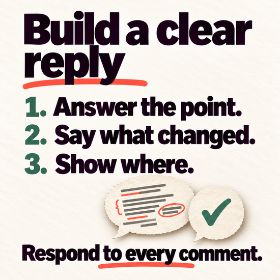
Make each response easy to check: answer the point, explain what changed and give its location in the manuscript. Respond to every comment, including requests you decide not to follow.
Step 5: Write a point-by-point response to reviewer comments
You're writing the response letter for a busy editor and a tired reviewer. Some people call it a rebuttal letter, although you'll usually agree with far more than you rebut. Its job is to make your changes easy to find and easy to check. If someone can verify everything you've done in ten minutes, you've written a good one. Most advice on how to respond to reviewers comes back to that.
The structure
Most good response letters follow the same shape, and there's a template you can copy further down.
- A short note to the editor. Thanks, and a summary of the main changes in three to five bullet points.
- A key. Explain how you've marked things up, for example with reviewer comments in italics, your responses in plain text and quoted changes in bold.
- The editor's comments, then each reviewer's in turn, numbered to match your revision table.
- For each comment: the comment word for word, your response, and what changed and where.
Answer each comment in three parts
Start every reply with a direct answer: “We agree”, “We have done this”, “We have partly addressed this” or “We respectfully disagree”. Then explain what you did. Then say exactly where the change is: section and paragraph, or page and line if the journal uses line numbers. If the new text is short, quote it. Quoting means the reviewer can check your change without hunting through the manuscript. That's why Noble recommends making the letter readable on its own.
Quote each comment in full, and don't reword it to make it easier to answer, because editors notice. If a comment makes several points, split it up and answer each one. And answer every comment, including the ones you're not acting on. A comment you skip in round one tends to come back in round two, usually in sharper language.
Get the tone right
When you respond to reviewers, aim for courteous, confident and specific. Reviewers are unpaid and usually trying to help, so thank them once, at the start, and mean it. You don't need to thank them again before every answer. Researchers analysed nearly 3,900 reviews from a large computational linguistics conference. After the authors replied, 87% of scores didn't change. The study's authors concluded that filling a response with thank-yous is unlikely to rescue a borderline paper. Conferences aren't journals, but the lesson travels. Evidence moves reviewers. Flattery doesn't.
Some phrases give away exactly how you're feeling. “As clearly stated in the methods” means “can't you read?”, and every reviewer knows it. Respect rarely follows “with all due respect”. Write as “we”, because the letter comes from all the authors, and refer to “the reviewer” rather than “Reviewer 2 claims”. Then aim for the tone you'd use explaining your work to a colleague at a conference: confident, friendly and not remotely grovelling.
Make it easy to check
Use formatting that still works when someone prints it in black and white. Plenty of guides suggest colour-coding your responses. But colour alone shouldn't carry the meaning, because not every reader can tell the colours apart. Use bold, italics or labels as well. Say which version of the manuscript your page and line numbers refer to, usually the clean revised copy. Then check that the tracked-changes version really does show every change you claim.
Using AI to help you respond to reviewers
None of the publisher policies we checked has rules just for response letters. So the general rules for authors apply. Most publishers allow AI help with language if you declare it in line with their policy. All of them hold you responsible for every word.
There are two things to watch. First, reviewer reports are confidential. Springer Nature's policies say you must not disclose referee reports without prior written consent. Nor should you share peer review reports with unsecured or public AI tools. So don't paste your reviews into a public chatbot.
Second, don't let a tool write your answers. A generic, over-polished reply that doesn't engage with the reviewer's actual point is easy to spot. It's also exactly the kind of thing transparent peer review makes public. Check the journal's AI policy before you start.
Write it as if it will be published
Increasingly, it will be. Nature now publishes reviewer reports and the authors' responses for research papers submitted from 16 June 2025. Nature Communications has done the same for papers submitted since November 2022. Even before that, around 70% of its authors were choosing to publish theirs. EMBO Press, eLife and BMJ Open publish peer review histories, and PLOS ONE does if authors opt in.
Many NIHR-funded researchers publish in NIHR Open Research, where peer review happens openly after publication. Reviewers work under their own names. You respond by publishing a revised version with a note on what has changed. Wherever you publish, your response letter may become a public record of how you handle criticism. Make it one you'd be happy for a future interview panel to read.
There's an upside. Published peer review files are a free library of real response letters. Pick a recent paper in your area from one of these journals and open its peer review file. See how experienced authors respond to reviewers, especially tough ones. Just remember that you're only seeing papers that made it. Bodo Stern makes that point in his piece on why Nature publishing only positive reviews shows half the story.
When a reviewer is living with dementia
Some dementia journals widen who reviews your work. At Sage's journal Dementia, people living with dementia and care partners may review your manuscript. They follow the same anonymous process as other reviewers. If you get comments from a reviewer with lived experience, answer them with the same care as any other. Use plain language and skip the jargon. They're often the comments that make a paper useful beyond academia.

You do not have to accept every suggestion. Explain your reasoning with evidence and offer a proportionate alternative where possible. A strong response can be both polite and firm.
Step 6: How to disagree with a reviewer
You don't have to do everything reviewers ask. Part of learning how to respond to reviewers is learning when to say no. Reviewers can be wrong, requests can be unworkable, and some changes would make a paper worse. Editors expect you to push back in those cases. What they want to see is a reasoned argument, not a refusal.
How to say no without starting a row
Say Reviewer 3 wants every analysis rerun with a different statistical model, and you're confident it won't change anything. Writing “we disagree” and moving on is the quickest way to get the same comment back in round two. This time, the editor will be on the reviewer's side. What changes minds is something the editor can check for themselves. “We don't think this is necessary” is an opinion. “We reran the main analysis using the reviewer's model and got the same result (Supplementary Table S3)” is evidence. It usually ends the argument.
When you respond to reviewers with a no, it also helps to offer something back. You might not run the new experiment, but you can soften the claim it would have tested. Or add it to your limitations. And if part of the reviewer's point is fair, say so. People find it much easier to accept a no from someone who has clearly listened. In practice it can be as simple as this. “We have not added a new cohort, as the reanalysis addresses the concern about sample size. We have, however, limited our conclusions to male mice and added this as a limitation.” Nobody could call that rude, and nobody could call it a climbdown either.
Requests for extra experiments or data
This is the most common disagreement, especially in laboratory research, and it has a real cost. Ron Vale looked at PhD students at the University of California, San Francisco. Between the 1980s and the early 2010s, their time to a first first-author paper rose from 4.7 to 6.0 years. He linked this partly to journals expecting more and more data in each paper.
Journals are aware of the problem. Review Commons organises peer review before a paper goes to a journal. It tells its reviewers to ask for extra experiments only if they're essential to the conclusions. Otherwise, reviewers should suggest qualifying a claim as preliminary, label wider ideas as optional, and estimate how long any substantial experiment would take.
So ask yourself whether the extra work is essential to the conclusion you're drawing. If it is, the honest options are to do it or to narrow the conclusion. If it isn't, say so, give your reasons and offer something proportionate. Shortage of time or money is a weak argument on its own, because editors expect you to do essential work. Pair it with a scientific reason, or narrow the claim.
When the honest answer is “we can't”
Some limits aren't about effort, and they're worth explaining properly when you respond to reviewers.
- Ethics and consent. Collecting new data, extending follow-up or recontacting participants may fall outside your approved protocol and what people consented to. In the UK that can mean a change to your approval, and sometimes fresh consent. The HRA now calls these changes modifications, and your sponsor decides whether one is substantial.
- Animal work. The 3Rs of replacement, reduction and refinement are part of the Animals (Scientific Procedures) Act. New animal work has to fit within your project licence or go through an amendment. A request for a new cohort to answer a question that existing tissue or a re-analysis could answer is worth challenging on those grounds. Sometimes a reviewer asks you to validate human-based work in animals. If so, the author guide to animal methods bias by Krebs and colleagues is worth a read.
- Data access. Data-access agreements for resources such as UK Biobank, CPRD and many cohort studies may not let you share individual-level data, or link the variable a reviewer wants. Say so, and share your code, code lists and the route by which others can apply for access instead.
Requests to cite particular papers
A reviewer's job includes pointing out relevant work you've missed, and sometimes that work is their own. That's fine. The problem comes when a suggestion serves the reviewer rather than the paper, and it isn't rare. In one journal's reviews, 29% of the citations reviewers asked for were to the reviewers' own work. Those requests were about four times as likely as others to come with no reason attached (21% against 5%).
It can affect outcomes, too. A 2025 study looked at more than 37,000 open peer reviews. Once authors had revised a paper, reviewers whose work they cited approved it 60% of the time. The figure for reviewers they didn't cite was 48%. Reviewers who asked authors to cite their own work were less likely to approve. But so were reviewers who suggested other people's work. That points to a genuine gap, not self-interest, behind plenty of citation requests.
So when you respond to reviewers who ask you to cite something, judge each suggestion on its merits:
- If the paper is relevant and your manuscript is better for citing it, cite it, whoever wrote it.
- If it's relevant but tangential, cite it briefly or explain politely why you haven't.
- If it isn't relevant, say so courteously, explain why, and don't add it.
- If you see a pattern, such as a long list mostly from one group with no reasons given, don't accuse anyone in your response. Mention it, factually, in a separate note to the editor.
What publishers say about citation requests
Publishers take this seriously. Elsevier tells reviewers to suggest their own work only for genuine scientific reasons. Its editors can remove inappropriate citation requests before authors see them. And it asks authors to tell the editor if a request looks wrong. Wiley asks authors to report citation requests made without a strong scholarly rationale to its research integrity team. COPE's discussion document on citation manipulation sets out the wider picture.
When a reviewer wants a different paper
Every so often a reviewer asks for something that would make a perfectly good second study. You've interviewed carers of people living with dementia at home, and they'd like care home staff added. You've used one cohort, and they want the analysis repeated in two more. It's fine to say no to that. Tell them it's a good idea, and explain that it goes beyond the question this paper sets out to answer. If you mean it, add it to your future research paragraph. Editors generally don't want a tight paper turned into a baggy one either.
The same goes for changes that would make the paper less accurate. Think of a causal claim your design can't support, or a statistical test that doesn't suit the data. Explain why, with a reference. Saying politely, and with evidence, that a reviewer has got something wrong is part of the job.
Step 7: Dealing with difficult reviews
Most of the time you'll respond to reviewers whose comments are fair, even when they sting. This step covers the exceptions.
Rude or dismissive comments
Most reviews are professional. In a random sample of 1,147 reports from a large peer review database, just 1.1% contained an unprofessional comment. Over a career, though, you'll almost certainly receive one. In another study of nearly 1,500 sets of reviewer comments, 12% included at least one unprofessional comment. And 41% included at least one criticism that was incomplete, inaccurate or unsupported. One example is claiming key literature was missing without saying which. As our guide to peer reviewing a paper explains, those reviews do real damage, especially to researchers from under-represented groups.
When it happens to you:
- Separate the tone from the substance. A rude comment can still contain a fair point. Answer the point calmly and ignore the tone completely.
- Don't match it. A journal may publish your letter one day. Let theirs be the one that looks bad.
- Get a second opinion from a colleague you trust before you decide a comment is unfair.
- Report offensive comments. If a comment is personal, offensive or discriminatory, write to the handling editor separately and ask them to remove it. If you're junior, it can help for your senior author to send that letter. That's the advice in the piece we republished on how to fight back against a peer-review bully.
Reviewers who contradict each other
Say you've written up a trial of a support programme for carers. Reviewer 1 says the methods section is far too long. Reviewer 2 wants every outcome questionnaire described in full, scoring and all. You can't give both of them what they want in the same few hundred words. Trying usually produces a methods section that satisfies nobody. In this case the fix is a supplementary file. Cut the main text back to what someone needs to judge the trial. Move the scoring rules for the Zarit Burden Interview and the other scales online. Then tell Reviewer 2 exactly where to find them.
Some clashes don't split so neatly. One reviewer wants you to adjust for education, say, and the other tells you not to. Then you have to choose. Go with the analysis you'd be happy to defend at a conference. If the other is quick to run, put it in the supplement. Tell each reviewer which way you went, and why. If you're still unsure, email the editor before you start: “Reviewers 1 and 2 disagree about adjusting for education. Do you have a preference?” Most editors would much rather answer that now than untangle it in round two.
The reviewer who misunderstood your work
It's tempting to reply “the reviewer has misread the paper”, and sometimes they have. But if a specialist reading carefully got the wrong end of the stick, plenty of other readers will too. So the honest answer is usually that the paper could have been clearer. Fix the text, then say so in the letter without making the reviewer look daft. “We're sorry this wasn't clear. We've rewritten the paragraph to make it explicit that…” costs you nothing. If the confusion is about your field's methods rather than your paper, a sentence or two with a good reference will do. Nobody enjoys a lecture, least of all reviewers.
When qualitative research is judged by quantitative rules
This deserves a section of its own. Victoria Clarke, Virginia Braun and colleagues ran a survey of 163 qualitative researchers, more than half of them early career. People described reviewers asking for things that don't fit qualitative methods. Bigger and more representative samples came up, along with statistical generalisability, inter-coder reliability statistics and proof of data saturation. The most common response was to decline the change and cite the methods literature. But some, particularly early career researchers, gave in to publication pressure even when they knew it would weaken the work.
You don't have to. Explain your approach in a sentence or two when you respond to reviewers. Cite the methodological literature and show what you did instead to make the analysis rigorous. Worked example 3 below shows one way to do it. If a reviewer insists, it's reasonable to ask the editor whether the change is a condition of acceptance.
A review that looks as if AI wrote it
AI is now part of peer review. In a 2025 Frontiers survey of 1,645 researchers, 53% of reviewers said they used AI tools in some way. Another analysis looked at reviews from four major AI conferences. It estimated that large language models had substantially modified between 6.5% and 16.9% of review text. Using AI to polish a review isn't always against the rules. But an AI-generated review can be vague and generic, miss the point of your paper, or suggest references that don't exist.
Handing the whole review to a chatbot is another matter. Elsevier says reviewers shouldn't put any part of a manuscript into a generative AI tool. Nor should they use AI to help review it. Nature's journals let reviewers use AI for support, but not upload manuscripts to public tools or hand over the critique. Both are clear that your unpublished paper is confidential.
If a review looks like that, don't accuse anyone, because you can't know. Respond to any genuine points it makes, and answer the rest with facts, not suspicion. For example: “We couldn't find the paper suggested in comment R2.4 in PubMed or Google Scholar. If the reviewer can share a DOI, we'll gladly consider it.” Then tell the editor separately what you noticed. Perhaps two of the suggested references don't seem to exist, or several comments don't relate to your manuscript. Wiley says its editors may disregard reports that show signs of inappropriate AI use. It cuts both ways, too. Ecologist Lizzie Wolkovich has written about reviewers accusing her of using ChatGPT. One called her manuscript “obviously ChatGPT”, when she hadn't used it at all. We republished her account as “Obviously ChatGPT” reviewers accused me of scientific fraud.
Look after yourself
A rude or careless review can stay with you far longer than an ordinary one. Don't rush to respond to reviewers who have upset you. Go back to the advice on handling your first reaction in step 1, and lean on the people around you. Don't make big decisions about the paper, or your career, while you're still smarting. It may also help to read why rejection in academia is structural, not personal.
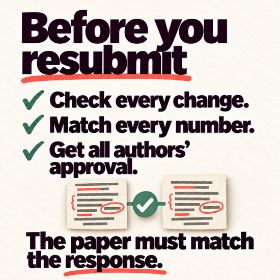
Check that every promised change appears in the manuscript, numbers agree throughout and all authors have approved the final files. The revised paper and response letter must tell the same story.
Step 8: Check, resubmit and handle the next round
Check that everything matches
Before you submit, read the response letter side by side with the revised manuscript and check every claim. It's surprisingly common to promise a change in the letter and forget to make it. Or to make it in the tracked copy but not the clean one. Page and line numbers move as you edit, so check them last, against the final version. The checklist below covers the rest.
Resubmit through the right route
Use the revision link in the decision letter, not a fresh submission. Age and Ageing, for one, warns that it will treat a new submission record as duplicate submission and withdraw it. Upload everything the journal asks for, usually the response letter, a marked-up copy and a clean copy, plus any updated figures, supplements and checklists. Age and Ageing and Dementia both use double-anonymised review. If your journal does too, check that nothing in your response letter or files gives away who you are.
The next round
Revised papers often go back to the same people, so expect to respond to reviewers again. They'll check whether you've dealt with their points. Most journals expect them not to raise new major issues. The exceptions are problems your changes created, or something serious they missed the first time. Review Commons tells its reviewers exactly that, and our guide for reviewers gives the same advice. If a new issue does appear, treat it like any other comment. If it's clearly new and has nothing to do with your changes, it's fair to point that out politely to the editor.
Sometimes the editor brings in a new reviewer, often because some expertise was missing first time round. Treat their comments as a fresh review, and refer back to your earlier answers where they raise a point you've already dealt with. Second rounds are usually lighter. If you're on a third round and the requests are still multiplying, it's worth a conversation with the editor.
If the answer is still no
Rejection after revision happens, and it isn't always fair. You can appeal, but only on solid grounds. That means a factual error in the reviews, a technical point the reviewers misunderstood, or evidence of bias. Nature considers appeals mainly where authors can identify a point the referees and editors missed. Wiley journals consider appeals only when they bring new evidence or information. The BMJ allows a single appeal, within 30 days, and it has to answer every point in the reviewers' and editors' comments. Appeals take time and rarely succeed, so be honest with yourself about whether yours is a real case or wounded pride.
More often, the better move is to take what's useful from the reviews, improve the paper and send it somewhere else. Don't send it out unchanged. Fields are small, and the same reviewer may see it again. Our posts on dealing with rejection in academia and staying resilient when rejections pile up might help.
Worked examples: weak and useful ways to respond to reviewers
The quickest way to learn how to respond to reviewers is to see it done badly, then well. We made these comments up, but each one draws on requests that come up again and again in dementia research. Between them they cover accepting criticism, clearing up a misunderstanding, owning a limitation and turning down a request that goes too far. For each one there's a weak response, the kind most of us have written at some point, and a useful one. We invented the numbers in the responses too. Treat them as illustrations, not scripts: your field, your journal and your data will change the details.
Example 1, from the lab: six mice and a request for a whole new study
Reviewer 2, comment 3
“My main concern is the statistics. If I have understood the methods correctly, the 42 hippocampal sections come from just six male mice per group. Yet the analysis treats each section as an independent observation. That inflates the sample size considerably. I would also want to see the finding replicated in a fresh cohort that includes females, along with a post hoc power analysis.”
Weak response
“We thank the reviewer for this insightful comment. Unfortunately, repeating the study is beyond the scope of the current work because of time and funding constraints. Our sample size is in line with previous studies in the field.”
Useful response
“The reviewer raises three points, which we take in turn.
Unit of analysis. We agree, and thank the reviewer for spotting this. Sections from the same animal are not independent. We have re-analysed the data using a linear mixed model with animal as a random effect. This makes n the number of mice (six per group). The reduction in phosphorylated tau remains significant but is smaller: 18% (95% CI 4% to 31%) rather than the 27% we originally reported (Results, paragraph 2; revised Figure 3B). We have updated the Methods (Statistical analysis) and the abstract to match.
Sex. We agree this is a limitation. All animals were male, which we now state in the abstract, the Methods and the legend to Figure 3. We have narrowed our conclusions to male mice. We have also added a limitation noting that other studies report sex differences in tau pathology. The findings may therefore not apply to females (Discussion, paragraph 5). A new cohort including females would need around nine months to age and an amendment to our project licence. It would amount to a separate study. We now name it as a priority for future work.
Power. A power calculation done after the event adds little to the P value already reported. We now report effect sizes with 95% confidence intervals throughout. We also now say that group sizes came from previous studies, not a formal calculation in advance (Methods, paragraph 4).”
Why the useful response works
The weak reply hides behind time and money and never mentions the statistics. Yet that's exactly where the reviewer is right. Sections cut from the same mouse aren't independent, and any statistician reading the letter would spot the dodge. The useful reply admits the error and reruns the model with the animal as the unit. It then reports that the effect fell from 27% to 18%. Having said yes to the point that hurt, the authors are in a much stronger position to say no to the new cohort. Limiting the claim to male mice deals with the sex question for this paper. Lazic and colleagues' paper on identifying the experimental unit, the ARRIVE 2.0 guidelines and the MRC's policy on sex in experimental design are all worth citing.
Example 2, clinical: a null trial and a request for another year
Reviewer 1, comment 2
“Given the null primary outcome, the authors should report effects separately by APOE ε4 status, sex and baseline MMSE score, as any benefit may lie in a subgroup. They should also follow participants up to 24 months to see whether effects emerge later.”
Weak response
“We do not agree that subgroup analyses are appropriate, as the trial was not powered for them. Longer follow-up is not possible.”
Useful response
“Thank you. We take the two requests in turn.
Subgroups. We understand the reviewer's interest, given how much people with early Alzheimer's disease vary. We did not prespecify these analyses, and the trial lacked the power to detect differences between subgroups. Even so, we have run them as requested and report them in a new Supplementary Table S4. These use tests for interaction rather than separate P values within each subgroup. No interaction test suggested that the intervention's effect differed by APOE ε4 status, sex or baseline MMSE. All P values for interaction were above 0.2. We now label these analyses as exploratory and keep them out of the abstract (Methods, Statistical analysis; Results, final paragraph). In line with CONSORT 2025, we also list them among the analyses we did not prespecify.
Follow-up. We agree that we cannot rule out later effects, and we have added this to the limitations (Discussion, paragraph 6). However, extending follow-up to 24 months is outside our approved protocol and the consent participants gave, which covered 12 months. It would need a substantial modification to our ethics approval and fresh consent from every participant. That isn't possible within this revision. We have added longer-term follow-up to our recommendations for future trials.”
Why the useful response works
The weak one refuses both requests and explains neither. The useful one gives the reviewer the subgroup analyses, because refusing outright can look like hiding something. But it makes sure nobody can mistake them for a finding, which is the real danger with post hoc subgroups. It then declines the follow-up for a reason no editor will argue with, and still concedes the scientific point. Need to argue about how much weight a subgroup result can bear? The ICEMAN tool for judging the credibility of subgroup claims is a good reference.
Example 3, qualitative: “only 14 interviews”
Reviewer 3, comment 1
“Fourteen interviews is a small sample, and I doubt these findings generalise to family carers more widely. Did the authors reach data saturation? I would also like to see some measure of agreement between coders, Cohen's kappa for instance. At present it is hard to rule out that the themes simply reflect the authors' own views.”
Weak response
“We reached data saturation after 12 interviews. Two researchers coded the transcripts independently and agreement was high.”
Useful response
“Thank you. We recognise that the original manuscript didn't explain our approach clearly enough, and we have revised it.
Our approach. We used reflexive thematic analysis, which treats the researchers' interpretation as a resource rather than a bias to eliminate. Within this approach, inter-coder reliability statistics and data saturation aren't appropriate markers of quality. The analysis doesn't assume a single correct way to code the data (Braun and Clarke, 2021; O'Connor and Joffe, 2020). We have added a sentence explaining this to the Methods (Analysis, paragraph 1).
Rigour. We have expanded the Methods to describe what we did instead. Two researchers developed the themes through regular discussion. A third reviewed a sample of coded transcripts and challenged the developing themes. We kept an audit trail of analytic decisions (Methods, Analysis, paragraph 2). We have also expanded our reflexivity statement (Methods, Research team).
Sample size. We have added a justification based on information power (Malterud and colleagues, 2016). The study has a narrow aim and a specific sample: adult children caring for a parent with young-onset dementia. The interviews were in depth, averaging 75 minutes (Methods, Participants).
Generalisability. We agree that the findings are not statistically generalisable, and we have removed wording that suggested otherwise. In its place we discuss transferability, with more detail about the setting and participants. Readers can then judge how far the findings apply to their own context (Discussion, Strengths and limitations).”
Why the useful response works
The weak reply plays along. It claims saturation and coder agreement, neither of which fits reflexive thematic analysis. And it hands the reviewer a fresh target for round two: how exactly did you measure agreement? The useful reply turns down the premise in two sentences. Then it shows the reviewer what the team actually did. It says who coded the data, how they challenged the themes and where the audit trail is. It also gives way where the reviewer is right, because 14 interviews with adult children can't speak for every family carer. Braun and Clarke's paper To saturate or not to saturate?, Malterud and colleagues on information power and O'Connor and Joffe on intercoder reliability are the references people reach for most.
Example 4, secondary data: sleep, dementia and UK Biobank
Reviewer 2, comment 1
“The authors conclude that short sleep increases the risk of dementia. However, UK Biobank participants are not representative of the UK population, sleep patterns may change years before a diagnosis, and there is no adjustment for childhood adversity. The authors should adjust for this and remove all causal language.”
Weak response
“UK Biobank is a widely used resource and our results are consistent with previous studies. Childhood adversity is not available in our dataset. We have changed ‘increases the risk of’ to ‘is associated with’ throughout.”
Useful response
“Thank you. We address these points in turn.
Reverse causation. We agree. Sleep can change during the long preclinical phase of dementia. We have added analyses excluding diagnoses in the first five and first ten years of follow-up. The association weakened (hazard ratio 1.24 using all follow-up, 1.12 after excluding the first ten years) but did not disappear (new Supplementary Table S5; Results, paragraph 4). The Discussion (paragraph 3) covers what this means.
Childhood adversity. UK Biobank did not measure this in a form we could use, so we cannot adjust for it directly. Instead we now report an E-value (Results, paragraph 5). To explain away our main estimate (hazard ratio 1.24), an unmeasured confounder would need a risk ratio of at least 1.79 with both short sleep and dementia, beyond the measured covariates. We now name it in the limitations as a possible confounder (Discussion, paragraph 6).
Representativeness. We agree that UK Biobank participants are healthier and wealthier than the general population, and now say so. This limits what the cohort can tell us about how common short sleep or dementia is. But its exposure–outcome associations generally match those in representative samples (Fry and colleagues, 2017; Batty and colleagues, 2020). We have added this to the limitations.
Causal language. Fair point. ‘Short sleep increases the risk of dementia’ was too strong for an observational study. We have changed the title to ‘Sleep duration and incident dementia in UK Biobank’. But swapping every ‘increases’ for ‘is associated with’ would dodge the question. The Discussion (paragraph 2) now says plainly that our question is causal. It sets out which analyses deal with reverse causation and confounding, and what remains uncertain.”
Why the useful response works
The weak one defends the dataset's reputation rather than the analysis. It says “not available” and stops there, then fixes the causal language with find and replace. The useful one takes the biggest threat, reverse causation, seriously enough to test it. It puts a number on the confounder it can't measure. And it acknowledges each limitation in the paper, not just the letter. That's the standard to aim for whenever you respond to reviewers. It also shows the authors understand the difference between “is this cohort representative?” and “are these associations biased?”, which reviewers often run together. The E-value comes from VanderWeele and Ding, the evidence on UK Biobank from Fry and colleagues and Batty and colleagues. Miguel Hernán's essay The C-word makes the case for stating causal questions openly rather than hiding behind “association”.
Example 5, any field: “you should cite these seven papers”
Reviewer 1, comment 6
“The authors have overlooked important prior work in this area and should cite the following seven papers.” A list follows. Six of the papers come from the same research group and deal with a different question. One is genuinely relevant.
Two weak responses
“We have added all seven references as requested.”
“These papers are irrelevant, and we suspect the reviewer is asking us to cite their own work.”
Useful response
“Thank you for these suggestions. We have read all seven papers. The first paper on the reviewer's list is directly relevant to our comparison of plasma biomarkers. We now cite and discuss it (Discussion, paragraph 4). The other six deal with amyloid imaging in a different population and don't bear directly on our research question. So we have not added them. We would be happy to reconsider if the reviewer feels a specific finding in these papers changes our interpretation.”
If a pattern worries you, add a short, factual note for the editor only, kept separate from the response. For example: “Six of the seven papers Reviewer 1 suggested come from one group. None relates closely to our study. We have cited the one we found relevant, and mention this only so that you are aware.”
Why the useful response works
Adding all seven pads the paper with irrelevant references, which publishers increasingly treat as citation manipulation. Accusing the reviewer is worse. You can't know who they are, you might be wrong, and a journal may publish your letter. The useful response takes the suggestion seriously, cites the paper that helps, explains why the others don't fit and leaves the door open. Any concern about a pattern goes to the editor, privately and factually.
The easy one: language
Not every comment is a battle. This one takes half an hour to put right, and how you put it right says a lot about you. The reviewer writes: “I would encourage the authors to look again at their language. ‘Dementia sufferers’ appears several times, Table 2 refers to ‘demented patients’, and the manuscript describes caring throughout as a ‘burden’.”
A useful reply: “Thank you. We have revised the language throughout the manuscript, tables, figure legends and supplementary material, following Dementia Australia's dementia language guidelines. We now refer to ‘people living with dementia’ and, in the context of the study, ‘participants’. The Zarit Burden Interview keeps its name, as this is the validated title of the instrument. Quotations from participants stay in their own words.”
When you respond to reviewers about language, make the change everywhere, not just where the reviewer spotted it. Say which guidance you followed. Dementia Australia's guidelines include a section on language in research. The DEEP guide Dementia words matter, written with people living with dementia, is another good reference.
A response to reviewers template you can copy
Use this whenever you respond to reviewers, adapting it to your journal. If the journal gives you its own response form, as some do, use that instead. Fill in the square brackets. We made up the editor's and reviewer's comments to show the level of detail that works.
Manuscript ID: [number]
Title: [title]
Dear Dr [editor's surname],
Thank you for your letter of [date] and for the chance to revise our paper. The reviewers read it closely, and their comments on [for example, the statistical analysis and the sample] led to real changes. We have answered every comment below. In short, we have:
- [Main change 1, for example: re-analysed the primary outcome with a mixed model, using the animal as the unit of analysis]
- [Main change 2, for example: added lag analyses excluding the first five and ten years of follow-up]
- [Main change 3, for example: clarified our analytic approach and expanded the reflexivity statement]
Our point-by-point response follows. We have put reviewer comments in italics, our responses in plain text and quotes from the revised manuscript in bold. Page and line numbers refer to the clean revised manuscript. [Or, if the journal asks you to switch off line numbers: locations refer to sections and paragraphs.]
All authors have read and approved this response and the revised manuscript.
Yours sincerely,
[Name], on behalf of all authors
Editor's comments
E1. “Please address the reviewers' concerns about loss to follow-up, which I share.”
Response: Thank you. We have compared participants who withdrew with those who completed the study, as set out in our reply to Reviewer 1 (R1.1).
Reviewer 1
R1.1. “It is not clear whether the 23 participants lost to follow-up differed from those who completed the study.”
Response: We agree this needed reporting. We have compared the two groups on age, sex and baseline MMSE score and found no meaningful differences. The comparison is in a new Supplementary Table S2, and we refer to it in the Results (page 9, lines 211 to 213):
“Participants who withdrew were similar to those who completed the study in age, sex and baseline MMSE score (Supplementary Table S2).”
R1.2. [The next comment, copied word for word.] And so on, until every comment has an answer, including the ones you've decided not to act on.
Reviewer 2
R2.1. [Start the numbering again for each reviewer, so everyone can find their own points.]
Final checklist before you resubmit
Run through this every time you respond to reviewers. It takes ten minutes and can save you weeks.
- Every comment from the editor and each reviewer has a numbered response, including the ones you didn't act on.
- Every change you promise in the letter is in the manuscript, in both the tracked and the clean versions.
- Page, line or section references point to the right place in the final version.
- Text quoted in the letter matches the manuscript word for word.
- Numbers match wherever they appear: abstract, results, tables, figures and supplement.
- Figure, table and supplementary file numbers are correct, and the text refers to each one.
- The reference list includes every new citation, correctly formatted, and none you've deleted.
- The manuscript is still within the word, figure and reference limits.
- Your reporting checklist (CONSORT, STROBE, COREQ, ARRIVE or similar) shows the new page numbers.
- Nothing in the letter or files reveals who you are, if the journal uses double-anonymised review.
- You've declared any use of AI in line with the journal's policy.
- Everyone has agreed any change to the author list, and the journal's form is complete.
- Every co-author has read and approved the final response and manuscript.
- You've read the letter one last time as a tired reviewer would, late in the evening. Is anything defensive, sarcastic or unclear?
- You're submitting through the revision link, before the deadline or within an agreed extension.
Further reading
For more on how to respond to reviewers, these are the guides we'd start with.
- William Noble, Ten simple rules for writing a response to reviewers (PLOS Computational Biology, 2017). The classic short guide.
- Hywel Williams, How to reply to referees' comments when submitting manuscripts for publication (Journal of the American Academy of Dermatology, 2004). Includes a handy bank of phrases.
- European Association of Science Editors, How to respond to reviewers' comments. Advice from editors, including what to do about unprofessional comments.
- PLOS, Responding to peer review. Practical guidance from a large open access publisher.
- Victoria Clarke and colleagues, survey of qualitative researchers' experiences of peer review (Qualitative Psychology, 2024). Essential reading if your work is qualitative.

"For papers: if the suggestions are feasible (a small experiment, or adding relevant literature), think of them as improvements to your work and make them. Usually, reviewers genuinely want to see your work published, and their comments are there to improve the paper. If a suggestion isn’t feasible but is relevant, mention it in your rebuttal and add it to your future work or limitations. If it isn’t relevant, say so – nicely – explaining that it’s outside the scope of this paper, although it’s an interesting suggestion. Address every point they make, one by one, even if it feels repetitive.
If a reviewer is nit-picking and insists on a reference or experiment that neither you nor your co-authors think will improve the paper (yes, sometimes they get philosophical and start wondering whether A has anything to do with C, even though your paper is about B), you can always talk to the editor during the rebuttal. Similarly, if you’re getting contradictory reviews or unreasonable requests, don’t hesitate to set out your reasoning in your response to reviewers and message the editor explaining why you chose not to act on a suggestion.
Hopefully this won't happen to you, but if things become too much effort with a journal, and the reviewer won’t budge or keeps finding more things to change, you can always move your paper to a different journal. Bear in mind that a journal’s impact factor doesn’t always mean better research, or more reads and citations.
Remember, always be polite, don’t get personal, and remember that reviewers do this for free and their ideas might improve your research. Ask your co-authors to check your responses, and make sure everyone agrees with them."

“I know it will be tempting to immediatley open the comments, but my advise is to jump into a zoom call with one of your co-authors and look at them together, and make that the first time you even look at them. When you care about a piece of work, it’s easy to hear ‘you’re no good at this’ in a comment that actually says ‘please explain this better’. They will be someone who you can vent to, who will understand the paper, and someone who can help you work out what needs fixing, what needs explaining and what’s reasonable to challenge. Then ask them to read your response for tone. You can disagree with a reviewer and still give them a clear, fair answer.”

"When I get reviews back on a paper, I first take a moment to appreciate that it has revisions and is not rejected! I’ll then have a quick read through and get a feel for the general themes and how much experimental work is requested. Next, I tend to leave it a day or two and then re-read and carefully note down exactly what each reviewer is requesting. Depending on the journal, (if it’s a “high impact” journal you may consider doing long experiments for a revision) if a reviewer has suggested something that feels beyond the scope of the paper or what is manageable, I tend to try and do something towards it whether discussing it as a limitation, suggesting as a future direction or doing a smaller part of the experiment. If it really isn’t feasible, I would reply and say so, potentially with a note to the editor too. You don’t have to necessarily do everything a reviewer has suggested, especially if it’s not possible anymore, but you may need to justify why you can’t in your response."

"The one thing I wish I’d known the first time I responded to reviewers is that you don’t need to accept and address every single point that every reviewer makes. My mentor gave me the best advice when we got feedback on our first paper together. For every item, he asked me (and he still asks me), “What EXACTLY are they asking for?” If the reviewer is just having a rant and saying how they would do it or all the good work they have done, there is nothing to action. You can be gracious, thank them for that point and move on.
Handling a comment you think is wrong and a request you can’t reasonably fulfil are two separate things. The first can be the most tricky, but just as reviewers should be polite in their feedback, so should authors be in their responses. But polite doesn’t need to be deferential. The latter is more common, and it’s often reasonable to validate their concern and highlight the reasons why it is out of scope or not possible for the current paper, then address it as a limitation or a future direction in the discussion — the sort of “Yes, and” approach.
It helps when you feel that the reviewer is coming from a place of, “This is interesting and worthwhile, and I see ways of helping you to make it better” — when they highlight the positives and come with a constructive attitude.
As for the emotional side of a harsh review, read it once and allow yourself a fixed amount of time to indulge in any visceral reactions (perhaps whilst listening to The Ballad of Reviewer 2 playlist 😜). But when that time’s up, let it go and get to work."

"As an editor or reviewer, I find it difficult when a response simply says, “We disagree and have not made any changes regarding this point.” It is not helpful to go back and forth reiterating the same point without getting a proper answer.
You do not have to agree with everything a reviewer says, but you can include their perspective in the Discussion as an alternative explanation, future direction or limitation. Including opposing views strengthens the Discussion. If a reviewer has raised a point of disagreement, another reader will likely think the same thing, and addressing it head on makes for a better paper.
Some of the trickiest comments concern study design or data collection that cannot be changed because data collection has finished and the funding has ended. Analyses can be redone and text can be rewritten, but data cannot simply be recollected. In these situations, I try to acknowledge the point as a limitation or future direction in the Discussion, and explain in the response letter that it is a valuable suggestion that we unfortunately cannot address with the available data.
I wish I had known before my first revision that it is OK not to agree with everything reviewers raise. You can acknowledge their points in the Discussion without feeling that you need to collect more data or completely change your interpretation of the results. Including counterarguments is always an option."
Common questions about how to respond to reviewers
Click a question to see the answer.
Before you respond to reviewers
How should I approach reviewer comments for the first time, especially if they feel harsh?
Read them once, then put them away for a day or two. First reviews nearly always feel worse than they are. When you come back to them, go through them with a supervisor or co-author, who will usually spot more praise and more fixable problems than you did. Then turn the comments into a numbered list and work through it. If the reviews are still affecting your sleep, mood or confidence after a few days, talk to someone: your supervisor, a mentor or your university's wellbeing service.
What do minor revisions, major revisions and revise and resubmit actually mean?
Minor revisions means the editor expects to accept the paper once you've made some smaller changes, often without sending it back to the reviewers. Major revisions means there are substantive problems the editor thinks you can fix, and the revised paper will usually be reviewed again. Revise and resubmit varies by field. In the social sciences it often means much the same as major revisions, while a biomedical “reject and resubmit” usually means your new version will be treated as a fresh submission. Read the editor's letter closely to see which you've got.
Deadlines and expectations
How long do I have to respond to reviewer comments?
It depends on the journal and the size of the revision, and your decision letter will tell you. Minor revisions often get a few weeks and major revisions a month or more. Age and Ageing, for example, asks for revisions within four weeks, while Nature Communications typically allows two months. If you need longer, ask the editor as early as you can.
Can I ask for an extension?
Yes. Most editors will agree if you ask early and explain why, for example because a new analysis or experiment takes time. Ask well before the deadline, not on the day. Some journals limit how long a revision can take, so check the decision letter first.
Do I have to do everything the reviewers ask?
No. Reviewers advise and editors decide. You need to respond to every comment, but you can decline a request if you explain why with evidence, and offer an alternative where you can. Give most weight to anything the editor says is essential.
Does a major revision mean my paper will be accepted?
Not necessarily. A major revision means the editor thinks the paper could be publishable if the problems are fixed, and many such papers are eventually accepted. But revised papers can still be rejected, particularly if the main concerns haven't been resolved.
Planning the revision
How do I turn reviewer comments into a revision plan?
Copy every comment into a table and number them: E1 for the editor, then R1.1, R1.2 and so on for each reviewer, splitting any comment that makes more than one point. Add columns for what you'll do, who's doing it, where the change will go and whether it's done. Tackle the comments that affect your conclusions first. Once your co-authors have agreed it, the table also becomes the skeleton of your response letter.
How should my co-authors and I divide the work and agree on our responses?
One person, usually the first author, should run the revision: keep the master copy, merge everyone's changes and draft the letter. Give each comment an owner, often whoever did that part of the work, and set deadlines that leave time for checking at the end. Settle disagreements in a meeting before anyone drafts the response, decide on the evidence rather than seniority, and agree who has the final say. Every author should approve the final version before it goes.
Big requests and genuine errors
What if a reviewer asks for experiments, analyses or data I can't realistically get?
First ask whether the request is essential to the conclusions you're drawing, or whether it really belongs to a different study. If it's essential, you either do the work or narrow your claim. If it isn't, explain why with evidence, and offer something proportionate, such as a sensitivity analysis, a softer conclusion or a new limitation. Real barriers are worth spelling out: consent that doesn't cover new data collection, an animal licence, a data-access agreement. Shortage of time or money on its own rarely persuades an editor.
What should I do if a reviewer finds a genuine error in my work?
Thank them, and fix it properly. Re-run whatever needs re-running, report the corrected results honestly even if they're weaker, and follow the change through the abstract, tables and conclusions. Tell your co-authors straight away. If the error changes your main conclusion, say so plainly in the response and talk to the editor. Embarrassing as it feels, it's far better caught now than after publication.
Writing the response
What should a response to reviewers letter include?
It's the document you send with your revised manuscript, sometimes called a rebuttal letter or point-by-point response. Start with a short note to the editor that thanks the reviewers and sums up the main changes. Then work through the editor's comments and each reviewer's in turn, numbering them, quoting each one word for word, and giving a direct answer, what you changed and where. A line explaining your formatting helps, and there's a template you can copy in this guide.
Do I need to respond to every comment, including small suggestions?
Yes. Every comment needs an answer, even if it's one line. For typos and small fixes, “Corrected, thank you” is plenty. Skip a comment, however minor, and it looks as though you missed it, and it has a habit of coming back in the next round.
How long should a response letter be?
As long as it needs to be to answer every point clearly, and no longer. For a minor revision that might be two pages. For a major revision with three reviewers, ten or twenty pages isn't unusual. Clarity matters more than length.
Tone and presentation
Should I thank the reviewers for every comment?
No. Thank them once, sincerely, at the start. Repeating “we thank the reviewer for this insightful comment” before every answer adds length without adding anything, and research on conference rebuttals suggests it won't change minds. Let the quality of your answers show your appreciation.
How do I show where I've changed the manuscript?
Do what the journal asks, which is usually a tracked-changes or highlighted copy alongside a clean one. In the letter, say where each change is, by page and line or by section and paragraph, and quote short changes so the reviewer can check them without hunting. Some journals, such as Age and Ageing, want line numbering switched off, in which case point to sections instead. And don't rely on colour alone to mark what's new.
Disagreeing with a reviewer
How do I disagree with a reviewer politely?
Give your reasons with evidence, offer an alternative, and acknowledge whatever part of the point is fair. Write “we respectfully disagree, because…”, never “the reviewer is wrong”. A response can be polite and firm at the same time.
What should I do if a reviewer has misunderstood my work?
Assume the paper could have been clearer, because it usually could. Rewrite the passage so the next reader won't trip over it, then explain politely in your response what you meant and where you've clarified it. If the confusion is about your field's methods, a sentence or two with a good reference is enough. Resist telling the reviewer they've misread it, even if they have.
How should I respond to a comment that's vague or hard to interpret?
Read it alongside the other reviews, which sometimes make the same point more clearly. Then answer the most reasonable reading and say how you've understood it: “We have taken this comment to mean… and have therefore…”. That shows good faith and lets the reviewer put you right if you've guessed wrong. If the comment matters and you genuinely can't tell what's being asked, a short question to the editor is fine.
Awkward requests
What if two reviewers want opposite things?
Find a change that satisfies both, choose the option that best serves the paper and explain your choice to both reviewers, or ask the editor which they'd prefer. Say openly in your response that the comments conflicted, so neither reviewer thinks you ignored them.
What should I do if a reviewer asks me to cite their papers?
Cite any paper that genuinely improves your manuscript, whoever wrote it. If the suggested papers aren't relevant, say so politely in your response and don't add them. If you notice a pattern of irrelevant requests, tell the editor in a separate, factual note rather than accusing the reviewer in your letter.
Difficult reviewers
What if a reviewer is rude?
Answer the substance calmly and ignore the tone. If a comment is personal, offensive or discriminatory, ask the handling editor to remove it, ideally through a senior author. Don't respond in kind, not least because your letter may be published.
What is Reviewer 2?
It's academic shorthand for the reviewer from hell: the one who seems to have read a different paper, wants a whole new study and can't resist a sarcastic aside. Reviewer 2 has spawned memes, mugs and plenty of gallows humour, and has some familiar company: the reviewer who wants their own papers cited, the one who wishes you'd written a different paper, and the one who sends back two lines. The stereotype doesn't stand up well, though. When one political science journal checked its records, Reviewer 2 was no harsher than anyone else, and if anything Reviewer 3 was the one more likely to be out of step. Most reviews are professional, and labelling a reviewer won't help you answer them. For a personal take, read our blog on self-worth versus Reviewer Two.
Can I contact a reviewer directly?
No. Even if you think you know who a reviewer is, all communication should go through the editor. Contacting a reviewer directly undermines the confidentiality of the process and is likely to count against you.
The editor and the next round
When should I contact the editor?
When you need a decision you can't make yourself: reviewers who contradict each other, a demanding request you're not sure is a condition of acceptance, or a deadline you can't meet. Write separately, too, about anything that shouldn't go in the response letter, such as offensive comments, pressure to cite particular papers or a review that looks AI-generated. Keep it short and specific, send it early, and don't use it to argue with the decision.
What if a reviewer raises new concerns in the next round?
Answer them properly, like any other comment. Reviewers are generally expected to stick to their original points unless your changes created a new problem or they missed something serious first time. So if a new request has nothing to do with your revisions, it's fair to say so politely, and to ask the editor whether it needs addressing. If a new reviewer has joined, refer back to your earlier answers wherever they repeat a point.
AI, publication and appeals
Can I use ChatGPT or other AI tools to help write my response to reviewers?
Check the journal's AI policy first. Most publishers allow AI help with language if you declare it in line with their rules, but you're responsible for every word. Don't paste confidential reviewer reports into a public AI tool, and don't let AI write the substance of your answers.
Will my response letter be published?
It might be. Nature, Nature Communications, EMBO Press, eLife and BMJ Open publish peer review histories, PLOS ONE does if authors opt in, and NIHR Open Research runs fully open peer review. Check the journal's peer review policy, and write every response as if it will be public.
When is it worth appealing a rejection, and when should I submit elsewhere?
Appeal only if you can point to a clear mistake: a factual error in the reviews, a specific technical point that was misunderstood, or evidence of bias. Journals set out their own process and time limits (the BMJ, for example, allows one appeal within 30 days), and appeals rarely succeed. If the editor simply judged that the paper wasn't right for the journal, or the reviewers made fair points, use their comments to improve it and submit elsewhere.

More on peer review and publishing from Dementia Researcher
For the other side of the process, read our step-by-step guide on how to peer review a paper. If a review has stung, try when peer review feels personal and how to fight back against a peer-review bully. And for tips on the whole publishing process, see our post on negotiating the peer-reviewed journal publication process as an early career researcher.






 LSE Impact Blog



 Nature Careers Blog