 Dear Nature,
I’m a particle physicist in the third year of my PhD programme in Central Europe. When I began working in academia, I was really motivated, interested and passionate about doing research. I wanted to become a professor and build a successful career in my field. Over the past few years, I’ve pushed myself hard, sometimes working 10 or 11 hours a day, five or six days a week.
For months, I didn’t realize that I was burnt out, but looking back, the signals were there. I felt physically exhausted and I knew that I needed a holiday. While I was working, thoughts would pop up such as “maybe this isn’t for me” or “I don’t belong here”. I kept ignoring the signs until eventually, about eight months ago, I broke down. I had very limited mental energy to perform my research. Eventually, I couldn’t even enjoy activities outside research, such as watching a film, or concentrate on simple things, including taking out the rubbish. My girlfriend and some of my friends even pointed out that something needed to change because I wasn’t able to function properly in daily life any more.
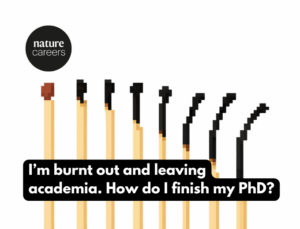
I reached a point of severe burnout, which led me to question the academic system and my own goals in it. Since then, I’ve made the decision to let go of my dream of becoming an academic and look for careers in industry instead. But I still have a year to go in my PhD programme and I don’t know how to find the motivation to continue. How do I regain focus, cope with my burnout and finish my degree? — A fatigued physicist
The advice
Burnout is everywhere. Nearly half (48%) of workers from eight countries reported feeling burnt out in a 2023 survey [1] by the Boston Consulting Group in Massachusetts. According to the 2026 State of the Workplace Report by the analytics and advisory company Gallup in Washington DC, 64% of employees are not engaged in their work and 40% reported feeling stressed daily. Burnout can be particularly pervasive in academic settings, in which researchers often feel intense pressure to perform. Nature’s careers team sought advice from two psychology researchers and a workplace strategist about how to cope with burnout while pursuing a PhD.
Acknowledge the signs
The World Health Organization defines burnout [2] as an occupational phenomenon that results from chronic workplace stress and is characterized by three dimensions: feeling exhausted, increased mental distance from one’s job and reduced professional efficacy.
Simply acknowledging the problem is key, says Amir Kabunga, a psychologist at Lira University in Uganda. “Thank you for acknowledging that you are burnt out,” Kabunga says. “That is the first step.”
“The enthusiasm and intense commitment that often characterize the early stages of an academic or professional path are natural expressions of youthful idealism — a sense of boundless possibility,” says Beata Mańkowska, an occupational burnout researcher at the University of Gdańsk in Poland. “Importantly, you have engaged in deep and honest self-reflection. You have begun to see your situation clearly, moving from idealism towards realism and sound judgement.”
Along with recognizing your own symptoms of burnout and the impacts that they are having on your professional and personal life, you critically analysed the limitations of pursuing an academic career. This is something to be proud of, Mańkowska says.
Take time to recover
The next step is to take some time away from the academic environment. “The only way to treat burnout is to interrupt the stress cycle,” says Jennifer Moss, author of the 2021 book The Burnout Epidemic, who is based in Kitchener, Canada. “You have to take a meaningful break in which you’re just focusing on rest and recovery.”
Because you’ve been exposed to high levels of stress for quite some time, there’s no way to power through or work harder to overcome burnout, Moss says. The best thing to do is to pause, rest, then reassess how you feel about your PhD and career path from a place of clarity. But Moss acknowledges that taking long periods of time away from your laboratory is a privilege that not everyone can afford. Financial constraints can make it difficult to prioritize personal well-being over income. Talk to your academic advisor and friends to discuss what opportunities are available for supporting a prolonged break. “Make it clear that if you got this space, you could come back in a way that’s much more engaged, clear-minded and productive; it’s better for the research and it’s better for the team,” she says.
If financial resources aren’t available through your university, another option is to get a part-time job that can keep you afloat but not ask too much of you while you recover before returning to the PhD. This sounds counter-intuitive, but can help you to “feel like you’re still being productive” while switching the focus of your work, says Moss. “For someone who needs a high level of productivity and has a perfectionist tendency, sometimes, that’s a good solution.”
As well as a long period of time off, Mańkowska recommends treating daily rest as an investment in restoring your personal resources. “A practical starting framework is the 8:8:8 principle within a 24-hour cycle: eight hours of work, eight hours of restorative leisure and eight hours of sleep.” Engaging in regular physical activity, maintaining a balanced diet and prioritizing high-quality sleep are all key for developing your resilience moving forwards. She also suggests that you establish firm boundaries between work and home, which can help to sustain your personal relationships and protect you from chronic stress.
Perhaps most importantly, it’s crucial to recognize that it’s not your fault you feel burnt out. “Everyone feels like it’s their lack of grit or their lack of ambition,” says Moss. “But it’s the workplace conditions that cause burnout.” Many narratives around toxic productivity are baked into academia and workplace culture. These narratives can be detrimental to a person’s health and well-being, but overcoming them requires change at an organizational level. “Burnout is not going to be solved just by taking a bath,” she adds.
Forging a different path
All of the specialists warned that if you hop back into the academic grind, but the workplace situation hasn’t changed, then you’re bound to repeat the cycle of stress. “I have seen individuals return to full vitality — but never by resuming the same patterns,” says Mańkowska. “Those who recover and remain well make a decisive shift: they no longer place professional achievement above health and personal well-being.”
Prioritizing well-being can take many forms, such as no longer working 11-hour days and implementing a self-reflection strategy. For instance, Moss suggests doing a burnout inventory each week to see whether or how your symptoms return. You can also ask yourself whether you’re feeling a false sense of urgency in terms of completing specific tasks, such as entering data or writing a portion of a manuscript. One way to assess whether a task is truly urgent is by having conversations with your supervisor about what your top three priorities should be for the week, so that you can stay focused and not overload your workday.
Find the original and more great content on the Nature Careers Website doi: https://doi.org/10.1038/d41586-026-00797-1 [3]