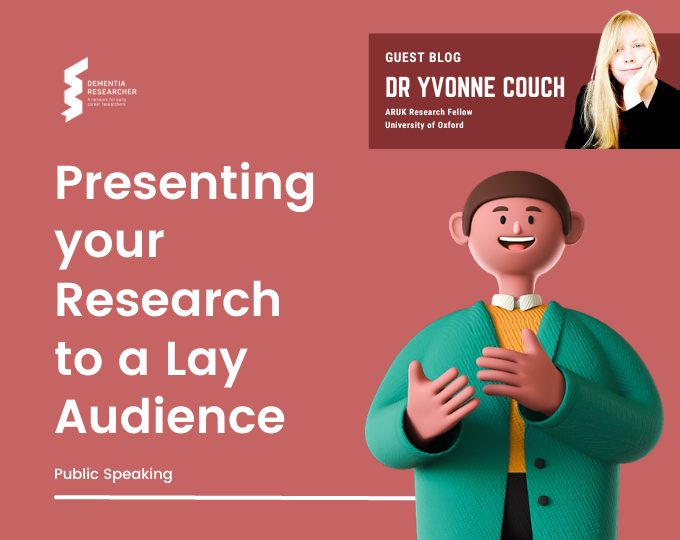
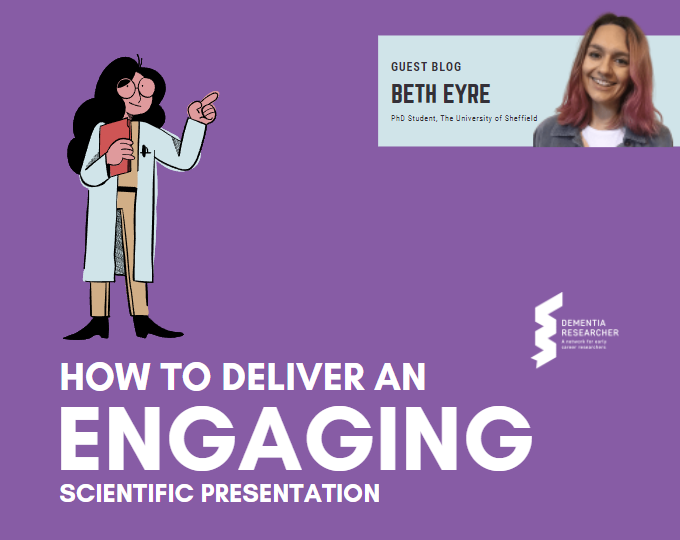
In this episode of the Dementia Researcher Podcast, host Adam Smith [1] (Programme Director at UCL) is joined by Dr Sam Moxon [2], Dr Lindsey Sinclair [3], and Dr Ece Bayram [4] to explore the art of delivering lightning talks.
Together they share practical advice on structuring short presentations, handling nerves, designing impactful slides, and engaging diverse audiences. With personal anecdotes and strategies from their own conference experiences, this discussion offers valuable guidance for early career researchers preparing to present their work with clarity and confidence.
Takeaways
- Lightning talks are concise presentations, usually under five minutes.
- Strong preparation is essential for success.
- An engaging delivery leaves a lasting impression.
- Slides should support the message, not overwhelm it.
- Rehearse to the clock to stay on time.
- Personal touches help connect with the audience.
- Focus on one key message instead of overloading with detail.
- Use clear, accessible language throughout.
- Treat the format as a teaser that sparks curiosity.
- Lightning talks are excellent opportunities for early career researchers.
If you would like to deliver a lightning talk at the ARUK Conference [5] or AAIC Neuroscience Next Conference [6] in February 2026 – get your abstracts submitted by October 22nd 2025.
Voice Over:
The Dementia Researcher podcast, talking careers, research, conference highlights, and so much more.
Adam Smith:
Hello, and welcome to the Dementia Researcher Podcast. Today, we're talking about conference lightning talks: fast, focused, a brilliant way to share your work and to be remembered. So stick with us as we share top tips for first time presenters.
Hello. I'm Adam Smith, programme director for Dementia Researcher, and I'm back as your host. Today, I'm joined by three guests. First, we have the brilliant Dr. Sam Moxon, a research fellow at the University of Birmingham. Sam works with bioprinting and tissue models and has recently become the CEO of his own spin-out company. Regular listeners will find Sam's a familiar voice as one of our contributors to blogs and podcasts. Hi, Sam.
Dr Sam Moxon:
Hi.
Adam Smith:
Next, we have the incredible Dr. Lindsey Sinclair, an honorary senior clinical research fellow and locum consultant in old age psychiatry at the University of Bristol and Avon & Wiltshire Mental Health Partnership, and also somebody who's recently started writing blogs for Dementia Researcher. Hi, Lindsey. And finally, we have the amazing Dr. Ece Bayram, who is an assistant professor at the University of Colorado Denver. Ece studies sex, gender, and ethno-racial differences in neurodegenerative diseases, and is incredibly active in the Lewy body community and in iSTAART as well. Hi, Ece.
Dr Ece Bayram:
Hello.
Adam Smith:
Thank you all for joining us.
Dr Sam Moxon:
Hi, hello. Thank you.
Dr Ece Bayram:
Hi, thanks for having us.
Adam Smith:
Let's start with some brief intros. In your own words, tell us a little bit about yourself. And to warm us up, I want to ask you, what would be your lightning talk walk-on song? Lindsey, why don't you go first?
Dr Lindsey Sinclair:
Okay. In addition to the introduction, you've just kindly given me, I'm about to move to a new university. I haven't quite signed on the dotted line yet, hence the air of mystery about it. But I'm super duper excited about moving to a new institution, and sticking my fingers in more dementia research pies. And I think my walk-on tune would have to be Blinding Lights by The Weekend. It's one of my all-time favourite songs.
Adam Smith:
Good choice. I'm going for that. Sam, why don't you go next?
Dr Sam Moxon:
Yeah. Hi, everyone. I'm Dr. Sam Oxen. I'm a biomaterial scientist primarily, but I've just started to step a little bit out of academia and into more commercial world. We spun a company out of our research about 18 months ago, and I found myself running that. That's been a heck of a journey, lots of ups and downs, but it's definitely something I would recommend if you get the opportunity to do it. I think my walk-out song would probably be Thunderstruck by AC/DC. That would get people really, really up for it.
Adam Smith:
I could go for that. And of course, as part of spinning out your own company, I would imagine you've become pretty familiar with the pitch, right-
Dr Sam Moxon:
Yes, definitely, absolutely.
Adam Smith:
... where walk-on music feels like it might actually be a thing. Have you actually had the opportunity to pick a walk-on song?
Dr Sam Moxon:
No, not yet. It's not walk-on music, but I had a weird pitch where it was everyone full of investors. 60 seconds, no slides, and you have to try and convert them. That was like a flash talk but on steroids. That was intense.
Adam Smith:
So you've got some expertise that are going to be useful today.
Dr Sam Moxon:
I hope so. Yeah.
Adam Smith:
Ece?
Dr Ece Bayram:
Well, in addition to what you shared about me, I can add I'm a MD, PhD from Türkiye. So I had a bit of an unconventional training path where I did clinical first, and then I dove into the research realm. And I became too obsessed with the research that I completely abandoned clinical and I'm in full research now, and I love it. My walk-out song is definitely going to be The Imperial March because it's going to... I'm a big Star Wars fan, so I can't do it any other way.
Adam Smith:
Not the Cantina music? I feel like-
Dr Ece Bayram:
Oh, no. I don't want it to be fun and relaxing. I want it to be attention-grabbing, and getting everyone's hands like they're ready to hear me out or else-
Dr Sam Moxon:
What about Duel of the Fates? That'd be pretty intense.
Adam Smith:
Yeah, absolutely.
Dr Ece Bayram:
Yeah?
Adam Smith:
I could see you with your... You'd have to have your arms crossed as you did that, and you'd definitely need a power suit. Actually, maybe we should make capes a thing. Do you need a cape for your next lightning talk?
Dr Ece Bayram:
I think that's a brilliant idea. I'm totally on board with that.
Adam Smith:
I can see an ISTAART cape.
Dr Lindsey Sinclair:
I actually have one from World Book Day. It's a dementor outfit. I feel like that would be too scary?
Adam Smith:
Yeah, probably. Well, if you had the mask going with it, definitely. Yeah-
Dr Lindsey Sinclair:
Definitely not.
Adam Smith:
Well, thank you all very much for your walk-on tunes. If anybody's watching or listening, I'd love to know what your walk-on tunes will be. Drop those in the chat.
As I mentioned at the start of the show, today, we're exploring a presentation style that's been cropping up more and more at conferences, the lightning talk. Short and sharp, often under five minutes, lightning talks are becoming a common feature on scientific meeting agendas. You'll find lots of guidance online about preparing abstracts or delivering talks and posters, but lightning talks are an entirely different beast, which is why I thought we'd focus on this today. And Lindsey, I'm going to bring you in here to set the scene for us. Can you start by explaining what a lightning talk is and how it typically works?
Dr Lindsey Sinclair:
Yes. A lightning talk, like you said, is something that's really, really short. And I think that's what makes it quite so tricky because you still need to have a lot of the same content as you would in a longer talk, but obviously delivered much faster, which means that you can't go into half as much detail as you would like. And I think that's the craft of them really, being able to decide what to put in and what to chuck out from a longer talk.
Adam Smith:
That's the crux, isn't it? It is exactly what it says on the tin, it's a short talk. Sam, why do you think conferences have embraced this format so widely?
Dr Sam Moxon:
Well, I think there's a couple of reasons. I think, firstly, it's the volume of abstracts that are going into conferences now. And not just the volume, but the quality as well. So it gets to a point where you don't want to reject a good abstract, so you shorten the length of talks. I think it's also because in academia, there's a push to get more early career researchers and PhD students giving talks as opposed to just 20, 30-minute plenaries all day. I think a five-minute talk is a good way to get, especially, young PhD students used to presenting. I think on top of that, there's a need to communicate science better to the public. And I think a five-minute talk gets researchers used to compressing a lot of information into a short space of time, and that's really helpful when it comes to translating those ideas to the public as well. So I think it's a multifaceted thing, but I think we're going to see a lot more of it as well.
Adam Smith:
I'd agree. Anybody listening who heard last week's show knows that I'm one of the people organising one of the AAIC Neuroscience Next hubs for next February. We've just been having to work on the programme and lightning talks feature in there just because you want to try and cram as many speakers in there as you can and give people the opportunity, and trying to strike a balance between having a speaker who's going to come onto the stage and get really deep into it for half an hour or you could have three people do 10 minutes each. I don't know. I think it's a balance there. Ece, from your experience, how does the audience do you think benefit from those short talks as opposed to the longer ones?
Dr Ece Bayram:
I think, right now, especially in this era, everyone has shorter attention span, so it's really hard to keep the attention of the audience on you during a long talk. So it gives you that chance to grab that attention, bombard them really quick, and then leave them wanting more. We all do the poster sessions. And a lot of the times, you don't get to see a lot of the posters that you're interested in because you may have spent way too long of a time at one poster, chatting with the speaker. So lightning talks gives you that chance to actually hear everything. Even though you may feel like, "That's not my topic, I'm not really interested in it," when you're exposed to it, you actually may hear something that grabs your attention and you may be like, "Hey, this is something I can pursue further." So it kind of gives you the chance to explore different topics you might necessarily be too focused on, and short attention span, quick grab, take your quick notes, and open for exploration in the later stages.
Adam Smith:
Sam, how do you decide what to include in a three to five-minute talk?
Dr Sam Moxon:
You've only got a short amount of time to grab people's attention, and I think we might talk a little bit later on structuring, but one thing I would encourage, not just in three to five-minute talks, but in all talks, is to keep the instruction as short as possible because no one wants to hear you setting in the scene for four or five slides. Everyone switches off. And I think if you've got visual data, especially things like fluorescent images, stuff that's really colourful, I think stuff like that should always go in a flash talk because it grabs the audience's attention. Something that's really visual, a video or anything like that, that can really grab the attention. And filling that or alongside that, the most impactful data you have, whether it's two or three figures, that tell the most compelling story because you want...
The idea of a flash talk is that afterwards, people will come to you when you're having a coffee or you're having lunch and ask you questions. So it's whatever that data is that you think could make a headline, that's what has to go in the bulk of your flash talk, get that data across. And even if you only show one figure and spend three minutes explaining in a way that's exciting, that's better than trying to cram 12 figures into a talk and people will only maybe pay attention to two or three of them.
Adam Smith:
That's quite a good point. I mean, how many talks have you been to at the last conference you went, and they spent the first three slides telling a bunch of dementia researchers what dementia is?
Dr Sam Moxon:
Yeah. Well, even telling the audience what's going to be in the talk. Just do the talk, and we'll see what's in the talk. I'm sat here, you don't need tell me what's going to be in it. I'm going to see what's in it.
Adam Smith:
I completely agree.
Dr Lindsey Sinclair:
Although, if you look at how you're taught to teach, and also some people like to be told what's coming up, so I can see why people do that. And just going back to what you were saying, Sam, I think that lightning talks are a bit like a window display in a department store. You're kind of like going, "Ta-da! This is a kind of thing I do," so that people can come up and talk to you about it afterwards if they want to know more detail.
Adam Smith:
So Sam touched on that there, Lindsey. What advice would you give on structure in a lightning talk, that Sam talked about? Do you think it's single message? Or can you do a story in four or five minutes?
Dr Lindsey Sinclair:
I'm a psychiatrist, and we absolutely love stories. That's basically our raison d'etre. So I always try and storify things, and part of the reason for that is that I absolutely love public engagement work. Towards the end of my PhD, I went to a workshop on essentially story structure and narratives in relation to science, and learning about something decidedly unsexy, called University Story Structure. I think a really common one is called the Hero's Journey, so think like Frodo and the ring, that kind of hero's journey type of thing, that helps you to understand what's compelling for people. And then the other thing which I did, which I would recommend to everyone listening is something called FAME Lab, which is in many countries all around the world, and I did the UK one. I had some absolutely brilliant training during that, for how to structure a three-minute talk.
In the case of fame Lab to the public, I think that it's the same, pretty much, with a little bit more detail and slightly less explanation, scientific terms for the scientific audience, and they used essentially the rule of threes. So think about dividing your time, if it's three minutes, into three 1-minute segments. Never try and deliver more than three pieces of information and any one of those sections, and just really trying to break it down and be very clear about exactly what you want to include. So yeah, a big shout out to FAME Lab. I thought that was brilliant, purely, for the training that they delivered, and it was also an amazing experience.
Adam Smith:
That's cool. Now, I'm jealous. That's very cool. So how do you prepare? Do you prepare differently for a lightning talk as opposed to a standard presentation?
Dr Ece Bayram:
Absolutely. I think this is where everyone's personalities come into play as well, because I prepare differently for regular talks than other people too. I am a very anxious person, in general, and stage fright is real. So for long talks, I actually don't prepare. I just set up the times for certain slides where I'm like, "Okay, by 20 minutes I should be at this slide." And if I'm not, I know that I need to speed up. If I'm already past it, I know that I need to slow down. That's kind of how I do it because the more I practise, the more anxious I get. So I don't want to do that, and I don't practise because of that. For lightning talks, since it's a way shorter amount of time, and you don't necessarily have a tonne of slides to go through, I do structure it way better and I actually do time it way better.
I always bring a timer with me to the stage. Some conferences actually have the timer that you can look at, but I like using my own just in case. So I have my timer on the stage with me just to make sure I'm sticking to the time, so I don't steal extra time from other people's presentations or end insanely early because I spoke too fast. I tend to do that when I'm really anxious. So when I'm preparing, I may go over it five, six, or 10 times at home, just making sure I'm sticking to the times. I don't put together a script because I know I'm not going to memorise and stick to a script, but I put together the specific messages for each minute, just like Lindsey mentioned, that I want to make sure that I covered, and I definitely focus on, "Okay, what is the message that I want people to take from this talk? Is it definitions about something?"
Maybe it's a community talk and you want them to lead with the right definitions or maybe it's the methods-focused talk and you want them to hear that, "Hey, here's this new method that I discovered that you should be looking at," or maybe it's a striking finding that I want them to realise like, "That's the cool finding that we should think about." So really focusing on that message, starting with that punchline, and then giving a little bit of details about how I got to that punchline, but by starting high and ending high. It's a little bit of fluctuation, but you don't build up to it. You start high, you grab that attention right away. And I always has my, especially, lightning talks on my friends, not science friends, my actual regular life friends who are not necessarily in the scientific field, to make sure that it's comprehensible for them.
Because at these conferences, especially during the lightning talk sessions, there are a lot of talks. You may go through 10, 20, 30 talks, back to back. You fade away. It's a lot. You really get exhausted when you're listening to it. So you need simple descriptions, simple explanations, and making it as easy to comprehend as much as you can. I think it really helps the listeners. You do need to know your audience and not provide dementia definitions, this is a dementia conference. But also, there are going to be people in the audience that faded away, that are hanging on by a thread. So they do need to be mindful of not bombarding them with even more hardcore terminology that they're just going to sleep during those short amount of time you get. So those are the things that I pay attention to personally.
Adam Smith:
That's interesting. So you work from bullet points rather than scripting yourself. Lindsey and Sam, are you in the same camp or do you script?
Dr Sam Moxon:
Well, Adam, I'm sort of like Jay-Z in this regard. Let me explain. So I remember-
Adam Smith:
Wait, wait a second. You're just going to liken yourself to Jay-Z now. That's a bold claim. I'm looking forward to this.
Dr Sam Moxon:
When he writes a song, he has a beat, but he doesn't write anything down. The beat just plays on loop, and he just produces a lyrics in his head over and over again. No script, no writing, just that. And that's similar to how I do a talk, I have my slides, I don't write any scripts. I just have a timer, my slides, and I just talk through it, never write anything down. And then I can feel sort of how the talk is going from that part. I can feel if the instruction is too long. If I come and I've gone three minutes over, I can then go back again. I'll just walk up and down my hotel room the night before, just going through it and going through it until I've got something that's roughly how I like it. So that the next day when I settle into it, I've got a structure in my head of how I want to do it. But I also know as the time goes on roughly where I should be, and it always finishes quite nicely to time.
I think that's an example of the thing we often forget in academia is everyone's brain is differently. And you see so many talks of people saying, "This is how you should write a talk, this is how you should do a talk." But actually, the best way to do a talk is the way that you find the easiest. And for me, it's just going over and over in my head, not writing anything down because that gives me anxiety. Whereas if I am just in a hotel room, stood up, pacing up and down, talking through it, I know I'm getting myself ready for it.
Adam Smith:
I suppose it's maybe more likely you'll be thrown that if you've written it down and then you don't say the right thing in the right order, suddenly, it can disrupt the flow of the entire thing.
Dr Lindsey Sinclair:
Yeah.
Adam Smith:
I don't know. Lindsey, do you think that the method Sam and Ece uses allows you to be a little bit more dynamic if things change?
Dr Lindsey Sinclair:
Yeah, I think so. I think you should always be aware of what's happening with your audience. For example, you're a minute in and everyone's gone to sleep, clearly, it's gone badly wrong. So you need to be looking at the effect that you're having on your audience, and responding to that. I sort of have a script, and now I have a flow of bullet points that I want to get through. But what I do with my talk, and again this comes back to psychiatric training and all the teacher training I've had at university level, I also try and incorporate as much as I can of something called VARK, which is about different learning styles, so the idea that some people are very visual, some people like to read the stuff, some people like you to say stuff. I also try and incorporate some of that, so that I'm trying to maximise the number of people in a room that I'm engaging.
But Sam's description of pacing up and down his hotel room made me chuckle. So on the day that I'm giving a short talk at a conference, I'll often sneak off to a disused part of a conference building. I mean, one that you're allowed to be in. But when there's no one else or the toilets, or something like that, and just practise what I'm going to say with the timer on my phone. And that's me. It's what gets me in the headspace where I'm like, "Yeah, I'm ready to go."
Adam Smith:
Do any of you record yourself, record the audio of this and then listen to it back?
Dr Lindsey Sinclair:
I video myself. I'm a terrible hand waver, so I video myself and just check that I don't look like I'm trying to direct traffic.
Adam Smith:
What about you Sam, Ece? Do you record yourself doing your talks? Do you listen to yourself back?
Dr Sam Moxon:
I've done it once. I did that 60-second pitch to the investors and that was basically record it, send it to the rest of the founding team for any suggestions, come back. That's the only time I've ever done it. I think it would thrill me a little bit hearing myself.
Dr Ece Bayram:
Yeah, I don't do it. I can't stand my own stout. I definitely don't want to watch any recordings of myself, and it does get me more anxious. It does get me like, "Oh, I got to pay attention to this, that." And it throws me off my natural flow, so it doesn't work for me. But it does work for some people, as we can hear from Lindsey and Sam, it's just not the right option for me. I will say I do things to kind of reduce my anxiety and I have my own ways of doing things, but it's not a bad thing to have anxiety giving these talks. Or if the audience picks up on your anxiety, it actually shows that you care. You don't want to go to a talk where the speaker's too professional that it comes off as they're just giving you whatever they memorise without really paying much attention to their emotions, et cetera.
It comes as robotic, it doesn't feel natural, and you don't leave the talk feeling like... It doesn't really capture you. But if you see someone anxious, if you see someone actually making mistakes fumbling through those words, you actually realise this person really cares about what they're doing. They want to deliver a good talk, and they're really trying hard. They may not be there yet, but that does stay with you and you do get intrigued because you're like, "Okay, there's passion in this. This person really cares about that topic. This topic must be something that someone cares about it this much." So it does capture you in that way as well.
Adam Smith:
I think, I don't know if you'd agree, that different styles suit different audiences. I'm not sure that our academic research audience appreciate that kind of uber-polished Ted Talk style, that kind of walk on confident and is word-perfect and says, "I don't really kind of go for that." I don't know. I guess other people do, but you kind of like a little bit of bringing the audience along with you, not just like you're selling and that's it. You're not just selling the idea to them, that you're trying to bring people with you. Moving on. You've all, I think, mentioned at some point the concept of visuals. Because I realised, I think, most lightning talks in the academic space probably allow you some slides. Although, I was at an Alzheimer's society event early this year, I think they called it Soapbox Science Competition, where there were no slides. So I know it might not always be possible. But Ece, I'll stick with you. What mix an effective slide or slides, plural, for a short presentation?
Dr Ece Bayram:
I think being mindful that it should grab people's attention, but it shouldn't be the only thing people are focusing on. They have to hear you giving the talk, too. So if you put too much text in it, people are just going to spend your whole talk trying to read all the texts, trying to gather what you're saying on the slide, so none of the attention will be on you. It should be complimenting your talk. It shouldn't be the main attention grabber. You should be the main show, and it's the prop that's going to help you shine even more. So keeping it on less text, more image-heavy, and not filling all the blank spots. Don't tyre people's eyes. Make it easy to actually look, "Okay, it's cool. Let's hear what this person is thinking about this thing." I think that helps. And again, I test run all my slides on my family and friends who are not into science, so I think they give the best feedback.
They're not necessarily looking for the itsy-bitsy details that's in a quick talk anyways, so that helps me structure things a bit better. Always be mindful of colourblind-friendly palettes because you don't know who in your audience may struggle looking at a graph and not knowing what you're showing because it's not colourblind friendly. And just make sure you don't have typos. Go through the text definitely, and just don't put too much text in. For the images too, don't make it too complicated. You are going to get the audience that may be in your field, but they may be junior or very senior. So you have to be mindful that everyone who looks at your video will understand what you're trying to get at.
Adam Smith:
Do you think there's a rule of thumb for how many slides, say, for a four-minute talk? Are you talking like one slide every 30 seconds? I mean, obviously, not necessarily evenly divided? But how many slides do you think is too many?
Dr Ece Bayram:
We usually go, for our clinical research talks, one slide per minute. But I do feel like if you can capture things in less slides, do it. If you need a couple more slides, do it. It is really based on the message you're trying to convey and your style. I like using memes and GIFs in my slides, for instance. And they take up some space, so there may be extra slides just to go through that GIF, give a little comic relief in between and move on. So I may have an extra slide that way. It's just works for me. But I would say one slide per minute has been the golden number, in general, for our talks.
Adam Smith:
With some bonus lightning slides that are just on for a few seconds to hammer home the point.
Dr Ece Bayram:
Yes.
Adam Smith:
Sam, you've already talked to this, you've already said you're kind of a fan of not cramming too much into a slide. What do you think is the risk here? What other common mistakes do you think when it comes to slides for short talks?
Dr Sam Moxon:
Yeah, I've seen this a lot. And surprisingly, it's often a senior researcher, PI, or a professor who's got a flash talk and has decided to put 15 years of research into five minutes because they want to have their story told. And that's a bit of a red flag I think for the ability to indicate because really the whole point of a flash talk is, "Pick one thing that's exciting, and show it us." If you try and cram everything in, people just leave feeling confused. A good flash talk, you walk away with one major learning, and that's when you know the flash talk's been good. You walk away and think, "I learned something new there, and it was this."
If you try and cram 10, 15 years worth of research or an entire paper into a flash talk, people have not going to have any idea what's going on, unless it's in their specific field of interest. Because generally, the flash talks are quite far reaching. You get a breadth of different topics, and it's quite a broad audience for the flash talks. And you just end up losing people. So I think I would say that's the biggest risk when you try and cram things in. Also, you risk stressing yourself out as well by trying to speak quickly, trying to talk through things fast. You really want a nice even-paced delivery, three to seven slides, and you need to be comfortable delivering it as well.
Adam Smith:
Well, you raise a good point there, I mean see if you agree, that sometimes the abstract submission process, because it's kind of generic, you'll go through the same abstract submission process whether you're putting in for a plenary or a lightning talk or a poster. And when you put your abstract in, you're probably going to be pitching a big abstract, which might be the entire study. But then when you are chosen, you're chosen to give a lightning talk, what you put in as your abstract to what you deliver on the day may have to change slightly. You may have to zero in, as Ece mentioned as well, or Sam, on one thing from that study. You can't present the entire massive 18-month study in that time, even though that might be inconsistent with what you put in your abstract.
Dr Sam Moxon:
Yeah, absolutely. I think that's the key though. When you go to a conference, if you wanted a talk, but you're going to poster, well, you've got a poster. So make your poster, make it as good as you can. Don't try and make it a talk. And the same if you wanted a 15-minute talk, but you got a five-minute flash, make a five-minute flash and do it as good as you can. I think it's that simple. It might sound a bit brutal, but take what you've been given and make the best of it.
Adam Smith:
You make a good point about it. You can just imagine, can't you, some senior researchers that don't even read the rules. They get to think, "Lightning talk, yeah" and then they just turn up expecting to do whatever they've usually done all along. And the poor organiser or the chair of the session sitting there very uncomfortably not wanting to be... I think we could do a whole separate podcast on just the skill of chairing a lightning session and how you move people along politely. Okay. So you've done the prep, but the real test, of course, is on the stage with the clock ticking, performance is critical. I'm going to come back to you, Lindsey. What tips do you have for handling nerves?
Dr Lindsey Sinclair:
Well, as a psychiatrist, I have quite a large toolbox of strategies. So dealing with nerves, as you'd expect-
Adam Smith:
Ece wants these.
Dr Lindsey Sinclair:
I have carried on with my clinical work throughout my research career, and I think that the two really complement each other. Like I said, working as a psychiatrist is brilliant, knowing how to handle confidence, and there's all sorts of different ways. There's finding a way of being in your happy place, so that comes more of visualisation type of things. So you'll often see people disappearing often on corridors, looking into the distance. That's probably what they're doing. You see people are doing breathing exercises and they really, really work. They essentially make you less anxious by altering the pH of your blood. Brilliant, recommend those to all of my patients with any kind of anxiety problem. Some people like to have sensory objects, some people like to have particular clothes. When I was a rower, competing, some people had lucky underwear. It's whatever works for you, frankly.
Adam Smith:
Ece, you said you get nervous. I'm going to ask you the same question because you deal with this. How do you handle your nerves?
Dr Ece Bayram:
Sometimes I just don't. That's why I don't practise, hoping that it doesn't build my anxiety up, and it does work for me. I usually try to remind myself, "Hey, if it goes insanely bad, I hope someone was recording so I can start my YouTuber career and make even more money." So I think about that, I'm like, "Okay, worst-case scenario, influencer for life." I'll make more money, which is good. Also, comedy is tragedy plus time. Even if you look terrible, do something terrible... I've seen people curse while giving talks too, and it makes you giggle. You laugh, and then you actually remember them. So there's nothing wrong with your talk, that everyone's going to remember for later on as well. And you end up laughing about it. I think all of us in clinic research, we've had instances where we made mistakes in our talks, we've given terrible talks.
No matter how professional experienced you are, you are going to give a terrible talk. You may have a very bad day that you may end up giving such a horrible talk and people are petrified by it, but it's just the way of life. That's how it goes. You brush it off, you move on. So I just keep that in mind. All those people I look up to, they failed at some talk too. So it's okay that I fail. I learn from it, I move on, and the next talk will be even better. And the more you give talks, it does take that pressure off. So jump on any talk opportunities you can get, especially early on in your career. Don't be like, "Oh, I'm not ready yet." No. If someone's inviting you, it means they think you're ready, so go for it. Give it your best. Even if you get super anxious, that's totally fine.
Adam Smith:
I think even with a four or five-minute talk is another thing I tend to rush. So when I'm nervous, I kind of rush through things. I'll speed through my four-minute talk it ended up being a three-minute one, just because I'm so desperately keen to get those words out there and get off the stage as quickly as possible. And I think even with a format, there should still be time to breathe, pause, pace yourself equally. So talking about timing though, what do you do if you lose your place or your time is cut, or you are on the stage and the chair nudges over and says, "60 seconds," and you are still on slide number two? How do you deal with that, Sam?
Dr Sam Moxon:
I've got to be honest here, it's never happened to me.
Adam Smith:
Now, you're just being cocky. That's just too perfect.
Dr Sam Moxon:
But I have seen it happen, and I've seen it handled terribly and handled badly. I think the worst thing you can do is ignore that and carry on at the pace that you were.
Adam Smith:
Yeah-
Dr Sam Moxon:
The best thing you can do-
Adam Smith:
You see, I think what seems to happen is the default, isn't it? That the speaker goes, "Yeah, sure. Okay, but I'm just going to get through this now," and you're not going any quicker.
Dr Sam Moxon:
I think the best thing you can do is, in that situation, and you've got 60 seconds left, take a couple of seconds to think, "What's the most important thing to show here?" Decide that quick, skip to it, tell it, jump to your discussion and your conclusions, and then invite people to come and speak to you afterwards if you'd like more information. It's a hard situation to get out of. So there's no best-case scenario, but there's a better-case scenario.
Adam Smith:
Yeah, I completely agree. Even if you just take 10 seconds or 20 seconds to just, "Okay, give me a second," flick through your slides and say, "These are the points I'm going to pick on." Actually, acknowledge it and face it head on, rather than just ploughing on. You've seen it happen too often. Has that happened to anybody here? Has anybody being told, "30 seconds," and you haven't had time? No, because you're all consummate professionals.
Dr Lindsey Sinclair:
It hasn't happened to me, but I saw it at a three-minute thesis competition. Someone who was on the stage for about 15 minutes, talking, and clearly went way over their time, and it was elephant-in-the-room territory. They'd been told, and they clearly were too anxious to be able to make use of that information. And everyone was just sat there thinking, "When is this person going to stop?" It was really awkward.
Dr Ece Bayram:
Yeah, it's happened to me too. It's not a rare thing. It happens and it's happened to me too, and I've definitely like, "Okay. I guess I'm out of time. Let's cut to the chase kind of a deal." But let's think about it in your regular life too. You may be telling a story and you may look at your friend, family, and they may be like, "Oh, cut to the chase," where you're like, "Okay, let me wrap this up." So it's just like that. You got to be mindful of people coming after you, people listening to you where, "We can wrap this up, it's fine." It's not the end of the world, and it doesn't show that you're bad at what you do. It's just that one little incident. You wrap it up, you move on, and it's done.
Adam Smith:
Yeah. When you got fixated on one slide and you realised you over described that, it's really hard. When you've only got four minutes, even just 20, 30 seconds where you spend too long describing on something than you planned, there's no coming back from that because that 30 seconds is half your conclusion in your last slide. You've just got to stay on track.
Dr Lindsey Sinclair:
But that partly comes down to the preparation and the practising , doesn't it? So that you know that you've allowed 10 seconds extra if you're waffling.
Adam Smith:
Yeah, good point. So if you are preparing your lightning talk, don't fill the whole four minutes, fill three and a half. It's better to finish slightly early than it is to not have enough time. So we all agree that lightning talks can be brilliant opportunities, but then definitely not without their challenges. What do you think now? I'm going to turn into my salesman's pitch now, of course. Anybody who's listening, abstract's just opened for the AAIC Neuroscience Next conference for 2026, which happening in February next year. And if you're in the UK also, well, abstract is open for the Alzheimer's Research UK conference, which is happening in Manchester just before and around the same time as Neuroscience Next. And both of those events have opportunities for lightning talk presenters. So for anybody who's listening, who's on the fence, what do you think are some of the biggest benefits of early career researchers giving lightning talks? I'm going to ask Sam.
Dr Sam Moxon:
Yeah. I think it's a good opportunity. Especially if you've not got a lot of experience with talks, it's a good opportunity to have a less high pressure. I mean, it's high pressure in the sense of this, you've got to try and be concise. But usually the flash talk, there's no questions afterwards. And if you ask any PhD student what they're most nervous about, it's getting a question afterwards that they don't know how to answer. Because everyone's confident in the research, but the one thing you can't predict is what you're going to get asked. Whereas a lightning talk, you don't have the opportunity for questions. It's speaker, next speaker, next speaker, next speaker. But I think it's also really good training for getting you used to making your data concise, making your explanations concise. That's going to be really critical when you're writing a paper and when you write your thesis.
So I think it's a really good exercise for helping you to gather your thoughts, work out what's most impactful, and translate it in a way that's digestible to a wide audience. And especially if it's one of your first talks, I think it's a really nice introduction to giving conference talks. Usually, the audience is friendlier. I mean, conference audience are pretty friendly anyway. There's usually one person though who sits the back and asks a billion questions. But it's usually because they're interested, not because they're difficult. But I think that is a really nice introduction to conference speaking, and definitely one that I think everyone should do at some point.
Adam Smith:
It definitely opens up opportunities as well as now. Obviously, if you get a poster, we should add, of course, that most hybrid conferences now that have digital posters that allow you to upload those two, most of those, certainly I know all the Alzheimer's Association ones and Neuroscience Next do, and I think Alzheimer's Research Uk do, allows you to record a kind of three-minute film to go with your poster to upload that alongside, which is almost like a three-minute lightning talk, like a little recording against that. So take those opportunities because I think that kind of visual way of doing it is far more engaging. I would agree. I'm going to ask all of you, as regular conference goers, what separates for you that kind of memorable lightning talk from a forgettable one? Lindsey.
Dr Lindsey Sinclair:
I suppose the memorable ones for me are, firstly, the ones which connect with my research interests. So I definitely always remember those. But that's just down to luck, isn't it? I think the next thing that I look for is someone who's excited about their work, who's passionate, who's engaging. He varies the tone of their voice, who moves around a bit, rather than just standing still and talking in a monotone. No matter how good your science is, if you don't have any of those presentation skills, it does make it harder for your audience to engage. And then coming back to some other stuff that we were saying earlier, not too much text on slides. For me, it's like nails on a blackboard, if you've got everything that you're going to say on the slides and then you just read it out. But we're all different.
Adam Smith:
I agree. Ece?
Dr Ece Bayram:
I love the personal touch when someone mentions how much they love what they do or how they're connected to that type of research, or they add a personal picture in there. And it doesn't necessarily have to be your kid or your dog or something else. It may be a still from a show that you like, some fun thing that connects to the research. I really appreciate that because I think that gives a chance for me to actually connect with the person behind the science, too. And that's shamelessly how I tend to pick my collaborators. I like to work with people who are very passionate about what they do, that it is a part of their life. It doesn't have to be their whole life. But if they're bringing some personal connection in there, that's just what I look for. That's just what I love.
Adam Smith:
Yeah. I quite like it that even if it's just a little, "I remember this happened and something else, what happened at the same day or why you kind of went down the route you did," does something personal add to that? What about you, Sam?
Dr Sam Moxon:
Yeah. I think this is where I'm maybe a bit fickle. A lot of it is how the person delivers it. It tends to be what grabs my attention. I remember even at university, I wouldn't always learn stuff from lectures. I'd learn by reading afterwards. But if the lecturer was really engaging, I would learn more in the lecture itself. So someone who presents with confidence and passion, and looks at the audience and has that engagement, that really grabs me. I remember the first conference I went to, I found that it was a hydrocolloid conference, materials in medicine.
I listened to someone talk for 30 minutes about adding things to ice cream to make them freeze better, and finding it fascinating just because of the way the person delivered it. It was completely different to what I was doing. And I realised that the way my brain works is I listen more to a speaker that's engaging. And if they're talking about something I'm interested in, even better. But if I find someone engaging to listen to, I can listen to and talk about anything and find it interesting. To me, it's about how it gets delivered.
Adam Smith:
We're almost out of time. But before we finish, I want each of you to share one very quick, in lightning talk style, piece of advice for anybody giving a lightning talk for their very first time. And I'm going to go to Sam first.
Dr Sam Moxon:
Remove your "erms." It's really hard to do. I found out that I did this. So I had a lot of public speaking training when I was a kid because I had a bad speech, not impediment, but I would try and speak too fast. And I thought I was great at public speaking. But in lockdown, my partner saw me talk and told me I "erm" quite a lot. So the first thing I would do is anytime I "ermed," I'd take a sip of water. Slowly, that became me not "erming," but taking a sip of water instead. And eventually, just a little gap. And if you can do that, you talk is a lot smoother. "Erms" can kill flow. It can also kill the audience's confidence in what you're saying. So get rid of your "erms"-
Adam Smith:
Absolutely. Di influencers, aren't they? They're called disinfluencers. And it's not just "erms." It can be people who start every sentence with a so, a kind of repetitive use of word, and things like that. They do that. Thank you, Sam. Lindsey? Lindsey, as I do it myself. Straight into it, Lindsey.
Dr Lindsey Sinclair:
"So, something from my sports world," you'll notice using so in the beginning of the sentence. Proper preparation prevents poor performance. Try saying that quickly after 10 pints-
Adam Smith:
I've heard a different version of that one.
Dr Lindsey Sinclair:
Yes, most polite version was able to be put on various swearing T-shirts. I think it really, really helps or at least it helps me. Any other piece of advice I would give to any early career researchers is do it. Talks look really good on your CV, and will help you get grants and posts later on. So definitely do it. Feel fair, and do it anyway.
Adam Smith:
Thank you very much. And Ece?
Dr Ece Bayram:
Well, to add on to all that amazing advice, I'll say be yourself. Everyone has their own way of giving talks and prepping for things. Just follow whatever feels right for you. If you're trying to fit into a mould, it's not going to work and it shows. So don't try that. Find whatever tips work best for you. And especially if you're a non-native speaker like me, don't worry about your accents. Talk slower and people will understand. And if people don't understand, then that's good feedback for your next talk and you'll talk accordingly.
Adam Smith:
Thank you very much. Obviously, I'm going to round off in a minute, but one of the things that regular attendees of our salon webinars will know is that we've trained friendly AI using content just from the Dementia Researcher website. The Dementia Researcher website has over 3,000 pages of blogs, online seminar transcripts, podcast transcripts, articles, all designed to support early career researchers. And we've given an AI just the content from our website, not from the internet, so we know it's entirely trustworthy. Sam's blogs, Lindsey's blogs will be in there. Ece, you've done an online seminar for us now and a podcast. So the transcripts have gone into educating this tool. I asked that AI to give me some top tips for lightning talks, and now I'm going to read them out and see if you got them to test you.
Number one was, "Practise to the clock, rehearse out loud several times, aim to finish under time. If you've given five minutes, aim for four minutes and 30. Record yourself once, listen back, and you can fix it where you rush, stumble or lose clarity." You all said that. Well done. Number two, "Confidence is not cocky." I think I said this. "Project enthusiasm and belief in your work, but avoid overselling," and, "Smile and speak clearly." Number three, "Keep it succinct, one message only. If the audience remembers one key point after your talk you've done well. Strip out the jargon and technical details. Speak with interest, but not giving a full seminar." You all nailed that. Number four, "Clear structure, start, middle, end. Start, to hook your audience in with the question or the striking fact. Middle, which is why you did it, and what matters, and what you did. And then give them something to take away at the end."
Acknowledgements. I think even though you're given a four-minute talk, there's always time to at least give a few acknowledgements. Whether that's to your participants, your supervisor, your colleagues, whoever's helped you be where you are, don't avoid doing that. Number five, "Connect quickly with the audience. Look up from your notes, make eye contact with people, and vary your voice, if possible. Tell your language for a mixed audience, avoid acronyms." Number six, "Disinfluencers. Plan for nerves. Breathe slowly before you start. Have a rescue line ready." Something like the key message I want to leave you with is "Have something there ready." Number seven, "A strong ending. Avoid trailing off and saying, 'Yeah. Well, that's it.' Have a clean, final line that you've practised." I've seen that done a lot as well. I don't know if you'd all agree that people get to the end and go, "Okay. Yeah, done. Thanks," and the audience starts clapping. Number eight was a bonus tip, "Embrace the format. Don't see the short time as a limitation. Think of it as a teaser trailer. Your aim is to spark curiosity and conversation where people will talk to you after you talk."
I think you got all of those in your top tips. Thank you very much to my brilliant guests, Sam, Lindsey, and Ece, for joining me, and thank you for listening. Lightning talks are short. But with preparation and focus, they can make a real impact. For more resources on presenting and conference skills and lots of other tools that will help, head to the Dementia Researcher website at dementiaresearcher.nihr.ac.uk. I've mentioned this already once, today, but I also want to take the chance to once again plug AAIC Neuroscience Next, which is happening on several days over February, but in Manchester as well on the 27th of February where we'll be hosting a day of this hub, with a focus on all the different kinds of biomarkers, from blood to imaging, to cognitive testing, to physical and the rest.
We've got 20 slots for lightning talk presenters across all those different domains. So if you work in one of those area of biomarkers, we'd love to see your abstracts. Abstracts are open now, and you can submit your abstract at alz.org/neurosciencenext. They're open through to the 22nd of October or the 26th of October for iSTAART members. But that's all we have time for today. Thank you very much again to Lindsey, Sam, and Ece. I'm Adam Smith, and you've been listening to the Dementia Researcher podcast. Thank you.
Dr Sam Moxon:
Bye.
Dr Ece Bayram:
Bye.
Dr Lindsey Sinclair:
Bye.
Voice Over:
The Dementia Researcher podcast was brought to you by University College London with generous funding from the UK National Institute for Health Research, Alzheimer's Research UK, Alzheimer's Society, Alzheimer's Association, and Race Against Dementia. Please subscribe, leave us a review, and register on our website for full access to all our great resources, dementiaResearcher.nihr.ac.uk.
If you would like to share your own experiences or discuss your research in a blog or on a podcast, drop us a line to dementiaresearcher@ucl.ac.uk [7]
Did you know... you can find our podcast in your favourite podcast app [8] on mobile devices, and our narrated blogs are also available as a podcast [9].
The views and opinions expressed by the host and guests in this podcast represent those of the guests and do not necessarily reflect those of Alzheimer's Association, UCL or Dementia Researcher
Meet the contributors
 Dementia Researcher


Essential links / resources mentioned in the show:
AAIC Neuroscience Next Website [11]
Alzheimer’s Research UK conference [12]
FameLab [13]