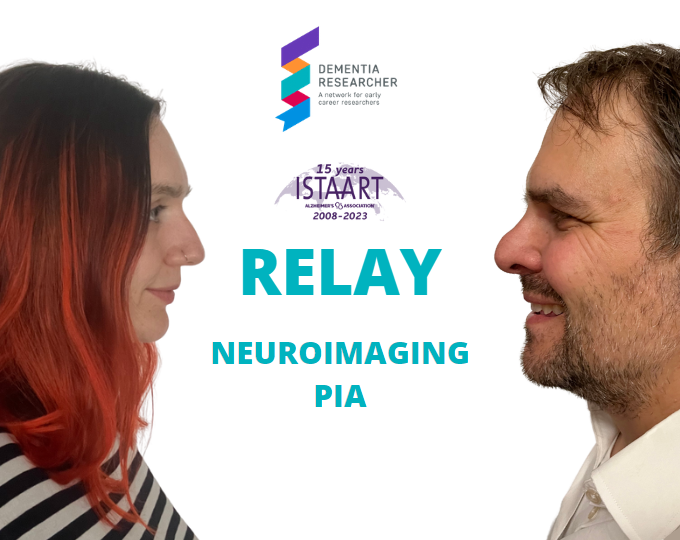
Welcome to the sixth season of the Dementia Researcher X ISTAART PIA Relay Podcast. This series features interviews with ISTAART PIA committee members talking about their research, the research landscape of their fields, and the work of the ISTAART Professional Interest Areas (PIA) they represent. As we build up to the Alzheimer’s Association International Conference in Toronto, join us for daily episodes that showcase the remarkable work being done in various research fields.
In this episode, Dr Shana Stites [1] interviews Dr Alexa Pichet-Binette [2], Assistant Professor at University of Montreal and Education Chair of the Neuroimaging PIA [3]. Alexa discusses her work using PET and MRI imaging [4], and how fluid biomarkers like plasma-based assays are reshaping Alzheimer's diagnostics. She also highlights the role of the Neuroimaging PIA in ISTAART, including collaborations, working groups, and the popular “year in review” sessions. They explore how these initiatives support early career researchers and foster community, with a preview of pre-conference workshops at AAIC 2025 in Toronto.
The Alzheimer’s Association [5] International Society to Advance Alzheimer’s Research and Treatment (ISTAART) convenes the global Alzheimer’s and dementia science community. Members share knowledge, fuel collaboration and advance research to find more effective ways to detect, treat and prevent Alzheimer’s and other dementias. Professional Interest Areas (PIA) are an assembly of ISTAART members with common subspecialties or interests.
There are currently 30 PIAs covering a wide range of interests and fields, from the PIA to Elevate Early Career Researchers to Biofluid Based Biomarkers and everything in between.
Voice Over:
Welcome to season six of the Dementia Researcher ISTAART PIA Relay Podcast. In this special series, we've invited members of ISTAART's professional interest areas to interview each other in a unique relay format. One guest becomes the next's host and the conversation keeps moving episode by episode. ISTAART, part of the Alzheimer's Association, brings together researchers, clinicians, and professionals dedicated to understanding and treating Alzheimer's disease and other dementias. We'll be releasing one episode each day in the lead up to this year's Alzheimer's Association International Conference taking place in Toronto and online, showcasing the vital work of ISTAART PIAs and talking hot topics in research. Thank you for listening and we hope you enjoy the series.
Dr Shana Stites:
I'm Shana Stites. I'm an assistant professor at the University of Pennsylvania. I work on the diversity and disparities PIA. And I am the outgoing chair. Today, I am delighted to be talking to Alexa Pichet-Binette from the neuroimaging PIA. Hey, Alexa, can I start by asking you to introduce yourself and tell us more about which PIA and how you're involved in?
Dr Alexa Pichet-Binette:
Yeah. I'm Alexa Pichet-Binette. I am a new faculty, new assistant professor at the University of Montreal and affiliated with Lund University and the BioFINDER Group in Sweden. And I'm involved in the neuroimaging PIA. Currently, I'm the education chair and incoming vice chair. And I think I've been on the PIA actually for four years or something. So, I've done a lot of the previous positions, all the trainee positions. So, I guess... No, not just, I guess. It's a great PIA and community, so I continue to be involved.
Dr Shana Stites:
Before we dive in more so on the PIA itself, can you tell us a little bit, especially for those people who might be tuning in, totally unfamiliar with your work, the focus of your research and what brought you into dementia research specifically?
Dr Alexa Pichet-Binette:
So, a lot of the research I do is very multimodal, incorporating a lot of different biomarkers. So, a lot of it is related to neuroimaging. I work both with magnetic resonance imaging or MRI, as well as positron emission tomography, PET, specifically Amyloid PET and Tau PET. So, the two pathologies that are needed for a diagnosis of Alzheimer's disease, and we can image them directly with PET scans. As well as more recently, also incorporating fluid biomarkers, blood-based biomarkers. There have been a lot of development in that area, so now with just a blood draw we can get a good idea of who might have amyloid pathology or Alzheimer's disease pathology in their brain.
So, this combination of using more accessible biomarkers and imaging has been something that, in the field in general, many people are worked on. And I continue to try to incorporate. And really, the idea is using this combination of different biomarkers to try to improve diagnosis, prognosis. And I work both on the preclinical phase of the disease, as well as when people have symptoms, so really across the continuum. I've had the chance to work with many different cohorts and open access data set throughout the years. And as I joined the University of Montreal recently, I'm trying also to work more closely with the memory clinic affiliated with the university, to try to also have an impact, let's say locally and continue to improve this diagnosis or prognostic aspect.
Dr Shana Stites:
Is it fair to say that plasma biomarkers are sort of like the big deal right now?
Dr Alexa Pichet-Binette:
I would say so. Not the only deal, but a big deal I would say. It's really changing, I mean, a lot of research aspects, clinical aspects. I think a big question now... And I mean there's many recommendations that are being put in place. The Alzheimer's Association is involved in a lot of those initiatives, so recommendation to try to understand better how to use them clinically. I think in some places of the world, this is at the more advanced stage than others, obviously. And I think another big aspect is that there are many assays available at the moment. So, trying to understand what an appropriate level is, let's say to be confident, okay, my measure from the blood can replace a PET scan or a lumbar puncture. I think that's a really big area now.
And then we need, let's say harmonised cutoffs so that it can be used more globally and accurately. So, we are very confident in these measures, because indeed, it's not a perfect one-to-one always with what we can capture in the brain. So, I think really try to understand how in which context it can be used best, is really important. Even within the neuroimaging field, we've seen this big change as well. Every year, we ask an early care researcher to do a year in review. And in the last year, it's very striking how well a lot of this presentation incorporates this comparison between imaging and blood-based biomarkers to, again, try to see, okay, when are they telling us similar information or different information? So, I think it has a big impact.
Dr Shana Stites:
So, even though this is like the neuroimaging PIA, there's still a substantial role looking at plasma or fluid biomarkers, because I guess the validation you're describing of those markers is reliant on the neuroimaging.
Dr Alexa Pichet-Binette:
Yeah.
Dr Shana Stites:
Can I back you up a second, because others listening to this podcast... So, a little bit of a tell. I've gotten to know the neuroimaging PIA, and you, and Dave Cash over the last few years, because of the closed collaborations between the diversity and disparities PIA and the neuroimaging PIA. And so, I know what others might not know, and that's part one. You guys are awesome in the work that you do. And that is you put on fabulous pre-conferences at AAIC, which I'll circle back to. But the other amazing thing you do is what you just referenced casually before. And that's the year in review, this literature review that you ask of your early career researchers. Can you take a second just to say a little bit more, because this is not something that I've heard in the other PIAs? And it really is something that's outstanding that the neuroimaging PIA does.
Dr Alexa Pichet-Binette:
Yeah. Thanks so much. Well, also, you're very kind to the imaging PIA. And we have had a nice collaboration, so right back at you with the diversity and disparity PIA. And this year in review that we do within the neuroimaging PIA is a little bit different than other PIAs. I think most of them have it online in January and it's a bit shorter. We have it during the pre-conference, the imaging day, if you will. It's called Alzheimer's Imaging Consortium, AIC. And it's really the equivalent almost of having a plenary for early career researcher over... It's a big task that we ask to cover the literature from the last year in about 30 minutes or so.
And I remember, now I think this summer will be my 10th AAIC. But I remember these presentation, these years in review so well. Every year, it's really like it starts the day also a really good snapshot or overview of, let's say what's been done, where the field is going. The researchers put a lot of efforts into this. They're always really stellar presentations. This year, Emma Cummins will give this talk. People can still register for the imaging day, if people are interested.
Dr Shana Stites:
I would highly recommend it, because I mean it's multifold. It's like you get this chance to really see a new early career investigator shine with a really big spotlight. And it's an amazing review that paints a very clear picture of where the field is right at this point. In addition to that, I guess I'll circle back to another question for you, Alexa, in terms of the neuroimaging PIA. So, you guys are all really busy with plasma biomarkers and the validation process for those. What else is high on the neuroimaging PIA's hit list at this point? And how does that intersect specifically with some of the work that you're most interested in?
Dr Alexa Pichet-Binette:
Yeah. I think another really interesting aspect now is the new anti-amyloid drugs that are becoming available in many parts of the world. I mean, the US has delivered those drugs way more, I think, than other places. And there, imaging is playing a very important role. So, these drugs come with many side effects that we can measure with a MRI, also to make sure that people are eligible for these therapies. Again, really good MRI baseline to make sure people fulfil all the criteria. They must not have too much vascular damage. So, there's different MRI modalities that we can use to ensure really the best, let's say patients can get these therapies. And the monitoring is rather frequent with MRI to make sure there's no side effects and so on. So, I think that's also an area that is generating a lot of interest.
Another example we talked about with this harmonisation, with the blood-based biomarkers, I think we're seeing something similar with these MRI sequences to make sure they can be relatively harmonised across centres. People need some training to be able to spot these when there's side effects. Sometimes it can be very small lesions. And so, I think that's another area that MRI has been quite important in the last year and will continue to do so. And with these new therapies, I think also research-wise now, it will be super interesting to try to see what happens in the brain using different MRI modalities, when these peoples have had the drugs who might respond better or less. So, I think that's an area that will be very exciting in the upcoming years. Now we have anti-amyloid therapies. The field is evolving very fast. I'm sure other therapies will become available, but this imaging aspect I think is playing an important role.
Dr Shana Stites:
You've been talking about the content that's of specific interest within the neuroimaging PIA. Can I pull you out a little bit to talk about the structure of the PIA?
Dr Alexa Pichet-Binette:
Yeah.
Dr Shana Stites:
Specifically, I guess maybe with an eye towards some of the content, these key topic areas that the PIA is most interested in. And then maybe if we're thinking about our listeners who have not been part of the neuroimaging PIA but might want to be joining in or coming to eavesdrop at least.
Dr Alexa Pichet-Binette:
So, maybe first with the general organisation of the PIA. We are a rather large group. Maybe a bit larger than some other PIA, because the neuroimaging PIA is the largest, we have the most members. I think it's over 1,000 or something. So, we try to have enough people on the executive committee to represent this large... the fact that we are a large PIA. And for that reason, also, because we have many members, to try to maybe sometimes gives chance to more people to join. If people are on the executive committee, some positions are only one year, where I think other PIAs are sometimes two years. And this is flexible. And when peoples get to education chair, they stay on for almost four years.
So, actually, not almost. Four years. Education, vice chair, chair, past chair, this is I think also a little bit different than other PIAs. But this is very technical. But in general, in the last years, I think for me really... And then I started as a trainee in the PIA. But all the years, everyone that was involved are very welcoming, motivated. It's always an amazing group of people. And I'm sure this is true of all the PIAs from ISTAART, but that's a really nice-
Dr Shana Stites:
Do you have working groups or special interest groups? Do you have smaller breakout organisation?
Dr Alexa Pichet-Binette:
Exactly. I'm glad you bring this up, because this is a new thing that we tried since last year. And we have one imaging and genetics. Genetics is not specifically covered within all the PIAs, so that's a new area really that emerged from an interest of the members. This is led by Tavia Evans and John Howen. And it's amazing what they've achieved this year. And again, when this work group was formed, any members can join. So, if this is of interest, of course, then everyone is welcome. They meet monthly or every two months. They even managed to put a workshop, as a pre-conference workshop this year. And I think this is also a place where we are hoping to grow. So, this was our first working group. And really, if people are listening and they have a more specific area that they're interested in, I mean we are super welcome. And I think the disparity PIA; you had a lot of experience with working groups also.
Dr Shana Stites:
We do. We form working groups and get our products done or achieve our goals that way.
Dr Alexa Pichet-Binette:
So, actually, the previous chair, Dave Cash, I think we tried to take this really great idea from another PIA and implement it. And I think giving how large the neuroimaging PIA is, this is a really great opportunity to get more people involved concretely and really work towards an area or some goals that people are interested in.
Dr Shana Stites:
Yeah. I would say the collaborations that have happened between the neuroimaging PIA and the diversity and disparities PIA have been fabulous on many levels. And I think they help to demonstrate the fact that wherever your expertise is seeded, be that imaging or genetics, or diversity disparities, social science research, you can build these cross... work from one PIA to build a cross-PIA collaboration in order to build out your methods or find additional expertise. I think that's an underutilised piece. People think that they're buying into one PIA and that's where they're sort of locked in. And these boundaries for the PIAs are really quite fluid. I mean, there's not a solid wall there that makes a hard stop from one to start the other. And the way the neuroimaging and diversity and disparities PIAs work together is a fine example of that.
Dr Alexa Pichet-Binette:
Yeah. I totally agree. And you mentioned also if people are listening and are interested to learn more or be involved, of course, people can join the committee. But we have a lot of webinars available. There's a lot of resources online, which I think is also a good way for people less familiar with ISTAART. They can get a sense what here neuroimaging, but all the PIAs are doing. And they are really great resources for many researchers, not just if people want to join a PIA. But I think that's a quite good way to see a bit what's being done.
Dr Shana Stites:
I would say, you said before that the diversity and disparities PIA is sort of like one of those experts on the working groups. It is like the thing that we know how to do or the thing that we use to solve all of our issues. I would say the counterpoint in the neuroimaging PIA are webinars. You guys put webinars together, and make it look so easy, and bring expertise from all over the place. It's just something you guys do like second nature.
Dr Alexa Pichet-Binette:
Yeah. And thank you. I want to say that there was a lot of them that started more during COVID, where suddenly a lot of things were doing in person during the summer. I was not there at the time. [inaudible 00:18:38], they worked really hard on this to get a good base of like, okay, how should we do this? And you mentioned the collaborations. In the last years, we've done a lot of webinars with a different PIA. So, one was, for example, the neuromodulatory subcortical nuclei. So, they're interested in a specific structure. We brought the imaging aspect to that. That was something we did this year, was another example of how we can bring different interests or multidisciplinary expertise together.
Dr Shana Stites:
I'm going to segue to AAIC. And I'm going to do that by reminding you of something else that the neuroimaging PIA is great at. And that is running pre-conference workshops. Does the neuroimaging PIA have an AAIC 2025 pre-conference workshop planned?
Dr Alexa Pichet-Binette:
Yep. So, as you mentioned, Dave Cash, he started a workshop. So, the workshop is getting started with neuroimaging, so it's tailored mostly for people who are really not experts but want to learn about it. And I think this is the fourth year now or fifth. And we try to make it user-friendly. You don't have to download everything on your computer. You can work remotely. So, we try that people get the most out of it. So, this will happen. And as I mentioned, the working group on imaging genetics also put one together, so basics of genetic analysis will also happen this summer. And the AAIC conference obviously is taking place on the Saturday, so one day before the full conference starts.
Dr Shana Stites:
And it would be a full day or is it a half day this year?
Dr Alexa Pichet-Binette:
Yes. It's a full day.
Dr Shana Stites:
It's a full day? Keeping with the tradition.
Dr Alexa Pichet-Binette:
Yes, yes. Thank you, Alzheimer's Association, for letting us have a full day. And as we mentioned, it starts with the year in review. There's different scientific sessions. We have also plenary speaker, Matthias Brendel, who will talk a lot of PET imaging, but I think he's also integrating lots more cellular data. So, I think he has a different approach than sometimes other people do in more PET research. I think that will be really interesting. And maybe just in case people are listening and might be interested, we also do a lunchtime mentoring session. People, I think can still register if they're interested. So, this is for trainees. And they can be paired with an earlier career, usually mid-career researcher.
Dr Shana Stites:
Is this part of the pre-conference as well, or now are you expanding out to talk about some of the other things that might be going on over the entire AAIC?
Dr Alexa Pichet-Binette:
This one is part of the pre-conference. So, yeah, if they attend the pre-conference. But I mean, people have always been super happy to discuss if they're interested. But indeed, people need to register for AAIC if they want to take part in this mentoring session.
Dr Shana Stites:
Now, you guys are really super busy in that pre-conference period, so this by no means is pressure. But I am curious, are there other things that the neuroimaging PIA has planned to happen throughout the rest of the conference or is most of the PIA's activities focused on that, the pre-conference period?
Dr Alexa Pichet-Binette:
A lot of the activities are, let's say pre-conference. During the main conference, we have a featured research session that was also led by this imaging working group. That will be on Sunday, imaging genetics. And then I just wanted to say, if people want to discuss or have any ideas or can tell us what we should do better in the PIA, everyone is very approachable and there the whole week, so we're always super happy to hear if people have ideas. But let's say the main activities are indeed during the pre-conference.
Dr Shana Stites:
Alexa, it has been fabulous talking with you. As we're coming into the end, is there anything else you'd like to share with us about the PIA, about your research that you're excited about for the upcoming AAIC conference?
Dr Alexa Pichet-Binette:
Maybe I do a little shameless plug that I'm excited about.
Dr Shana Stites:
Please.
Dr Alexa Pichet-Binette:
And not related to the imaging PIA. The plenary session on Sunday, so the opening day, we'll also show I think interesting imaging, data biomarkers in general from Sylvia Villeneuve. She was my PhD supervisor. And it will have been almost day to day, 10 years since she started as faculty, so I think it's a nice coincidence. And I think it'll be a really great overview of really, again, multimodal changes in the preclinical phase of the disease. So, also from a scientific and personal side, I think that will be exciting. Maybe I just would like to say, really, if people have ideas, we mentioned these working groups, that is something we want to improve, we would be very happy to welcome ideas.
We really try to increase involvement of more members and not just within this executive committee. So, basically, don't hesitate. We had one person reaching out with ideas for a webinar that now we're trying to plan in the fall. So, that's another, let's say example of how people can get involved. Really, I think if you have ideas, we'd be very happy to make them come true or work with you.
Dr Shana Stites:
I'll just bridge it by saying, I believe... So, ISTAART has an ISTAART homepage that a person can log into using their ISTAART number, ID and password. And then once you are logged into the page, you can search up a PIA, including the neuroimaging PIA. And once you do that search, you will see all of the current and some of the past executive committee members. And you're able to message them and get in contact for some of the things Alexa is talking about here, in terms of if you have things you want to share, things you want to complain about, ideas you want to run with, that's the way to get in touch with people. Does that sound...?
Dr Alexa Pichet-Binette:
Yes, that's a good point. That's a really good resource. And maybe I forgot to say earlier, but every year we also have prizes for best papers in neuroimaging in different categories, so trainee, mid-career or more senior researchers. And really, I know it's not right away, of course, but I think it's usually February or March, but really to encourage people to submit their papers. We're always trying also to increase our diversity. Sometimes we get a lot of submissions from researchers in the US or Europe or Canada. So, really, don't hesitate to send in your papers in the different categories. I think this is also a great prize, especially at the younger stage of the curate. And we have a thorough committee to try to evaluate all this, but I would really encourage people to take advantage of these prizes. De Leon prizes they are called.
Dr Shana Stites:
You're absolutely right. I think there's this feeling that, oh, if my paper is good enough, somehow the folks who are judging the papers will just magically find it and know that. But as somebody who's participated in judging and evaluating papers, I will tell you that those papers don't just magically show up. It takes somebody sending them in. And sending them in has nothing to do with how they're evaluated, and so you really at least need to help with that first step. Send it in so it can be part of the pool. Otherwise, it's too hard. You don't know where those papers are, believe it or not. Whether or not we know about the papers is not a reflection on how good the paper is. So, please send them in as Alexa's saying. Alexa, again, thank you so much. It's been fabulous talking with you. And it's time to end today's podcast. Before we go, I have one final question. What advice do you have for someone who is just learning about ISTAART and how has ISTAART helped you by being involved?
Dr Alexa Pichet-Binette:
I don't want to repeat myself about the advice. We mentioned so many things already that are happening. But maybe how it helped me is, really, it can help you form a community or be part of a community in a way. I mentioned everyone that I interacted with within the PIA; they are super welcoming. Every year, we ask them again, can you join for the mentoring? Can you want to judge or something? And you get to meet new colleagues, that in the end can be very long-lasting colleagues. Form new collaborations, that we just mentioned. So, I think it's really this idea of community that I think ISTAART has been good at fostering. And that would be my main reason for being involved.
Dr Shana Stites:
Thank you, Alexa.
Dr Alexa Pichet-Binette:
Thanks so much, Shana.
Dr Shana Stites:
Thank you for listening over the six shows. ISTAART's PIAs are a great way to expand your network and find new collaborators. We hope these podcasts have inspired you to become involved. You can find profiles on myself, my wonderful guest, and information on how to become involved in the ISTAART on our website at dementiaresearcher.nihr.ac.uk, and also at www.alz.org/istaart. And that's ISTAART with two A's. You should also check out the new ISTAART podcast, which is available on the Dementia Researcher website and in the podcast apps. We're looking forward to the AAIC conference, so if you haven't already registered, visit alz.org for more information, and come find us and say hello. Finally, please remember to like, subscribe and leave a review of this podcast through our website, iTunes, Spotify, and SoundCloud, and all the other places you find podcasts. I'm Shana Stites and thank you so much for listening.
Voice Over:
The Dementia Researcher Podcast was brought to you by University College London, with generous funding from the UK National Institute for Health Research, Alzheimer's Research UK, Alzheimer's Society, Alzheimer's Association, and Race Against Dementia. Please subscribe, leave us a review, and register on our website for full access to all our great resources. Dementiaresearcher.nihr.ac.uk.
If you would like to share your own experiences or discuss your research in a blog or on a podcast, drop us a line to dementiaresearcher@ucl.ac.uk [6]
Did you know... you can find our podcast in your favourite podcast app [7] on mobile devices, and our narrated blogs are also available as a podcast [8].
The views and opinions expressed by the host and guests in this podcast represent those of the guests and do not necessarily reflect those of UCL or Dementia Researcher
Meet the contributors
 Dementia Researcher
Essential links / resources mentioned in the show:
Join ISTAART [10]
AAIC Website [11]
Follow #AAIC25 [12]