 Print This Post
Before we get into the meat of this article, I’d just like to start with the disclaimer that the UK Fellowship system is still relatively new to me. The NIH grants system in the USA is structured quite differently, and this caused one of the steepest learning curves when I arrived here four years ago. Since getting my fellowship, I’ve mentored a few other applicants, and I’ve been in a lot of mock interviews, and I think there’s a few things I can offer. These thoughts may not be immediately obvious, especially if you’ve come from outside the UK system, but they are also not the only source of advice you’ll need while you’re chasing a fellowship.
It’s maybe a marker of the lack of flexibility in our granting system (why can’t we get PI salary on most project grants?!), but at the moment, one of the only ways to secure even a chance of a future in academia, is to win an independent fellowship. We’re lucky in the field of Dementia Research that we have a few organisations willing to fund this space, in addition to the high-value general interest Wellcome and MRC Career Development Awards. I have an Alzheimer’s Research UK Senior Research Fellowship, then there’s the Alzheimer’s Society Dementia Research Leaders and the Race Against Dementia ARUK Fellowships. So how can you maximise your chances of success in one of these schemes?
The first piece of advice, which carries equal importance to the second piece of advice, is to make sure that lots of people read your application, and then put you through mock interviews. The people you consult should not only be people that do your exact kind of science. While you will get at least a couple of expert reviews on each proposal, you will need wider panels of people, including lay audiences, to understand the importance of what you are proposing, and why you should be the one funded to do it. If you lose everyone on the first page by diving straight into hyper-field specific technical language, or making significant assumptions about the extent of knowledge in your field that the reviewer has, then you’re not going to bring everyone along for the ride, and they are less likely to fight for you when shortlists are discussed.
The second piece of advice is something that I utterly failed to do, and that I clearly suffered from in my failed Wellcome CDA application.
When these people tell you to make changes, LISTEN TO THEM.
My feedback from this unsuccessful application was quite hard to take – the panel were sure that I was a leader in the field, could deliver the work I had proposed in the time I’d planned, was at the right career stage with a productive record of research… but they just didn’t think my experiment was the right one. For a long time I raged about this, as I couldn’t understand how I could be a world-leader in the field, but be proposing the wrong experiment. When the red mists cleared, I eventually realized that I didn’t do a good enough job of explaining why my work was essential to a non-expert. I assumed that a panel of people with molecular biology experience would innately understand why isoform localization in a complex tissue like the human brain was important. At no point did I clearly spell out why those aspects of the project were critical knowledge gaps, and so all that I showed was that I could successfully deliver an extremely expensive proteomics experiment, which unsurprisingly, the panel were unwilling to fund. My mock interviewees were really clear with their feedback on this point, and embarrassingly, I didn’t take their advice. That’s on me.
If I’m honest, those two points are pretty much the whole story. If you take nothing else from this article, then that’s okay. There’s a couple more pieces I can add. Talk to previous awardees and see if they are happy to share their successful applications with you. See how they use preliminary data sparingly to craft a persuasive rationale for the work, but not to baffle reviewers with everything they’ve ever done. You’ll get an idea of the level of detail they used, and how they explained their story effectively. It’s good to hear from them how the whole process goes, how they responded successfully to critiques, and some of the unexpected things that might get asked in interview.

Most major UK fellowship schemes fund fewer than 15% of applicants — so if you don’t succeed first time, you’re not alone.
I don’t have good figures for this, but from looking around at the cohort of recent RAD and AlzSoc fellows that I know, it seems to be becoming more and more common to stay in the University that you trained in as a Post Doc to do your Fellowship. My hunch is that this is partly because the time it is taking to get to the independence is ever increasing, and many of us have commitments outside of the lab that make moving a difficult thing to do. It also makes a lot of sense to stay in a place that has all the kit you need, an established support network, and the ability to hit the ground running and get to productivity faster. However, traditionally staying in the same place has been frowned upon, and the key thing to achieve if this is what you want to do, is to demonstrate your independence from your current PI. This can be done in a bunch of different ways. In a large university, perhaps you can think about moving to a different department with complementary researchers? If you’re staying next door, you can tell a strong story about how you came to your scientific question, which is informed by the work you’ve done for this PI, but then goes off down a different route. This can be really clearly illustrated in a narrative CV format. Make connections and start collaborations with people outside your PI’s network. You can apply for small grants, such as the pilots awarded by the Alzheimer’s Research UK Local area networks, and show productivity on small independent projects. Many universities have small internal funds for this kind of work too, and it doesn’t take much to fund a couple of extra experiments that are “just for you.” If you want to stay in your home institution, this is almost certainly something you will get asked at interview, so make sure to have a persuasive, succinct answer prepared for this.
And with that, we come to the final stage, the interview. First, let’s acknowledge up front that it is utterly insane that so much of our future success depends on a 17 minute Teams call. This feels like a huge amount of pressure, but if you’ve done a good job of building your application with persuasive preliminary data and a strong personal narrative, then you are already 80% of the way there. The talks that begin these interviews are usually 5 minutes long, maybe 10 if the timing is extremely generous. This is very very short. You don’t have time to go into any level of detail on any one piece of data. In fact, I have seen plenty of people who went on to receive Fellowships that show no actual experimental data at all in their talk. It’s not about cramming everything you’ve ever done into 5 minutes – that is all covered in your CV. The application has experimental detail and preliminary data, and if someone on the panel wants to know a technical detail, or how an experimental control will be used, they will ask.
The job of the interview talk is twofold in my mind; first, somewhat unfortunately, it should clearly remind the panel which of the many applicants is currently sitting in front of them, as believe me, these things start to blur. Second, it should give a persuasive rationale for why your scientific question is the one they should choose to fund to answer, and why you are the person they should choose to answer it. This may include some high-level methods, but if you’re talking about statistical choices, fluorophore dyes and specific western blot gel types, you’ve gone too far. The talk should be an enjoyable introduction, which then invites questions and a collegial open discussion. You cannot possibly address every aspect of your proposed work in the talk, or anticipate every possible question, and a cluttered and rushed presentation is likely to put people off, regardless of the quality of the work being proposed. When giving longer talks, I almost never script anything, but for the 5 minute Fellowship interview talk, it really should be scripted and practiced. You must talk to time, and you must be precise with your language, even when you’re super nervous. It’s therefore easier to write the whole thing out.
The final word must be to accept that this process is brutal. Funding lines are tight, and at least part of success is the luck of catching someone who really loves your project on the panel, who is willing to fight for you compared to others.
You can’t predict this, you can’t prepare for it, and you just have to give it your best regardless. This also means that you simply can’t take every rejection personally. You have to pick yourself up off the floor, take any constructive feedback you can, and build yourself up to fight another day. Unfortunately, this is not a skill that will be wasted in your future career, as the mark of a successful career is still many more rejections than successes. Good luck!
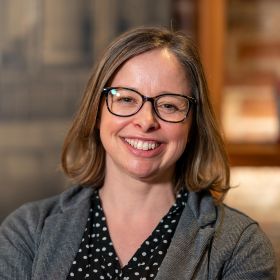
Dr Becky Carlyle
Author
Dr Becky Carlyle is an Alzheimer’s Research UK Senior Research Fellow at University of Oxford, and has previously worked in the USA. Becky writes about her experiences of starting up a research lab and progressing into a more senior research role. Becky’s research uses mass-spectrometry to quantify thousands of proteins in the brains and biofluids of people with dementia. Her lab is working on various projects, including work to compare brain tissue from people with dementia from Alzheimer’s Disease, to tissue from people who have similar levels of Alzheimer’s Disease pathology but no memory problems. Becky is also a mum, she runs, drinks herbal tea’s and reads lots of books.

 Beccy Owen
 Bernie McInally
 Dementia Researcher
 Dr Chloe Fawns-Ritchie
 Dr Yvonne Couch
 Dr Clíona Farrell
 Dr Becky Carlyle

 Rahul Sidhu