
 Print This Post
This week, I found out that my first first-author data paper has been accepted for publication. I was so excited to get this news, and it prompted me to think back on the long, eye-opening journey to get to this point. With so many iterations, going from “final draft” to “final final final FINAL draft”, there are so many stages and phases of paper writing that were unknown to me. In this blog, I’m going to reflect on the different stages of getting a manuscript published and hopefully give some insight to others tackling this milestone.
The experiments for this paper started over three-years ago during my PhD, as a sort of side project that ended up being one of my largest and most interesting thesis results chapters. Having initially written this data up as a thesis chapter, my supervisor and I were confronted with how this might look as a paper; where the holes were, and if anything needed to be repeated.
Luckily, I stayed in my PhD lab for a postdoc position, meaning I could continue to work on this project on the side to get it over the line. After my PhD submission, I drafted a rough paper outline with the figures listed from my thesis. That first draft was created about a year before the initial submission to a journal. Looking back at that initial draft, the paper looks so much cleaner and stronger now, with extra experiments done here in my home lab, and through a collaboration in the US, filling in parts where bigger questions remained.
There are two discussions I valued having early in the paper writing process. Firstly, my supervisor discussed who would be included as an author, and the order of the authors.
Although I had done the bulk of the experiments, it was good to think about who had contributed, and to what extent.
Authorship remained a continuous and evolving conversation as more collaborators worked on the project. Secondly, it was useful to discuss who will do what for the paper. Who will be responsible for making the figures, who will write the text (even further detail for the different sections), and who will take responsibility for circulating to coauthors and being corresponding author. This helped to set expectations for the work to come.
It took about six months from that very first draft for all extra experiments to be completed, formulated into figures and written up properly. Over a couple of months, my two PhD supervisors and I went back and forth editing the manuscript until we were happy with what we had produced. With this first “final draft” created, we circulated to all coauthors. This ended up being about four-months before final acceptance. It took between 2-4 weeks to get feedback from coauthors. Their input at this point was very valuable, as most coauthors had only contributed to one section, and had not seen the full story brought together.
Their feedback was implemented and reviewed again by myself and my supervisors. At this time, I also got on with preparing all the supplementary information in a final format, prepared some raw data for figshare, and uploaded omic datasets to GEO and PRIDE repositories. As is the story of paper writing, each of these things were more time consuming than I initially thought, but important for being able to submit a good quality manuscript.
With another month down, we shared the revised “final” manuscript again with our coauthors, as well as those acknowledged in the paper, and the brain banks who provided material for the study. This time giving only a week for any final points to be raised.
Finally, it was time to submit. As corresponding author, my supervisors took the lead for this. We submit the paper to Acta Neuropathologica. This journal has a fast turnaround time, advising that they will decide to either send for review or desk reject within 48-hours. Having heard nothing after a couple of days, we cautiously took this as good news, and after a week, we heard that the paper had been sent out for review.
Within a month, we received our revisions back and had four weeks to complete them. Typically, these arrived on my first day of a two-week holiday. At first glance, they were relatively straight forward points to address, and my supervisor took the lead in dissecting what needed to be done. Many of the points we could address with changes to the text, but some experimental and analysis changes would be down to me. After working on these on my return from holiday, it became clear they were more time consuming than we initially thought and we asked for a further two-week extension from the journal. This allowed us to more comfortably implement the revisions and still be able to give our coauthors a week to read the revised manuscript.
The revision process was an intense experience, and a week after re-submission I was over the moon to hear that the journal editor had accepted our revisions, and they would publish the paper.
Now, I am awaiting the proofs for publication, which we will have 48-hours to review. Although it ended in a relatively straight forward journey from submission to acceptance, the time taken to get a manuscript over the line is significant. Every journal will have different processes and timeframes for revisions, meaning many months can be spent on this process. Plus, multiple rounds of revision are common with certain journals.
As early career researchers, we hear anecdotes and rumours about the publication process, some more scary than others. I hope that this step-by-step account of my experience will give a further perspective on how to tackle this feat. Overall, after a long year of preparing this paper, I’ve learned the importance of celebrating all the small wins, from having a complete draft, right up to submitting revisions. Now on to the next one!
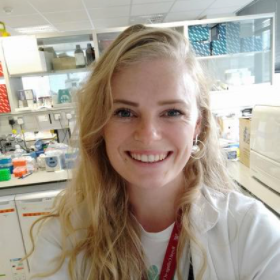
Dr Clíona Farrell
Author
Dr Clíona Farrell is a Postdoctoral Researcher in the UK Dementia Research Institute at University College London. Her work focuses on understanding neuroinflammation in Down syndrome, both prior to, and in response to, Alzheimer’s disease pathology. Originally from Dublin, Ireland, Clíona completed her undergraduate degree in Neuroscience in Trinity College, and then worked as a research assistant in the Royal College of Surgeons studying ALS and Parkinson’s disease. She also knows the secret behind scopping the perfect 99 ice-cream cone.

 Dementia Researcher

 Dr Becky Carlyle
 Dr Emma Law

 Dr Yvonne Couch