 Print This Post
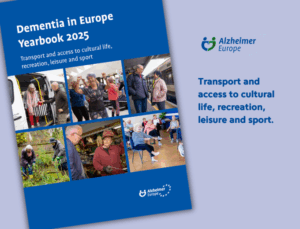 Alzheimer Europe has today released the Dementia in Europe Yearbook 2025, which presents an overview of programmes and resources relating to transport and access to cultural life, recreation, leisure and sport. These areas play an important role in helping people with dementia and their carers remain active and connected in their communities.
The Yearbook outlines the core European and international accords that protect the rights of people with disabilities, including people living with dementia. These include the Charter of Fundamental Rights, the United Nations Convention on the Rights of Persons with Disabilities, and the European Pillar of Social Rights. The report then examines how each European country addresses transport and cultural participation through national policies, schemes and local initiatives.
Transport initiatives across Europe
The findings suggest that many transport related schemes, such as concession programmes or the sunflower lanyard, sit within broader measures for older people or people with disabilities, without specific reference to dementia. A number of countries have implemented awareness raising campaigns or training for transport staff on how to support people with dementia, although this remains far from common practice.
Participation in cultural life, recreation and sport
The Yearbook highlights dozens of initiatives across Europe that encourage participation in cultural and recreational activities. Examples include adapted museum tours, dementia inclusive performances, arts and exercise classes and local community based sports sessions. Many of these initiatives have been developed through partnerships between national associations and cultural or sporting organisations, and are mostly local in scale.
Ongoing barriers to access
Despite examples of good practice, the report identifies persistent barriers linked to eligibility criteria for supports such as concessionary travel, disability cards and parking cards. These criteria often do not recognise dementia as a disability, or do not account for the cognitive and progressive nature of the condition, meaning that people with dementia frequently become eligible only when mobility has significantly deteriorated.
Feedback from members of the European Working Group of People with Dementia and the European Dementia Carers Working Group provided important context for the report. Their contributions highlighted the importance of staff training in transport settings and the frustration caused when eligibility criteria focus solely on physical impairment.
Comment from Alzheimer Europe
Jean Georges, Executive Director of Alzheimer Europe, commented:
“Alzheimer Europe chose to focus part of its 2025 Yearbook on transport, following feedback from the European Working Group of People with Dementia and the European Dementia Carers Working Group, informing us that the availability and accessibility of transport was a vital part of their day to day lives. Additionally, from our previous work on dementia inclusive communities and independent living, we knew there was much work taking place to support people with dementia to remain active in their communities and we wanted to explore this further, through the examination of access to cultural activities, leisure, recreation and sport.
It is perhaps unsurprising that many initiatives relating to transport, such as concessionary schemes, are aimed at a broader cross section of the population, including older people or people with disabilities. However, given the feedback from both Working Groups about the interactions with staff making a significant difference to a person’s experience when travelling, we had hoped that we might have seen more examples of training and awareness for staff working for transport companies.
We were pleased to see so many initiatives in the domains of cultural life, recreation, leisure and sports, in countries across Europe, with many examples of venues and companies providing dedicated offers for people with dementia, to encourage their participation. It is to the credit of our national member associations, that there were many examples where they had built partnerships with other organisations to develop programmes and projects. It is also notable that whilst we often look for national impetus on issues relating to dementia, a considerable number of examples come from local and regional initiatives.
We were disappointed to see that many examples of supports that could improve the lives of people with dementia, such as concession schemes or disability and parking cards, are subject to rigid eligibility criteria which often excludes them, particularly where disability criteria are tiered and primarily focused on mobility issues or physical impairment. The variation in eligibility criteria was marked, not only between but also within countries. Whilst welcoming the potential benefits offered by the standardised EU Disability Card and EU Parking Card for Persons with Disabilities, the underlying problems with eligibility criteria remain. As such, we call on national governments to abide by their commitments to the UNCRPD, recognising dementia as a disability and adopting assessments and eligibility criteria which take into account the cognitive and sensory challenges of dementia.
There is evidently much work to be done in these areas. A concerted effort is needed across all levels of governments, from an EU level down to local communities, to ensure that transport is accessible and affordable for people with dementia and their carers. Additionally, there should be a continued push to ensure that cultural, recreational, leisure and sports offers are inclusive of people with dementia and their carers, regardless of where they live.”
The full report is available on the Alzheimer Europe website