 Print This Post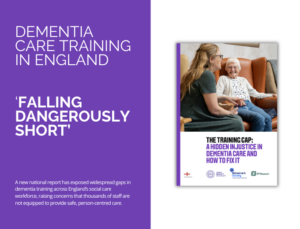
A new national report has exposed widespread gaps in dementia training across England’s social care workforce, raising concerns that thousands of staff are not equipped to provide safe, person-centred care.
The study, commissioned by Alzheimer’s Society and led by Leeds Beckett University, describes the situation as a “hidden injustice” affecting people living with dementia and their families.
Training often limited to basic awareness
Despite longstanding policy commitments, the report finds that most dementia training offered to care staff remains at a basic awareness level, rather than providing the practical skills needed for day to day care.
More than half of training packages analysed focused only on introductory awareness, while just 39 per cent were designed for staff who regularly work with people living with dementia.
Survey data revealed a similar picture on the frontline. Only 55 per cent of care staff reported receiving dementia specific training, even though 95 per cent said they had received some form of dementia related content.
Researchers warn that this reliance on general or minimal training leaves many workers without the depth of knowledge required to support complex needs.
Heavy reliance on short, online courses
The report highlights serious concerns about how training is delivered. Around half of all programmes rely primarily on e learning, often completed independently without interaction or facilitation.
In many cases, training is brief. Half of all courses offer just one to two hours of dementia specific content, far below the eight hours recommended for meaningful learning.
“This approach is unlikely to equip staff with the knowledge and confidence needed to deliver high quality care,” the authors conclude.
Key topics overlooked
Critical areas of dementia care are also being neglected. Fewer than half of training packages cover working with families, equality and diversity, or end of life care, with the latter included in just 23 per cent of programmes.
The report also finds that less than half of care staff receive any dementia training during their induction, meaning many begin work without even basic preparation.
Knowledge gaps persist among staff
Even where training is provided, its impact appears limited. Around one third of staff did not demonstrate consistent basic knowledge of dementia in standardised assessments.
Only just over half said they felt highly competent in the care they provide, while most expressed a desire for further training.
Calls for mandatory training standards
In response, the report calls for a legal requirement that all social care staff undertake structured dementia training aligned to national standards.
It recommends a minimum of eight hours of evidence based training for staff working directly with people living with dementia, supported by clearer regulatory guidance and stronger leadership within care organisations.
A growing challenge
The findings come as dementia rates continue to rise. There are currently around 826,000 people living with dementia in England, a figure expected to reach 1.2 million by 2040.
With an estimated 70 per cent of care home residents affected by dementia, the report argues that improving workforce training is essential to meet growing demand and ensure quality of care.
“No professional should care without training”
The report concludes with a stark warning: dementia is a complex condition, and care staff must have the right skills to respond.
“No professional should be allowed to care for a person living with dementia without adequate training,” the authors state.
For policymakers, providers and regulators, the message is clear. Without urgent action, the gap between what people with dementia need and what the workforce can deliver will continue to widen.


 Alzheimer's Society