
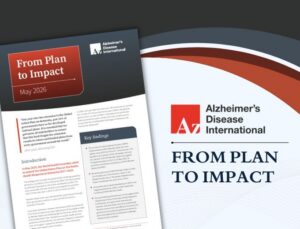
 Alzheimer’s Disease International’s latest annual report reveals slow progress on national dementia planning one year after the Global Action Plan was extended — with Africa still recording zero plans and funding failing to keep pace with commitments.
A landmark new report from Alzheimer’s Disease International (ADI) has found that just 24% of the world’s governments have adopted a national dementia plan, despite a renewed global commitment to tackle the condition that is on course to affect 139 million people worldwide by 2050.
From Plan to Impact 2026, published this month, provides ADI’s annual assessment of progress by World Health Organization Member States against the Global Action Plan on the Public Health Response to Dementia. The report arrives one year after the World Health Assembly voted in May 2025 to extend the plan through to 2031, giving governments six additional years to fulfil the actions originally agreed in 2017.
Progress Too Slow
The figures make for sobering reading. As of May 2026, just 47 WHO Member States have implemented a national dementia plan (NDP) — a rise of only two since last year’s report. That represents 32.2% of the plan’s target of 146 countries, and just 24.2% of all 194 Member States that agreed to act nearly a decade ago. Including non-WHO Member States and territories, the total number of plans worldwide stands at 56.
Chris Lynch, ADI’s acting CEO, did not mince words: “One year into the extension to the Global Action Plan on dementia, just 24% of governments have so far developed national plans. It is essential that we galvanise all stakeholders to ensure that this hard-fought-for extension results in robust and funded plans from every government around the world.”
A Stark Regional Divide
The geographic spread of existing plans reveals a profound imbalance. Europe leads with 23 plans among WHO Member States, followed by the Americas with ten, the Western Pacific with seven, the Eastern Mediterranean with four, and Southeast Asia with three. Africa, a continent home to hundreds of millions of people, has not a single national dementia plan in place.
Twenty countries are currently in the process of developing an NDP or integrating dementia into a broader health strategy — a pipeline that offers some cause for optimism, but one that must be converted into fully adopted and funded plans if it is to make a real difference.
The Scale of the Challenge
The urgency behind ADI’s call to action is underlined by the scale of the dementia challenge. The condition currently affects tens of millions of people globally and is forecast to reach 78 million by 2030, rising to 139 million by 2050. The economic costs are equally staggering: from US$1.3 trillion per year in 2019, the financial burden of dementia is projected to more than double to US$2.8 trillion annually by 2030 — costs that span healthcare, social care, and unpaid family caring.
Recognition Where It Is Due
The report does acknowledge meaningful progress. Five countries — the Maldives, Ukraine, Poland, Argentina, and Peru — have each adopted their first national dementia plan since May 2025. ADI highlights the significance of this group: spanning vast differences in geography, economic capacity, and social structure, these five nations demonstrate that dementia planning is achievable across all contexts.
What Needs to Happen Next
ADI sets out clear recommendations for governments and international bodies. Member States are urged to treat the 2031 deadline as a genuine target, not a distant horizon, and to accelerate the development of funded, comprehensive plans. The report is explicit that plans without money are plans without impact: funding for implementation has not kept pace with the growth in the number of plans.
ADI also calls on governments to formally recognise national Alzheimer’s and dementia associations as key partners in the design and delivery of plans, drawing on their direct expertise and community connections. And with the United Nations set to address non-communicable diseases (NCDs) in forthcoming global commitments, ADI urges Member States to ensure dementia is fully embedded within those frameworks, given the significant overlap in risk factors between dementia and other major NCDs.
The full From Plan to Impact 2026 report is available at .
Download the Report



 Dr Clarissa Giebel



 Adam Smith