
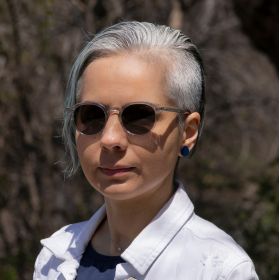
Dr Arezoo Talebzadeh
Name:
Dr Arezoo Talebzadeh
Job title:
Architect and Researcher
Place of work / study:
Ghent University Belgium
Area of Research:
My research explores how the acoustic environment in dementia care settings can be designed and augmented to support the wellbeing of people with dementia and reduce behavioural and psychological symptoms of dementia, combining my background as a practicing architect with a PhD in soundscape research.
How is your work funded:
My research is currently self-supported, without external grant funding
Tell us a little about yourself:
I hold a PhD in Architectural Science and Engineering from Ghent University, Belgium, where my research examined how soundscape design can help people living with dementia sense time and space, supporting quality of life and personal agency in care settings.
My current work investigates differences in auditory processing among people living with dementia, recognising that hearing abilities, auditory scene analysis and sound preferences vary widely across individuals, dementia types and stages of the condition. I explore how this variation can inform targeted, personalised soundscape interventions. My recent work also applies large language models to optimise sound selection for dementia care environments.
As a senior architect with 20 years of experience in institutional and long-term care design, I work at the intersection of the built environment, soundscape science and clinical research, translating soundscape evidence into environments and interventions that better serve people living with dementia.
Tell us a fun fact about yourself:
I’m a runner and get around cities by bike or on foot, so I experience the city’s soundscape at street level every day. I stayed in Ghent, Belgium for the last two years of my PhD while practicing architecture (full-time) in Toronto, Canada, so I’ve become very good at time zones and very reliant on good coffee.
Why did you choose to work in dementia?
As an architect, I’ve always been fascinated by the perception of space (and soundscape, the perception of the sonic environment), which is a dimension architects often neglect. I was also drawn to questions of aging in architecture and urban design, and that’s where I came to understand that dementia can profoundly alter how a person perceives their environment. As architects, we design assuming we know how people experience space, but for someone living with cognitive impairment, that experience can be very different, and our assumptions quietly leave them out. That’s what I decided to focus my research and career on. I can’t cure dementia as an architect, but I can design interventions that help people with dementia and their caregivers navigate space and time more easily, and ease some of the anxiety and stress the disease brings.
What single piece of advise would you give to an early-career researcher?
My biggest advice is: don’t be afraid of the unconventional path. I did my PhD while practicing architecture full-time, on a topic that sits between disciplines: architecture, acoustics, gerontology, clinical research. That in-between space can feel lonely and illegible at first; there’s no ready-made community or career track for it. But the questions that fall between disciplines are often the ones most worth asking, precisely because no one owns them. So find your question first, and let it pull you across boundaries. Second: work with the people your research is for. Some of the most important things I learned didn’t come from the literature, but from spending time in care homes, listening to residents, families, and care staff. Real-world settings are messy and humbling, and that’s exactly why they matter. And finally, be patient with yourself. Research in real care environments moves slowly; things go wrong, recruitment stalls, equipment fails. We did an RCT during the pandemic at the Toronto Rehabilitation Institute, and you can imagine how hard and slow the process was, but even small movement is better than staying still.
What book are you reading right now? Would you recommend it?
I’m never reading just one book — I always have a few going at once across formats. Right now I’m listening to Tiny Experiments by Anne-Laure Le Cunff through the Toronto Public Library app, reading Build the Damn Thing by Kathryn Finney as an e-book, and working through Living Disability by Emily Macrae with my book club at work. And on my bedside table there’s Before the Coffee Gets Cold by Toshikazu Kawaguchi. I like the mix — something for the mind, something for the venture, something for the heart — and I hold myself to at least thirty minutes of non-research reading every day.
Favourite film of all time?
Melancholia by Lars von Trier
Favourite ways to unplug and unwind?
Going for a long run without headphones
What’s the best decision you ever made?
The best decision I’ve made (so far) was starting a PhD in my forties, while practicing architecture full-time. It changed not just what I know, but how I see: it gave my curiosity a structure and my career a mission.
What’s your favourite vacation spot?
I can’t pick just one, so I’ll cheat: Berlin for its energy, that raw, creative vibe you can’t find anywhere else; Ghent for being, honestly, the perfect city; medieval beauty at a human scale, and a place close to my heart from my PhD years; and northern Ontario for pure, untouched beauty, lakes, rock, and silence that resets your soul.
Do you collect anything?
Honestly, I’m a minimalist; the only thing I collect is books.