 Print This Post
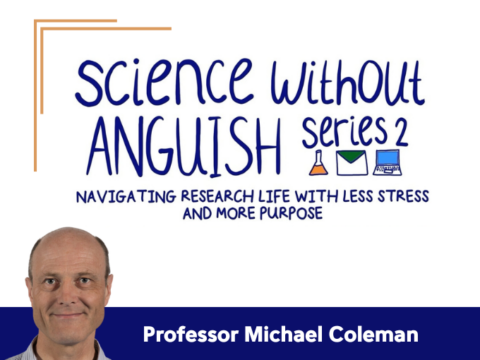
Science Without Anguish returns with a fresh set of reflections from Michael Coleman, taking readers through the quiet puzzles that shape everyday research life. From the way we build our personal mental maps to the tricks our thinking plays on us, these essays explore why smart people can still feel stuck, blindsided or overwhelmed, and how a bit of awareness can lighten the load.
Michael looks at trust, bias, blame, and the small shortcuts the mind takes without asking permission. The result is a series that feels both familiar and gently challenging, offering scientists a space to recognise themselves and see their working lives from a clearer angle. If you have ever wondered why a setback feels larger than it should, why someone else seems to glide through what you find difficult, or why your thinking occasionally ties itself in knots, there is something here that will ring true.
Have a wander through the latest posts and see which ideas speak to you.
About the Author
It’s not what you are that matters, it’s who, so let’s start there:
Who: I value sincerity, loyalty, reciprocation, and getting the best from myself and others in a culture of psychological safety. I don’t like inappropriate use of the word ‘can’t’, especially about other people, and I believe ‘progress’ at someone else’s expense is not progress at all. I’m driven to understand things by piecing them together into a bigger picture because I don’t have the brain space to hold unconnected fragments, whether it’s molecular and cellular mechanisms, human psychology or the society we live in. And for some reason, I’m driven to spend long hours on a bike!
Why: As a first generation university student and the first from my school to go to Oxbridge, this opened up a whole new world for me, but also a whole new set of challenges. To deal with this, and the further challenges that each new life stage brings, the self-help and personal development trail has been a constant throughout my adult life. I can hardly believe how ‘far’ that’s taken me, but after a certain point it’s not achievement that matters: it’s who you become along the way and what you do with it.
What: I’m a professor of neuroscience at the University of Cambridge and Senior Research Fellow at Churchill College. I run a team of fantastic co-workers studying how nerves (axons) die and how to keep them alive. Crucially, we are identifying the diseases and specific patients where targeting the mechanism we work on is most likely to succeed (the NMNAT-SARM1 pathway, or ‘programmed axon death’) so Pharma can do the best possible clinical trials.
Getting to this point has involved so many ups and downs that I feel compelled to pass on what I’ve learned. Over time I’ve realised that the examples we’re usually given of how to handle them are not necessarily the best for each of us, that we have more choice than we realise in our path through the world of research. So in parallel, I am building coaching skills to help the next generation of scientists navigate academia and improve its culture and effectiveness for the longer term. At home, I’m a husband, and a father to three amazing young adult kids.