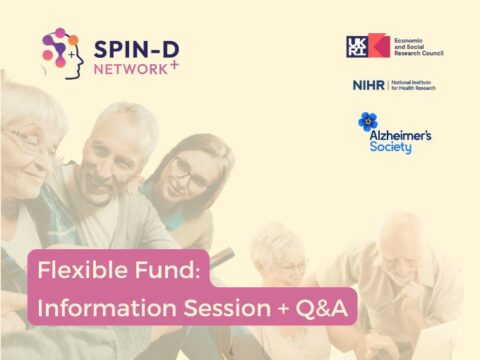
This livestream recording shares practical guidance on Round Two of the SPIN-D Network Plus Flexible Funding call for 2026
Hosted by Dementia Researcher, the session supports early career researchers considering an application and explains what the fund is designed to support.
Professor Georgina Charlesworth introduces the SPIN D Network Plus and outlines the three funding streams available:
- Inclusion in Practice funding of up to £5,000 for early stage ideas, partnership building and co production
- Proof of Principle funding to test or implement promising approaches
- Data Access Funding to support use of datasets such as PROTECT, available alongside Proof of Principle awards
The session explains eligibility, full economic costing, realistic budgeting, timelines and expectations around outputs and reporting. Applications must be led by early career researchers and align with the SPIN D focus on dementia risk reduction, early stages of dementia and brain health inequalities.
Steve Kennedy, a lived experience reviewer diagnosed with frontotemporal dementia, shares what the funding panel looks for. He highlights the importance of meaningful public involvement, clarity, respect and research that responds to real world needs rather than treating lived experience as an add on.
The Q and A covers common questions including:
- What counts as an early career researcher
- Whether salaries can be included
- Eligibility of charities, companies and community partners
- Building on existing work rather than starting from scratch
- How lived experience researchers and unpaid carers can be involved
- What makes applications stand out or fall short
The session closes with advice on preparing strong applications, avoiding common mistakes and using SPIN D funding as a stepping stone towards larger grants.
SPIN D Network Plus – https://spindementianet.org
SPIN D Flexible Funding call details – https://www.dementiaresearcher.nihr.ac.uk/funding/spin-d-flexible-funding-scheme/