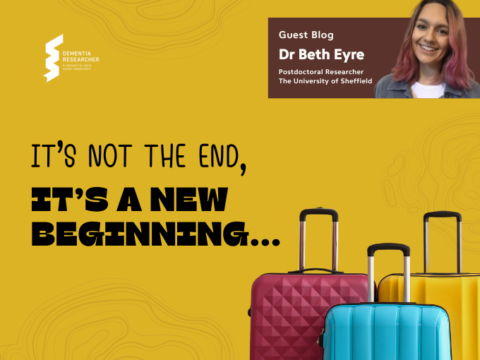
Blog – It’s not the end, it’s a new beginning
After 3.5 yrs & 32 blogs charting her PhD story, we're sorry to be saying goodbye to Dr Beth Eyre as a regular blogger. Read her final words of wisdom.
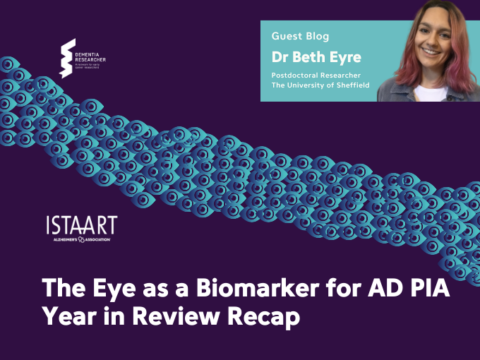
Blog – Eye as a Biomarker for AD PIA Year in Review Recap
Dr Beth Eyre reflects on the ISTAART Eye as a Biomarker for AD PIA Year in Review webinar, sharing the latest developments from the field.
Blog – Subjective Cognitive Decline PIA Year in Review Recap
Dr Beth Eyre reflects on the ISTAART Subjective Cognitive Decline PIA Year in Review webinar, sharing the latest developments from the field.
Blog – Reflections on my (kind of) first year as a post-doc
Beth Eyre's latest blog is a candid reflection on the first months of her post-doc journey, discussing realities and challenges of academia. Visit her new world
Blog – How to make your PhD application stand out
Boost your PhD application with insider tips from Beth Eyre on creating a standout CV and personal statement. Show passion, be prepared!

Blog – How to find a PhD… an insider’s guide!
Unlock the secrets to finding your ideal PhD with Beth Eyre's insider guide. The best sources, leveraging social media and more. Your PhD journey starts here!
Blog – Demystifying the PhD
Uncover the complexities of a UK PhD with Dr. Beth Eyre's blog "Demystifying the PhD." From funding to stages, it's your go-to guide for a doctoral journey.
Blog – Cracking the Viva: Preparing for PhD Success
Join Dr (pending minor corrections) Beth Eyre on her triumphant viva journey, as she shares indispensable tips to conquer your PhD defense with confidence.
Blog – 5 things I wish I had known about writing up my PhD thesis
Beth Eyre gives tips for PhD thesis writing, emphasising routine, realistic expectations, separating writing and editing, and completion over perfection.
Blog – The many hats of a dementia researcher
Discover the Multifaceted World of Dementia Research in Beth Eyre's Blog. Uncover the Numerous Hats Worn by Researchers during Their PhD Journey.
Blog – How to find a Postdoc Job
If you're finishing your PhD, and not ready to apply for Junior Fellowships... you may need to find a Postdoc Job. Beth Eye has some suggestions.
Blog – Writing a fellowship application
Coming to the end of your PhD? So is Beth Eyre, and in this blog she talks about what she has learned making her first fellowship application.
Blog – Hello imposter syndrome my old friend
Do you doubt your talents & accomplishments and have an internalised fear of being exposed as a fraud... this is normal and Beth Eyre discusses
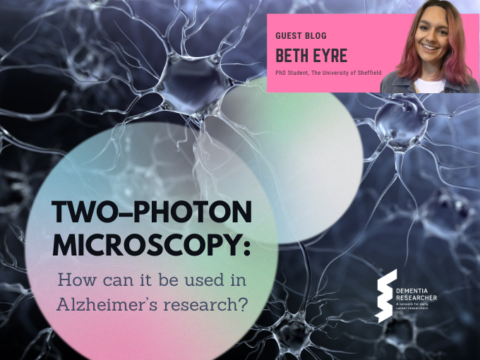
Blog – Two–photon microscopy: How can it be used in Alzheimer’s research?
Blog from Beth Eyre, exploring how two-photon microscopy can be used to help us learn more about Alzheimer’s disease & inform research.
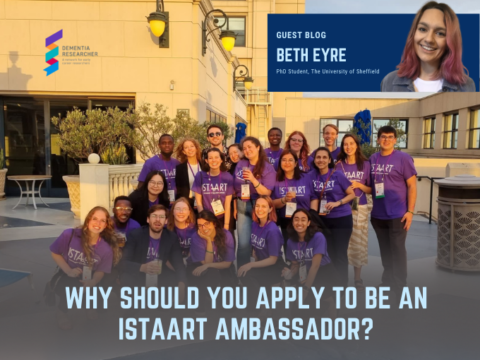
Blog – Why should you apply to be an ISTAART Ambassador?
Beth Eyre talks about her experiences as an ISTAART Ambassador and the brilliant benefits the programme could bring for you.
Blog – A guide to moving abroad as a PhD student
Beth Eyre provides a very practical guide of things you need to think about and plan for when moving overseas for a work placement
Blog – How to give an engaging scientific presentation
Presenting in-person is different to presenting online, in this blog Beth Eyre share some (award winning) top tips for delivering a scientific presentation
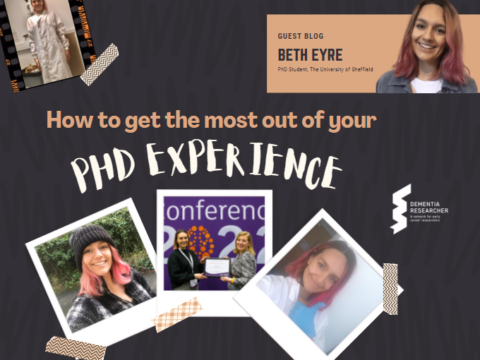
Blog – How to get the most out of your PhD experience
Beth has finished her last PhD experiment, prompting her to reflect on her PhD experience, and the oppertunities that others should keep an eye open for
Blog – How to approach networking as a PhD student
Beth Eyre shares some of the things she has learned about networking and what might help you during your own PhD - Read or listen.
Blog – The perils of ‘what next’…?
The last year of your PhD can be challenging, researching, writing, the viva... and the hard part... what next? Beth Eyre shares her thoughts and plans.
Blog – The highs and lows of scientific research
An insight into the highs and lows of scientific research – from Beth Eyre's perspective as a third year PhD student in Neuroscience.
Blog – 3 Tips for a PhD interview
With many doctoral training programme deadlines approaching, this blog from Beth Eyre might just help you ace the interview.
Blog – How does the brain clean itself? And is this linked to Alzheimer’s?
Beth Eyre provides insights into the brains waste system – and how it may be important in Alzheimer’s disease. So, saddle up for some fascinating science!
Blog – 5 transferable skills you can gain from a PhD
Beth Eyre reflects on the skills she has gained through her PhD, and how they could be transferred into the job market (over and above awesome lab skills).

Blog – What I wish I’d known before starting my PhD
Beth Eyre is about to start the 3rd year of her PhD, in this blog she shares some advice that she wishes she'd received when she was starting out.
Blog – Is blood flow the missing link to helping understand Alzheimer’s?
In the first of our blood flow blogs, Beth Eyre discusses her own research and gives a whistle stop tour about the importance of blood flow.
Blog – The importance of taking a break
This month Beth takes a break from the lab, and discusses the importance of taking a break, and how it can actually help your work.
Blog – Writing your first Journal Article
As Beth Eyre gets to work on her 1st lead author paper, she shares her experience so far, useful for anyone studying for a PhD that has this to look forward to

Blog – My experience of the ARUK 2021 conference
Two years into her PhD and Beth Eyre hasn't had an opportunity to attend a face to face conference. Beth reflects on the virtual ARUK 2021

Blog – Neurovascular coupling in Alzheimer’s disease
Beth Eyre talks about her research into Neurovascular coupling and how this related to dementia, proving there is nothing basic about basic science

Blog – Why should you become a lab-based dementia researcher?
It can sometimes feel like you take 2 steps forward & 1 step back during your #PhD, but as long as you're moving forward, you're doing well! In her first blog for 2021 Beth Eyre shares tips for looking after your wellbeing in a pandemic.
Blog – Looking after your wellbeing as a PhD student
It can sometimes feel like you take 2 steps forward & 1 step back during your #PhD, but as long as you're moving forward, you're doing well! In her first blog for 2021 Beth Eyre shares tips for looking after your wellbeing in a pandemic.
Blog – Beth Eyre introductions and discovering science
In her first blog for Dementia Researcher, Beth Eyre introduces herself and brings us up to date on the last 10 years, what brought her to science, and where we now find her as a 2nd year PhD Student at The University of Sheffield researching Neurovascular and cognitive function in preclinical models of AD.