This funding call has closed
Applications closed on 11 July 2025. The details below are kept for reference, and the funder may run this scheme again.
Dementia is expected to affect 1.2 million people in the UK by 2030. People living with dementia, and those who support them, want care that helps them live well. However, inequalities in dementia care and research often prevents this from becoming a reality.
Many people and families remain underserved. This includes those from ethnically diverse backgrounds, living alone, in areas of high deprivation, rural areas, with multiple conditions, more advanced dementia, and/or nearing end of life.
The purpose of the Small Research Project Fund
- Support the development and pump-priming of small, collaborative research projects that address inequalities in dementia care and research, especially for people who need greater support. By “greater support,” we mean the important moments in a person’s dementia when they go from being able to manage on their own to needing extra help and care, whether from professionals or family and friends.
- Bring together and nurture collaborations between community partners, lived experts, and researchers to support learning and development through funded projects. We are keen to fund research projects that reflect a wide geographical spread across the UK.
Applying
We invite people to submit applications in ways that work best for them. This may be by filling in the form below electronically, on paper, through our online submission form, or by audio or video recording your responses to questions. We just ask that these are submitted to us before the deadline.
If you need support completing this form, especially in recording responses to questions, please email EMPOWER_Dementia_Network@kcl.ac.uk and we will be happy to support you.
Please note: The online submission form (Qualtrics) does not allow you to save your progress. To help with this, we provide a Word document version of the form. We strongly recommend drafting your responses in the Word document first, and then copying them into the online form when you’re ready to submit.
Small Research Project Fund Frequently Asked Questions
If you have a question about this funding call, please take the time to look through the FAQs document below. If you still need clarity, or are unsure on something after looking through them, please email us at EMPOWER_Dementia_Network@kcl.ac.uk
Expressions of Interest Launch Webinar
Watch back our Expressions of Interest launch webinar from June 2nd. In this video, we outline and answer questions on key information about the call.
What do we mean by ‘research projects’?
This fund is research-focused but takes a broad view to what we mean by ‘research projects.’ We welcome any small-scale work that uses research methods – like interviews, surveys, or creative co-design – to explore, evaluate, or co-develop solutions to inequalities in dementia care and research. These may include:
- Early-stage or exploratory studies
- Evaluations of existing community-led initiatives
- Pilots that lay the groundwork for larger research
- Efforts to scale up successful local and grassroots work
- Innovative approaches to embed inclusive practices and challenge stigma at a societal level.
For example, you might be a community organisation already running a support group for people living with dementia and want to explore whether it could be scaled or evaluated in partnership with researchers. Or you may have an early-stage research idea that would benefit from pump-priming to further develop or demonstrate feasibility. You might even have an idea based on your lived experience of dementia that you think is important to pursue in partnership with researchers and community organisations. All ideas are welcomed at this stage.
The purpose of the Expression of Interest (EOI) stage
The Expressions of Interest Stage is the first step in applying for funding. The purpose of this stage is to encourage people to share their ideas so that we can connect you with other applicants from across the UK who have similar goals and interests to work together. You do not need to have a research partner already – just share your idea, and our core team will help match you with researchers and other collaborators to help develop your ideas into collaborative research projects. Following this, groups will be invited to submit a full application with the support of the EMPOWER core team from September 2025. More guidance on this will follow.
Who can apply?
We invite expressions of interest from all people – even if you have never submitted to a funding application before or do not have experience in doing research. We particularly encourage applications from:
- People with lived experience of dementia
- Family, friends, and unpaid carers of people living with dementia
- Researchers
- Community organisations (including charities, foundations, and local grassroots groups)
- Practitioners
- Volunteers
All funded research projects must be developed in partnership with community organisations (e.g., grassroots groups, local and national charities, and third sector organisations) and lived experts (people with dementia and their carers) who should serve as co-applicants and/or co-leads. Everyone, including those with lived experience, is encouraged to join as a co-applicant at the full application stage.
You are welcome to submit ideas as part of a group or team or as an individual. You do not need to have a full team in place to submit this form. If applying individually, we will support you in connecting with others who share similar interests. For help filling in the EOI form or with any questions, please contact us.
The research projects we will fund
We are looking for collaborative and sustainable research projects that will lead to real change and can be expanded in making a lasting difference to people affected by dementia across the UK and beyond. The four priority areas for our small project fund are:
- Raising public awareness and addressing stigma and social exclusion.
- Supporting families, friends, and unpaid carers.
- Building a compassionate, skilled, and supported workforce.
- Inclusive uses of technology (e.g., digital tools, online platforms, Virtual Reality, Artificial Intelligence).
Projects should address at least one of the priority areas but are encouraged to explore links between them. In all projects, applicants need to show and explain what they learned about working together inclusively. We also welcome projects that focus specifically on using and developing innovative methods of co-production with people affected by dementia who need greater support.
More information on each of these priority areas, alongside example project ideas our Network could fund under each area, are provided in the ‘SRPF Priority Areas‘ document. Please note that the examples we provide in this document are starting points and we are open to all ideas that fit within the scope of this call. We encourage applicants to be creative in shaping their own solutions and ideas.
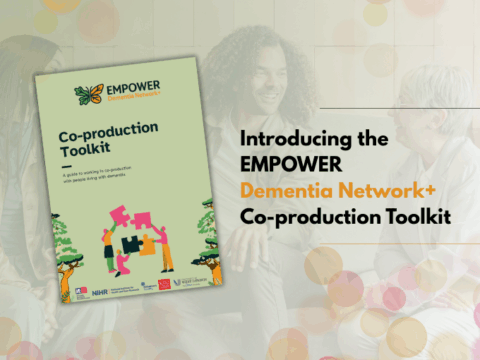
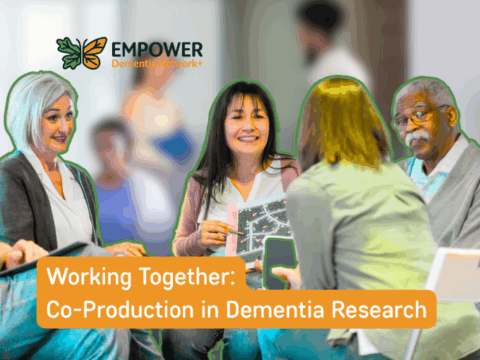
Co-production needs to be at the heart of research projects
Co-production is central to everything we do in the EMPOWER Network. We expect all proposals to be developed and delivered using inclusive co-produced principles. Funded research projects must meaningfully involve and fairly remunerate community partners and lived experts for their time, expertise, and contributions.
To support you with co-production, we worked with Network members to develop a co-production definition and co-production training. This definition can be read here. Our online training session on co-production is happening on June 17th (10:00-11:30). You can register for this event here.
Co-production support fund
To support the development of strong, co-produced project funding applications, teams can apply for a co-production fund of up to £5,000 to help prepare their full application. This fund will support travel and materials for in-person meetings, time for lived experts and community partners, research support, and accessibility, translation and interpreting. We will open this fund towards the end of July 2025. More details on this will follow, but the process will be simple and straightforward.
Acknowledgments
The processes, priority areas, and forms in this Small Project Fund have been co-developed with the invaluable guidance and insights of grassroot and community organisations, lived experts, policymakers, researchers, and practitioners across primary, social, dementia, and palliative care. Their contributions have ensured our call reflects the real-world priorities and needs of people affected by dementia requiring greater support. We are grateful for their time commitment and expertise that has contributed to this call.
Thank you for considering applying to the EMPOWER Dementia Network+ Small Project Fund. Please complete the form below to express your interest. We will get in touch by the end of July 2025.


Visit funding web page
(https://empowerdementia.co.uk/grants-and-funding/small-research-project-funding/)