Print This Post
Earlier this week, I was fortunate enough to host our regular podcast show here at Dementia Researcher. Our topic was Lewy Body Dementia (LBD) and there was a very common theme. LBD is horrifically hard to diagnose. This is the sad story of many dementia-causing diseases. The symptoms of dementia are, themselves, comparatively simpler to identify and diagnose. The challenge for clinical assessments is to determine the underlying disease that is causing the dementia.
Our brains are so complex. Our neural circuitry is composed of 86 billion neurons and 85 billion non-neuronal cells, all interacting in very specific ways to product the rich tapestry of humanity. Neurodegeneration isn’t like spraining an ankle where you generally see pretty much the same symptoms and can offer similar results in terms of treatment and recovery. Every single dementia patient is affected differently because none of us have the same brain or the same way of thinking. There are overlaps but we are all unique.
The best a clinician can do (and they do so well) is look at the overlaps. Alzheimer’s can be commonly identified as the cause of dementia because the patient will tick a specific set of boxes. They will struggle to form new memories, forget what happened very recently but accurately recall more distant memories. Speech will become more difficult, they may struggle to multi task and they may easily get lost or struggle to judge distances and gaps while walking. Alzheimer’s is the most common cause of dementia and probably the one we know the most about and can best identify.
LBD is a whole different beast. I know because I have lived through that immense confusion.
That ‘is it or isn’t it’ scenario where you don’t really know why a relative you care for deeply is declining in the way that they are. As someone who has worked closely in Alzheimer’s research, watching my grandfather deteriorate was especially troubling. Symptoms I had never come across were being reported and witnessed on a weekly basis and the clinicians could not nail down what his diagnosis was. One clinician suspected LBD but we never got confirmation.
What makes LBD so difficult to identify is the fact that it doesn’t follow a neat and predictable pattern. This story was told exactly thought my grandfather. His symptoms would fluctuate daily. He had cognitive issues that would point towards Alzheimer’s but they were often accompanied by other symptoms that did not fit the bill. Disturbed sleep, hallucinations, motor symptoms etc. He deteriorated quickly until, eventually, he succumbed to an infection that his body just did not have the capacity to fight anymore. As a family, we were all left wondering what had inflicted this upon him.
And that’s the story of Lewy Body Dementia (even if my grandfather didn’t have it). It is a condition that has no clear boundaries. It’s often confused with Parkinson’s and has a lot of the same fundamental biological causes. If you want to know more, check out the podcast episode. Ultimately, it’s a disease that leaves many families navigating more than just loss. They also have to navigate uncertainty.
So why am I talking about this now? It’s not just because it’s LBD awareness week. That podcast recording cracked a seal for me. It brought me straight back to my grandfather’s decline.
As I listened to 3 experts in the field describe the disease I heard so many things that I could relate to in my grandfather’s behaviour. The fluctuations, the hallucinations, the confusion that never quite fit another diagnosis; it all clicked into place in a way it hadn’t before. Yet, I know that I will never actually know what afflicted him. No neat ending or real closure. What remains is the need to talk about it anyway, to give shape to an experience that was defined by uncertainty, and to acknowledge how deeply it still lingers, even years later. This is the story of LBD. It does not end with certainty but we have to talk about it so that, one day, another family gets the closure they need.
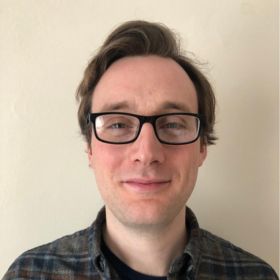
Dr Sam Moxon
Author
Dr Sam Moxon is a Research Fellow at the University of Birmingham. His expertise falls on the interface between biology and engineering. His PhD focussed on regenerative medicine and he now works on trying to develop 3D bioprinting techniques with human stem cells, so that we better understand and treat degenerative diseases. Outside of the lab he hikes through the Lake District and is an expert on all things Disney.

 Beccy Owen
 Bernie McInally
 Dr Chloe Fawns-Ritchie
 Dr Yvonne Couch
 Dr Clíona Farrell

 Dementia Researcher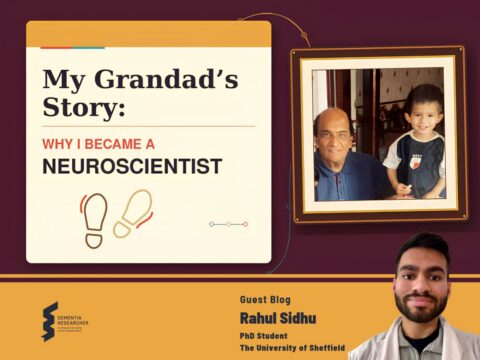
 Rahul Sidhu

 Dr Emma Law
 Dr Ajantha Abey