 Print This Post
My name is Becky Carlyle and I have a confession to make; I am overwhelmed. For months I’ve tried to deny it, but after an insane week of flying by the seat of my pants, it’s time to admit it in public. This month’s blog was going to be about setting up your own lecture course (which I do promise to get round to), but it’s time to put this out in the open.
The new job is basically impossible.
I try in these blogs to be realistic yet positive, to be as constructive as one can. Those of you who have met me will know that I always try to lead with a smile, and I mostly succeed. But every now and then I think it’s important to just acknowledge that the life of a modern academic is really, really hard. I’m at a conference this week and I finally had lunch with an old friend from Medical School. I’ve known since getting back to Oxford that he lives nearby, he works in Oxford, and we use a whole bunch of the same techniques, albeit different systems. Readers, it has taken us four years to have lunch. Four years! And now we’ve had lunch,
…and it is now a week after I wrote those two paragraphs, and the feeling of overwhelm has only deepened. I probably shouldn’t be writing this blog now, but I just found a particularly thorny tick box on a grant I was supposed to be working on, and so I need a break.
This career stage is desperately difficult folks, there’s no doubt about it. This week I have juggled a panel appearance at a conference, last minute submission of a grant, student welfare concerns, had the introductory meeting for my new role as EDI Co-Lead, run a whole new tutorial on the basal ganglia (almost nailed it), all with a stinking cold while trying to be a present and fun parent and finally, not completely neglecting the wonderful people in my lab who are the ones actually doing the science I’m supposed to be here for. Just at the time when we have all these brand new career responsibilities, we tend to be facing new responsibilities at home, be these kids, caring for aging relatives, supporting partners through career transitions – it’s all happening right now, meaning that those hours at work have to count for double, and let’s face it, there’s not enough of them.
Sounds terrible right? For all of those people reading this who are about to withdraw their Fellowship applications – don’t do that. I still firmly believe this is one of the best jobs in the world. At the moment there are only four of us in the whole world who know where a particular protein is in Alzheimer’s Disease brains (and it’s a long way from home), and trying to figure out why and how it got there is a real delight, especially as the team working on it is so utterly life affirming (shout out to Helen, Paula and Ishan). My first two PhD students, Hend and Kaitlyn, have had a fantastic first year, both passing their first year reviews with much joy just before Christmas. And watching the Medics I teach learn how events as devastating as a stroke have helped us piece together our most important neural circuits has been priceless.
It’s just that we all go through phases, especially when things are new, where things seem utterly relentless. I am overwhelmed. And that’s where I am right now. And the first goal of this blog is to say that out loud, so that hopefully everyone else out there who feels the same can breathe a small sigh of brief relief. It wouldn’t be a Becky blog without me trying to offer a few pieces of advice too, though as I hope is obvious from the above, I have not cracked this feeling. However, there are three things I would suggest.
One: Develop a system for prioritization and use it religiously.
I use two parallel systems for organization – inbox flags, and long-term project planning. I check e mails in breaks between periods of focus, and those that can be responded to without significant thought are responded to instantly. Those that need a bit more attention, but that are not substantial enough to go on the To Do list, get flagged, and flags are dealt with first thing in the morning. Bigger things that need the To Do list, such as grant writing, important letters, report production and talk designing go on a Kanban Board in Microsoft Loop (a surprisingly good tool, and will be free for most of you through institutional subscriptions, many other options are available) with a deadline, which may be the real deadline or a self imposed one. Massive tasks like grants can be broken down into checklists, as it always feels good to tick things off, and sometimes I’ll even write that list out on paper to have the satisfaction of crossing something off. I scroll through both these systems every couple of days, so that I don’t lose track of longer-term goals or annoying e mails I couldn’t face handling at the time. If a Team member sends something over Teams that needs more than an instant reply, it gets sent to my e mail for flagging, or my Kanban if necessary.
Without this system I would be utterly lost at sea.
Two: Don’t drop the fun stuff
It’s very easy in periods of overwhelm to turn into a working machine – to put your head down for hours a day and not come up for air until you’re febrile with hunger. This is not a good idea. This is a spiral that leads towards burn out. Take the time out to laugh with your kids with your phone in another room, to go for a run in the fresh air, to head to the cinema with friends. Something that allows you to turn off the constantly roiling thoughts in your head, to remind you that you exist as a person outside the treadmill, and that there is light at the end of this phase where you will be human again. This is a time to nurture your relationships as much as you can, as opposed to dropping them in favour of more hours facing the screen. It’s so hard to do, but it is essential to remember there is life outside, and that life is good.
Three: There should be an end point
This level of overwhelm is not healthy and not possible to deal with in perpetuity. It absolutely must have an end date. At the moment, with this new teaching role, every tutorial every week of term takes almost two days to prepare for. This is a huge source of my lack of time. I know that the end of term will come, and I will have a few weeks to catch my breath before it begins again. And next year, I will be running all of this for the second time, and it will take half as long to prepare. The year after, I will just be marking the essays and delivering the material, as it becomes more familiar. This year therefore, is an unusually tough time crunch, but it will end. That makes it possible to knuckle down, to be relentless, and to get through this particularly hard period. If you can’t see some kind of end to your overwhelm, if there is nothing that will be changing for you, then you need to proactively create a change. Step down from some committee work, find a graduate student to help with your teaching and assessing, devolve more responsibility in your lab to your team. Talk to others about how they cope, where they managed to free up their time, and have a meeting with HR. The more we talk, and the more we highlight these problems, the more likely we are to be able to club together to come up with solutions that work for everyone.
I think that’s all that I’ve got. I see you, it is hard, and still, you’ve got this. See you all at Overwhelmed Anonymous at the ARUK Conference soon. I can’t wait.
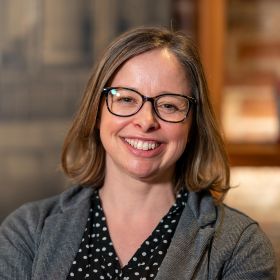
Dr Becky Carlyle
Author
Dr Becky Carlyle is an Alzheimer’s Research UK Senior Research Fellow at University of Oxford, and has previously worked in the USA. Becky writes about her experiences of starting up a research lab and progressing into a more senior research role. Becky’s research uses mass-spectrometry to quantify thousands of proteins in the brains and biofluids of people with dementia. Her lab is working on various projects, including work to compare brain tissue from people with dementia from Alzheimer’s Disease, to tissue from people who have similar levels of Alzheimer’s Disease pathology but no memory problems. Becky is also a mum, she runs, drinks herbal tea’s and reads lots of books.

 Dr Clíona Farrell
 Dr Becky Carlyle
 Beccy Owen
 Dementia Researcher
 Rahul Sidhu
 Dr Yvonne Couch