
Those of you who read my last blog post will remember that I’ve gone through a recent period of overwhelm. My new job is a hugely positive career development that I’m extremely excited about, and yet this has been one of the toughest years of my working life. As the academic term has ended, the relentless nature of the job has let up a little. Two weeks ago in fact, I made the mistake of saying out loud that I was “almost back on top of things.” Like clockwork, two hours later, my phone rings, it’s an Oxford number, and a big weight suddenly settles in my stomach. It’s the school office, and I need to come and pick up my child, because he has a rash and his tummy hurts. The immediate relief I felt on picking him up and finding that the most important person in my life seems to be just fine, turns to frustration one hour later when he is bouncing off the walls of the living room and thoughts of tummy aches are banished to the distant past. I was almost on top of things! As the beautiful open afternoon I had ahead of me is swallowed by episode after episode of Pokémon, I cycle through all the emotions. Relief that he is fine, frustration that I’ve lost a workday, guilt for the frustration that I’ve lost a workday when this most precious person could have been unwell. I get nothing done other than answering a couple of e mails.
Now, two weeks later, I’m just about caught up again (touch wood), and a new article has been released that has had me reflecting on the Motherhood Penalty, what is has meant for me personally, and whether there are in fact small things we can do at work to address it. I’m choosing to specifically talk about Motherhood here because it is still true that in most heterosexual relationships the mother is the primary parent, and that childcare organisations often assume that that’s the case even if it isn’t. A new report summarized in Nature this week that shows that even in Denmark, a country with excellent childcare subsidies and dual parental leave policies, woman are 29% less likely to still employed in academia eight years after their first child, and suffer a 12% drop in earning compared to women who don’t have children. Men with children are also less likely to be employed in academia (14% less likely), but they do not suffer any loss of earnings, suggesting they may be transitioning to alternate workplaces such as the pharmaceutical industry, whereas women are cutting back their careers.
When the authors dive into the reasons behind these numbers, they alight on a survey of 3,400 researchers that suggests that women in academia take on substantially more of the childcare than men.
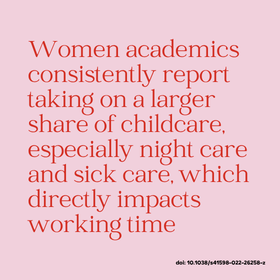
Women report taking a much larger share of night-time and sick care and the accompanying doctors’ visits. The most interesting category for me was drop offs, as this matches with my own experience. Men and women dropped their children off at nursery at much the same rates, but women were more responsible for picking their child up. This affects my productivity in two ways; first, I can’t just work a bit longer to finish a task I’m halfway through. Whatever is currently underway has to be immediately put on hold as you rush to pick up, and then if you’re lucky, picked up first thing the next day. If you’re unlucky, a whole bunch of emails came in in the interim, something went wrong in the lab, and maybe you’ll finish whatever you were doing next Thursday.
Second, for me, doing pick up also means I’m responsible for the evening cooking and managing the mental load of what we have in the fridge, what nutrients my somewhat fussy child might be missing out on this week, use by dates and planning the shopping. I find this mental load utterly draining, and no amount of organization or preparation seems to remove it. I hope my husband forgives me for saying he exists completely unbothered by this, and it means that past bedtime, he has the energy to get his laptop out and finish things up, whereas I am desperately trying to stay awake for half an hour of adult unwinding time before going to bed. We’ve talked a lot about this and just haven’t come to a better solution – there’s just too much to do in the day. He does all laundry, breakfast and drop off every day, which gives me two extremely valuable quiet hours at work in the morning when my brain is functioning at its best. I don’t think there is a better solution for us, but I am certainly more worn down by the everyday of family life than he is. And I don’t think our experience is unique.
The thing you notice the most on becoming a parent is that your time is no longer your own. I now giggle about how busy I thought I was as a Post Doc, when I was working much longer hours without the constant task switching required from being a more senior academic. I can no longer choose to give up a weekend to finish up a grant, or to stay at work till 10pm to wrap up rebuttal edits to a paper. Everything must be done at 5am before anyone wakes up, or during working hours. The lack of flexibility in the working day provided by childcare constraints, and poor after school care options, followed by an evening of childcare and housework often described as “The Second Shift,” leads to what the original coiners of the phrase describe as a “Leisure Gap” between men and women, with women being too busy / exhausted to attend to their own health and interests. This loss of “me time” affected me in ways that I couldn’t imagine before becoming a parent, and I’ve spent much of the last 4 years of parenthood trying to regain some level of balance here. I now treat my daily run as part of my workday, which is sometimes when I do my best thinking, and sometimes just when I get 43 beautiful minutes of my mind going blank.
So what do we do about it? I was at a whole day workshop last week that was supposed to focus on turning Motherhood into a superpower and improving life for us all, but was mostly just re-hashing the problem. And part of that is because personally of course, there isn’t much you can do. It is 100% true that my focus and productivity during working hours is through the roof, and I think I’m mostly a more understanding boss since having a child – I just have very limited time to do it compared to someone without children. When you’re planning children with a partner, you must be open about your career goals and how you will approach parenting as a team. Try to divide tasks clearly rather than leaving them for someone to do, which leaves you open to resentment when one party doesn’t do it (ie. me never taking out the bins). Outsource some of the daily grind if you can afford it – we pay for four hours of cleaning a week and it is worth every penny of freed up time. When it comes to work, get involved in meaningful collaborations wherever possible, meaning that you are not the sole person responsible for writing the grants, progress reports and the papers.
In the last six months a male colleague and I have taken it in turns to lead on submitting a collaborative grant to different agencies, and it has been such a relief to work with someone else equally driven to do exciting science and not have to drive the grant across the line myself every single time.
My biggest advice for individuals may be somewhat controversial, but I do wish I hadn’t waited till I was 37 to have a child. The fatigue from sleepless nights is so much worse as you lope towards 40, and my ability to think on 2 solid hours plus bits of sleep was hugely reduced. Even more importantly, my career was no more secure at 37 than it was at 27. You can’t predict how your career will evolve, and under current conditions, there is no good time, or even better time, to take an academic career break to have kids. So doing it when you have more energy, and only have to worry about your own job and not the jobs of all of your team members, may be a choice I’d taken with hindsight. Finally, I’d suggest you don’t have a child with a partner if you’ve never seen them clean a toilet unbidden.
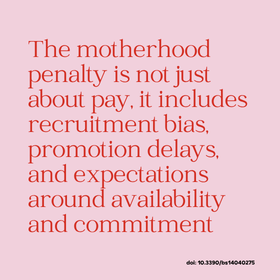 When we come to how to change the system and the embedded social attitudes that leads to the Motherhood Gap in academia in the first place, bizarrely it seems that much of our focus should be placed on making things better for men. Working families has a great summary of the barriers to equal parenting, and how improving the share of work done by fathers has positive effects on both members of the partnership. Studies in Sweden have shown that for each month of parental leave taken by a father, there was a 7% increase in the mother’s earnings. Mothers are more likely to be in work when their child is three if the father is more involved in childcare nine months post-birth. The big answer therefore, is campaigning for improved paternity leave, and encouraging male staff members at all levels to use it. Men consistently report feeling that they suffer at work if they ask to leave to pick up an ill child, or have to walk out of a meeting that is running late due to their childcare responsibilities, whereas most would think twice before bringing this up with a woman. Having a father take paternity leave where it’s just them and the child alone makes it less likely that the woman will be the sole primary carer for the child in future. If you are the boss therefore, encourage your new fathers to take their paternity leave, and help everyone out by not having important meetings during time when childcare responsibilities might butt into work hours (before 9.30, after 4pm).
Most of us at this career stage will not yet be on evaluation panels for tenure and promotions, but will hopefully be getting there in the next few years. The full report documents a drop in publication rate of approximately three publications per year for women in the eight years after the birth of a child, with no discernible drop for men. These panels must account for the difference in productivity that results from Motherhood, and also recognize that the lack of women in senior positions means our mothers are doing more committee work, at the cost of their scientific productivity. In many departments time-swallowing committee work by women is seen as the price of entry, not positively valued, and this must change. Not only do we have less time available than non-parents, but more of our time is taken up by these roles. Don’t get me wrong, this committee work can also be a superpower, and learning how to navigate the relationships between the department and the university can ultimately be beneficial for your career in the long-run, but there is no denying that it is time away from research at a time when you are expected to be productive.
It’s important to recognize that in current conditions you are making your career more difficult by choosing to have a child. But I am convinced that we are improving the systems in small ways, and that by building the right support systems, you can have a fighting chance. And the more we talk about these issues, the more we refuse for them to be swept under the carpet, the more likely it is that we will get to transformative changes.

Dr Becky Carlyle
Author
Dr Becky Carlyle is an Alzheimer’s Research UK Senior Research Fellow at University of Oxford, and has previously worked in the USA. Becky writes about her experiences of starting up a research lab and progressing into a more senior research role. Becky’s research uses mass-spectrometry to quantify thousands of proteins in the brains and biofluids of people with dementia. Her lab is working on various projects, including work to compare brain tissue from people with dementia from Alzheimer’s Disease, to tissue from people who have similar levels of Alzheimer’s Disease pathology but no memory problems. Becky is also a mum, she runs, drinks herbal tea’s and reads lots of books.

 Dr Yvonne Couch
 Dementia Researcher
 LSE Impact Blog

 Nature Careers Blog




Great breakdown—clear and easy to follow. It’s refreshing to see accurate information presented simply.