 Print This Post
With the AAIC happening this week it’s definitely conference season (Adam Smith – Blog – AAIC 2025, Big, Busy and Worth It), but how easy is it for everyone to attend? Cost definitely matters but what other barriers stand in the way of some of our community being able to partake?
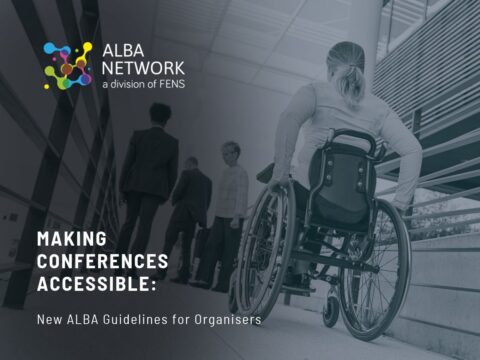
I recently attended the Royal College of Psychiatrists International Congress. Our President’s opening lecture mentioned that the conference had made great strides towards trying to make it an inclusive event as possible. This made me prick up my ears and I started to notice the many small things that they had done, far beyond what should be the absolute basics of making sure that there is a lift, suitable toilet facilities for all and wheelchair spaces in session rooms (IC25 venue and accessibility guide).
For example, there was a prayer room, noisy areas were marked on the conference map, plenary lectures had livestreams to quiet rooms, sensory objects were available if required and there was a plain food station. There were live captions for all talks, or at least when the system didn’t crash there were captions! Babies under 12 months were allowed in all sessions and personally I didn’t notice any issues with this in any of the sessions that I attended.
This got me thinking about the many conferences that I have attended over the years and how they have changed in terms of inclusion (Towards inclusive and sustainable scientific meetings | Nature Cell Biology). As humans we tend to view things through the lens of our own (necessarily partial) experience, which can make it difficult for conference organisers to make their events truly inclusive for all. For example I really hope that over the years it has become easier for delegates with physical disabilities to attend conferences, although I don’t have any personal experience of this. Conferences can be extremely overwhelming for neurodiverse delegates and hopefully small changes like those at the RCPsych congress will make it easier for neurodiverse scientists to attend.
As I mentioned earlier, conferences can cost a lot to attend. Using AAIC ‘25 as an example, there are the registration costs which are not insignificant if you aren’t a student, travel to Canada, big city hotel costs and then travel within the city. I’m lucky enough to have been awarded 2 grants to enable me to attend this year. These costs, usually paid upfront, can be a real problem for scientists who do not have significant family financial backing, particularly because it can take a long time to get the money back through expenses. Likewise, if you need a visa to attend a conference in another country, this takes additional time meaning that long registration windows can be really helpful.
Speaking more personally, the introduction of virtual conferences during the covid-19 pandemic and the continuation of hybrid conferences after the pandemic was a game changer for many. I have never attended as many conferences before or after the pandemic as I did during it. It was so much easier both financially and logistically, particularly with sessions being recorded and then available on demand aka when the kids were in bed. Watching a livestream of “Inside Out” with my husband and children during the 2021 BNA festival of neuroscience is still something that they happily reminisce about (BNA2021 | The British Neuroscience Association). Don’t get me started on the “networking opportunities” available during the average online conference though.
When I first started working in science it was not unusual to see the eponymous “manel”, where all speakers were male. In this respect things definitely seem to have changed for the better and conference organisers now value session submissions with a diverse range of speakers, both in terms of gender, ethnicity, geographical location and other characteristics such as age and career stage.
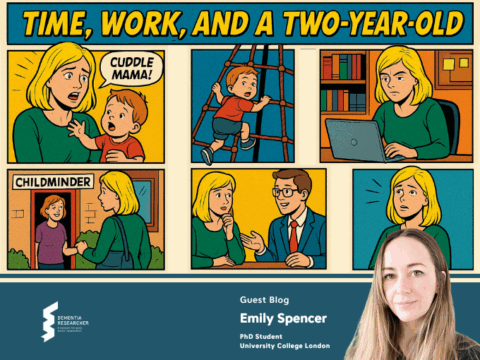
There does also seem to have been a trend towards making it easier for working parents to attend conferences. When I had my first baby I was still feeding him when I went back to work. This made it really hard to go anywhere where there weren’t facilities to express milk.
I’ve never forgotten the utter grimness of expressing milk in a toilet on one occasion and then having to tip the milk down the sink because it couldn’t safely be given to my baby.
Now it seems almost the norm to have a parent/baby room, often with a fridge which really does make life so much easier for lactating parents. It also seems increasingly common for conferences to offer childcare on site, which is a good solution for many, but not for all parents. Some organisations offer grants to cover conference childcare costs e.g. by taking a caregiver with you, but perhaps this should be more widely accepted as a legitimate cost in project grant applications. Some even allow babies in, which I first remember noticing at British Neuroscience Association’s 2019 festival of neuroscience. Maybe other conferences allowed this earlier, but because of my young children I tend to go to far fewer conferences than some of my peers…
Thinking of other practical but important elements, increasingly dietary labelling is visible at conferences and there are a decent range of food options. This really matters and can make all the difference for those with food allergies. It is just soul crushing looking at a range of delicious smelling food when there is nothing that you can eat. There still aren’t always alternatives for all meals though, which in my experience particularly affects snacks at coffee breaks. A vegan friend was sad about missing out on Welsh cakes at congress.
Putting all of this together, fundamentally though science is a team sport and if part of the team is excluded from an event then the team will perform less well. Inclusion matters at conferences and although the times are still a changing we are heading in a better direction.

Dr Lindsey Sinclair
Author
Dr Lindsey Sinclair is an Honorary Senior Clinical Research Fellow at the University of Bristol and a Locum Consultant in Old Age Psychiatry. Her research explores the relationship between depression and dementia, combining lab work with epidemiology and genetics. Clinically, she works with older adults experiencing a wide range of mental health problems. Outside of work, she’s a keen baker and runner, and has a particular talent for creating ambitious birthday cakes.

 Dementia Researcher
 Bernie McInally
 Emily Spencer
 Dr Lindsey Sinclair