 Print This Post
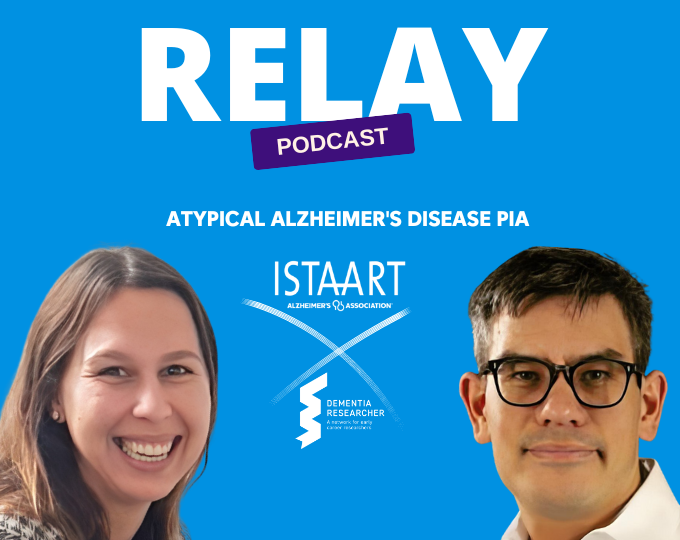
Welcome to the sixth season of the Dementia Researcher X ISTAART PIA Relay Podcast. This series features interviews with ISTAART PIA committee members talking about their research, the research landscape of their fields, and the work of the ISTAART Professional Interest Areas (PIA) they represent. As we build up to the Alzheimer’s Association International Conference in Toronto, join us for daily episodes that showcase the remarkable work being done in various research fields.
In this episode, Dr Alexa Pichet-Binette interviews Dr Colin Groot, an expert in neuroimaging and atypical Alzheimer's disease from Amsterdam University Medical Centre. They discuss the clinical and biological diversity within atypical variants such as posterior cortical atrophy (PCA), language and behavioural forms, and CBSAD. Colin shares insights into ongoing studies on tau PET, mortality, subtyping PCA, and how ISTAART’s Atypical PIA is pushing forward international collaboration and inclusivity in clinical trials and diagnostic criteria.
The Alzheimer’s Association International Society to Advance Alzheimer’s Research and Treatment (ISTAART) convenes the global Alzheimer’s and dementia science community. Members share knowledge, fuel collaboration and advance research to find more effective ways to detect, treat and prevent Alzheimer’s and other dementias. Professional Interest Areas (PIA) are an assembly of ISTAART members with common subspecialties or interests.
There are currently 30 PIAs covering a wide range of interests and fields, from the PIA to Elevate Early Career Researchers to Biofluid Based Biomarkers and everything in between.
Voice Over:
Welcome to season six of the Dementia Researcher ISTAART PIA Relay podcast. In this special series, we've invited members of ISTAART's professional interest areas to interview each other in a unique relay format. One guest becomes the next's host, and the conversation keeps moving episode by episode.
ISTAART, part of the Alzheimer's Association, brings together researchers, clinicians, and professionals dedicated to understanding and treating Alzheimer's disease and other dementias. We'll be releasing one episode each day in the lead-up to this year's Alzheimer's Association International Conference, taking place in Toronto and online, showcasing the vital work of ISTAART PIAs and talking hot topics in research. Thank you for listening, and we hope you enjoy the series.
Dr Alexa Pichet-Binette:
I'm Alexa Pichet-Binette, I'm an assistant professor at the University of Montreal, and I'm the education chair and incoming vice chair of the neuroimaging PIA, or professional interest area. And today, I'm really delighted to be talking with Colin Groot, who is from the atypical PIA.
Hi, Colin, very nice to see you. So, as we get started, I was wondering, can you maybe introduce yourself a little bit and tell us which PIA you are involved in?
Dr Colin Groot:
Sure thing, Alexa. I'm Colin Groot, I'm from the Amsterdam UMC location, VUMC in Amsterdam. I'm currently an assistant professor, mainly focusing on neuroimaging. I am involved in the atypical professional interest area, so it's focused on the atypical variants of AD, which I will be talking about in just a moment. I am now the current junior trainee in the executive committee, and I'm hoping to become the communications chair next year.
Dr Alexa Pichet-Binette:
Fingers crossed for that. And you mentioned, so the work that you will be talking about more with the atypical PIA. And can you tell us a bit more about the PIA and maybe how your research fits in that area?
Dr Colin Groot:
I am mainly focused on neuroimaging myself, so my own work focuses on the neuroimaging aspects of atypical Alzheimer's disease. So, we know from the literature that all of the atypical variants of AD are characterised by a very specific clinical phenotype. It's actually also how they are defined. But all of those clinical phenotypes also go together with a very specific neurobiological phenotype, that is to say, an atrophy pattern that's very specific to a particular variant.
Now, also, recently with the addition of tau PETs to our curriculum, we can also look at the tau pattern in these phenotypes, and it's also very different. So just to name one example, the most common atypical variant of AD is the posterior cortical atrophy. So, the name already gives it a little bit away that the atrophy in this variant is specifically located towards the posterior parts of the brain, and if you look at a tau PET image of even in individual patients and not only on the group level, but even in individual patients, you clearly see that this tau pattern is also posteriorly located. So that is my own main focus within the atypical variant sphere. It's mapping this heterogeneity in tau PET, but also structural MRI associated with each of the clinical variants.
Now, in addition to that, I have a PhD student who is currently focused on, and is actually already published in the Journal of Neurology, or I should say the journal called Neurology, otherwise, we'll get confused, which is more of a clinical perspective on atypical variants of AD. We looked to see whether mortality from the time of a diagnosis of atypical variants of AD, so we looked at all the different variants, whether that's actually shorter than for typical Alzheimer's disease. And what we actually found was yes, time from first diagnosis to death was a little bit shorter for atypical variants of AD by, from memory, I think one or two years across variants.
Now, I do have to say that this is an indication that it might be that the atypical variants are progressing faster. So, we know all this from the literature as well, that especially individuals who have a more neocortical atrophy and tau-PET pattern tends to progress faster and that's also what we see in atypical variants. However, there's also the issue that atypical variants are diagnosed typically later than typical variants of Alzheimer's disease, so it might just be that we are diagnosing people later and that also results in a faster progression to death, let's say. So, we are looking into that right now.
Dr Alexa Pichet-Binette:
That's super interesting. Congrats for already having a PhD student published already also. And you mentioned this thing about the mortality. Could you break down the different variants of AD or by the different types of atypical AD, or was it more as a whole? Because of course the sample size is often quite small in those variants.
Dr Colin Groot:
You hit it right on the nose. So, it is always very difficult with the atypical variants. So, the phenotypes and also the effects are quite extreme, but the samples are always small. So just to give a quick recap of what atypical variants there actually are and what we were looking at. So, I mentioned the posterior cortical atrophy variant of AD, which is also called the visual variant because it starts out with visual impairments along with that posterior atrophy pattern that I talked about. We also have the logopenic variant of primary progressive aphasia, and the aphasia part already gives it away a little bit that it's a language issue in these individuals, at least at the beginning, mainly word retrieval and fluency issues. So that's the language variant of AD.
We also looked at the behavioural variant of Alzheimer's disease in this particular study. So, in those individuals, the clinical phenotype is characterised by behavioural issues, so it's just agitation, lack of empathy, lack of motivation. So that's actually a clinical phenotype that's very reminiscent of a behavioural variant of frontal temporal dementia, and that's even rarer. The behavioural variant of Alzheimer's disease, we are looking at one to 2% of AD cases. We were able to include a large enough sample to assess it.
And then also what we looked at this, and maybe people don't notice, but there's also cortical basal syndrome that's underlied by Alzheimer's disease. So that's CBSAD in short, which you could call the motor variant of Alzheimer's disease because it's characterised by difficulties in moving and in that sphere are the impairments.
So, in this particular study, we took all of them together, so the sample sizes were in the back of our head, and we looked first at atypicality, and then we clearly saw a significant difference between typical and atypical. So that's with all the phenotypes combined, because when you break them up, you clearly see that it's consistent across the different variants, but you get an issue of statistical significance because you're breaking down an already quite small group. So, I would venture to say that the effect that we saw is probably across variants, although we could not statistically prove it for every variant because sample sizes were just too small.
Dr Alexa Pichet-Binette:
It's very nice that you could include a broad spectrum of all the atypical variants, so that's great. I fully agree with what you mentioned about the very striking pattern of Tau PET. It's a nice coincidence that we're paired together. I also look at [inaudible 00:09:12], and it's very, very impressive. And so, you mentioned a lot of the different variants in your work or maybe at the research centre. Is there one in particular, one atypical variant that you mostly focus on, or you look at them more broadly together?
Dr Colin Groot:
Recently, I've mostly focused on all of them together. I've mentioned this particular study on mortality. We're also looking into, and that's together with Nico Franzmeier from Munich, into the association between network or connectivity and Tau PET again. So, this is also including all of the variants, and it's I think worth noting the results of that study as well. It's led by Hannah de Bruin, also a PhD student here as well. What we saw is that taking all of the variants together again, actually from many different centres because we had to arrive at a sample size that we could actually do this analysis, and in Alzheimer's disease in general, there is quite a striking association between functional connectivity and Tau. So functionally connected regions also tend to harbour or collect Tau more strongly.
So that was already done in Alzheimer's disease in general, but we wanted to see whether in atypical variants of AD, that would also translate, because there's quite a striking regional pattern of tau, but this is also underlined by their functional connectivity. And in short, yes, the results were very consistent across variants, so I think that's a very nice paper as well. It's under review at this moment.
So that's recently. So, there's mortality and a functional connectivity, but back eight years ago, I think I mostly focused on posterior cortical atrophy. One of the reasons is obviously because that actually is one of the most recognisable atypical variants. It's also the most common, and it is not common but it's the most common among the variants. So, I think it's around five to 10% of cases with AD, or Alzheimer's. See, sorry, I'm so used to that acronym, that have posterior cortical atrophy. And eight years ago, when I did this study, there was only a sample size large enough for the posterior cortical atrophy analysis. But what we did there is actually quite different, and it's also nice to illustrate this because there has been talk within the posterior cortical atrophy sphere that there are specific subtypes. So that there are actually within these very specific variants, there are subtypes, and the most commonly described are a dorsal variance of posterior cortical atrophy, which is to say that the tau or atrophy is mostly located towards the dorsal stream of visual processing, and the ventral stream.
Now, what you can expect based on those two subtypes is that the dorsal stream is more associated with visual spatial impairments and the ventral stream is more associated with object perception deficits. So, what we did is we used a method called latent dirichlet allocation, which is a fancy name of just a specific clustering approach, to see whether, and this was on atrophy still because it was back when tau PET wasn't very common, to see whether covariant patterns of atrophy can be detected within a sample of posterior cortical atrophy patients. And on the group level, yes, you could see that, so we could delineate actually this dorsal and ventral stream of atrophy. However, most PCA patients have atrophy to a degree in both of these streams, and it was also not a very clear delineation between the specific cognitive impairments that these people had.
So, I think there are some bases for subtypes of PCA, but it might be a very rare occurrence that people are really that specific into an already specific phenotype.
But it was very nice to see all of these different factors we called them of atrophy within a posterior cortical atrophy, but I wouldn't recommend subtyping people with posterior cortical atrophy even more because we do know also from the literature, and this is also recognised in the published consensus criteria of stereo cortical atrophy, that it's quite a heterogeneous group and there's loads of different symptoms associated with posterior cortical atrophy, but most people have a mixed bag of these symptoms and not a very specific set.
Dr Alexa Pichet-Binette:
That's so interesting. I didn't know about these two potential subtypes within PCA, and it's very fascinating also how we can learn a lot about the brain or disease mechanisms in a way with these atypical cases, so that's really interesting. So now we talked a lot about the posterior cortical atrophy, and I saw that within the atypical PIA, one work groups are around PCA, if I'm not mistaken. So that's also a very active area of research or of interest I guess within the PIA, is that right?
Dr Colin Groot:
So, there are a couple of different initiatives actually revolving around posterior cortical atrophy. One is the work group that you just mentioned, and it's basically, in a nutshell, it's the clinical criteria for posterior cortical atrophy were defined in 2017. Since then, we know a lot more, so on Alzheimer's disease in general, but also on posterior cortical atrophy, mainly in terms of biomarkers that are a lot more accessible right now. So, what this work group is revolving around is basically updating or providing recommendations for updating the clinical criteria for PCA in light of those new developments in the field. So that's one of the initiatives. It's led by Keir Yong, who is the incumbent chair of the atypical Alzheimer's Disease PIA.
And the other is a PIA-supported initiative that is led by Victoria Pelak, but focuses on the mapping, the progression in posterior cortical atrophy. So, like I mentioned, that people with atypical variants tend to progress faster, but it's becoming really important to map this for the atypical variants, so even though it's not a very common occurrence, it's still five to 10% of the Alzheimer's disease population. And with these new disease modifying treatments that are becoming available, or at least at trials that are now ongoing, it becomes really important to try to find a way to include these individuals into trials. And to do that, you'd need an effective method of tracking the specific progression that is seen in posterior cortical atrophy, because you have different progression of tau because it's located in other brain regions, but also the clinical progression needs to be measured differently compared to, for instance, a normal or a typical Alzheimer's disease patient, which is more language or memory focused, and in cortical atrophy, like I mentioned, it's the visual impairments. So, the tracking both on a biological level and a clinical level needs to be adjusted based on these phenotypes.
Dr Alexa Pichet-Binette:
These are both very important initiatives, and indeed with the incoming treatments in different parts of the world, how to establish how far along are these atypical cases will be very important.
Dr Colin Groot:
I should mention this also. There was a really nice... There was a meeting called CONu, Controversies in Neurology I think from memory, and members of the atypical PIA were there to discuss the role of atypical AD in disease modifying treatment trials. We had two people, one a proponent and one an opponent. Actually, the opponent was probably also agreeing with the proponent, but it was to get a discussion going. So, there was a really nice event. I was not there myself, but I heard afterwards that the general consensus was that yes, we should definitely include people with atypical variants into disease modifying treatment trials, and we should look, for instance, with the initiative that Victoria Pelak has started on PCA progression, look to see how we can incorporate this and accommodate their specific phenotypes.
Dr Alexa Pichet-Binette:
And is this something, let's say people who are members of the atypical PIA, anyone can join in a way if that fits their interest?
Dr Colin Groot:
Sure, yeah.
Dr Alexa Pichet-Binette:
If people are thinking, oh, well that's very related to what I do, is it possible for people to join these working groups or they're already set?
Dr Colin Groot:
Well, no, we are very interested in all people who want to join. And especially, I think one of the nicest things about the atypical PIA is that yes, we are focused on one very specific in this case phenotypes, but that brings together people or researchers from very different disciplines. You Have a pathological perspective, you have a clinical perspective, neuroimaging perspective, genetics perspective even. We haven't talked about this but there's also differences in genetic makeup of people with atypical variants of AD. What most obvious example is that APOE4, which is the most important risk factor for Alzheimer's disease, is less strongly involved in atypical variants. So many different backgrounds come together in these work groups, and it's exactly what we want, because when you're compiling these criteria, you need all of these different perspectives in order to arrive at a holistic view of a very complex phenotype.
So, the short answer is yes, we are very interested in people to join. The intermission session last year, which was also last year at AIC, which was loosely based also on the clinical criteria but also on we have this now. How are we moving forward? That was quite informal and also just nice to bring all these people together, so also from a personal perspective, it was nice to attend, and also professionally interesting.
Dr Alexa Pichet-Binette:
This multidisciplinary aspect of the PIA is really interesting. Yeah.
Dr Colin Groot:
Mm-hmm.
Dr Alexa Pichet-Binette:
We tend to be sometimes more in your images, but you see me standing, but you're a bit broader, so that's really nice. And now you talk a lot about very hot research that you've been doing and with collaborators, but are there other, let's say, exciting areas in the field or that you know will be presented this year at AIC?
Dr Colin Groot:
Yes. So, we are selecting abstracts for the PIA session that's every year, we have on the PIA Day, which is Saturday, we have our own session obviously. There has been some very exciting stuff sent in. So, one of the things that I do want to highlight is I mentioned the logopenic variants of primary progressive aphasia, so that's a language variant of Alzheimer's disease. And although there are quite clear symptoms that are associated with this variant, it's still quite hard to diagnose sometimes because typical Alzheimer's disease can also come with language impairments. So, there are now several initiatives that are based around AI to detect speech patterns or impairments that could be indicative of a PPA syndrome in the future.
So last year, there was actually also some talks about that. I do have to recognise that the sample sizes for these are very small, so it's very computationally difficult to do this. The AI algorithms are still being developed so we are not there yet, but I do think that in the future, and there's going to be a presentation on that this year as well I know from the abstract and also... But in the further future, I think these types of developments may become really important because you can apply them on a larger scale. If you have a recording of someone, then you can use AI to maybe get an indication or a probability that someone might get a logopenic variant PPA syndrome. It is really cool, I think. So that's one of the things that are being presented now in our incoming nice topics.
And also, what I found is that the copathology, so we know from Alzheimer's disease that many people also have copathology and it becomes worse and worse when people get older. And then the copathology of, for instance, TDP-43 pathology, which is a different kind of pathology, is very prevalent, and the role of these copathologies in atypical variants of Alzheimer's disease is also an active area of research. So, for instance, the TDP-43 pathology is less commonly found in the atypical variants of AD. That might be because it's mostly related to memory impairment, so if you have memory impairment, it's usually an exclusion criteria for an atypical variant of AD. So that might be the case, but also vascular changes are less common in atypical variants of AD than compared to typical variants.
So, I think this is a very nice area of research because you can use these atypical variants of AD as a disease model for what the effect is of these copathologies in general in AD, because atypical variants are a very nice disease model anyways because they have so extreme phenotypes. So that is one of the things that are very interesting and also shortens, and this is actually because it's involved in my own research here in Amsterdam.
So, a quick recap of a study that we're doing led by Ilse Baader. We are looking to see whether we can detect Alzheimer's disease in actually the eye clinic, so we are asking people who come to the eye clinic to do a blood test and to see whether we can detect indications of tau in the blood. But what we can also do in that same study population is do a very short test, which if you test poorly on this particular test, it's very indicative of PCA, posterior cortical atrophy. So those digitised tests that normal functioning people can very easily do but people hwit PCA perform very poorly at. So that is very broadly applicable I think because it's a digital test and it's very short, so that's also a very active area of research that I'm personally interested in.
Dr Alexa Pichet-Binette:
The first results of this project will be presented also this summer.
Dr Colin Groot:
It's not developed by us this test so it might be that other people are working on it and are in further stages, but we are only doing the first... I think it started first a few weeks ago.
Dr Alexa Pichet-Binette:
Oh, nice.
Dr Colin Groot:
And so too early days.
Dr Alexa Pichet-Binette:
Well, it'd be nice to follow up on that. And I also fully agree with the hot topic of copathologies. Even if I work more on let's say more typical AD, this is also a big area of research, maybe which pathology is more contributing to symptoms and so on, so that's a nice area of convergence. And I was also wondering if you can, coming back a bit to the PIA news, you mentioned a lot of cool stuff that were presented in the PIA Day. And could you tell us a bit more how the PIA is organised and how it works within the atypical PIA?
Dr Colin Groot:
Like all PIAs, we have different members with a different task. So, we have a chair, a vice chair, a communications chair, and the programmes chair, which is pretty common. Myself, I am the junior trainee at this moment. What's a little bit more uncommon is that we serve two-year terms at the atypical PIA, so I think that leaves room for also implementation of your ideas rather than a single year when maybe your ideas that you have one year cannot be implemented anymore because you are not elected the next year, so that's nice. Also, quick shout out to the elections that are ongoing right now. So, I think you can still vote for the atypical PIAs and all the other PIAs on the ISTAART website.
Yeah, one of the other things that we are organising each year, and I think are worth mentioning is we do general clubs with the authors of the papers involved in them, which are also really nice webinars. We also organise what we call basic webinars, or actually ISTAART has named it that. But then we are taking a step back and we are looking at the really basic principles of a certain phenotype sometimes for atypical variants of Alzheimer's disease, but also sometimes modalities. So, this year for instance, we had Daniel Ohm was more of a fundamental scientist focusing on the microscopic level of pathology in Alzheimer's disease and how that relates to atypicality. So, I think that's always really nice, and it's also focused very much on early career researchers, and I think in that same vein, we are also very much encouraging early career researchers by only selecting early career researchers for our PIA Day. We have also a poster competition where only early career researchers such as PSD students and post-docs can participate, or we only selected early career researchers.
So, I think that's one of the focuses of our PIA, is getting really those early career researchers involved in what we are doing, and we try to accommodate that by having webinars with such a broad scope.
So, in that regard, we are like any other PIA where we have our FRSs that we submit each year and perspective sessions, which are also accepted for this year as well at AIC.
Dr Alexa Pichet-Binette:
What are the topics generally of those sessions that will be presented if people will be attending AIC?
Dr Colin Groot:
So, we have our session on the PIA Day obviously, but we have an FRS on Tuesday which is called, and you can put this in your AIC agenda, what is Atypical for AD? From Syndrome to Biology. And you can already garner from that title, from syndrome to biology, that we are shedding light on every aspect of atypical AD. A very nice oral speaker, so Deepthi Pooja, Neus Falgàs Martinez, Rosaleena Mohanty, who is also in our committee, and Lea Grinberg. And we are really aiming to have all of the perspective that I talked about earlier, so the clinical perspective, the neuropathological perspective and the neuroimaging perspective all in one session. So, I think if you are interested in a broad array of research with a specific focus on atypical variants of AD, you must certainly come to the session.
And we have also another session that is called a perspectives session and it's a little bit also related to what I talked about earlier, because it's called Improving Clinical trials for Atypical Alzheimer's Disease, A Call to Action. So, the different initiatives that I mentioned earlier, trying to incorporate atypical variants of AD into clinical trials and accommodate the different clinical phenotypes is really an area of active research and I think it should be, so we have a great lineup of speakers there as well. It's on the Tuesday, so if you're interested in atypical AD, you can just try to be... Don't make it too late on Monday and come to all of the sessions on Tuesday.
Dr Alexa Pichet-Binette:
Those sessions also really speak to this multidisciplinary of the atypical PIA that we were discussing earlier. That's quite nice. And then I was thinking, again, going back to this multidisciplinary, is there let's say one area, one expertise that you think, oh, we would need more of that within the PIA or the field in general to increase this dialogue within atypical AD?
Dr Colin Groot:
Yeah, so that's a great question actually. So, I think all perspectives are welcome, but I think the neuropathological perspective is maybe... It is now spearheaded by a few people that are really great, but I think maybe it's a little bit underrepresented maybe at this moment still. So even though we are not short on expertise, maybe that's one area where we might have need for more different perspectives. And always, this is just not that there are few people involved, but the clinical perspective is so important because it's the thing that's most important to patients. So that's also just incredibly important that we get different perspectives and maybe also from countries that are maybe a little bit less represented in general. So, we have people from USA and also in Canada and also from Europe, but maybe other countries outside of those continents might be a little bit underrepresented at this moment. I think this is a feature of many of these initiatives, but we are very interested in learning the perspective of people from outside of that typical group.
Dr Alexa Pichet-Binette:
Yeah, this last point really echoes a lot of also what we have been discussing in the last years within our PIA, to increase the diversity is very important. And will you be presenting anything yourself or your students during the conference?
Dr Colin Groot:
Yes, although not on atypical Alzheimer's disease. So, it is relating to what we talked about, the diversity in research. So, this goes beyond the scope of the atypical AD topic, but I'm presenting on differences in amyloid and tau relating to different patient characteristics such as race and age and sex. So, it is relevant to atypical variants of ad, but it's not on that.
And also, the PC centre that I mentioned, Hannah is presenting on the connectivity versus tau paper, so that is very relevant. I don't remember by heart what day and time, but if you look up in the app, atypical variants, you will definitely find it. Yeah, and obviously that's not my own team, but the PIA members are presenting in the different sessions, FRS perspectives, so there's a lot going on.
Dr Alexa Pichet-Binette:
Your work that you present is very neuroimaging related, so I'll mark this abstract [inaudible 00:35:07] to see you. Well, thank you so much, Colin, for discussing with me today. That was really great. I think now it's time to end today's podcast, but before we go, maybe a last question. As an early career researcher, would you have any advice for who's learning about ISTAART or wants to be involved or thought it was super exciting what you presented in the PIA? What would you recommend?
Dr Colin Groot:
I recommend, so in the first place, if you're coming to AIC, be at our sessions. We are always very communicative, so if you feel like you want to get involved, ask us. If you are not able to attend AIC, we have social media channels. We are on LinkedIn, we are on X, we are on Blue Sky, we have our own page on the ISTAART website. You can even reach out to me personally if you want to become involved and you don't want to use social media. So, we are very interested in all career researchers no matter your background, so please don't hesitate to contact us via any of these channels if you want to get involved.
Dr Alexa Pichet-Binette:
That's great. I think everyone should follow this advice and everyone from the PIA is very friendly, so really, no one should hesitate, I think. Thank you so much, Colin, for taking the time to join us today, and I look forward to seeing you in Toronto.
Dr Colin Groot:
Yeah, see you there.
Dr Alexa Pichet-Binette:
Thank you everyone for listening. You can find profiles on myself and Colin, my very nice guest today, and more information on how to become involved on ISTAART on our website at dementiaresearcher.nihr.ac.uk, or also at alz.org/ISTAART, and there will be a link in the show notes so you can reach those websites very easily.
I'm Alexa Pichet-Binette and you've been listening to the Relay Podcast from Dementia Researcher and the Alzheimer's Association. You can hit subscribe on YouTube or any podcast app that you use to make sure you don't miss any other episode. This was the first one. We have really other nice ones coming up where you can hear more about dementia research and the upcoming conference, so thank you so much. See you next time.
Voice Over:
The Dementia Researcher podcast was brought to you by University College London with generous funding from the UK National Institute for Health Research, Alzheimer's Research UK, Alzheimer's Society, Alzheimer's Association, and Race Against Dementia. Please subscribe, leave us a review and register on our website for full access to all our great resources. Dementiaresearcher.nihr.ac.uk.
If you would like to share your own experiences or discuss your research in a blog or on a podcast, drop us a line to dementiaresearcher@ucl.ac.uk
Did you know... you can find our podcast in your favourite podcast app on mobile devices, and our narrated blogs are also available as a podcast.
The views and opinions expressed by the host and guests in this podcast represent those of the guests and do not necessarily reflect those of UCL or Dementia Researcher

 Dementia Researcher
 Alzheimer's Association