 Print This Post
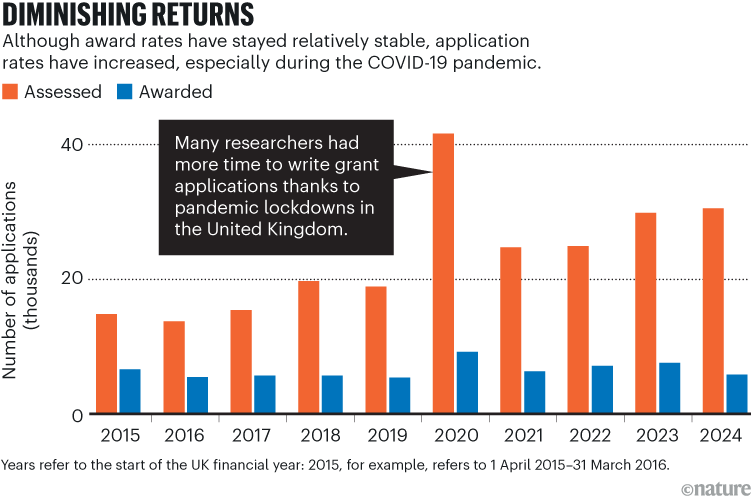
The proportion of research and innovation awards granted by UK Research and Innovation (UKRI), the United Kingdom’s national funding agency, has nearly halved over the past seven financial years, as application rates surged by more than 80%, new data show.
The UKRI data, published last month, show that between 2017–18 and 2024–25, the number of applications to the national funding agency increased from 16,355 to 29,927. Meanwhile, the number of awards granted per year increased by only 3% over the same period, to 5,667 in 2024–25 (see ‘Diminishing returns’). A substantial bump in applications was seen in 2020–21, the first year of the COVID-19 pandemic, and a similar, but smaller, bump was seen in awards, which levelled out over the following years.
The increase in applications is mostly due to applications to Innovate UK — which supports industry-driven research and now accounts for more than 56% of the assessed applications. The award rate for these applications was 14% in 2024–25.
For academic and research-led grants from UKRI, applications and award rates vary between research councils — the subject-specific bodies that allocate funding in areas such as engineering, medical research and social sciences — but many have seen a fall in award rates over the past financial year. Overall, the proportion of awards granted per year — including research and innovation, fellowships and training grants — fell from 36% in 2017–18 to 19% in 2024–25, the lowest in the decade. The total number of active awards has remained fairly stable, and is now around 21,000.
Price of progress
Despite the stagnation in the number of awards, the value of UKRI grants steadily increased from around £3 billion (US$4 billion) to more than £6 billion between 2015–16 and 2023–24, before falling to £4.5 billion this financial year.
Over the past few years, laboratories and universities have reckoned with the consequences of significant inflation. In October 2022, the UK consumer price index hit 11.1%, a 41-year high. According to the UKRI data, over the past three years, the average amount awarded for a successful application exceeded £800,000. In 2015–16, the average value of a grant was just more than £450,000.
Eleanor Riley, an immunologist at the University of Edinburgh and a member of the UKRI’s Medical Research Council (who spoke to Nature in a personal capacity), says that research budgets have barely kept pace with inflation. A lack of investment from the country’s government is mostly to blame, she adds. A research and development analysis, published this year by the Campaign for Science and Engineering, an advocacy group in London, showed that government spending in real terms — when adjusted for inflation — plateaued in 2019 owing to high inflation.
The activities of other funders, including US-based research institutes affected by funding cuts from President Donald Trump’s administration, might have also affected UKRI application volume, with more researchers in the United States looking outside the country to secure funding.
Demand management
In 2022, the Technopolis Group — an international research and consulting organization — published a review of the UKRI’s response to the substantial bump in applications and the expedited review timelines in the COVID-19 pandemic. During this period, UKRI staff and reviewers faced widespread burnout, according to the report, and more than one-third of awardees had experienced delays while waiting for a decision.
A number of UKRI councils have adopted demand-management policies to reduce pressure on their peer-review systems as applications increase. In 2015, the Natural Environmental Research Council (NERC) implemented a demand-management policy limiting the number of applications from individual institutions on the basis of success rate: those with a low success rate were subjected to a cap on the number of applications they could submit. Although this is not the only way to reduce pressure on peer-review and grant systems, it tends to lead to more-robust applications, says Riley. She says other councils could follow suit.
A number of councils, including the NERC and the Engineering and Physical Sciences Research Council, no longer allow uninvited resubmissions, as of this year. The Biotechnology and Biological Sciences Research Council does not accept applications that have already been peer reviewed or are under peer review by another funding body or research council.
This new policy has attracted criticism that the resubmission policies could prevent researchers from improving grant proposals on the basis of feedback from the rejection. “This is a huge mistake. My experience on NERC panels is that resubmissions score higher and are more likely to be funded: the review process improves good proposals that should not be lost (along with the time spent on them),” argued Jen Gill, an ecologist at the University of East Anglia, UK, on Bluesky.
A UKRI spokesperson told Nature’s reporter that the body would “continue to review and revise [grant funding] mechanisms including demand management and innovative assessment processes”. “We recognize that the high demand for funding, of all types, affects success rates, and reflects high investment from the sector — from applicants to research offices to reviewers.”
A more radical response would be to do away with grants and focus on block funding, lump sums delivered to institutions rather than through competitive, researcher-targeted grants, says Mike Thelwall, a data scientist at the University of Sheffield, UK. Thelwall — whose published work includes papers on rethinking peer review and the use of large language models in research — says that the rise in applications indicates a “huge increase in the amount and cost of work for academics completing these applications”. “[Researchers] must be spending less time either teaching or doing research, and spending more time on writing these grants,” he says. Over the coming years, artificial-intelligence systems could help to increase the efficiency of the proposal-writing process, he adds, but they won’t stump up more funding.
Find the original article and more at doi: https://doi.org/10.1038/d41586-025-02584-w

 Nature Careers Blog



 Dementia Researcher