 Print This Post
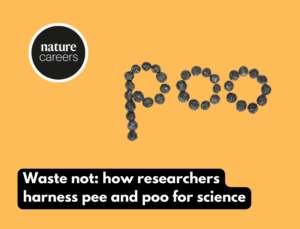 As Mathilde Poyet ushers me through the Global Microbiome Conservancy’s laboratory in Kiel, Germany, I’m met with all sorts of state-of-the-art equipment. It’s an impressive facility, with typical lab apparatus, such as incubators, the latest sequencing devices and anaerobic chambers for culturing bacteria. But the most important stuff in the lab is stored in a freezer at −80 ºC. The samples are so crucial that there is a back-up battery system — if the electricity to the freezers goes off, the materials will remain intact. These test-tube samples aren’t some immortality serum or cancer-fighting bacteria: they’re faeces.
To be precise, they’re suspended stool samples and bacteria that have been cultured from faeces. But at one point, this was poo that Poyet and her colleagues, including her partner Mathieu Groussin, had collected as part of their work for the Global Microbiome Conservancy (GMbC), of which Groussin is a co-founder. Poyet likes to call the project their “first baby” (one of their real babies, their infant daughter Aelis, joins us in their office as we speak).
“We’ve seen all sorts of poop across the Bristol stool scale — all shapes, all sizes, all colours,” says Poyet, referring to the stool classification chart physicians use to assess digestive issues.
Poyet and Groussin’s work is predicated on the idea that faeces provide an ideal snapshot of the human gut microbiome: the genetic content of the community of organisms found in intestines. This differs across populations1 and can serve as a health indicator. Most research on the human gut microbiome focuses on populations of European descent. But the GMbC solicits samples that are more globally representative. The samples in the freezer come from as far afield as Ghana, Tanzania, Finland and Thailand.
Over the past nine years of the programme, the team has sampled 50 populations spanning 19 countries. Its members have worked with local scientists, ethics boards and communities to collect the samples, and have taken cars, boats, helicopters and even quadbikes to sample sites. Back in the lab, researchers analyse the stool content, sequence the genetic material of bacteria cultured from samples and store the live samples in their biobank.
To outsiders, taking stool samples constantly might seem — and smell — disgusting. In Kiel, the scientists occasionally make “poop soup”, using a vessel called a bioreactor to see the effects of different scenarios on procured bacteria. They do this only a few times a year, because the process can be long and expensive, and the aromas pungent, prompting their more-conventional floor mates to give the workspace the nickname “smelly lab”.
But faeces provide a remarkable window into human health. “It’s our best way to interrogate what’s in the gut from healthy people,” says Groussin. “It’s a little bit gross, but that’s just our best way to access this incredible and important biodiversity.”
A treasure trove for science
With the microbiome a buzzy research topic, other scientists around the globe are taking samples to study it themselves. And as seen during the COVID-19 pandemic, wastewater analysis is a valuable public-health tool — providing scientists with the means to monitor pathogens in the population before an infection surges.
“The waste we put into the environment is really data rich,” says Janelle Thompson, an environmental microbiologist at Nanyang Technological University’s Asian School of the Environment in Singapore. Thompson and her team sample Singapore’s wastewater to detect harmful microorganisms in the environment, looking for biological “signals” from organisms or viruses that are shed from the human body.
“You can identify where signals are occurring and follow them over time to see when they’re occurring,” she explains. For example, in 2021 and 2022, Thompson and her colleagues were able to identify variants of concern for the coronavirus SARS-CoV-2 at university campus sites and treatment plants2. This was long before these variants became dominant, indicating “minimal silent circulation”, according to the team.
The implications of research into human waste span several scientific disciplines. Amid a global fertilizer shortage, some scientists (and farmers) are looking to urine as fertilizer, owing to its nitrogen content. A study in Nature Water3, published earlier this year by a group of researchers at Stanford University, California, created a prototype system that extracts nutrients from urine. The team estimates that its design could generate up to US$4.13 per kilogram of nitrogen recovered. And research published in 20204 shows that urine-based fertilizer might also help to conserve other resources, reducing greenhouse-gas emissions and water use.
As well as a public-health bellwether, stool samples are being used in the development of a potentially life-saving process to treat infections of Clostridium difficile, through transferring healthy faecal bacteria and other microbes from one host to another.
C. difficile infections are “really caused by a disturbed microbiota”, explains Josbert Keller, a gastroenterologist at the Haaglanden Medical Centre in The Hague, the Netherlands. Keller was part of a group that published an early clinical trial5 into the effectiveness of faecal transfers, also known as faecal microbiota transplants, in 2013. “If the patient is not able to restore this microbiota, then it can recur and recur, and that’s the moment that faecal microbiota transplants can really cure a patient.”
Now, faecal transfers are being looked at as a way to treat obesity6, type 2 diabetes7, Parkinson’s disease8 and other conditions.
Something that’s often perceived as disgusting can actually have a lot of intrinsic value, says Bryn Nelson, whose 2022 book Flush: The Remarkable Science of an Unlikely Treasure was described by its publisher as “an urgent exploration of the world’s single most squandered natural resource”. As part of the research and writing process, the former microbiologist spent years looking at the applications of faeces — and found at least 24 fields that take important information from what we consider waste products. Referring to excrement’s ‘ick’ factor, he says: “We just have to kind of get past that hurdle to discover all the information that it contains.”
Getting into the field
Poyet comes from a wet-lab background. For her PhD, she studied the fruit fly Drosophila suzukii and often spent full days dissecting specimens of the insect. Her research now involves sifting through stool samples to access bacteria that are not exposed to oxygen. Some samples are more foul than others, she says, adding: “What is really gross when working with stool sample is actually when people don’t digest the food, and you can find food almost intact in the stool. I really don’t like it.”
For Thompson, working with waste materials was also a natural fit. “I’ve always just been fascinated by the microbial world and then accessing it for human benefit,” she says. “Microbes are slimy, they can be smelly, but I don’t find them gross.”
Stools and urine are also something that you get desensitized to over time. Chong Chun Wie, a microbiome researcher at Monash University Malaysia in Subang Jaya, oversees stool-sample collection as part of his work on the human microbiome. His research looks at how the gut microbiome differs across ethnic groups9 in the region. Unlike Poyet and Groussin, he is not involved in fieldwork. Instead, bottles are sent to donors who deposit their samples at home, but there is still handling to be done in the lab.
“The more you do it, the more you just get used to it because it’s something you do routinely,” he says.
Marissa Ledger, a medical microbiology resident at McMaster University in Hamilton, Canada, studies the history of parasite infections. Ancient fossilized poo samples — decayed organic components that resemble soil — can be incredibly valuable in archaeology and palaeontology. Ledger’s undergraduate training was in anthropology, studying skeletal remains. She soon learnt that studying parasites in preserved faecal matter is a better way to chronicle infectious diseases throughout human history, likening the fossilized stools to time capsules that can yield nuanced details about infections and diets in a community.
“When I decided that I wanted to look at parasite infections, understanding that they should have been a huge contributor to disease in the past, I was more like, ‘That’s a really cool goal,” she says. “I never really kind of thought of it as gross until I had the response of people talking to me saying, ‘You study ancient poo? That’s crazy.’”
There’s a stronger cultural taboo towards poo than towards pee, observes Marine Legrand, an anthropologist at OCAPI, an interdisciplinary action and research programme in Paris that looks at ways of recycling human waste, such as by using urine as fertilizer. Although funding is available for research on faeces, it seems to be directed more towards medical than agricultural applications. “When we look for funds, it’s easier to find funds to work on pee than to work on poo.”
The public restroom
Taking into account audience and cultural perceptions is an important part of the communication process in science, and talking to the public and other researchers about poo presents a unique challenge.
First, “there needs to be a different approach for different audiences”, says Tatiana Schreiber, director of social research at the Rich Earth Institute, a non-profit organization in Brattleboro, Vermont, that is devoted to turning urine into fertilizer. The institute encourages “peecycling”, annually collecting more than 50,000 litres of human urine from willing donors so that its researchers can conduct trials in the field and develop its processing and handling technologies. The team also deals with consumers directly, and Schreiber says that farmers and people who buy produce often want more data-backed information.
At OCAPI, Legrand and her colleague Claire Benveniste also have communication down to a science of sorts. “I usually try to analyse the first reaction in person and then adapt the vocabulary,” Benveniste says. With the public, they avoid scientific jargon, opting for more-everyday words, such as poo and pee. When they chat to mayors or their deputies, or professionals in the building sector, they tend to euphemize, using words such as ‘excreta’. With teenagers or children, they use more humour.
“When you can treat your research really seriously, it’s kind of fun to have this aspect to it where it can be a joke sometimes, and it can make people laugh,” Ledger says. “I think that’s actually really important in research: finding ways to make it fun and enjoyable for a diverse group of people.”
There’s often a fine line between poking fun at the research and making sure that it is being taken seriously. “Something I struggle with is that it’s always funny,” says Liz Terveer, a medical microbiologist and the head of the Netherlands Donor Faeces Bank in Leiden. “An important thing for research is that you can connect to it. But sometimes it’s a little bit too funny.”
Communicating science isn’t just about making sure the public understands the overall purpose of the research. Much of the work involves people who are having medical treatment, and Poyet and Groussin strive to make sure that these individuals understand what the stool samples can reveal. One approach that usually works is to ask people about stomach pains and whether there’s a certain food that makes them ill.
“I will then explain it’s very likely because of your gut microbiome: all those little ‘animals’ that are in your stomach and that help you digest your food,” she says.
Why study gross things?
A lot of questions in this whole area of human-waste research remain understudied. The more gross something is, Nelson says, the more potential there is to uncover something new, because people have stayed away from the topic.
“There’s so much we don’t know about a lot of the things we were scared to study or disgusted to study,” says Nelson. “If you’re really interested in studying something gross, you probably have a better shot of making it your own niche.”
Back in Kiel, Groussin asks me if it’s OK to change his daughter’s nappy while we speak. (“Of course,” I say.) After all, as Poyet emphasizes, poo is a natural part of the human experience.
“It’s gross only because of our cultural habits: it’s biomaterial and that gives us so much information,” she says. “It would be a pity not to do [this research] just because it’s gross.”
Find this and more great content on the Nature Careers website doi: https://doi.org/10.1038/d41586-025-03350-8

 Nature Careers Blog
 Dementia Researcher