 Print This Post
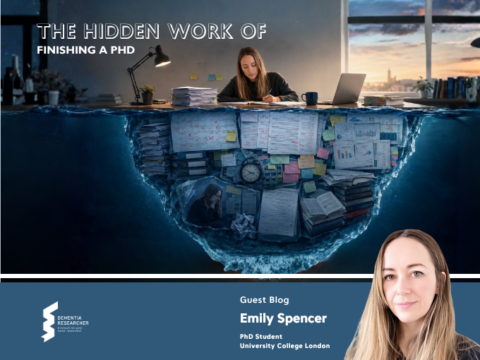
No one has ever claimed that doing a PhD is easy. Even the most capable candidate will have days or weeks or months where they question their ability, second guess decisions that they have made, or feel like they are battling to achieve the things that they need to. Since I started my PhD in 2022, I’ve looked on as friends and colleagues have had to dig deep – particularly in their final year when their thesis is occupying every waking moment. In today’s blog, I will be considering my own response to that pressure, particularly when it’s accompanied by a feeling of disconnection.
I would love to say that I am approaching crunch time in my own PhD journey, but in reality it still feels very far off. With 10 months left on the clock, I have finally finished collecting the video data I need for my primary study, but still have huge question marks looming overhead about the focus of my analysis, and how those findings will then inform the final phase of my research. Crunch time for many means the time spent translating all of their work into the final thesis, but that feels like miles off for me.
I still have an incredible amount to achieve in 10 months – without even considering the two-thirds of my thesis remaining unwritten.
In general, I’ve been feeling relatively relaxed about things. I know that I am hard-working, that I respond well to deadlines, and that even under pressure I can produce high quality outputs. Inexplicably, though, I am fully aware that in my last couple of supervision meetings I have come across as frazzled, overwhelmed and increasingly uncertain. It’s something I find extremely frustrating; it’s important to me that I present myself as together, as capable – and certainly not as an emotional wreck who can’t handle their workload.
Yesterday, one of my supervisors – very kindly – asked whether I am taking too much on. It was hard to know how to respond. Because yes, I am trying to manage a lot. I’m currently splitting my time between two different institutions and four different projects. I have a young child, and without any family nearby there are limited options in terms of taking some of that pressure off. In an ideal world I probably wouldn’t need to work alongside my PhD, but the reality is that’s not financially viable for us. I imagine that all of the things I’m juggling would feel a lot more manageable on a full night’s sleep – but in recent months those have been extremely hard to come by.
I absolutely love being a parent – I tell my son all the time that he is my best thing (a reference to one of the Mog books that he loves). But I’ve also found it to be lonely, at times. It isn’t as easy for me to do the things I used to do, whether that be in my personal life or professional life. A big part of my social life has always come from my church community, but going along to a service on a Sunday can now feel really isolating. Running around after my toddler trying to stop him climbing onto the stage or running into a pillar or throwing his stuffed cat at the vicar mid-sermon (all things that happened this weekend) does make me question the value of being there. As far as work is concerned, going for a drink at the end of the day would be lovely, but if it’s a day where I need to pick my son up from childcare then it just isn’t feasible. I was recently meant to submit an abstract to a European conference, but kept putting it off as I just couldn’t see how I could make it work. Even with the girls I play football with, I’ve made my excuses for almost every social that has been planned. In all of these contexts, I just feel like my personal situation is too different, too anomalous, and it’s easier to keep a distance.
Doing a PhD in and of itself can also be quite an isolating experience. For some, their PhD may form part of a larger, collaborative project, but for many of us, we are effectively on our own – save for fortnightly or monthly meetings with supervisors. I think in recent weeks that cumulative feeling of isolation or of difference has tipped over into the tangible, and made everything seem a bit more overwhelming than it needs to be.
Going back to yesterday’s disastrous supervision, my first instinct was frankly to go home and get some much-needed rest. Against my better judgment (and after a bit of a cry), I stayed in the office, and later in the day ran into a fellow student who I hadn’t seen for a while. While we were catching up, she was joking about how she has been super emotional in every supervision recently – at which point I told her I had been the same that very day. I was so grateful for that moment of connection, for the reminder that even if I can feel that my circumstances are very different to that of my peers, that there is also so much that we share – if only I keep myself out of self-imposed exile long enough to see it. When feeling disconnected it’s very easy for me to shut down and become more insular, but clearly that isn’t a good response. As crunch time approaches, it will be ever more important to be emotionally present, looking for those points of connection and fraternity. Supposedly a burden shared is a burden halved, after all.

Emily Spencer
Author
Emily Spencer is a PhD Student at University College London looking at improving how GPs communicate with people with dementia and their family carers about their future care. Emily previous had a 5 year career break to pursue a career as a musician, and has previously undertaken research on improving the care people with dementia receive from their GP practice, as well as end-of-life and palliative care provision in the community. Emily is also a new mum and will be writing about her experiences navigating motherhood and a research career.

 Dr Ajantha Abey
 Dementia Researcher

 Dr Yvonne Couch