 Print This Post
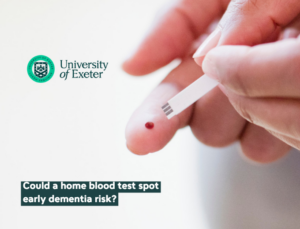 A finger prick blood test taken at home, paired with online cognitive testing, could one day help identify people at higher risk of developing dementia, according to new research from the University of Exeter.
The study, published in Nature Communications and funded by the NIHR Exeter Biomedical Research Centre, found that levels of two blood proteins linked to dementia correlated with how participants performed on a series of brain tests. Both the blood sample and the cognitive tests were completed by participants in their own homes.
The team measured Ptau 217, which is associated with Alzheimer’s disease, and Gfap, linked to broader brain decline. Tau showed the strongest links to cognitive performance. Together, the two markers allowed researchers to sort participants into low, medium and high risk categories.
The 174 participants involved were drawn from the wider PROTECT study, an online research platform that follows more than 30,000 UK adults aged 40 and over. Participants take regular cognitive tests covering memory, attention and executive function. For this study, they were posted a finger prick kit, took the sample themselves, and returned it by post.
Professor Anne Corbett, of the University of Exeter Medical School, led the work. She said: “Our previous research has shown that a finger-prick blood test can effectively be taken at home and posted to labs, and that we can identify the biomarkers in blood linked to dementia. This new study builds on that to show that we can link these biomarkers with performance on brain tests, giving us a potential way to predict risk of dementia.
“This work raises the potential for screening people for their risk without the need for clinic visits or complex clinical assessments. It would ensure the people at highest risk could be prioritised for monitoring and diagnosis, unlocking the best support and treatment for those that need it most.”
The wider context matters here. Almost a million people in the UK are estimated to have dementia, but only one in a thousand people showing the earliest signs of brain decline currently receives a specialist evaluation. Co-author Professor Clive Ballard said the combination of cognitive testing and postal blood sampling could offer an efficient way to reach people in the community who would not otherwise be prioritised for further assessment.
Professor Marian Knight, NIHR Scientific Director for NIHR Infrastructure, said the approach could reduce the burden on the NHS by moving early screening out of hospitals and clinics, while helping identify people earlier and tailoring treatment more effectively.
The research team note that further validation work is needed before this kind of testing could be rolled out more widely. The study was also supported by the NIHR HealthTech Research Centre in Brain Health and the NIHR Applied Research Collaboration South West (PenARC).
The paper, Alzheimer’s Disease blood biomarkers measured through remote capillary sampling correlate with cognition in older adults, is published in Nature Communications.
Get involved: The PROTECT study is open to anyone aged 40 or over living in the UK. You can sign up at protectstudy.org.uk.
 Dr Emma Law
 Alzheimer's Association

Good Morning,
Just seen on BBC New about your study.
Is it possible my husband and I could take part as well.
My husband has mild dementia.