 Print This Post
Although my substantive role is with ENRICH Scotland, I still retain a few hours within the Neuroprogressive and Dementia Network (NDN) in Scotland, which occasionally involves supporting the Scottish Dementia Brain Tissue Bank. This is a collaboration between the University of Edinburgh’s Alzheimer’s Scotland Dementia Research Centre and the NDN. I tend to think of my role, and those like me, as the foot soldiers. We are the ones who actually turn up at front doors armed with paperwork, consent forms and gratitude that sat nav works in rural Scotland.
I will not go into huge detail about the Brain Tissue Bank itself as the information is readily available online, but once someone has expressed an interest, had the process explained and discussed consent, they may then have the pleasure of a visit from a Clinical Study Officer like myself.
During these visits, and hopefully after the tea and biscuits, we establish capacity, obtain the appropriate consent and carry out a range of assessments. The outcomes are then registered and later become available to researchers when the brain tissue donation occurs post mortem. It is serious and important work, and heavily reliant on the goodwill of participants and family considering and agreeing to hand over their body when the time comes.
Alongside the original face-to-face visit, annual follow-ups are carried out using a telephone-based cognitive assessment called the Free-Cog. Ideally the same assessor carries these out each year to provide continuity, as people tend to respond better when they are speaking to someone vaguely familiar rather than a random stranger suddenly asking them to remember words and dates out of nowhere. The assessment itself is designed to be telephone-friendly and covers several areas intended to record any cognitive deterioration over time.
It was during one of these calls that I began wondering whether all people with dementia actually see themselves as belonging to one collective group in the way researchers, healthcare staff and policymakers often do.
The trigger came during the very first question of a recent assessment.
“Can you tell me anything that has been in the news recently?” I asked.
After a couple of seconds, the lady, who had relatively mild Alzheimer’s disease, replied:
“There’s not much good happening in the world just now, but I’ll tell you, he’s not a very good advert for dementia is he?”
I shall leave folks to decide for themselves who she may have been referring to; suffice to say it I didn’t think it was about the latest “Bake Off” finalist.
What struck me afterwards was not simply the humour or sharpness of the comment, but the assumption sitting underneath it. Her remark suggested she did not simply see herself as part of some broad, undifferentiated “dementia community.” Instead she appeared to view another’s in exactly the same way the rest of us might view anybody else in public life — with judgement, opinion, criticism and perhaps a touch of exasperation.
It made me wonder whether we in research, healthcare and policy-making are often more invested in the idea of “the dementia community” than many people actually living with dementia are themselves.
Healthcare systems have always naturally grouped people together because systems more or less depend upon categories. We discuss cohorts, pathways, interventions and lived experience groups. These are useful and necessary concepts, but they are not always how individuals see themselves. Despite extensive research into person-centred care, the old “appendix in bed 4” mentality can still occasionally linger in healthcare. Scott (2022) concluded that “a one-size-fits-all approach to helping people navigate their lives following a diagnosis of dementia does not comport,” and perhaps, even though we all know that, we need to be reminded on occasion.
Most people do not abandon the identity they have built over seven or eight decades because of a diagnosis. They remain the retired joiner from Galashiels, the former Church of Scotland Minister from Dunbar or the woman still convinced nobody else in Scotland can make soup like she does. Dementia may become part of their life, but not necessarily the defining membership card of some collective movement.
In truth, people with dementia probably view others with dementia in much the same way the rest of us view each other. Some they warm to instantly, others perhaps less so. A diagnosis does not suddenly create automatic solidarity any more than owning a Labrador or supporting Scotland at football creates universal harmony. If anything, the latter generally creates collective disappointment interspersed with brief optimism every 28 years.
Working in research you occasionally catch yourself unconsciously speaking about “people with dementia” as though they represent one unified voice, when in reality they remain gloriously individual. Some become passionate advocates for research and awareness campaigns, as we now frequently see through their involvement in conferences and research events. Others prefer privacy and quietly get on with life, with the diagnosis just being another thing they have to deal with day to day like arthritis. Some want to discuss clinical trials and policy reform while others would much rather discuss horse racing, grandchildren or why the council no longer empties bins properly, a favourite topic regardless of cognitive state.
Something that still surprises me after many years is how humour survives. Not universally, of course, but often far longer than society expects. Likewise personality, political opinion and the ability to deliver a devastating one-liner at precisely the moment healthcare professionals ask daft questions. Anyone who has spent time working around dementia will know that cognitive impairment does not necessarily diminish someone’s capacity to hold very firm views on politicians, football referees or the price of a bacon roll at a garden centre.
Perhaps that is actually reassuring.
Dementia may alter cognition, memory and function over time, but individuality often remains remarkably intact. Beneath the diagnosis there is still a person with their own preferences, prejudices, humour and worldview. Sometimes healthcare remembers that well and sometimes, if we are honest, systems unintentionally smooth people into categories because categories are easier to manage on spreadsheets and meeting agendas.
Yet every so often a supposedly routine telephone cognitive assessment reminds you otherwise.
Usually with one perfectly timed sentence.
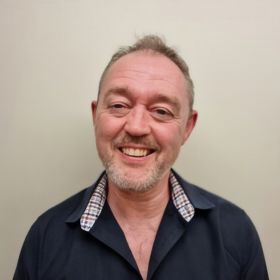
Bernie McInally
Author
Bernie McInally is a Clinical Studies Officer at NHS Lothian and the Neuroprogressive and Dementia Network. Bernie’s background is in Nursing, working in Mental Health and with Older People. He retired from full time NHS clinical work, and is now back working in Clinical Research supporting delivery of the Enabling Research in Care Homes (ENRICH) Scotland. He is passionate about research delivery, and opening access to people in all communities.

 Rahul Sidhu
 Ajantha Abey
 Dr Clíona Farrell
 Beccy Owen
 Dr Sam Moxon
Yes as Kate Swaffer so elegantly put it “If you have met one person with dementia, you have met one person with dementia “