 Print This Post
This World Alzheimer’s day, 21st September 2025, I am on a career break, taking some time between postdoctoral roles in the Alzheimer’s disease field. During this time away from academia, and all the joys and difficulties it throws my way, I’ve been prompted to reflect on why I am still drawn to study and research Alzheimer’s disease. I think that this is an important and exciting time to be in the Alzheimer’s field, with breakthroughs bringing much needed hope. In this blog, I’ll discuss the progress, along with some challenges that still remain.
The numbers don’t lie, and the sheer amount of people affected by Alzheimer’s, either having the disease themself, or caring for a loved one with it, is huge. Almost 1 million people in the UK have a dementia-causing disease, with Alzheimer’s making up a significant proportion of these cases (60-80%). Alzheimer’s disease and other dementias are the leading cause of death in the UK, and 1 in 3 of us will be directly affected by it in our lifetime. Thinking of someone I know or love with Alzheimer’s disease triggers heartbreak and distress. The symptoms of dementia cause an insurmountable emotional burden, as well as taking a physical toll. Yet, despite huge amounts of research going into this devastating disease, we still do not know two paramount pieces of information. Why someone gets the disease, and how to cure it. I think that it’s these unknowns that draw researchers to the field.
Less than 5% of people who develop Alzheimer’s disease have a known genetic cause – such as a dominantly inherited familial gene mutation (like in the APP or PSEN1/2 genes) or by having trisomy 21. Therefore, in the majority of cases, the disease is referred to as sporadic, and why someone develops the disease is still a question mark. Huge strides have been made in understanding the underlying pathological mechanisms and genetics of the disease. We know which genes, proteins and biochemical pathways are involved in the disease processes, and fundamental scientists are continually furthering our understanding of how brain cells are affected by disease processes. But why these specific biochemical changes occur in someone’s brain is yet to be fully understood. There are lifestyle risk factors, as well as genetic risk factors, but, in most cases, there is no final answer to why someone develops Alzheimer’s disease, and what kickstarts the disease process. I think that this unanswered question, and the possibility to help people by solving it, is a massive inspiration to researchers to dive deeper.
Likewise, there is no cure for Alzheimer’s disease, and very few disease-modifying treatments. If you ask most researchers what their dream outcome of their studies would be, it would be to find a viable treatment to cure Alzheimer’s disease. The Alzheimer’s Research UK “For a cure” campaign really sums up where our research efforts are pointed.
However, for unanswered questions to be desirable to study, there must be hints that we are making progress. And importantly, with both of these unknowns, it feels like we’re at the precipice of real answers. I started working in the Alzheimer’s field around 5 years ago, and in this time alone, there has been phenomenal progress across many areas. Firstly, the approval of several disease-modifying targeted therapies (anti-amyloid monoclonal antibodies) for Alzheimer’s disease has made waves in the field. Despite drawing some criticism, these developments show that tangible progress can be made by targeting disease-relevant pathways. Moreover, this progress is inspiring further drug development and clinical trial efforts. This past summer, positive clinical trial data was presented from Roche about their brain-shuttle/anti-amyloid drug, which reports to significantly reduce side-effects of existing anti-amyloid therapies. Better still, many other disease-relevant targets are being examined for therapeutic potential. The 2025 Annual Alzheimer’s Clinical Trials Pipeline report shows an increase in new phase 1 clinical trials compared to previous years, with 182 active clinical trials for Alzheimer’s disease. I hope that the momentum in this area is maintained, and pharmaceutical partners continue to find it a worthwhile venture.
 To me, another area with some of the most impressive progress is the biomarkers field. The development of more sensitive biomarkers for Alzheimer’s disease is not only allowing the aforementioned clinical trials to continue with specific and accurate outcome measurements, but also has the potential to overhaul current diagnostic norms in the very near future. This year, a landmark trial, the “Blood Biomarkers Challenge”, was launched in the UK to test the use of a p-tau217 blood test for the earlier diagnosis of Alzheimer’s disease across over 1000 individuals. With the rapid development in biomarkers screening, there is a very-near future where blood-based biomarkers can be used in the clinic to more accurately, and cheaply, diagnose someone with Alzheimer’s disease, without invasive procedures. Accurate diagnosis is not only important for future therapies that come along, but also for allowing appropriate lifestyle adaptations to be made so that someone can continue living with dignity as long as possible. These breakthroughs in both the treatment and biomarkers fields, which have been hugely informed by advances in basic science, offer much inspiration to continue researching Alzheimer’s disease.
Although these big advances are exciting, we can’t forget the challenges that are prevalent in the Alzheimer’s disease field. Funding is still a hugely limited resource. Grants are highly competitive, and researchers are forced to spend a large chunk of their time trying to secure and maintain funding. Inflation and rising costs are also not being met by funders, limiting scientists resources. In the UK, the charity sector makes up a large amount of funding for dementia research – it would be great to see government prioritising dementia research more. Internationally, such as with the funding cuts suffered by the NIH in the US this year, collaborative research grants are threatened too. Good research thrives on collaboration, but some international partnerships are currently under strain.
Not only is research funding a difficulty, but funding for healthcare is critically low. This threatens access to good care, where public health systems, such as the NHS, are overburdened, with long waiting lists. As mentioned above, access to memory clinics, PET scans or lumbar punctures, are critical for early Alzheimer’s disease diagnosis. And early diagnosis goes hand in hand with getting the desperately needed support for patients and their loved ones. And of course, when access to healthcare is precarious, this can lead to further disparities for those in difficult socioeconomic circumstances.
Finally, a big current issue in the Alzheimer’s disease and other medical research fields, is the lack of diversity in research practice itself. Historically, most research was carried out on white men, and still today, many studies focus only on samples or individuals of white European ancestry. This lack of representation limits interpretations that can be made from datasets. The field at large needs to address this challenge head on, and researchers should do everything they can to improve upon racial and sex diversity in their work. Our datasets should represent true world populations. I see certain researchers doing their utmost to address this, and I truly hope it becomes the norm soon.
Overall, despite these and other challenges faced by the field today, I am optimistic at the state of the Alzheimer’s disease research field.
It feels like we are at a turning point, with many more breakthroughs on the not so distant horizon.
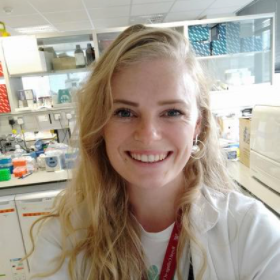
Dr Clíona Farrell
Author
Dr Clíona Farrell is a Postdoctoral Researcher in the UK Dementia Research Institute at University College London. Her work focuses on understanding neuroinflammation in Down syndrome, both prior to, and in response to, Alzheimer’s disease pathology. Originally from Dublin, Ireland, Clíona completed her undergraduate degree in Neuroscience in Trinity College, and then worked as a research assistant in the Royal College of Surgeons studying ALS and Parkinson’s disease. She also knows the secret behind scopping the perfect 99 ice-cream cone.


 Dementia Researcher
 Dr Becky Carlyle
 Dr Emma Law

 Dr Yvonne Couch