 Print This Post
I attended the European Alzheimer Disease Consortium (EADC), a gathering of clinical researchers from many European countries to discuss all things dementia research related, in late October 2025. This event was hosted by Dr Tom Russ from the Alzheimer Scotland Dementia Research Centre in the University of Edinburgh’s magnificent Playfair Library. One of the presentations made me think more closely about AI (Artificial Intelligence) and the potential to change many of the things we do in research.
Dr Mike Weiner, Professor Emeritus of the University of California San Francisco (UCSF) did a talk about fully automated conversational voice agents and how they will revolutionise clinical research trials and routine care. He outlined the ideas the UCSF have been working on: A fully automated Virtual clinician to perform the CDR.
The CDR is a clinician led interview which is often used as a primary outcome in clinical trials to track changes in cognitive function over time. The tool is used to assess the severity of cognitive impairment in individuals, particularly those with Alzheimer’s disease or other types of dementia. It helps to determine the level of dementia based on a person’s cognitive abilities, daily functioning, and overall impairment.
It is a structured interview conducted with the carer then the participant or patient. It evaluates six domains of cognitive function: Memory – It evaluates the individual’s ability to recall recent and past events. Orientation – It assesses the ability to be aware of time and place such as knowing the day of the week, the location of the hospital or clinic. Judgment and Problem Solving – It measures the person’s ability to make decisions and solve problems in everyday situations. Community Affairs – it looks at the individual’s ability to manage social relationships and engage in community activities. Home and Hobbies – it assesses how well the person can manage household tasks and engage in hobbies or leisure activities. Personal Care – it evaluates the ability to manage personal hygiene and other daily self-care activities.
For each domain, the clinician assigns a rating based on the severity of impairment. The ratings are as follows:
- CDR 0 (No Dementia) – No evidence of cognitive impairment.
- CDR 0.5 (Questionable Dementia) – Mild cognitive decline, but the person is still functioning well. Some difficulties are noted but do not significantly impair daily life.
- CDR 1 (Mild Dementia) – Clear evidence of cognitive impairment in at least one domain, but the individual can still manage most daily activities with some assistance.
- CDR 2 (Moderate Dementia) – More significant impairment in multiple areas of function, requiring considerable help with daily living.
- CDR 3 (Severe Dementia) – The individual is severely impaired and unable to perform many basic activities of daily living. Extensive assistance is needed.
While the CDR is a widely used and reliable tool, it relies on the accuracy of the information provided by the caregiver or family member and on the clinician’s values ascribed to answers given by the participant, as to where they score on the rating scale. All of which make this tool highly subjective.
This is where the work being done in UCSF is of interest to anyone involved in clinical trials. We were given a demonstration of how the automated voice agent could ask the CDR questions and modulate for various answers. And as with all AI tools it seemed a bit clunky and….automated! They had devised the tool from working with colleagues and by answering the CDR themselves. The real test will be once they have added 8000 spoken CDRs to the database of real people with dementia and their care givers. This has been made possible because Dr Weiner was the founder of the ADNI study, started over 20 years ago, ADNI being the Alzheimer’s Disease Neuroimaging Initiative study. From this, 11 years ago they developed a Brain Health Registry and this stands with over 100,000 volunteers, which is where they will get their 8000 pairs to input on the CDR and develop a fully automated conversational voice agent capable of delivering the CDR for clinical trials. Their reasoning is that this will take away the subjectivity to this type of rating scale and make it more accurate and standardised for use in clinical trials.
My thoughts on this are fourfold:
- How does one mitigate for the complex and difficult interviews carried out by clinicians whereby the direction of travel of the CDR is unexpected and can be exceptionally emotional for the caregiver during their interview as they have a realisation of all the deficits in their loved-ones reactions and capabilities. I have had firsthand experience of this during CDR interviews whereby that the caregiver becomes upset and may cry. We have to pause from the interview to allow time for recovery. This is a time where I put my research hat to one side and show empathy and understanding for the difficulties faced.
- If a fully automated CDR is possible, it will inevitably save money and potentially time and will this lead to other rating scales being developed? I feel this will de-skill clinicians but perhaps I am taking a luddite view on this.
- Most controversially – will we negate the need for clinicians completely? Why pay all that money for clinical expertise when we can have AI on hand to do it for us.
- Will the AI agent be able to understand regional accents and local vernacular?
I am undecided whether this is a good development or not. I fear we will lose the empathy and understanding coming from the expertise a clinician brings to the table when interviewing a caregiver or a person with dementia and the nuances picked up during these interviews. But I can also see that to take the subjectivity out of a rating scale which is relied on as a primary outcome measure within clinical trials has to be a positive way forward.
The future is nearly here – is it the dystopian future we fear or is it enlightenment and progress? You decide. Before it is decided for you!
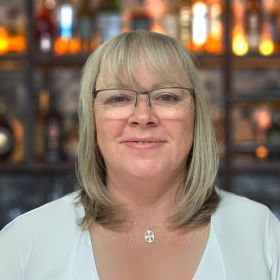
Dr Emma Law
Author
Dr Emma Law is Strategic Manager for the The Neuroprogressive and Dementia Network in Scotland. Emma has 13 years experience as a Clinical Trails Network Manager and over 35 years experience as a Nurse, many of which were spent in the delivery of Clinical Research Trials. Emma completed her PhD and is passionate about giving people living with dementia and their carers access to participate in research.


 Dr Chloe Fawns-Ritchie
 Dr Yvonne Couch
 Dr Clíona Farrell
 Beccy Owen
 Dementia Researcher
 Rahul Sidhu