 Print This Post
Wasn’t that a snazzy title? This one I am actually writing way back in May when I came across a Times Higher Ed article that I sent to a variety of colleagues and by doing so, annoyed them intensely. But let’s not rush into the ‘today we’re going to talk about’ bit before we do some definitions for both ends of the spectrum. For the young people listening, pedagogy is the theory and practice of teaching and learning, essentially, how knowledge is taught, shared, and understood. For the old people listening, Gen Z is apparently anyone born after 1997 (I know, it’s horrifying right? I was actually just old enough to remember the general election results from that year). So hopefully it’s obvious that today we’re going to talk about whether we need to adapt the way we teach the young people of today.
I’ll start by saying that I also found the THE article vaguely annoying. I won’t cite it but I will describe it. It starts by listing insults supposedly aimed at Gen Z (“lazy”, “chronically online”, “entitled”) before mirroring them back at educators (“technologically impaired”, “boring”, “condescending”). It criticises us as educators for stereotyping Gen Z, while simultaneously stereotyping educators, and then it proceeds to distil an entire generation down into a pool of humans somehow irrevocably neurologically transformed by TikTok, Covid and AI. It slides very quickly from social observation into pseudo-neuroscientific determinism. It treats students as products of technological conditioning rather than people capable of adaptation, discipline, boredom tolerance, reflection, or intellectual growth.
But what it does raise is an interesting point about the speed of the developing world and the speed of educational adaptation.
In another article on the same site, which was much less provocative and much more informative, the author pointed out that the majority of jobs that candidates were training for now didn’t exist 10 to 20 years ago. And yet our courses have not massively adapted. For a lot of biology and medicine and chemistry and physics we teach very similar core material to what was taught 20 years ago. And yet 20 years ago if I had wanted to find out more about the TCA cycle the internet was still in its relative infancy. I did not have a smart phone in my pocket, in fact I had a very clunky affair with rubber buttons, I did have a laptop but it weighed a ton. My University had a ‘computer room’ where you could go and spend some hours browsing papers but we made notes on paper in lectures and did not have instant answers to hand.
Part of the criticism of the original article was basically ‘if you’re going to record your lecture then why should I bother going when I can watch the recording in my pyjamas at 11pm with some pot noodles’. Now, this is where I become way older than I probably actually am because even as an undergrad I could see this as an issue. We had lecturers who, at that stage back in the mists of time, printed out their PowerPoint slides and left a pile for you to collect by the door. And of course, you always had a mate who just told you to grab one because they were rancidly hungover. But for me, my two favourite lecturers were a guy called Mike (who’s last name I have forgotten) who insisted on doing all his lectures on acetates using an overhead projector, and Alan Crossman who wrote a great neuroanatomy text book and who would basically put up a picture of a brain and talk for an hour. These two lecturers forced me to engage with the content, mainly by forcing me to take notes.
Now we have the issue that almost no students need to take notes because they can get the answer to anything very quickly, whenever they want.
So, the original article posits the question, how do we engage these students in the same way I was engaged by the acetates and the brain picture?
The author suggests that Gen Z have zero attention span, and another article suggests the way we capitalise on this is essentially by making our lectures in shorter chunks with ‘cliffhangers’. Part of me thinks this is utterly ridiculous because frankly who wants to hear: ‘Coming up next in the exciting world of energy production, you’ll never guess what happens when pyruvate is diverted into the TCA cycle’. Nobody. And the other part of me also thinks it’s ridiculous because these people are going to have to be adults at some point, with adult jobs where you actually do have to focus for more than two minutes on a task and so maybe this is the time where they should be learning to grow up.
Having said all that there is somewhat of a case of moving with the times. I loved my old lecturers for just talking at me for an hour because it forced me to take notes. This generation, according to a paper by Sarah Chardonnenes on educational practices in the digital age, require more than just the ‘passive passing on of information’. They need more of an interaction. In the original annoying article, which is written in the tone of a Gen Z student, they say they need a ‘reason to show up in person’.
I teach at a University where we do quite a lot of small group teaching. My tutorials vary widely from year group to year group and from topic to topic. I do journal clubs, journal club ‘rap-battle style’ with students presenting two different papers that contradict each other, reverse tutorials where they teach me, quizzes, all sorts. But this interactive style of teaching also allows me to be creative with the students. One of my favourite tutorials is a third year one for more advanced students where we talk about inflammation and mood disorders. I start by getting them to tell me the holes in the current research, or where the clinical gaps are, then I get them to walk me through what they would do to discover a new drug or a new biomarker if I gave them a million pounds.
 The advantage of this approach is that the answers are not set in stone. They need to be up to date with some of the literature but they also need to know some fundamentals of techniques and how they’re applied, they need to think about ethics and how to frame research questions. It’s much more flexible as an approach and there is no ‘one size fits all’ answer in the way there would be if I gave them an essay and we worked through that. There’s a case for mixing this in to lectures as well but this runs the risk of the age-old problem of one person answering everything vs you picking on random audience members. The former doesn’t allow everyone to contribute and the latter makes more introverted students nervous.
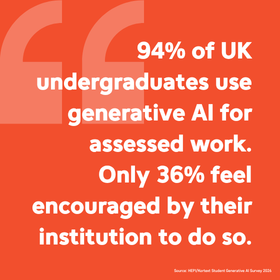
If I do set them an essay, I try and make it one where they are required to come down on one side or the other. For my second-year medics when I taught neuroscience, their opening essay of the year was entitled ‘Astrocytes are the most important cell in the brain. Discuss’. Now, I’ve just fed this into chatGPT and asked it to tell me what it would write. And it does outline a great essay where it talks about the role of astrocytes in the brain and compares them to neurons, it defines ‘importance’ and ‘brain function’ and gives some good primary papers. But actually what I want from this essay is for them to realise how many different types of cell there are in the brain. It has totally failed to talk about microglia, or endothelial cells, or oligodendrocytes.
For just memory or knowledge-based tasks, Chardonnens suggests that generative AI is used as a way to personalise learning. She uses the example of maths students who were all given essentially the same assessment, and then they worked through the problems they got wrong with the tool. This allowed their learning to be personalised and at their own pace. So with tasks that you give your students to take away, consider a basic Q&A style list they work through with chatGPT to highlight their weaknesses and work on them.
To get them to focus, much of the literature suggests that actually we need to think more about metacognition. Even that annoying THE article suggests they know they can’t concentrate, so forcing them to think about that, and to set learning and achievement goals for themselves prior to starting really helps them to have something to aim for and brings them more focus. I am very much a millennial but even I know the satisfaction of ticking off a to-do list at my desk every day.
The final thing we need to think about from a teaching perspective is soft skills, or things that chatGPT can’t teach them.
I know we believe that our job is to pass on our knowledge, but actually our job is to pass on our wisdom.
They have all the knowledge, it’s two clicks away at any moment. But it won’t tell them how to give a good scientific talk, it won’t teach them how to pitch an idea to an investor, it won’t tell them how to think critically about a paper, it won’t tell them how to creatively problem solve in the lab. All of these things require them to be present, to engage and to practice in person with other humans.
So yes, maybe Gen Z are different from us. They’re much more technologically aware than we were at their stage. But our job is to ‘keep up with the field’ in terms of our research and so there’s no reason we can’t keep up with the field in terms of pedagogy and just be a bit more imaginative. Part of the trouble here, of course, is that a lot of us are doing this on the fly around all the other jobs we actually do, so integrating innovative teaching practices can be challenging. But for me personally, I like mixing my tutorials up a little because fundamentally if I’m enjoying myself, hopefully so are they.
Dr Yvonne Couch
Author
Dr Yvonne Couch is an Associate Professor of Neuroimmunology at the University of Oxford. Yvonne studies the role of extracellular vesicles and their role in changing the function of the vasculature after stroke, aiming to discover why the prevalence of dementia after stroke is three times higher than the average. It is her passion for problem solving and love of science that drives her, in advancing our knowledge of disease. Yvonne shares her opinions, talks about science and explores different careers topics in her monthly blogs – she does a great job of narrating too.

 Dementia Researcher
 Rahul Sidhu

 Dr Emma Law
As a semi-retired lecturer, I find myself craving the days of lively tutorials around a challenging question or issue, and the interaction patterns with students. I admit I find myself falling into the pit of ‘In the old days, students were …’ Thank you so much for such a balanced and relevant perspective. Makes me wish I was looking at a career in the evolving world! (At 72, unlikely! 😄).