 Print This Post
If you’ve been reading my blog for a while now, then you’ll already know that I consider the personal development of my team as critically important for the success of my lab. Motivated and ambitious people that feel they are working towards scientific goals, but also towards their future careers, are fantastic to have in the lab. They ensure that things get completed, push to publish, and drive things forwards in ways that you might find difficult to do yourself, given all your competing priorities. There is, however, a major problem with these people. In almost all cases, to progress their careers and maximise their opportunities, they’re going to leave. This leaves you in a really difficult position, as suddenly, there are conflicting motivations at play. You’d love to keep this person in your team, as you trust them, they do great work and you know your lab productivity is in safe hands with them at the wheel. But for them? They have to differentiate themselves from you, to establish their independence, and at some point, that independence means leaving you behind.
This blog therefore is going to deal with where that leaves you as a PI. First, we’ll start with some practical advice on how to minimise the impact when a postdoc leaves, or any one person in your lab. Hopefully, someone leaving the lab is a success story, and they are off to a bigger and brighter next step. In the current funding landscape though, this won’t always be the case – sometimes contracts come to an end, and there is no clear onwards destination. So we’re going to talk about structures in the lab that you can implement throughout someone’s time in your lab, that will hopefully keep important knowledge in your team, even if people leave under stressful, less than ideal circumstances. Then, we’ll get into the wishy washier stuff, thinking about the conflicting goals of staff versus PI, and how to reframe this tension positively.
No one is irreplaceable
The very first thing to say is that no one is irreplaceable. No matter how much it seems that way, I have always discovered that when an “essential” team member leaves, others morph and step up to fill that gap. As a group of individuals scientists can be somewhat ruthless with our time, and it doesn’t make logical sense to help out with work that someone else is already doing successfully. But once that person leaves, you may be surprised by the willingness of others to move forwards and fill the gaps they’ve left. It’s your job to take a rational look at what work needs to be continued post departure, what might be worth dropping, and then figure out how the remaining work best fits the skills of your team. I’ve found it’s best to make this a discussion, to enable people to best work to their strengths and interests, and sometimes, the reshuffle logic might surprise you.
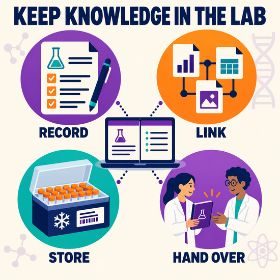
Good offboarding begins well before someone’s final day. Shared records and clear handovers help the science continue after they leave.
Record keeping is the insurance policy
Preparation for leaving is all about record keeping throughout a position, making sure that critical information exists outside of a single person’s head. If any of my lab are reading this, they’re going to have a little chuckle. They’ll tell you that I’ll get very into talking about record keeping and databases for the lab once every few months, and then utterly fail to follow up on it until the next time. In my lab, the electronic lab notebook sits, (or should sit) as the uniting force for most forms of data, with a shared Teams space for databases that complements individual notebooks. As a PI, LabArchives is a wonderful thing. While everyone will organise their books a different way, it allows for protocols to be uploaded alongside results, can be used to smoothly link raw data to processed outcomes, and can easily be shared with incoming team members so that they can get an overview and search for details in a way that just can’t be done with physical books.
The bit we haven’t quite cracked as a team is the analysis code and the large data files. Through our GSK collaboration we used a Trusted Research Environment and have actual paid data curators in charge of organising it. This arrangement works really well for the postdocs on the project as they collaborate on analyses, but as yet, none of the PIs have found the time to log in and figure their way around it. There’s GitHub to use as a code repository, and various storage servers for large files, but given an afternoon, there is no way at this point that I’d be able to locate a particular image file that I needed to add a scale bar to, without the help of the person who put it there. So that’s something for me to work on, and something that will become increasingly important for all of us as science continues to increase throughput and generate ever more data.
Build an offboarding protocol
The final practical thing to suggest is to have an offboarding protocol that every member of the lab goes through. I have to hold my hands up at this point – I haven’t implemented this yet. But my mentor, Richard Wade-Martins has an excellent process, where the departing member records and annotates all the resources they have generated, all the samples and reagents they’ve left in the lab, and where their critical imaging files are located prior to leaving. This isn’t something that can be rushed off in the final afternoon, it’s a process that needs to be started well in advance, and can be coupled to the team member sorting through their stuff, throwing out things that can be thrown out, and handing over key reagents to centralised stores or specific people in the lab. If this is something you’d like to implement, then there’s a great example and some more practical tips here in a document from Harvard Data Management.
The harder challenge when a postdoc leaves
So far, this has all been about making sure the lab doesn’t lose the scientific plot when somebody leaves. The harder challenge is making sure that, as PI, you don’t lose the emotional one. Thus far, we’ve had a solvable problem with clear, practical solutions, and unfortunately, emotions aren’t like that. In a way, this career is all about departures, and by the time you’re a PI you’ll tend to have started over again in a new city at least once, and will have made and drifted away from friends as you all move around the world more times than you can remember. This temporary nature of all your relationships is a feature of being a graduate student and postdoc, but this changes when you become a PI. All of a sudden, you’re the person that stays in the same place, and you can feel like you’re the door, while everyone else is rotating around you. This brings the joy and excitement of meeting interesting people from around the world, of exploring different backgrounds and ideas, but also brings a genuine feeling of loss and even grief when you are left behind. In the current funding environment, there’s also the additional aspect of really wanting people to stay in your team, but not managing to secure the support for them to do so. When people leave under these circumstances, there is happiness that they have progressed to their next opportunity, but in addition to all the other feelings, there’s also guilt and failure. It’s a lot to manage.
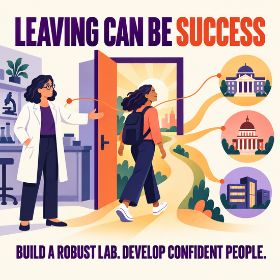
A researcher moving on is not necessarily a failure of retention; it can be evidence that the lab helped them develop the confidence and skills to progress.
Build a network that stays put
The first thing therefore, is to prioritise making long-term relationships for yourself. Once you get to the PI level, make sure you work on building a network of peers that includes people who aren’t going anywhere soon. That can obviously include other PIs, but don’t forget your administrators and professional services staff. They also sit at the centre of the revolving door, and experience the frequent losses and change that comes with this career. There is nothing wrong with being genuinely upset when someone leaves your team. But there is an important distinction between having those feelings and making the departing person responsible for managing them. This network will be particularly helpful when you feel injustice or guilt about the whole thing, as it will give you somewhere outside the person moving on to vent. Fellow DR blogger Yvonne Couch recently had to listen to me rant about the lack of PhD funding in the UK, and how I’d spent all this time and energy training an amazingly talented person, only to have to send her off to a better resourced lab and more senior PI in a different country. This frustration was (and still is) real, but it can’t be shared in your team, it has to go outside.
Now, even those of you who don’t have a particularly eagle eye, will have noticed by now that I’m still coping with the recent departure of a team member. We had known it was coming for quite some time, after just missing out on so many PhD funding applications. But still, when we had the meeting where it finally became obvious that the only remaining outcome was for them to move, to a really amazing but different place, it took every single ounce of my being not to cry. I was not gracious, I was not able to be excited in that moment. I did apologise, both in that meeting and a week or so later when I’d manage to rein in my feelings, but it was probably the most difficult professional moment of my career so far. The alternative option has turned out to be by far the better option for the team member for so many reasons, both personal and professional, but the whole thing still stung deeply. So how did I pull myself out of this pit? Through making sure I focused on the positives, and thinking practically about how to handle the negatives.
Why staying should be a decision
Part of reframing is that mobility remains important for early career researchers. Moving exposes people to different levels of resources, different ways of working, styles of management, and enables them to find their strengths and build a diverse skill set. For this reason, even a sideways move may be viewed as a positive. Staying should therefore be an active career decision that benefits the researcher, rather than the path of least resistance because retaining them benefits the PI. For example, PhD students may stay to finish a paper, but if they want to move up, they should very carefully consider whether to start the next one. These conversations are worth having regularly at career development meetings to ensure that expectations and goals are matched from both sides, and that nothing comes out of the blue.
How we define success as a PI
We come therefore, to how we define success as a PI. There’s the easy metrics, big grants, high-impact papers, flashy talks at mega conferences. But there’s also the people you train. And unfortunately, one of the strongest metrics of your success in that realm, is the future they create once they walk out of your door. By building this expectation into your relationship from the start, you’re actually building your network for the future. Yes, some of these people will go on to build labs, and could be future collaborators. But many more will go to work for research funders, for pharmaceutical companies, in policy and politics. Having your reputation in the wider world be that you built this great lab, with great science, but also developed great people who’ve gone on to do amazing and varied things, is priceless.
Sometimes, on my really low days, I head on to LinkedIn and look at what those people who spent time in my old labs are doing, and it is truly affirming to see them out in the world as doctors, company directors and inspiring school teachers. So I don’t think the answer is to get better at not caring when people leave. If you’ve worked closely with someone, watched them grow, relied on them and enjoyed having them around, of course it’s going to hurt when they go. Instead, the trick is to build a lab robust enough to cope with their departure, while building people confident enough to make it happen. Then you tidy up the freezer, reshuffle the experiments, try not to lose the data, and watch with pride as they go off and do something brilliant without you. Perhaps being the door isn’t such a bad job after all.

Dr Becky Carlyle
Author
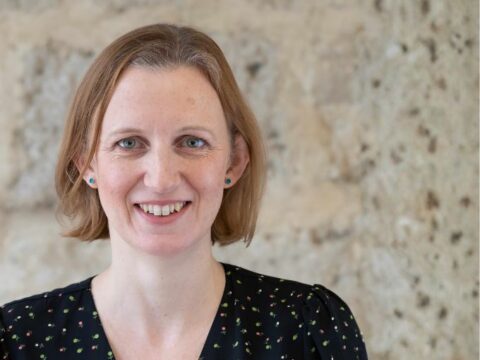
Dr Becky Carlyle is an Alzheimer’s Research UK Senior Research Fellow at University of Oxford, and has previously worked in the USA. Becky writes about her experiences of starting up a research lab and progressing into a more senior research role. Becky’s research uses mass-spectrometry to quantify thousands of proteins in the brains and biofluids of people with dementia. Her lab is working on various projects, including work to compare brain tissue from people with dementia from Alzheimer’s Disease, to tissue from people who have similar levels of Alzheimer’s Disease pathology but no memory problems. Becky is also a mum, she runs, drinks herbal tea’s and reads lots of books.


 Dr Yvonne Couch
 Dementia Researcher
 Dr Becky Carlyle

Becky makes a claim in this one that is worth arguing with: staying in a lab should be an active career decision that benefits the researcher, not the path of least resistance because keeping them suits the PI. It sounds obviously right written down. It is much harder to act on when you are the PI holding a half-finished project together, or the postdoc who has a mortgage and a contract ending in four months. So which is it in practice, and has anyone ever told you plainly that it was time to move on? We would like to hear from both sides of that conversation.