 Print This Post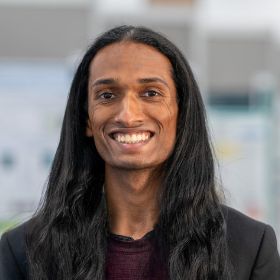
Dr Ajantha Abey
Ajantha Abey studies neurodegeneration using human stem cell models, with his current postdoctoral work focused on Parkinson’s disease. His route from Sydney to Oxford has included neuroscience and humanities study, research into canine dementia, a research assistant role and a PhD using stem cell models. He reflects on international moves, funding uncertainty and learning to communicate with confidence.
“Do your homework on potential supervisors and bosses.”
Finding neuroscience at university
I enjoyed science at school and was attracted to research through family members and school experiences, but I had not considered studying neuroscience until university. First-year human biology and psychology made me realise that everything to do with the brain was the most interesting part of my studies. I became increasingly interested in memory and ageing and wanted to put that interest towards a major societal issue. Dementia research offered both an interesting challenge and an area of serious need.
Building research experience in Sydney
Between 2014 and 2017, I studied at the University of Sydney, majoring in Neuroscience, alongside Latin and Ancient History. My qualifications were a Bachelor of Science (Advanced) (Honours I) and Bachelor of Arts. A study abroad year at the University of Bristol in 2015–2016 gave me experience of living in the UK. In 2018, I completed an honours research project at the Sydney Brain and Mind Centre studying Alzheimer’s-like dementia in pet dogs. Honours was part of my undergraduate degree: a year-long research project culminating in a thesis. I stayed on as a research assistant in 2019, continuing work on canine dementia neuropathology and regenerative medicine trials.
Taking time to choose a PhD
My research assistant year gave me time to work out what I wanted to study, contact potential supervisors and apply for PhD places and funding. Earning a salary also allowed me to build savings before starting doctoral research. I emailed researchers whose work interested me and travelled to the UK in summer 2019 to meet people and visit laboratories. Those conversations gave me useful advice and a sense of the people and places I might work with. Some of the people I met later became my supervisors, collaborators and even my examiner.
Moving countries during the pandemic
In 2020, I moved from Australia to Oxford to begin a full-time PhD using stem cell models to study Alzheimer’s and Parkinson’s diseases. I wanted international experience and the chance to work with established laboratories using induced pluripotent stem cells, or iPSCs. Moving countries was a major change, made more challenging by the start of the COVID-19 pandemic. My PhD was titled “Investigating selective neuronal vulnerability in Alzheimer’s and Parkinson’s disease with induced pluripotent stem cells” and was supervised by Richard Wade-Martins, Colin Ackerman and Nora Bengoa-Vergniory. I was funded mainly by an Oxford Clarendon Scholarship, plus a Goodger and Schorstein scholarship. I completed my PhD in 2024 and began my postdoc at Oxford in November that year.
Starting my postdoc
I am a Postdoctoral Research Scientist in the Wade-Martins Group, also known as the Laboratory of Molecular Neurodegeneration, in Oxford’s Department of Physiology, Anatomy, and Genetics. The ASAP-funded project I work on is led by Professor Steph Cragg and focuses on dopamine and acetylcholine dynamics in the striatum. My part involves making stem cell models of striatal cholinergic interneurons for in vitro modelling in human cells, supporting Parkinson’s disease research.
Reconsidering the next destination
During my PhD, I had been working towards postdoctoral or industry research in the United States. I visited laboratories, spoke to researchers at conferences and built contacts there. After finishing, the changes I saw in the US political and research environment, including uncertainty around hiring, funding and immigration, contributed to my decision to remain in the UK.
The working week behind the experiments
I work full-time across the office and laboratory. Reading papers, developing ideas, planning experiments, analysing data and writing can be done on a computer, sometimes from home. I also spend substantial time performing experiments and maintaining cells. When cells need frequent feeding and care, this can mean coming in seven days a week. Alongside my own project, I help keep shared parts of the laboratory running, support and supervise students, and teach during term time. My salary comes from a project grant that included funding for a postdoctoral researcher.
Managing funding and visa uncertainty
Short contracts, funding extensions and visas create persistent uncertainty. Jobs and visas can depend on each other, and their timing can be difficult to manage. Visa costs are also substantial. As an Australian moving to the UK, I have had options that many other researchers do not. My PhD funding covered three years, but the project took four. Savings from my research assistant year and additional scholarships helped bridge the gap. Running out of support for living costs towards the end of a PhD is an experience I know I share with others.
Learning to speak with confidence
Presenting well has been the most important skill I have developed, and it was not something I was confident about at the start. I deliberately took on teaching and opportunities to present. Practice helped me become more comfortable speaking to an audience. Coaching sport also helped me learn to project my voice. Training courses and seminars varied in how useful they were individually, but together they helped me understand how academia works and what I needed to do to progress.
Finding support through conversations
Talking with more senior PhD students, postdocs, group leaders and researchers at conferences has been valuable. People have usually been friendly and willing to offer advice, including when I contacted them without an introduction. Teaching and committee roles have helped me build relationships, develop confidence and meet students who later joined the laboratory and contributed to projects.
What makes the work rewarding
I enjoy helping students understand new concepts and develop as scientists and people. I also enjoy laboratory work itself. Seeing the signal I hoped for under the microscope, or producing a graph that reveals an exciting result, can be memorable. The opposite happens too: cells die or become contaminated, experiments do not give the answers I hoped for, and data sometimes make little sense. Those setbacks require perseverance and resilience.
Preparing for the next step
As an early-stage postdoc, I am working to publish, strengthen my CV and generate pilot data that could support fellowship applications. There are many possible routes within and beyond academic research. I feel able to leave the familiar academic path if I want to, but I am enjoying the research and want to continue for now. Preparing for the next stage means thinking ahead and building relevant skills in the role I already have.
Three practical steps
- Find early career researcher networks near you and get involved.
- Attend seminars, ask questions and talk to people while you are there.
- Practise speaking in front of groups, whether through science, teaching, sport or another interest.
What I wish I had known earlier
Do your homework on potential supervisors and bosses. They can have a substantial influence on your working life and future career. Speak to people who currently work with them and those who have worked with them in the past.
Useful links
- Wade-Martins Group, University of Oxford
- Team Cragg, Aligning Science Across Parkinson’s
- Clarendon Fund scholarships, University of Oxford
- Global Talent visa for researchers (GOV.UK)
- Find postdoctoral jobs on Dementia Researcher
Further reading from Ajantha
- Mastering the PhD Journey: Key Application Insights
- PhD Application Advice: Assessing & Approaching a New Lab
- How I Came to Enjoy Public Speaking as an Introvert



 Beccy Owen

 Dr Yvonne Couch
 Dr Becky Carlyle