
 Print This Post
Have you ever had training on how to peer review a paper? Sooner or later every early careers researcher gets an email asking if they would like to peer review a paper. Before then, there is a good chance your supervisor might forward a manuscript vague “could you have a look at this?” and nothing else. It is true to say that most researchers do their first peer review with no training at all, piecing it together from the reviews they've had on their own papers or through participation in journal clubs.
This guide is the walk-through guide to peer review we wish we'd been given: what the job actually is, what you'll be sent, how to peer review a paper step by step, how to write a report an editor can use, and the newer questions about AI that nobody covered when most of us started.
We wrote it for early career researchers in any area of science, health and medicine. We've had dementia researchers in mind, and there's a box on where to start in our field, but almost everything here applies whatever you work on. It draws on guidance from journals and publishers, the Committee on Publication Ethics (COPE), research on peer review itself, and advice from editors and reviewers.
In brief
Nobody is born knowing how to review a paper, and right now journals are struggling to find reviewers, which is good news if you're early in your career. The job is easy to describe and harder to do: tell the editor, with reasons, whether the paper's conclusions stand up, and help the authors fix what doesn't. The decision itself belongs to the editor, not you.
Read it more than once. On the first pass you'll mostly be working out what the authors did; the problems tend to show up on the second. Sort the ones that would change the conclusions from the ones that wouldn't, and give a reason for every criticism. Don't paste any of it into ChatGPT, not even the abstract, because the paper is confidential until it's published. And if the journal's instructions say something different from us, follow theirs.
On this page
We start with why editors need you, what is and isn't your job and what you'll be sent. Then come how to get your first invitation, what to check before you say yes, co-reviewing with your supervisor, the ground rules and using AI as a reviewer.
The heart of the guide is how to peer review a paper, step by step, followed by what to check in each section, spotting integrity problems and AI-written papers, writing the report and a worked example. We finish with tone, making your recommendation, reviewing a revised paper, getting credit, free training and answers to common questions.
 Why editors need you
If you've ever waited months for reviews on your own paper, you've felt the problem from the other side. Editors are finding it harder and harder to get people to say yes. A study of 20 years of data from the journal Biological Invasions found that acceptance rates for review invitations fell steadily, until by 2023 one reviewer declined for every one who agreed. The same study found that early career researchers were the most likely to accept and senior academics the least. A family medicine journal reported a similar pattern, with acceptance peaking at 56% in 2020 and dropping to 36% in 2024.
So if you've been wondering whether journals really want to hear from someone at your stage, they do. You're the people still saying yes.
What you get out of it
Learning how to peer review a paper makes you a better writer, because once you've had to work out what a confusing methods section is trying to say, you stop writing confusing methods sections. You see how papers are judged from the inside, which takes some of the mystery out of your own submissions. You get to know editors, and editors remember reviewers who are thorough, fair and on time. Plenty of editorial board members started exactly this way. And it counts as service on your CV and in promotion cases, as long as you record it (more on that in getting credit).
The honest bit
It's unpaid, and it takes time. One estimate put the time researchers spent on peer review in 2020 at over 100 million hours, worth close to 400 million US dollars for UK-based reviewers alone, and the same work suggests a typical review takes around six hours. Whether reviewers should be paid is a live argument, and one of our contributors has made the case for paying peer reviewers. For now, it's a choice you make, and saying no is always allowed.
What is a peer reviewer's job? (And what isn't)
This is the bit most guides on how to peer review a paper skip, and it's the source of a lot of anxiety. First-time reviewers often feel they're meant to catch every error, judge whether the paper is publishable and somehow spot fraud too. You're not.
Springer Nature's guidance puts it simply: the main purpose of peer review is to give the editor what they need to make a fair, evidence-based decision, and to show the authors how they could strengthen the paper. So you're writing for two audiences, the editor and the authors, and the editor makes the call.
What is your job
- Judging whether the methods are sound and suitable for the question being asked.
- Checking whether the data support the conclusions. This is the big one. Overclaiming is the most common problem you'll find.
- Checking the reporting is clear and complete, so that another group could, in principle, repeat the work.
- Giving context, if the journal asks for it: does the paper add something, and does it engage with the relevant literature? Some journals, such as PLOS ONE, ask reviewers to judge whether the science is sound rather than how important it is, so check which you're being asked for.
- Flagging concerns about ethics, integrity or anything that doesn't add up, to the editor.
- Saying where your expertise stops. Nature's editors say it's absolutely fine, and often intended, for a reviewer to assess only one technical part of a paper thoroughly. Editors often pick reviewers precisely for one method.
What isn't your job
- Making the decision. You recommend. The editor weighs your report against the others and against the journal's criteria. Reviewers disagree all the time, and that's expected.
- Copyediting. If the writing gets in the way of understanding, say so, with an example or two. But don't correct every typo. Journals have copyeditors, and your time is better spent on the science.
- Turning it into the paper you'd have written. Ask whether this study answers its own question, not whether it answers yours. PLOS advises against asking for work that would really be the next step in the research.
- Investigating misconduct. If something looks wrong, tell the editor. Journals have processes and tools for looking into it. Don't contact the authors or start digging yourself.
- Proving a paper was written by AI. More on this below, but the short version is that noticing problems is your job and diagnosing their cause isn't.
- Checking absolutely everything. Nobody recalculates every number or reads every reference. Do sensible checks, spot-check what looks odd, and be clear in your report about what you did and didn't look at.
- Specialist statistical review, if you're not a statistician. Say the statistics are beyond you and suggest the editor gets a statistical reviewer. That's a useful comment, not an admission of failure.
So is spotting AI your job? Not in the sense of detecting it. A made-up reference is an error whoever, or whatever, made it, and noticing errors is very much your job. Working out whether a chatbot was involved isn't. We cover what to do in spotting problems.
What you'll be sent, and what you won't
Nobody tells you this in advance, so here's what to expect. Every journal and submission system is slightly different, but this is the typical picture.
Before you agree
The invitation is usually an automated email from the journal's submission system, sent on behalf of a named editor. It normally includes the paper's title and abstract, the deadline for your review, and links to accept or decline. In single-anonymous journals you'll often see the author list too. You usually won't get the full manuscript until you've agreed, so the abstract is what you have to decide on.
Once you've accepted
- The manuscript, with author names removed if the journal uses double-anonymous review.
- Figures and tables, sometimes as separate files.
- Supplementary files, if the editor has chosen to share them. Journals differ on whether reviewers are expected to assess these, so check.
- The journal's reviewer guidelines and review form, which tell you what the editor wants to know.
- Sometimes more: a completed reporting checklist, a data availability statement, links to data or code, or a trial registration or protocol.
What you usually won't see
- The cover letter. Authors write this to the editor, and many systems hide it from reviewers by default, partly because it can identify the authors.
- Who the authors suggested or asked to exclude as reviewers.
- The similarity or plagiarism report, which the editorial office normally runs for editors.
- The other reviewers, or their reports, while you're still reviewing. You review independently.
- The editor's own notes and discussions.
After the decision
Many journals send reviewers the decision letter and the other reports once the editor has decided. Not all do. When you get them, read them properly. Seeing what other reviewers spotted that you missed, and what the editor made of it all, is some of the best free training going.
The review form
The form itself is usually simple: a box for the authors, a separate box only the editor sees, and a drop-down for your recommendation. Some journals add rating scales for novelty or clarity, which you'll find either helpful or baffling. Whatever's on it, don't write your review in it. Write it in Word or a notes app and paste it in at the end. Submission systems log you out without warning, and losing two hours of work to an expired session is a rite of passage you can skip.
Who knows who
Journals use different peer review models. In single-anonymous review, the most common kind, you know who the authors are but they don't know who you are. In double-anonymous review neither side knows. In open review, names are shared, and in transparent review the reports are published alongside the paper, sometimes with reviewers' names. Springer Nature has a clear summary of the different models. Whatever the model, write as if your name were on it.
Check the journal's guidance: before you start, find out how this journal runs its reviews. Will the authors know who you are? Could your report be published next to the paper? Are you meant to read the supplementary files, and can you show the manuscript to a co-reviewer? The answers are usually at the bottom of the invitation email or on a “for reviewers” page. If you can't find them, email the editorial office. A two-line question takes them a minute to answer; sorting out a confidentiality breach takes a lot longer.
How to get your first invitation
Editors find reviewers in a handful of ways: their own networks, the reference lists of the paper they're handling, database searches for people who've published on the topic, and names suggested by the authors. So the first job is simply to be findable.
- Get your online presence in order. Nature's editors recommend keeping your web page up to date with keywords that describe what you do, and maintaining your ORCID and Google Scholar profiles. If an editor searches for someone who knows your method, you want to come up.
- Tell editors you're willing. Email the editor of a journal in your area with a short note about your expertise, or introduce yourself at a conference. It feels forward. Editors short of reviewers tend to welcome it.
- Co-review with your supervisor, properly and with the editor's knowledge. See the next section but one.
- Join an early career reviewer scheme. Some journals and publishers keep pools of early career reviewers, and eLife has run one for years.
- Review preprints in the open. PREreview's Open Reviewers programme is a mentoring scheme for early career researchers. Trainees publish their first preprint reviews on the platform, giving them a public record of reviewing before any journal has asked.
Starting out in dementia research
Alzheimer's Research & Therapy runs an ECR Peer Reviewer Panel, which its editorial board calls “Reviewer School”. It points members to free training and then offers hands-on reviewing. More than 120 junior researchers have come through it, and it's open to new sign-ups.
At AAIC 2026 in London, the editors of the Alzheimer's & Dementia journals ran an ISTAART half-day manuscript peer review workshop for senior PhD students, postdocs and early career scientists. Keep an eye out for it at future conferences.
Reviewing grants is another way in. The Alzheimer's Association is inviting ISTAART members to register as grant reviewers, and our guest blog on peer reviewing grant applications explains what's involved. For a first-hand account of a first journal review, read my first time as a peer reviewer.
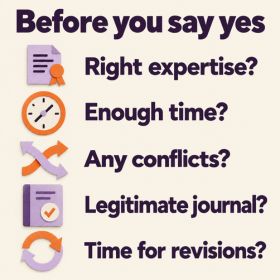
Before accepting, check your expertise, availability, potential conflicts, the journal’s legitimacy and whether you can review a revised version.
Beware of invitations that are too good to be true
If an invitation comes from a journal you've never heard of, gushes about your “eminent expertise”, or is miles outside your field, look the journal up before you reply. Predatory journals send out review requests too, and reviewing for them adds nothing to your CV and helps a business that exploits researchers. Check whether the journal is indexed in the usual databases, whether its editorial board is real, and whether people you trust have published there.
Before you agree to peer review a paper
Read the abstract and ask yourself five questions.
- Do I know enough? You don't need to be the world expert, but you need to be able to judge most of it properly. If you can only judge part of it, accept and tell the editor which parts, or decline.
- Do I have the time? Check the deadline against your diary. If it lands in the week as your annual leave, or during a conference, or (even worse) near a grant deadline say no or ask for more time when you accept. Editors don't mind being asked. What they can't stand is the reviewer who agrees, and then goes quiet, or emails them the due date asking for another month. If you do say yes, consider spreading the work over two or three sessions rather than one long sitting, because you'll spot far more with fresh eyes.
- Do I have a conflict of interest? Nature's editors give the classic examples: you've collaborated with one of the authors, you have a paper competing with this one, or you have financial interests that could look like they'd sway you. Personal friendships and rivalries count too, and so do colleagues in your department. If you're unsure, ask the editor. Even in double-anonymous review you may recognise the work, and if you do, say so.
- Is the journal legitimate? See above.
- Will I be able to review the revised version too? Some journals assume that agreeing to review the first version means you'll look at later versions as well, so factor that in.
How to say no
Quickly, so the editor can find someone else. You don't need to explain at length. If you can, suggest an alternative reviewer. COPE asks that suggestions are based on suitability, not personal favours, but there's nothing wrong with putting forward a capable postdoc or colleague who'd value the experience. Something like this is plenty:
“Thank you for thinking of me. I'm not able to review this paper within your timeframe. You might consider Dr [name] at [institution], who works on [method or topic].”
Co-reviewing with your supervisor: do it properly
This is how most researchers learn to review, and it's a good way to learn, as long as everyone does it in the open.
A survey of researchers published in eLife found that around three quarters had co-reviewed a paper, and almost all of them saw it as useful training. The same survey found that about half had ghostwritten a review, even though 81% said ghostwriting was unethical. The difference between the two is simple. Co-reviewing means contributing to a review when you weren't the person invited. Ghostwriting is doing that without the journal being told your name.
Ghostwriting is a problem for three reasons. You do the work and get no credit. The editor doesn't know who actually reviewed the paper. And unless the journal agreed, sharing the manuscript with you may have broken its confidentiality rules. Springer Nature, for example, says anyone who wants to pass an invitation to a colleague must contact the journal first.
How to make it work
- The invited reviewer asks the editor first whether a junior colleague can help. Most editors are happy to say yes.
- Your name goes to the journal, either in a co-reviewer field on the form or in the confidential comments to the editor.
- You do a full review independently, then compare notes with your supervisor. That's where most of the learning happens: seeing what they spotted that you didn't, and why.
- You get credit for it. Web of Science's reviewer recognition service lets reviewers add collaborators to a review record.
If you're the one being asked to “have a look at this”, it's fine to ask: “Shall I write it up so you can let the editor know I helped?” A good supervisor will be glad you raised it. And if you're the supervisor, co-reviewing with a student or postdoc is one of the most practical things you can do as a mentor, which we cover in our guide on how to be a good mentor.
The ground rules
The COPE Ethical Guidelines for Peer Reviewers are the standard most journals sign up to. COPE guidance says that most reviewers too often start without any guidance, so this is what they think reviewers need to be reminded of:
- Keep it confidential, during the review and after it. Don't share the manuscript, discuss it with colleagues, or mention it on social media. Many journals ask you to delete your copies once you're done.
- Don't use what you read. You can't use unpublished findings, methods or ideas for your own work, or to get ahead of the authors.
- Declare conflicts of interest, and ask the journal if you're not sure.
- Judge the work, not the people. Don't let authors' nationality, gender, religion, institution or anything else about them shape your review. That's harder than it sounds. Research has shown that authors' names can have an astonishing influence on reviewers.
- Be objective and constructive. No hostile, sarcastic or personal remarks.
- Do your fair share, and do it on time.
Don't ask for citations to your own work without a good reason
Suggesting relevant papers the authors have missed is part of the job, even when some of them are yours. Demanding citations to your own work as the price of a good review is not. One journal found a reviewer who had asked for an average of 35 extra citations per review, about 90% of them to the reviewer's own papers, and banned them. The test is simple: only suggest a paper, yours or anyone's, if the manuscript would be weaker without it, and say why. Springer Nature warns that it notes any attempt at reviewer-coerced citation against your record.
Using AI as a reviewer: what's allowed
This is the area where the rules are moving fastest, and where first-time reviewers are most likely to slip up without meaning to. The single most important rule is the same almost everywhere.
Never upload a manuscript, or any part of it, into ChatGPT, Claude, Gemini, Copilot or any other generative AI tool. That includes the abstract, a figure or a table.
Taylor & Francis, for example, states that reviewers must not upload unpublished manuscripts, files, images or information into generative AI tools, and must not use AI to generate review reports. Science and The Lancet take a similar line, and the Nature Portfolio's AI policy also bans uploading manuscripts and asks reviewers to declare any AI use in their report.
Why the rule exists
An unpublished paper is confidential. It may contain unpublished data, new methods, or information about patients or participants. Once you paste it into a public AI tool, you've lost control of where it goes, and you've broken the confidentiality the journal promised the authors when they submitted. There's an accountability issue too. The editor asked for your judgement, and you're responsible for every word of the review.
What may be allowed
Some publishers let reviewers use AI to tidy the language of their own review, as long as no manuscript content goes in. Taylor & Francis, for instance, says AI may be used to help improve review language. Others ban AI entirely, and some ask you to declare any use at all. So the honest answer is that it depends on the journal, and you have to check.
Why outsourcing your judgement is a bad idea anyway
In July 2025, journalists found that a number of preprints contained hidden instructions aimed at AI reviewers, written in white text or tiny fonts, telling any AI reading the paper to give it a positive review. When a Dutch university news service tested one of these papers, the hidden prompts changed the AI-generated reviews. If a reviewer had pasted the paper into a chatbot, they'd have been handing the authors the pen.
Check the journal's guidance: find the publisher's AI policy before you open the manuscript, not when you're halfway through writing your report. It's normally under “editorial policies” or in the reviewer instructions. If the journal says nothing at all, take that as a no, and drop the editor a line if you want to check.
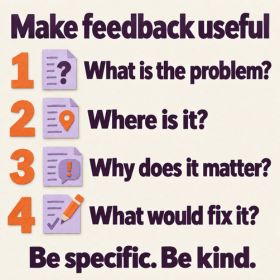
Make every major comment actionable: identify the problem, locate it, explain why it matters and suggest what would address it. Be specific and kind.
How to peer review a paper, step by step
There's no single right way to review, but beginners do best with a method. This one follows the approach in Mathew Stiller-Reeve's guide for Nature, which recommends three separate readings, each with a different focus. It also follows a best-practice guide for early career researchers in the International Journal of Epidemiology, which treats a review as a piece of writing with three stages: reading, planning and composing.
Step 1: Set yourself up
Before you read a word of the paper, read the journal's reviewer guidelines and look at the review form. Note what type of article it is (an original research paper is judged differently from a review or a short report) and what the journal's criteria are. Open a blank document for notes. Put two or three blocks of time in your diary over the week rather than one long session, because you'll spot more with fresh eyes.
Step 2: First reading, for the big picture
Read the whole paper through without stopping to pick holes. Then, without looking back, write three or four sentences in your own words: what question it asks, what the authors did, what they found and what they conclude. If you can't do that, that's your first finding, because the paper isn't clear enough yet.
Ask yourself whether there's a fatal flaw: something so fundamental that no amount of revision would fix it, such as a design that can't answer the question. Stiller-Reeve's advice is that if there is, you don't need to review every remaining detail. Explain the flaw clearly and carefully, and submit.
Step 3: Second reading, for the methods and results
This is where most of your time goes. Read the methods and results slowly, with the figures and tables open alongside. Does the design actually answer the question? Is there enough detail to repeat the work? Does every claim in the results trace back to data you can see? Use the section-by-section list in the next part of this guide as a prompt. Write your notes as you go, with page and line numbers.
Step 4: Third reading, for the story and the context
Now go back to the introduction and discussion. Does the introduction set up the question fairly, with the key literature? Does the discussion stay within what the results show, admit the limitations and avoid claiming more than the data can bear? Check the abstract against the paper, and the figures against their captions: you should be able to understand each figure without reading the text. Spot-check a few references, especially any you don't recognise.
Step 5: Sort your notes
Go through your notes and put each point into one of two piles. PLOS puts it well. Major issues are the essential things the authors must fix before the paper can be considered further. Minor issues still matter, but they're smaller and won't change the overall conclusions. Delete anything that's just personal preference about how you'd have done it.
Step 6: Write the report
Use the structure in writing the report. Each major point should say what the problem is, where it is, why it matters and what would fix it.
Step 7: Leave it, then edit it
If you can, sleep on it. Then read your report through, ideally out loud, which Stiller-Reeve recommends because you'll hear anything that sounds harsh or muddled. Check that your recommendation matches your comments. Check you haven't revealed who you are, if the review is anonymous. Then submit it, on time.
How long will it take? Longer than you think, the first few times. Estimates for an experienced reviewer are around six hours for a typical paper. Your first might take two or three times that, and that's normal. It gets quicker.
What to check when you peer review a paper
Use this as a prompt, not a form to fill in. Not everything applies to every paper.
Title and abstract
Read the abstract again once you've read the whole paper. It's surprising how often the numbers in it don't quite match the results table, or the conclusion is bolder than anything the discussion dares to say. Titles drift too: a study of patients in one clinic can end up with a title that sounds as if it settled the question for everyone.
Introduction
Most papers say what they set out to do in the last paragraph of the introduction. Find that sentence. If you can't, or it's vague, say so, because everything else in the paper gets judged against it. Then ask whether the gap they describe is real. A quick search of the last couple of years often turns up a study that has already answered it, and the authors haven't mentioned it.
Methods
- Is the design suitable for the question? An observational study can show an association, not that one thing causes another.
- Who took part, how were they recruited, and who was left out? How was the sample size decided?
- Are the controls or comparison groups appropriate?
- Do the authors report ethics approval and consent?
- Did the authors pre-register the study or follow a published protocol? If so, does the paper stick to it?
- Is there enough detail for someone else to repeat it?
- Have the authors followed the right reporting guideline? The EQUATOR Network lists them, including CONSORT for randomised trials, STROBE for observational studies, PRISMA for systematic reviews and ARRIVE for animal research. Opening the relevant checklist yourself is one of the quickest ways to spot what's missing.
Results
- Does every claim trace back to data in a figure or table?
- Do the numbers add up? Check that participant numbers are consistent between the text, tables and flow diagram, and that percentages match their counts.
- How much data is missing, how many people dropped out, and how was that handled?
- Are effect sizes and confidence intervals reported, not just p-values? Have the authors run lots of tests and only reported the interesting ones?
- Do the figures show what the captions say they show?
Discussion and conclusions
This is where papers most often run ahead of their data. Look out for words like “prevents”, “leads to” or “drives” in a study that could only ever show an association. Then find the limitations. If they get a single sentence near the end, they probably need more, and it's fair to say so. Finally, check who the findings are being applied to. Results from 200 people in one memory clinic don't automatically tell us about everyone over 65.
Data, code and references
“Available from the authors on reasonable request” is a common line in data availability statements, and in practice it often means nobody will ever see the data. If the authors link to a repository or to their code, click the link and see what's actually there. As for references, nobody expects you to check them all. But if one looks unfamiliar, look it up. It should exist, and it should say what the authors say it does.
Don't assume someone else will catch it. In a BMJ experiment, reviewers were sent papers with nine major errors deliberately planted in them. On average they found fewer than three. These weren't beginners. Even experienced reviewers miss a lot, which is exactly why a systematic approach beats relying on instinct.
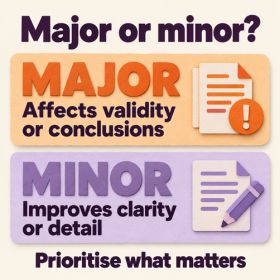
Separate concerns that affect validity or conclusions from smaller changes that improve clarity or detail. Put the most important issues first.
A note for dementia researchers
A few issues come up again and again in our field. Check how dementia or cognitive impairment was defined and diagnosed, and whether that's consistent across groups. Watch for reverse causation: changes in behaviour, sleep, mood or activity can be early signs of dementia rather than causes of it, often years before diagnosis. And check whether results from animal or cell models are being presented as if they apply directly to people.
Spotting problems: integrity concerns and AI-written papers
Most of the time, when you peer review a paper, it will be honest work with ordinary flaws. Occasionally, something won't feel right. Here's what to look for, and, just as important, what to do and what not to do.
Integrity red flags
- Images that look duplicated, flipped, stretched or spliced, especially western blots and microscopy.
- Data that look too good: perfectly smooth curves, no variability, or results that are suspiciously identical across groups.
- Numbers that can't be right, such as percentages that don't match their totals, or more participants in a subgroup than in the whole study.
- Strange phrasing where a standard technical term should be, sometimes called “tortured phrases”. Software that disguises copied text by swapping in synonyms produces oddities like “bosom peril” for breast cancer.
- A reference list padded with irrelevant citations to the same few authors or journals.
These can be signs of anything from a sloppy mistake to a fake paper bought from a “paper mill”, a business that sells fabricated manuscripts. You can't tell which from where you're sitting, and you're not expected to.
So, is spotting AI your job?
Not quite. It helps to start from what the rules actually say. Many journals allow authors to use AI tools, as long as they disclose it in line with the journal's policy. Sage's guidance for reviewers says AI can be a powerful tool when it's properly disclosed, and that what reviewers should note is irresponsible or undisclosed use. So the question isn't “did they use AI?” It's “is the work accurate, and is it transparent?”
The signs Sage suggests looking out for include:
- References that don't exist, or that have the wrong journal, year or DOI. This is the most concrete sign, because AI tools are known to invent plausible-looking citations.
- Vague, generic statements such as “studies have shown” with nothing cited.
- Smooth prose that says very little, repeats itself or over-explains the obvious.
- Contradictions between one section and another.
- Technical terms used slightly wrongly.
- Leftovers, such as placeholder text or the odd line that reads like a chatbot talking to its user.
What's not a sign: poor grammar or awkward English. Sage is explicit that bad writing doesn't point to AI use, and a large share of the world's researchers write in their second or third language.
Don't run the paper through an AI detector
It's tempting, but don't. First, it breaks confidentiality, because you're uploading the manuscript to a third-party tool. COPE has looked at exactly this case: a reviewer uploaded a manuscript to an online AI checker and reported that most of it was AI-generated. The COPE council member who presented it said it's nearly impossible to detect AI-generated text properly and definitively, and that the reviewer had breached confidentiality in the process.
Second, the detectors aren't reliable, and they're biased. A Stanford study tested seven popular detectors on essays by non-native English writers and found they wrongly labelled more than half of them as AI-generated, while being almost perfect on essays by native speakers. In an international field, that's a fairness problem, not just a technical one.
What to do if you have concerns
- Check the journal's AI policy for authors, and whether the paper includes a statement on AI use.
- Check the specific things that worried you. Search for a reference you suspect doesn't exist. Looking up a single citation in PubMed or Google Scholar doesn't breach confidentiality.
- Review the science on its merits. If the evidence doesn't support the claims, that's your critique, whoever or whatever wrote the paper.
- Tell the editor, in the confidential comments. Stick to what you observed, not what you suspect. Leave any accusations out of your comments to the authors.
Here's the kind of wording that works:
“Confidential to the editor: I could not find references 12 and 18 in PubMed, Scopus or Google Scholar, and reference 23 does not appear to contain the finding it is cited for. I also noticed that the western blot in Figure 3B looks very similar to the one in Figure 5A. I may be wrong about both, but I thought you should know.”
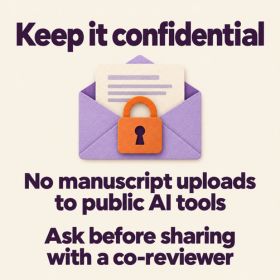
Protect the manuscript: do not upload it to public AI tools, and obtain the editor’s permission before sharing it with a co-reviewer.
That's it. You've done your job. The journal has research integrity staff, screening tools and processes for what happens next, and COPE has guidance for editors on handling it. If you're not sure whether something is a problem, say that too. Editors would much rather hear a concern that turns out to be nothing than miss one that matters.
How to write a peer review report
Most journals' guidance agrees on the basic shape. PLOS suggests structuring it like an upside-down pyramid, with the most important points at the top. Nature's editors say the best reviews have two things in common: they back up every statement with detailed argument, and they stay constructive even when there's a lot to criticise.
The structure
- Summary. A short paragraph, in your own words, on what the paper asks, what the authors did and what they claim. It shows the editor and authors you've understood it, and sometimes reveals that you haven't.
- Overall assessment. A few sentences on the paper's genuine strengths and your main concerns, so the editor can see your view at a glance.
- Major issues, numbered. For each one, say what the problem is, where it is (page, line or figure), why it matters to the conclusions, and what the authors could do about it.
- Minor issues, numbered. Shorter points that would improve the paper but don't affect its conclusions.
- Confidential comments to the editor. Anything that shouldn't go to the authors: a possible conflict of interest, integrity concerns, the limits of your expertise, or context for your recommendation. Don't use it for a second, harsher review that the authors never get to answer.
- Your recommendation, usually selected on the form. Some journals ask you not to state it in your comments to the authors, because the editor may decide differently.
How long should it be?
Long enough to do the job. A short review of a strong paper is fine, if it's specific. Research suggests the best peer review reports are at least 947 words, but length isn't the point. A page of vague comments is worth less than five sharp ones.
A template you can copy
Summary
This manuscript reports [design] in [population or model] to test whether [question]. The authors find [main result] and conclude that [conclusion].
Overall assessment
The paper's main strengths are [specific strengths]. My main concerns are [one-line summary of each major issue]. [Whether, in your view, these could be addressed.]
Major issues
1. [Problem]. [Where: page, line, figure.] [Why it matters for the conclusions.] [What would address it.]
2. …
Minor issues
1. [Point, with location.]
2. …
Confidential comments to the editor (separate box)
[Limits of your expertise, any concerns, reasoning for your recommendation.]
A worked example: weak review vs strong review
Here's a made-up abstract with some problems planted in it. Before you read on, try spotting them yourself. The quickest way to learn how to peer review a paper is to see it done badly and then done well, so below are two reviews of it.
Daily crossword puzzles and the risk of dementia: a cohort study (fictional)
Background: Cognitive activity may protect against dementia. Methods: We followed 4,210 adults aged 60 and over from a community cohort for a mean of 3.2 years. At baseline, participants reported how often they completed crossword puzzles. We identified incident dementia from electronic health records. Results: 118 participants developed dementia. Those who completed crosswords daily had a 47% lower risk of dementia than those who never did (hazard ratio 0.53, 95% CI 0.34 to 0.82). Conclusions: Daily crossword puzzles prevent dementia. Public health campaigns should encourage older adults to do a crossword every day.
In the full paper, the methods also mention that 927 participants (22%) had no follow-up records, and the analysis is adjusted for age and sex only.
The weak review
“This is an interesting and well-written paper on an important topic. However, the authors should consider confounding. The sample size could be bigger. The English needs polishing in places. The authors should also cite Smith et al. (2019) and Smith et al. (2021). I recommend major revisions.”
There's nothing rude here, and that's the trap. It's simply no use to anyone. There's no summary, so the editor can't tell whether the reviewer understood the paper. “Consider confounding” doesn't say which confounders, or why they matter. “Could be bigger” isn't a problem the authors can fix for a study that's already been done. The language point gives no examples. The two citations come with no reason, and look suspiciously like the reviewer's own work. And it misses the biggest problem of all, that the conclusion claims cause and effect.
The strong review
Summary. The authors followed 4,210 adults aged 60 and over for a mean of 3.2 years and report that daily crossword use at baseline was associated with a lower risk of incident dementia (HR 0.53). They conclude that crosswords prevent dementia and recommend a public health campaign.
Overall assessment. This is a large community cohort with a clear question, and the association is worth reporting. However, I don't think the design supports the causal conclusion, and there are concerns about reverse causation, confounding and missing data that need to be addressed before the findings can be interpreted.
Major issues
1. Causal language. This is an observational study, so it can show an association but not that crosswords prevent dementia (abstract, and discussion p.14). I'd suggest rewording the conclusions throughout and removing the public health recommendation, which goes well beyond the data.
2. Reverse causation. With a mean follow-up of 3.2 years, many people diagnosed during the study were probably already in the early stages of dementia at baseline, and may have stopped doing crosswords because of it. Could the authors repeat the analysis excluding cases diagnosed in the first two years, and discuss this in the limitations?
3. Confounding. The model adjusts for age and sex only (methods p.7). Education, socioeconomic status, depression and hearing loss are all associated with both cognitive activity and dementia risk. I'd ask the authors to adjust for these where the data allow, or explain why they can't.
4. I was surprised by the missing data. The methods (p.6) say 927 people, nearly a quarter of the cohort, have no follow-up records at all. If the people who dropped out were the ones whose memory was already slipping, that alone could produce the association. Could the authors compare them with those who were followed up, particularly on crossword use and baseline cognition, and run a sensitivity analysis?
Minor issues
1. Participants reported their crossword use only once, at baseline. Please give the exact question and response options, and acknowledge this as a limitation.
2. It would help to list the diagnostic codes used to identify dementia in the health records.
3. Please report absolute risks or event rates in each group alongside the hazard ratio, so readers can judge the size of the difference.
Why the second review works
It shows the reviewer understood the study. It says something fair about the paper's strengths. Every major point says what, where, why and what to do. The requests are things the authors can actually do with the data they have. It doesn't ask for a different study. And it's firm without being unkind.
Getting the tone right
Most of us can remember a review that stung. Unkind reviews are common, and they do real damage. In a survey of 1,106 scientists across 46 countries, 58% had received at least one unprofessional review. Everyone got them at similar rates, but researchers from groups under-represented in science were the most likely to say a review had knocked their confidence, their productivity and their career. A careless sentence from you can stay with someone for years.
The good news is that you don't have to become Reviewer 2. In fact, Reviewer 2 may have been framed all along: one study of a political science journal's records found no evidence that Reviewer 2 was any harsher than the others. Reviewer 3 was the more likely culprit.
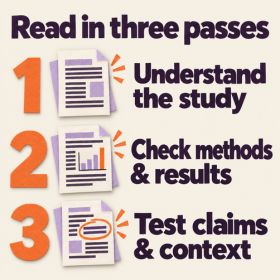
Give each reading a purpose: understand the study, examine the methods and results, then assess whether the claims fit the evidence and context.
How to be honest without being harsh
- Follow the golden rule. Write the review you'd want to receive. PLOS suggests only writing comments you'd be comfortable signing your name to, because the authors will read every word.
- Talk about the paper, not the people. “The analysis doesn't account for…” rather than “the authors have failed to…”.
- Name the strengths, specifically. “Interesting paper” means nothing. “The recruitment of a community sample rather than a memory clinic one is a real strength” tells the authors what to keep.
- Turn criticism into a request. “The paper would be stronger if…” lands better than “this is inadequate”, and it's more useful.
- Cut the sarcasm, rhetorical questions and exclamation marks. They never read the way you meant them to.
- Remember a real person will read it. Quite possibly a PhD student who did most of the work.
Being kind doesn't mean going soft. If the paper's main conclusion doesn't hold, you must say so, clearly. Kind and honest aren't opposites. For the other side of this, read when peer review feels personal and how to fight back against a peer-review bully.
Making your recommendation
Most journals ask you to choose from four options, though the wording varies.
- Accept: ready to publish as it is, or with trivial changes. Rare for a first submission.
- Minor revision: sound work that needs light changes before it's ready, such as clarifications, extra detail or toned-down wording.
- Major revision: potentially publishable, but needs substantial work, such as new analyses, a rethink of the conclusions or a lot more explanation.
- Reject: the problems can't be fixed through revision, or the paper isn't right for this journal.
Make sure your recommendation and your comments tell the same story. If you recommend major revisions but every point is minor, or reject without explaining a problem that can't be fixed, the editor won't know which to believe. If you recommend rejection, still give the authors useful comments. They'll take the paper somewhere else, and your review can make that version better.
Don't be put out if the editor goes a different way. They're weighing several reviews and their journal's priorities, and reviewers disagree all the time. That's the system working, not your review being ignored.
When the paper comes back
If the authors revise, you'll usually be sent the revised manuscript (often with changes tracked), a response letter answering each comment point by point, and your original report. Sometimes you'll see the other reviewers' reports and responses too.
Your job this time is narrower. Check that each of your points has been dealt with, either by a change or by a reasoned explanation of why not. It's fine to accept a good argument. Authors don't have to do everything a reviewer asks, and sometimes they're right. Don't raise new major issues that you could have raised the first time, unless the revision has introduced them or you've spotted something serious you genuinely missed. Moving the goalposts at round two is one of the most frustrating things a reviewer can do. A second-round review is usually much shorter, and that's as it should be.
Getting credit when you peer review a paper
Reviewing only helps your career if you can show you've done it, and anonymous work is easy to lose track of. The main tool is the Web of Science Reviewer Recognition Service, which used to be called Publons. It lets you record and verify your reviews even when they're anonymous or the paper was never published, and it can export your review history to your ORCID profile automatically. Many journals offer a tick box on the review form to add the review to your record. Some also send certificates.
On your CV, add a peer review section listing the journals you've reviewed for and roughly how many reviews. Don't list manuscript titles, which are confidential. In narrative CV formats, such as the Résumé for Researchers, reviewing belongs in your contribution to the research community. Our guide to academic promotion criteria explains how this kind of service fits into a promotion case.
Free training on how to peer review a paper
A word of honesty first. In a randomised trial at the BMJ, short training courses had only a slight effect on the quality of reviews, although trained reviewers did find more of the errors. A course can show you how to peer review a paper in principle. Practice, feedback and reading other people's reviews are what make you good. With that said, these are worth your time:
- Focus on Peer Review from Nature Masterclasses: free, about three and a half hours, taught by journal editors, with a certificate.
- Web of Science Academy, ACS Reviewer Lab and Elsevier's Certified Peer Reviewer Course, all free and all listed in the European Association of Science Editors' peer review training toolkit. The Web of Science Academy includes a course where you write a review and then revise it with a mentor.
- PREreview Open Reviewers, a mentoring programme for early career researchers that ends with published preprint reviews.
- PLOS's peer review checklist and template, short enough to keep open while you work.
- The COPE Ethical Guidelines for Peer Reviewers, the ethical standard most journals follow.
- Ella August and colleagues' staged writing guide to peer review in the International Journal of Epidemiology, written specifically for early career researchers.

"It's important to remember you're not marking an essay or proofreading the manuscript. You're judging the rigour and scholarship, and wherever possible your review should work to support and improve the authors' work. If you know of recent papers they may have missed, can see a way the rigour could be strengthened, or have spotted repetition or redundant passages that could be removed, that's really constructive. On the flip side, authors can rarely go back and do their research again, so suggesting they should have gone about the methods a different way is less helpful.
Remember too that authors have to work within a journal's strict word limits. Suggesting where they could expand or add depth can help, but it's more useful if you also suggest where constructive cuts could be made.
And don't worry about what the other reviewers will say. Sometimes you'll repeat each other's comments, sometimes you'll spot different things, and sometimes you'll disagree. That's a problem for the editor, not a reflection of your academic judgement.
Finally, if you want that first invitation to be a reviewer, ask your PI, mentor or colleagues to put you forward when they decline one. They're probably inundated. Just be prepared for a lot of invites very quickly!"

"Put your name on your reviews. Pros and cons but overall I think this is a positive thing to do: more transparent, forces reviewers to be more polite and constructive and far less likely to dish out belligerent trolling. Peer reviewing should never have got to the point of being two or three anonymous reviewers dictating the terms of acceptance. You should be able to own any critique you make. I always sign my reviews now unless journal or funder policies forbid it."

"It's not about how you would have designed and done the project described if you had the money to, it's about whether the research you are reading and reviewing makes sense and reaches valid conclusions from the data and methods available. Also, don't be reviewer 2. Be kind, even when you don't like something."

"If you're doing it properly, it will take much longer than you think it will."

"Make sure that every point you want addressed comes in the form of a specific ask. If the authors don't know what you're looking for, they probably won't fix it.
Being polite and constructive, even when you're recommending rejection, is essential. Think about the golden rule: how would you feel receiving that comment?
Finally, if possible, read the paper twice. The first time, read it without making notes or thinking about what you're going to say. Then start the review on the second read. That's especially useful early in your reviewing career."

"Be kind. People work really hard even just to get to the submission stage."

"A useful peer review is one that provides a clear problem or point that you can address well. Peer review can really highlight issues you may have missed and improve your manuscript, but only if the reviewers comments provide a clear direction of what they want addressed.
Ask your PI, they will likely get a number of requests that you could then help with and do together, that would be my preferred option to give yourself confidence. Otherwise you can email an editor, or find an ECR scheme which a number of journals now run."

"If you're doing your first peer review, we recently published this article: 'Reviewing manuscripts for scientific journals: recommendations for early career scientists' this and two other papers may be of use, 'How to write an effective journal peer review using a staged writing approach: a best-practice guide for early-career researchers' and 'Peer review guidance: a primer for researchers'."

"When you are ready, open up a conversation with your PI/Line manager that you would like to peer review a paper, it’s likely that they are inundated with requests and they will have the option to recommend someone else. Be honest that it would be your first time and would like some support/oversight or even suggest to do it together. My PhD supervisor ran a session where they peer reviewed a paper as a journal club and this was incredibly insightful into how approach it, and made the task seem less daunting than it is.
Genuine fair feedback that will improve the manuscript, from ways to improve the flow and readability of complex ideas/results, to improving data visualisation and reproducibility in the methods. Sometimes even recommendations of literature that might have fallen through the cracks when preparing the initial manuscript. Experimental suggestions are welcome too; however, these have to be within reason and must supplement the work presented, they might have already done these but didn’t include them in the first submission. Ideally the reviewer comments should help to take the paper to the next level."
“I’m not sure how common this is, but I use the confidential comments to the editor to explain which aspects of a paper I feel confident assessing and where my expertise is limited. For example, complex statistical analyses might look reasonable to me, but I’m not necessarily qualified to judge whether they’re appropriate. Being clear about those limits helps the editor identify where an additional expert review may be needed.”



 Dr Yvonne Couch
 Alzheimer's Association
 Nature Careers Blog