
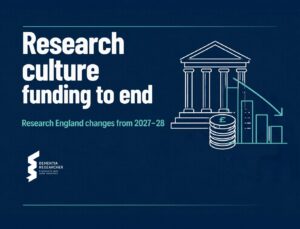
 Research England has confirmed that three ring-fenced funds English universities have used to improve research culture, support policy engagement and involve the public in research will close at the end of 2026-27. Core quality-related (QR) research funding and Higher Education Innovation Funding (HEIF) are protected and will rise modestly, but the Enhancing Research Culture Fund, the Policy Support Fund and the Participatory Research Fund all end in academic year 2027-28. In their place comes up to £9 million over three years for regional and national networks.
The changes were set out on 4 November 2026 in a UKRI announcement and a circular letter to heads of English universities. Research England says they follow engagement with the sector over the summer and the wider UKRI allocations process, and that UKRI first floated the plans in late 2025.
What is changing
- Core QR and HEIF: both protected, with what Research England calls a modest increase and more flexibility for universities to spend in line with their own priorities. UKRI’s strategy commits to keeping core QR for English universities at no less than £2.2 billion a year in real terms over the Spending Review period. No new figures for 2027-28 were published.
- Three targeted funds end: the Enhancing Research Culture Fund, the Policy Support Fund and the Participatory Research Fund close from 2027-28. Research England says it has put £390 million into them since 2021.
- Research capital: the Research Capital Investment Fund (RCIF) is being tapered from 2026-27 and refocused on maintaining and renewing existing buildings and equipment, rather than new projects. From 2027-28 the minimum allocation rises from £10,000 to around £50,000 and no single university can receive more than 8% of the pot, currently around £8 million.
- HEIF formula: a consultation on changes to how knowledge exchange money is allocated is open until 4pm on 15 January 2027.
How much money is going
The announcement gives the six-year total but not the annual sums. Research England’s budget for 2026-27 fills that in: £30 million for enhancing research culture, £29 million for the Policy Support Fund and £6 million for participatory research, £65 million a year in all. The replacement is up to £9 million spread over three years, from 2027-28 to 2029-30.
That is a large drop in money ring-fenced for these purposes, though not necessarily in what universities spend on them. Core QR is unhypothecated, so institutions can choose to keep paying for culture, public involvement and policy work out of it. Research England’s argument is that the funds were always time-limited, that they have built the foundations, and that good practice now needs to be part of normal business rather than reliant on a separate pot.
Where research culture goes now
Research England says healthy research cultures remain a priority, but the levers change. Rather than paying for projects, it plans to:
- set up a research culture collaboration network with four regional coordinators, a coordinator for small and specialist institutions, and a central hub
- build a shared repository of what has been learned across research culture, policy support and participatory research
- support senior leaders and governing bodies to embed research culture in how institutions are run
- run an open call for sector networks, and launch a Good Practice Exchange to strengthen the evidence on what works
- consult on stronger research culture and environment conditions in its terms and conditions for 2027-28, which it says will not add to reporting
More detail is promised in early 2027. Research culture will also continue to count through the people and environment element of REF 2029, though its weighting was cut to 20% last December after pushback from research-intensive universities. If you want a sense of why practical action matters here, read why research culture needs more than good intentions.
The state of the research estate
Published the same day, Research England’s report on the condition of the research estate estimates it would cost £5.2 to £5.3 billion to bring English universities’ research buildings and facilities up to a fully operational standard. The median university said a quarter of its research estate needed major repair or was inoperable, and 17 of 69 that answered said at least half was in that state. Real-terms capital and maintenance spending fell 28% between 2017-18 and 2022-23.
Against that backdrop, capital money is being spread more thinly rather than increased. The Russell Group welcomed the protection for QR and HEIF but warned that the infrastructure cuts would be harder to absorb, pointing to the role RCIF-funded facilities play in innovation clusters and work with industry.
What this means for early career researchers
At many universities, Enhancing Research Culture money has paid for exactly the kind of support early career researchers rely on: mentoring and development schemes, small seed funds, training, peer networks and work on wellbeing and inclusion. Some of that was set up to be self-sustaining, but much of it will now depend on whether institutions, many of them already making cuts, choose to fund it from core budgets. Professor Dame Jessica Corner, Executive Chair of Research England, acknowledged that “some institutions will face greater challenges in adapting to these funding changes than others.”
It’s worth finding out what your own university’s research culture fund currently pays for and whether there are plans to keep it going. The same applies if your work depends on public involvement budgets or policy fellowships and secondments that came from the Participatory Research Fund or Policy Support Fund. For dementia research in particular, where patient and public involvement is central to good studies, it’s worth asking how that work will be resourced. On policy engagement, see our recent piece on the visibility problem in academic policy engagement.
These changes sit alongside UKRI’s wider shift towards fewer, larger and more streamlined funding streams. Dr Yvonne Couch looked at what that means for researchers in Understanding Changes to the UKRI Funding Strategy.
What happens next
- 15 January 2027, 4pm: HEIF formula consultation closes, with one formal response expected from each eligible university
- Early 2027: further details of the research culture network, the open call and the Good Practice Exchange
- Spring 2027: Jessica Corner steps down as Executive Chair of Research England at the end of her four-year term
- Academic year 2027-28: the three targeted funds end, the RCIF threshold and cap apply, and the £9 million transition programme begins
Research England is also running an independent review of how specialist institutions are recognised in its funding. Questions about the changes can go to researchpolicy@re.ukri.org, or kepolicy@re.ukri.org for knowledge exchange.

 NIHR

 LSE Impact Blog




 Nature Careers Blog



 Dr Becky Carlyle