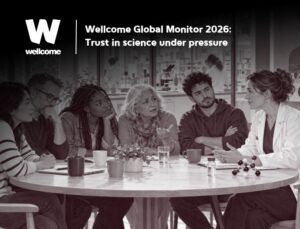
 Trust in science – The Wellcome Global Monitor 2026, the world’s largest survey of public attitudes to science, finds that trust has fallen since the Covid-19 pandemic, and that it is lowest among people who feel society isn’t working for them. The UK remains one of the highest-trust countries in the world.
Wellcome Global Monitor 2026: Trust in science under pressure was published this month by Wellcome. It draws on responses from more than 140,000 people in 140 countries, collected in 2025 through the Gallup World Poll, with analysis by Ipsos. It’s the third wave of the Monitor, after 2018 and 2020, so for the 108 countries that took part every time it gives a picture of how trust has changed before, during and after the pandemic.
The core question is simple: “In general, would you say that you trust science a lot, some, not much, or not at all?” Around it sit questions on trust in scientists, doctors and nurses, government and journalists, on who benefits from science, and, for the first time, on artificial intelligence.
Why the Wellcome Global Monitor 2026 matters for dementia research
Dementia research depends on public trust more than most fields. Trials need volunteers, cohort studies need people to stay in them for decades, and patient and public involvement only works when people believe their time will be used well. New tools like blood tests for Alzheimer’s, AI in diagnosis and disease-modifying drugs all land in a public conversation shaped by how much people trust the science behind them.
The report’s message for researchers is that trust isn’t just about what people know. It tracks people’s finances, their confidence in public institutions and their own experience of healthcare. That has direct implications for who takes part in research, and for how we approach groups who are already under-represented in dementia studies. If you want some background first, our blog on the importance of public trust in science is a good place to start.
The pandemic boost has gone
Across the 108 countries surveyed in all three waves, 72% of people said they trusted science ‘a lot’ or ‘some’ in 2025, down from 80% in 2020 and 77% in 2018. The share with little or no trust rose to 19%, from 13% in both earlier waves. The proportion trusting science ‘a lot’ fell in all 14 global regions between 2020 and 2025.
The picture varies by region:
- Five regions are now below their 2018 levels: sub-Saharan Africa, Central Asia, Western Asia, Eastern Asia, and Australia and New Zealand.
- Seven regions, including Northern America, Northern Europe and Latin America and the Caribbean, are back close to where they were in 2018.
- Two regions, Western Europe and Southern Europe, held on to some of their pandemic gains and are higher than in 2018.
Scientists themselves saw the biggest swing of any group. The share trusting scientists ‘a lot’ rose from 34% in 2018 to 43% in 2020, then fell to 32% in 2025. They’re still one of the most trusted groups, just behind doctors and nurses (39%) and well ahead of national governments (26%) and journalists (17%), but the report describes their position as “less stable”.
Across all 140 countries in 2025, 26% of people trusted science ‘a lot’ and 44% ‘some’. In 16 countries, including the UK, half or more of the population trusted science ‘a lot’.
The UK picture
The Wellcome Global Monitor 2026 report doesn’t break out UK trends, but its public dataset allows a 2025 snapshot. Our own weighted analysis of the UK sample (around 1,000 adults) finds:
- 51% trust science ‘a lot’ and a further 34% ‘some’, twice the global rate of strong trust.
- 50% trust scientists in the UK ‘a lot’, and 60% say the same of doctors and nurses.
- 14% trust the national government ‘a lot’, while 31% don’t trust it at all.
- 42% think the work of scientists benefits ‘most’ people in the UK, and 56% say it benefits people like them ‘a lot’.
- Just 17% think government leaders value the opinions and expertise of scientists ‘a lot’.
- 31% think AI will benefit people in the UK ‘a lot’, with 13% unsure.
High trust overall shouldn’t breed complacency. The report finds that in high-trust countries, the people who don’t trust science are further apart from everyone else in how they see its benefits. In Sweden, Iceland, the United States, Finland and Australia, that gap was more than 40 percentage points.
Trust follows how life is going
The clearest pattern in the report is that trust in science is tied to people’s circumstances.
In 2025, people who said they were living comfortably on their income were around twice as likely to trust science ‘a lot’ (39%) as those finding it difficult (20%). Since 2020, trust fell by 16 percentage points among people finding it difficult to get by, against 10 points among those living comfortably. The gap between the two groups grew from 13 points in 2018 to 19 in 2025.
Education follows a similar line. People with a degree were nearly twice as likely as those with primary education to trust science ‘a lot’ (39% against 20%). But the steepest falls since 2020 were at both ends: 18 points among people with tertiary education and 16 points among those with primary education.
At the country level, trust in science is lower where economic inequality is higher (a moderate correlation of r = -0.34), where people have less confidence in national institutions, and where perceived corruption is higher. The authors are careful to say these links are moderate. Social conditions influence trust in science, but don’t fully explain it.
Healthcare experience matters
For anyone working in clinical or health services research, one finding from the Wellcome Global Monitor 2026 stands out. Globally, 26% of people trusted science ‘a lot’, but among those with a lot of confidence in their country’s hospitals and health clinics, that rose to 43%. People confident they could access the care they needed were also more trusting (42%).
The report suggests that people judge science partly through the systems that make it tangible in their lives, and hospitals and clinics are where most people meet it. Where confidence in healthcare is low, it’s more strongly linked to having no trust in government (34%) than no trust in science (12%), but the link with low trust in science is still there.
That’s relevant to how we recruit. Our blog on recruiting participants for clinical trials looks at some of the practical side of building that trust with people and services.
Who benefits from science?
Most people feel science helps them personally. Eight in ten (81%) said the work of scientists benefits people like them. But only 36% said it benefits ‘most’ people in their country, and one in five (20%) said ‘very few’. Across the 108 trend countries, the share saying ‘most’ people benefit fell from 42% in 2018 to 37% in 2025.
The report splits people into three groups. A quarter (25%) are ‘enthusiasts’, who feel they and most others benefit a lot. They tend to be better off, more educated and more confident in healthcare and government. Just 7% are ‘sceptics’, who feel neither they nor others benefit. They tend to be on lower incomes, less confident in institutions and less sure they could get the healthcare they need. The other 68% have mixed views, and most of them think science benefits them more than it benefits others.
People who trusted science were 23 percentage points more likely to see it as beneficial, even after allowing for age, gender, education and finances. But the two don’t always move together. In Central Asia, Southern Asia and Northern Africa, trust fell after 2020 while views on the benefits of science held up.
Vaccines, climate change and AI
The Monitor also looks at how trust plays out on specific issues, and the findings are a reminder that trust and agreement aren’t the same thing.
- Vaccines: when a doctor or nurse recommends a vaccine, 34% of people want it straight away, 48% prefer to think it over and 15% don’t get vaccines at all. Even among those who don’t vaccinate, the most common answer was ‘some’ trust in science (39%).
- Climate change: half of people globally see it as a major threat to their country, rising to 61% among people who trust science ‘a lot’.
- AI: asked for the first time, a quarter (25%) think AI will benefit people in their country ‘a lot’, 38% ‘a little’, 18% ‘not at all’, and 19% don’t know. People who trust science are more optimistic about AI (38% ‘a lot’), but even among them, 13% weren’t sure.
A note on the data
The Wellcome Global Monitor 2026 is open about its limits. Survey methods changed over time in some countries, most importantly China, which moved from face-to-face interviews in 2018 to telephone in 2020 and a paid online panel in 2025. Because of China’s population, that affects global results. With China left out, trust levels between 2018 and 2025 look more stable, though the fall in strong trust since 2020 is still there.
The analysis is also correlational. It shows that trust is linked to income, education, inequality and healthcare experience, not that any one of these causes it. Regional groupings can hide big differences between countries, which is why the report includes country spotlights on places such as Brazil, Chile, Ethiopia, France, South Africa and the United States.
Our UK figures are a straightforward weighted breakdown of the 2025 public dataset for the UK sample. They are not taken from the report and don’t show change over time.
Earning trust, not assuming it
In his foreword, Wellcome’s Chief Executive John-Arne Røttingen sums up the challenge: “So perhaps the question for those of us who work in science is not simply: how do we build greater trust in science? It is: what do we need to do to earn the trust of people across different perspectives and contexts?”
The report concludes that there is no single route to earning trust. Showing that science delivers benefits isn’t enough on its own. Scientists, funders and institutions need to earn trust in ways that reflect the societies they serve. For early career researchers, that means good public engagement, inclusive recruitment and honest communication about uncertainty are part of the job, not extras. Our blog on reaching out of the science communication bubble offers some ideas on where to start.
Watch Wellcome’s webinar on the findings:
The full dataset is freely available for your own research, along with an interactive dashboard, country and regional factsheets and the technical report, at wellcome.org/globalmonitor.
Suggested citation: The Wellcome Trust (2026) Wellcome Global Monitor – Trust in science under pressure. https://doi.org/10.21955/wellcomeopenres.1115455.1
 Nature Careers Blog