
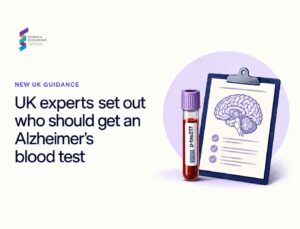
 Blood tests that pick up the biology of Alzheimer’s disease are already turning up in NHS memory clinics and on the private market, and the UK’s neurologists and old age psychiatrists have now set out how they should be used. New Alzheimer’s blood test guidance from the Association of British Neurologists (ABN) and the Royal College of Psychiatrists (RCPsych), published this week in Practical Neurology, makes 22 recommendations. The headline is straightforward: plasma p-tau217 is the test of choice, but only as part of a full specialist assessment of someone with measurable cognitive problems where Alzheimer’s is already suspected.
The guidance was written by a panel of 13 clinicians, nine neurologists and four psychiatrists, drawn from the ABN Cognitive Advisory Group and the RCPsych Faculty of Old Age Psychiatry. The first author is Dr Haniah Habash-Bailey (Barts Health NHS Trust), who drafted the statements with Professor Jonathan Schott (Dementia Research Centre and UK DRI at UCL) and Professor Charles Marshall (Centre for Preventive Neurology, Queen Mary University of London), the corresponding author. Co-authors include Dr Ashvini Keshavan and Professor Simon Mead.
The panel worked from draft statements through a meeting and rounds of online review until everyone agreed on every recommendation. Alzheimer’s Society and Alzheimer’s Research UK reviewed and endorsed the guidance, and the patient and public involvement group of the ADAPT study helped shape a lay summary and one-page guide published alongside it.
Why guidance, and why now
NICE has recommended cerebrospinal fluid (CSF) testing to confirm Alzheimer’s pathology since 2018, but fewer than 5% of NHS dementia diagnostic services have been able to offer it. CSF and PET are concentrated in large neuroscience centres, which leaves access shaped by where you live, your income and your ethnicity. Diagnosis on clinical assessment and structural imaging alone matches the post-mortem picture only around 70% of the time.
A blood test could change all of that. The catch is that Alzheimer’s pathology is common in people who will never develop symptoms from it, possibly more than half of cognitively healthy people over 80, and in people whose symptoms have another cause altogether. Put a cheap, easy test into lots of hands with varied expertise and you get plenty of positive results that don’t mean what people think they mean.
Two national studies, ADAPT and READ-OUT, are testing how these blood tests work in real NHS practice and whether they’re cost-effective. Their results aren’t in yet, but the tests are already available, including direct-to-consumer. The authors argue clinicians need guidance now rather than later, and say it will be reviewed every year as the evidence comes in.
What the guidance says
Which test, and how. Plasma p-tau217 is the recommended biomarker. It outperforms p-tau181 and p-tau231 and is more stable and accurate than the plasma amyloid beta 42/40 ratio. Newer assays that detect only brain-derived p-tau217 may eventually be more specific still. Handling matters: there’s no need to take blood at a particular time of day, but samples need the right tubes, prompt processing and an unbroken cold chain, following the testing lab’s own procedures. Clinical testing should use assays that carry regulatory marking or have been robustly validated in a UKAS-accredited lab.
Who to test. This is where the guidance is firmest. The blood test is an adjunct to a comprehensive clinical assessment, never a stand-alone diagnostic. It should not be used in people without symptoms outside research. It is appropriate only when Alzheimer’s is suspected on clinical grounds and there is objective evidence of cognitive impairment, so not for people with subjective cognitive decline whose testing is normal. In mild cognitive impairment, which some NHS services apply to as many as 70% of patients, testing should be selective.
Testing should also be avoided when another neurodegenerative diagnosis can be made confidently. Most people with Lewy body disease have some Alzheimer’s pathology too, and in Creutzfeldt–Jakob disease p-tau217 can be markedly raised without any Alzheimer’s pathology at all. It may still help in atypical presentations such as primary progressive aphasia, posterior cortical atrophy or corticobasal syndrome, where Alzheimer’s is a reasonable suspect and the answer would change management.
The paper illustrates this with two 75-year-old women. One has six months of worsening memory, a family who say it’s out of character and an ACE-III score below what you’d expect for her: a test is appropriate. The other worries about her Sudoku and crossword times, scores 99/100 and has a partner who isn’t concerned: a test is not, because even a high result wouldn’t support a diagnosis.
Reading the result. Results should be interpreted with two cut-points, giving low, indeterminate and high ranges. For a stand-alone diagnostic test both the positive and negative predictive values should exceed 90%, and around one in five results will fall in the indeterminate middle. Those should be treated as uninformative, with diagnosis resting on clinical assessment and imaging, and CSF or amyloid PET considered where it would change management.
A low result rules out Alzheimer’s with a high degree of confidence, but says nothing about Lewy body disease, frontotemporal dementia or other causes. A high result has to be read against age and the clinical picture, both of which shape how much it means, and it can be reasonable to monitor someone over time before confirming a diagnosis. Results can be thrown by other conditions: renal impairment (especially an eGFR below 45), low body mass index and anaemia can push p-tau217 up, very high BMI can push it down, and some systemic amyloidoses may raise it.
Equity and access. Testing should be set up in community memory clinics, not just tertiary centres, with routes for people with indeterminate results to reach CSF or PET. The authors point to lumbar puncture services run in psychiatry- or geriatrician-led memory clinics as one model. Communication should be adapted for health literacy and culture, with proper translators and written information in the right languages.
The recommendation most likely to draw attention is the last in this group: blood tests should not be used to triage who gets to see a dementia specialist. With memory services under heavy pressure, the authors see a real risk of using a negative result to turn people away, which would shut out those with other dementias and treatable causes of their symptoms. For that reason they don’t recommend testing in primary care.
Talking to patients. Clinicians should explain the purpose and possible outcomes before testing, including what happens if the result is indeterminate. Results should be given in the context of the whole assessment, with honesty about uncertainty. A positive result shows Alzheimer’s pathology is present, not that Alzheimer’s is causing someone’s symptoms, and a negative one doesn’t rule out other dementias. Structured communication tools are recommended to keep these conversations clear and consistent.
A practical tool for clinicians: DART-CU
The tool the guidance points clinicians towards is DART-CU, the Decision-Support for Alzheimer’s Blood Biomarker Result Tool for Clinical Use. It’s an interactive e-module developed at UCL with funding from Alzheimer’s Research UK, designed to support clinicians using plasma p-tau217 in diagnostic assessment. It works through case examples, and the two case scenarios in the paper are adapted from it. It covers the conversations before a test as well as what to do when the result comes back, including the awkward indeterminate and discordant ones.
If you work in a memory clinic, are training in neurology or old age psychiatry, or are researching how these tests play out in practice, it’s well worth working through.
Why it matters for researchers
Blood biomarkers are now part of everyday dementia research, from trial screening to cohort studies, and this guidance draws a clear line between research and clinical use. Testing people without symptoms stays a research activity. If your study returns biomarker results to participants, or you’re designing a disclosure protocol, the communication principles here are directly relevant.
The guidance also maps out where the evidence is thin: real-world performance and cost-effectiveness in the NHS, confounders not yet described, brain-derived p-tau217 assays, and how to deliver sample handling, lumbar puncture and result communication outside specialist centres. That’s a fair amount of implementation research waiting to be done. For more background, our podcast on the clinical opportunity for blood-based biomarkers and our blog on what FDA clearance of a p-tau217 test means are good places to start.
Things to bear in mind
This is consensus guidance, not a systematic review. The authors set out to produce practical advice for clinicians rather than a full synthesis of the evidence, and it comes ahead of the ADAPT and READ-OUT results that will inform how blood tests are rolled out in the NHS. The panel was drawn from specialist neurology and old age psychiatry, which is worth keeping in mind alongside its position on primary care. The recommendations will be reviewed annually and updated as new evidence emerges.
The ADAPT study is funded by Alzheimer’s Research UK, Alzheimer’s Society, the Postcode Innovation Trust, the National Institute for Health and Care Research and Gates Ventures. Several authors acknowledge support from the UCLH NIHR Biomedical Research Centre. A lay summary and one-page guide are available as an online supplement to the paper.
Habash-Bailey H, Barber R, Bass N, et al. Blood biomarkers for Alzheimer’s disease: guidance on appropriate testing from the Association of British Neurologists and Royal College of Psychiatrists. Practical Neurology (2026). https://doi.org/10.1136/pn-2026-005461




 Dr Chloe Fawns-Ritchie
 Dr Clíona Farrell