 Print This Post
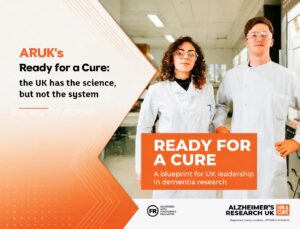 If you spent July at AAIC, or had a proper break over the summer, you may well have missed Alzheimer’s Research UK’s latest policy report. Ready for a Cure: A blueprint for UK leadership in dementia research came out in July. With everything else going on it got less attention than it deserves, so here’s a reminder of what it says and why it matters to anyone building a career in dementia research.
Ready for a Cure: the short version
The report’s central argument is that the UK isn’t short of science. It has world-class discovery research, strong biomarker capability, big data assets like UK Biobank and SAIL, a respected regulator, and a good track record in early-phase trials. What it lacks is the join-up needed to turn that science into benefit for patients. The report calls the missing piece a “translational gearbox”: the link between discovery, trials, regulation and use in the NHS.
The findings draw on 14 interviews and two written responses from people across discovery science, clinical research, trials delivery, industry and clinical academia, plus desk analysis of trial and funding data.
The numbers worth knowing
- Over the past decade the UK has fallen from 2nd to 6th in the world for new dementia drug trials started each year. It started only 15 in 2025, level with Australia. For Phase III trials alone, it ranked 11th in 2025, down seven places on 2024.
- The UK still ranks 3rd for trials currently running, with around 45–50 active as of March 2026. That suggests the UK is keeping its existing research going but isn’t winning enough new trials.
- Between 2020/21 and 2024/25, NIHR-supported Phase III dementia trials in England recruited 551 participants. Cancer trials recruited 24,242.
- Only around 2% of people going through memory services receive specialised diagnostic investigations, and many wait up to five months for a diagnosis, by which point some are too far along for disease-modifying treatment trials. The figures come from the Memory Services Spotlight Audit.
- Combined UKRI and NIHR spending on dementia research from 2019/20 to 2023/24 was £551.1m, against £1,434.4m for cancer.
- Only £18m of the £340m Innovative Medicines Fund had been spent by 2025/26, and none of it has gone to the new disease-modifying Alzheimer’s treatments.
Three barriers, three asks
The report identifies three problems. There is no national leadership pulling the pathway together. The system isn’t trial-ready at scale. And the NHS isn’t set up to adopt dementia innovation routinely.
Its recommendations to government are specific:
- Give the new Dementia Tsar ownership of an end-to-end strategy, reporting directly to the Health Secretary.
- Make BARBARA, a national registry linking existing assets like Join Dementia Research, DPUK cohorts and the UK Dementia Trials Network, a government priority by 2030.
- Set an 18-week referral-to-treatment target for dementia diagnosis.
- Create a Dementia Drugs Fund modelled on the Cancer Drugs Fund.
- Review NICE’s appraisal methods.
- Fund ten Pathfinder sites to pilot biomarker-enabled, trial-ready NHS services.
Why this matters if you’re early in your career
The report is unusually direct about the workforce. It calls workforce fragility one of the most serious risks to the whole ecosystem. It points to short-term contracts, unclear progression routes and a disproportionate loss of women from the field. It also says clinical academic careers are becoming less attractive, with trainees choosing faster, more secure routes to consultant posts.
The numbers back this up. The UK has 512 active clinical researchers in dementia, compared with 6,964 in cancer. Vacancies for consultant psychiatrists in England rose from 6% in 2015 to 14% in March 2025. And while 93% of old age psychiatrists want patients to have better access to trials, only 15% are running trials themselves.
None of this will surprise anyone who took part in our Listening to Early Career Researchers survey or has been caught in the perpetual postdoc cycle. What’s new is seeing these issues treated as a threat to the UK’s ability to deliver trials and treatments, rather than as a side issue. The report asks for the forthcoming NHS workforce plan to include sustainable career pathways across clinical, academic, data and technical roles.
Why the Ready for a Cure report is worth reading in full
The report is also a useful one-stop overview of the current landscape. It maps where the science is heading on diagnosis, treatment and prevention, and it has a clear diagram of which initiatives sit where on the pathway. If you need context for a grant application, a thesis introduction or your next conversation about why the drugs aren’t yet available on the NHS, this is a good place to start.
Questions about the report can go to ARUK’s policy team at policy@alzheimersresearchuk.org.

 Dr Emma Law
 NIHR
NIHR