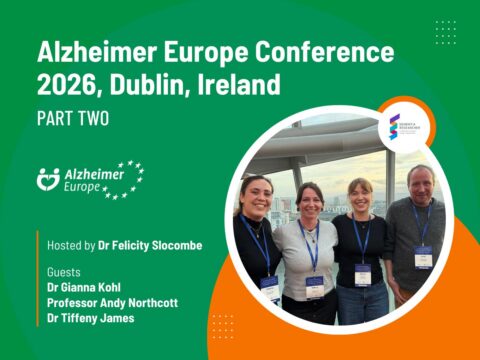
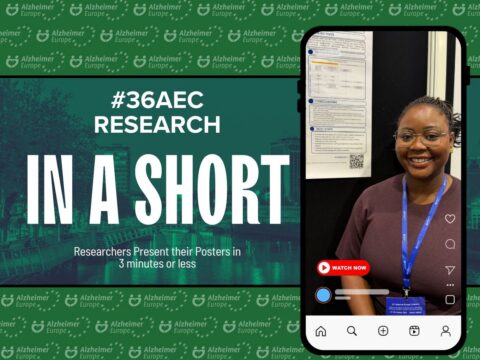
This episode of the Dementia Researcher Podcast comes from the 36th Alzheimer Europe Conference in Dublin. Researchers, policymakers and people with lived experience met there under the theme “Sláinte: Building momentum in dementia through policy, research and partnership”.
Hosted by Dr Jodi Watt from the University of Glasgow, the episode features Dr Rasa Mikelytė from the University of Kent, Dr Julieta Camino from the University of East Anglia and Dr Catherine Quinn from the University of Bradford. It was recorded at the end of the second day.
There was far more going on than any one person could see, so the panel take turns sharing the sessions, posters and conversations that made them think. Many of their picks are about everyday parts of life with dementia that research can overlook, from the chairs people sit in all day to how farmers access services. Rights and identity come up throughout. People living with dementia spoke about the right to stay at home. There was discussion of the language we use about dementia. And LGBTQIA+ sessions made non-binary and trans experiences part of the conversation. Young onset dementia had more attention than the panel has seen before, and they reflect on the “A Day in My Life” plenary and what it showed about working carers.
Each guest also talks about their own work at the conference: social care for people with young onset dementia, care workers supporting people at the end of life, and helping family carers with activities of daily living.
In this episode:
- Being seen, heard and valued
- The difference a chair can make
- Who gets to choose the language?
- How to tell if co-creation is real
- Human rights, in the words of people with dementia
- Young onset dementia comes into focus
- Queer biographies and the strength of community
- Lived experience on stage, and beyond it
Narrator:
The Dementia Researcher podcast, talking careers and research, sharing conference highlights, and so much more.
Welcome to the Alzheimer Europe Conference 2026
Dr Jodi Watt:
Hello, and welcome to the Dementia Researcher podcast. I'm Jodi Watt from the University of Glasgow, and I'm guest hosting the first of our two highlight shows from the 36th Alzheimer Europe Conference here in Dublin. This year's theme is "Sláinte: Building Momentum in Dementia through Policy, Research and Partnership." There's far too much happening for any one person to see, so I've brought together three delegates to share what's caught their attention over the first two days. Joining me are Julieta Camino from the University of East Anglia, Dr Catherine Quinn from the Department of Applied Dementia Studies, the University of Bradford, and Dr Rasa Mikelytė from the University of Kent. Welcome to all of you. So let's start by getting to know you. Please tell us a little about yourselves and your work. Catherine, you want to go first?
Dr Catherine Quinn:
Hi. So I'm Catherine. I'm an Associate Professor at the Department of Applied Dementia Studies at the University of Bradford. I've been in dementia research for probably about 20 years now.
Dr Jodi Watt:
Wow.
Dr Catherine Quinn:
And I also sit as part of the NIHR Policy Research Unit in Dementia and Neurodegeneration Exeter. So part of my work, I do dementia education, I do dementia research, and obviously, I do policy work as well.
Dr Jodi Watt:
Nice.
Dr Rasa Mikelytė:
As of two days ago, I'm a Senior Research Fellow at the University of Kent. Most of my work is in dementia. And in terms of subtopics, I do social care, palliative care, sexuality, that kind of stuff.
Dr Jodi Watt:
Nice. And Julieta.
Dr Julieta Camino:
Hi, I am Julieta. I'm an occupational therapist by background. I worked as a clinician for many years, but now I'm a researcher at the University of East Anglia, where I did my PhD, and I am looking into supporting family carers of people with dementia to provide support with activities of daily living. So that's me.
Dr Jodi Watt:
Well, thank you for introducing. Some of you might remember me from previous blog posts. I've been out of research for a little bit, but back for this conference, currently I work on REF at the moment, so slightly different topic. So let's turn to the conference, if anyone wants to share any highlights.
Seen, heard and valued
Dr Catherine Quinn:
I flew in yesterday and then I hopped on a bus and then I got here straight for the plenary session. But then after that I went to the quick oral presentations and what really struck me was one of the presentations where they talked about the importance of people with dementia being seen, heard, and valued. And it just really struck a note with me because I've worked in this field for a long time, but it just really struck me about the importance of just remembering the person is there.
And for me, particularly, things that I really took from yesterday was one session that maybe focused more people on the more advanced stages of dementia. So Tamara Backhouse was talking about the personal care and maybe those more restrictive practises that can occur. And also I went to this talk that was about chairs for people with dementia. I'm talking about physical chairs.
Dr Jodi Watt:
Sure, like this.
Dr Catherine Quinn:
And it really shocked me, because I've worked with a lot of people with advanced dementia in research context and we often think about their needs. And this was a presentation about the fact that if you've got the person in the right type of seating, it can make a bit of a difference to their quality of life in terms of their posture. And if you improve somebody's posture, you can make a big difference in terms of their ability of eating and drinking, et cetera.
Dr Jodi Watt:
Sure.
Dr Catherine Quinn:
And I've done research in a lot of care homes and there's always these issues where you have these chairs with the high sides, either side, and people can't see each other to interact with. And it just really shocked me that presentation was something simple as changing the way somebody is seated.
Dr Jodi Watt:
Yeah.
Dr Catherine Quinn:
And particularly if I think of somebody in advanced dementia where we're maybe not thinking about what can be done to help them in the same as we do when we've got somebody more in the early stages. But just the fact that there are still things that people can do that can make a difference to people's quality of life.
Dr Jodi Watt:
Yeah. This has been my first Alzheimer Europe Conference. I'm not sure if it's characteristic of the conference, but I think something that's really struck me as sort of presentations about those things that you maybe consider to be potentially slightly, not necessarily obvious, but almost so obvious you don't consider them. Like I'm from rural Scotland, and Martin Robertson did a talk today about farming and access to services for farmers. I've spent my whole life around farmers, and I just hadn't thought about it in that kind of way before.
So there's definitely, I've enjoyed how much of that there is that's going on, giving consideration to those things that you might just bypass, because they're part of the everyday. So yeah, sounds very interesting for sure. Rasa?
Why language matters
Dr Rasa Mikelytė:
Well, I'm going to be a shameless teacher's pet and say that my highlight yesterday was your presentation -
Dr Jodi Watt:
Thank you.
Dr Rasa Mikelytė:
On language and how we talk about dementia. I liked how you were very upfront about all the work done before and when you showed on the slide just how many different sources there are, and that the tone and the audiences they're intended for is different. So yeah, I just really liked your opening of language matters, because I'm really on board with language matters. Plus if I get anything wrong here, you'll correct me. So there's also that.
And because you did it with Martin, and I know the guide itself is not intended for people with lived experiences, it's policy and research language, but it made me think how in professional spaces, I feel perfectly comfortable calling someone out about the language they're using, but doing quite a bit of co-design and co-production, I'm also in spaces where people living with dementia use language that might be difficult to hear for another person living with dementia. So because particularly in the Q&A, there was a bit of touching on that aspect.
I really, really liked it. I think this is the next avenue to go to because it's just trickier to navigate, because people's own descriptions of their own experiences, their own illness, et cetera, are theirs. But when it lands with difficulty for someone else, then what do we do? And what duty of care do we have in those spaces, if it's research spaces?
Dr Jodi Watt:
Yeah. Well, thank you. It's nice to, I'm obviously very passionate about that topic and that's why I'm at this conference despite having stepped out for a little bit to work on REF. Yeah, it's such an important topic, and it's been really powerful to hear lots of different perspectives, but it's also highlighted the sort of continued issue of how do you make it as close to not perfect, because it will never be perfect, but as perfect as possible for everyone's involvement and everyone's life experience and stuff.
It's been really beneficial to be able to talk a little bit about that. But yeah, thank you. Julieta?
Co-creation and human rights
Dr Julieta Camino:
Yeah, I also had a discussion with one of my colleagues who went to your presentation. She was very impressed, and she was left thinking about the language, so that was something to share. I have two different highlights. For me was I went to a session on co-creation, and I took a very practical approach because one of the things that worries me is I want to develop interventions for carers to support activities of daily living.
And co-creation is one of my methods I want to apply, but I am not sure how to measure that we are co-creating and how do we make sure that people who are in the table contribute at the same level and how to manage power imbalances. So there were some discussions about different measures that you can take and to take notes about who is participating, and also asking the people who are there, how do they feel about it, and how much they think their values and opinions have been taken into consideration.
So I thought that was something very practical for me. And on the other side, I went to an ethics session, which I'm not very familiar with, but it was very, very interesting to hear people with dementia talking about human rights, and what are their rights from very simple things that we take for granted. And there was a discussion about how in Ireland, there's a system in place where people with dementia cannot decide whether to stay at home or not. And this lady was saying that she's fighting for that, because she wants to stay at home for as long as possible.
So it really left me thinking about rights and things that I don't consider in my daily practise, my daily research, but are still really important for people with dementia.
Dr Jodi Watt:
So that session was sort of driven by people living with dementia.
Dr Julieta Camino:
It's a mix. So yes, it was a mix. So there was talks about deprivation of liberty, and the practises that happen in the UK, and how people with dementia are retained in hospital, and they are overmedicated because of those policies. But also there were people with dementia talking about their own experience and how they're fighting for their rights.
Dr Jodi Watt:
Yeah, I wasn't able to go to the ethics session, but it's one of those ones where I wanted to go, but it was parallel sessions sort of thing. But I think there's been a really interesting undertone, at least for me for the couple of the past, today and yesterday, with regards to just the general feeling of rights and rights advocacy for people living with dementia, which has been really, really nice to see. There's also more people here who are living with dementia that I have seen at other conferences, which is also very powerful as well.
Lorenzo's House and young onset dementia
Dr Jodi Watt:
So I wanted to go round again, and just see what people have enjoyed that's maybe slightly, not necessarily out of their comfort zone, but maybe slightly different to what they would usually work on or things like that. So for me, something I really enjoyed. I really enjoyed speaking with people from Lorenzo's House, who have sort of an exhibitor booth here today. They gave me a lovely bracelet that before we started recording, I promptly managed to snap and then put back together again.
But yeah, so Lorenzo's House is like a virtual global community that empowers families navigating young onset dementia and provides direct support and raises awareness. I think for me it's been, again, having stepped out, and come back for just this conference, it's been really interesting to sort of see a bit more of a focus on young onset dementia than I've seen at other places. And I think this is sort of very exciting. As someone who had grandparents who had not young onset dementia, but as a child trying to understand the diagnosis, that was very complicated for me, and there was an absence of this sort of thing.
And I think the focus on young onset when you're talking about people in their 30s and 40s and 50s who have young children, and those young children are trying to navigate it, I think it's an invaluable resource and I'm really excited to see what they're going to do. And they have a lot in place already, like a lot of clubs and matchmaking to try and put together people who are having similar experiences so they can talk together and stuff. Just really, really powerful stuff and very exciting.
So yeah, not exactly a poster or a talk, but something that I thought was really powerful. So yeah, did anyone else want to share some of their sort of slightly more, not rogue, rogue's not the right word, but slightly more outside of their usual field things?
Learning from other countries
Dr Catherine Quinn:
I think what gets me outside of my usual field is actually going to talk to some people from different countries and therefore hearing about the dementia care provision in other countries because I think being from the UK, we can get a bit fixated onto what our systems offer. And actually it's really interesting hearing what practises and what's occurring in other countries as well. And I guess the big things, we often share the same issues. Post-diagnostic support is not brilliant anywhere, I don't think.
And it's almost a bit reassuring to hear that from other countries, but I think you can learn a lot. I have to say, I went to a session today about sex and gender in dementia, and just thinking about the implications of that even in terms of how that's recorded in research studies and the fact that these systems perhaps haven't recorded that information. So how can you interrogate data if previously it wasn't recorded? So just really highlighting the importance of that, thinking around sex and gender when you're thinking about brain health initiatives, just really highlighted this to me why there needs to be that focus on those topic areas.
Dr Jodi Watt:
I think for sure seeing different cultural contexts and just what work is going on that's not like a UK-centric, because I think in terms of our workspaces, we're quite a UK-centric panel today. Yeah, for me, I was looking around, I've only made my way through half the posters so far today, but I was looking around and I saw a guy in leathers and I was like, "What's going on here?" And yeah, he was talking about what's happening in Norway with the Harley Owners Group, and just this sort of ride together initiative, which is like a community activity group for younger people living with dementia.
So again, as I say, quite a lot in terms of young onset dementia going on. His work was very exciting. Stig Hoel, H-O-E-L, yeah.
Dr Julieta Camino:
I was thinking that in terms of sex and gender, this is very random, but I was in my poster, and a woman came to see my poster, and she's someone I know, she's very experienced in sex and gender research. And she asked me if I had considered in my study to split the sample into carers, female carers, and male carers and how that might affect the results. And I didn't think about that. I'm quite surprised about that, because you just need to come to a conference, go to different sessions about intersectionality, sex and gender.
Then someone comes and tells you, "Do you think about this difference between how women and men provide care?" And I didn't. So I thought that that was something very simple, but for me very important, because it really made me wonder, made me think about, okay, I do need to have a more open mind when I do the research and when I propose my research questions, et cetera. So yeah, it was as simple as that, but yeah, important.
LGBTQIA+ lives and queer biographies
Dr Jodi Watt:
Yeah, I think it's very interesting, isn't it? It's always simple things like that you maybe haven't fully considered. I think there's been a really interesting narrative around gender at this conference. I was in the LGBTQIA+ sessions earlier, and it's the first time in my life as a queer person that I've sat in a conference, and people are talking about being non-binary, being trans. That's huge. As someone who is non-binary, I've been concerned my entire Alzheimer's career about what, if I get Alzheimer's or dementia, what that looks like for me.
So having those conversations, I was nearly tearing up hearing those conversations happen. It was very exciting. And yeah, unfortunately, I missed the sort of gender sessions because I was in the LGBTQIA+ session, but that in itself is really exciting. There's so many sessions on this now that I can't go to them all. So yeah. Rasa, did you have any other highlights?
Dr Rasa Mikelytė:
Well, it's a highlight. It's not fitting your topic of something unusual because I was also in the sexuality or LGBTQIA session with you. But what I picked up from there was a presentation by Joanna from Austria, whose surname I have of course forgotten, but she was talking about biographies and embodiment. And I really liked the acknowledgement that for queer people, biographies are sometimes nonlinear and sometimes complicated, and sometimes the way you present your biography in some spaces might be different than others.
I just think, I wonder if we're not talking enough about how it's also a strength when queers live with dementia, because when biographical disruption happens due to dementia processes, as queers, we have mastered this. Growing sideways, non-chrononormative living is, because I really like the session, the entire session, not just Joanna's presentation, for acknowledging and spelling out how living with dementia and being queer or gender queer might be different.
Dr Jodi Watt:
Yeah.
Dr Rasa Mikelytė:
But I think we need to lean into our strengths too. Yes, we have to acknowledge the difficulties, but I think there are some really distinct ways of community, of belonging. What you were saying about the bikers, what we're talking about, farmers, this is kind of how to experience dementia in communities that you already belong to. This can be a strength. Anyway, I was determined to feel hopeful somewhere, so I felt hopeful there.
Dr Jodi Watt:
Yeah, yeah, I think, yeah, that was a really interesting and exciting session that way, at least, yeah, that's how I found it.
Our own research
Dr Jodi Watt:
Before we finish, I want to give you each a minute to tell us about your own work. Catherine, do you want to go first?
Dr Catherine Quinn:
Yeah, so I was presenting this morning at 8:45.
Dr Jodi Watt:
Nice and early slot.
Dr Catherine Quinn:
But I was presenting about the DYNAMIC study. So this was a study that we did that looked at improving the social care provision for people with young onset dementia and the families. So specifically looking at the experiences of people with young onset dementia and the families in relation to social care, speaking to social care professionals, and then working through a process where we identified priority areas for improving social care. We narrowed in on improving social care professionals' awareness of young-onset dementia and supporting people around the financial impact of young onset dementia, because this is a condition that has quite a huge financial impact on people.
And we developed some resources about that that are available on the Young Dementia Network website. But it was really lovely today to be able to present about all the work we've been doing on that study.
Dr Jodi Watt:
Amazing. Rasa?
Dr Rasa Mikelytė:
Right. I am presenting tomorrow, I think at two o'clock. Quite suitably, the graveyard presentation shift for an end-of-life presentation for the second, if not third year in a row, the end of life gets that slot, which I swear is, if not overtly intentional, this is subconsciously happening. But I'll be talking about a project where the overall aim is to co-design resources for care workers on supporting people living with dementia and their families at the end of life.
But I'll be talking about one of the first steps of this project, scoping out people's experiences, and speaking to those three groups, so people living with dementia, family carers or supporters, and friend carers and supporters too, and care workers across different care sectors in the UK. So home care, care home, sheltered accommodation. We haven't got anyone in live-in care working currently, but with past experience among our participants talking about their experiences.
And the project really leans into the idea of hesitance, that sometimes when we talk about good end-of-life care, or any topic in care for that matter, we kind of see it as a capability issue, as in just give people information, and they'll do the thing that you're asking them to do. But with what we sometimes call in the trade "taboo topics," or areas where you may not feel comfortable because it's not as discussed topic, or because it's emotionally loaded, purely information is not enough.
There's much more about motivation where you may know what you want to do, you may know what the right thing to do is, and yet you may hesitate for a variety of reasons. So kind of leaning into that hesitance and what can we do about it is what I'll be talking about.
Dr Jodi Watt:
Yeah, that sounds very—
Dr Rasa Mikelytė:
Where everyone's gone. Sorry, I interrupted you there, but everyone will be gone. Everyone will be on their flight.
Dr Jodi Watt:
Are you absolutely here?
Dr Catherine Quinn:
Yeah, I think I'm still here for that.
Dr Rasa Mikelytė:
All right then.
Dr Jodi Watt:
I'll be popping in. As long as I've not misunderstood when my flight is, I'll be there. And what about yourself?
Dr Julieta Camino:
So I'm presenting one of my studies that is looking at how to maximise the time that carers spend supporting people with dementia with activities of daily living. So what I am presenting is I'm trying to identify what are the strategies that they can use that can reduce the time that they spend with ADLs. So yes, I am presenting it today.
Dr Jodi Watt:
Okay, perfect. I should probably also talk about myself and what I'm doing. We've already talked a little bit about my language work that's been presented. I also do have a poster tomorrow about my drug repurposing work, and essentially can we repurpose some drugs, and hopefully cut costs in terms of treatment or management? The answer is maybe. So yeah, but feel free to pop along. I don't know if this is going out before tomorrow, but yeah.
The big sessions
Dr Jodi Watt:
Yeah, so I do realise that we haven't actually mentioned, I don't think, any of the bigger sessions that have been going on.
So we've had the Prime Minister of Ireland was here. I wasn't at the opening ceremony. My bad. Was anyone there? Anyone?
Dr Catherine Quinn:
Yeah.
Dr Catherine Quinn:
It was really impressive, yeah.
Dr Jodi Watt:
Yeah? Did you have any standout moments from what was said? Or was it more just a welcome to Dublin situation?
Dr Catherine Quinn:
I think it's just something where you've got... when you've got somebody at that level.
Dr Jodi Watt:
Yeah, exactly, you're pulling a Prime Minister.
Dr Catherine Quinn:
I think anything that you're bringing that somebody at that level who's got an interest in dementia research to come along and care about the topic, I think is so important. We need that higher up endorsement of this area.
Dr Jodi Watt:
Yeah, I mean, there was also a session today with Irish MEPs conversing around dementia and what the dementia agenda is in terms of Europe and in terms of Ireland, which again, I also wasn't at, my apologies, but I've heard a lot of conversation around that and about how exciting that was to hear sort of MEPs talking quite transparently about where they think things are going to go. Earlier on, we had a session, a plenary session, Living with Dementia, Day in My Mind, a Day in My Life.
Did anyone have any standouts from that session?
Dr Julieta Camino:
Yeah, I thought that was very interesting to see how the families supported the people with dementia and how they created this environment.
Dr Jodi Watt:
Sure.
Dr Julieta Camino:
I was quite caught by that image of all of them participating, doing activities, programming. And I felt that there was quite a big difference with the UK and how people are a bit more lonely. And I did wonder about where are the people who live alone? So it was really reassuring to see all that, but also I did feel about those people who are probably not here or not represented, and that they don't have family. And I was wondering how do they live with dementia, and how do we need to do more for them to be here and represented.
But yeah, I think it was very interesting, yeah.
Dr Jodi Watt:
Yeah.
Dr Rasa Mikelytė:
I was kind of struck. I'm now bringing a negative tone. I was hopeful before. We're done now. This is negativity. But I was reflecting, one of the family carers. Sorry to turn away from you. I'm not sure which one of you to look at. But when she mentioned that she couldn't bring her mom this year because she couldn't find care cover, and I understand that there are factors like familiarity, of who's supporting you, but that aside, I was kind of thinking, "Well, you're giving a keynote at a massive conference." I mean, I don't know if the conference tried to help or not, but I kind of reflected that my first Alzheimer Europe was in 2014.
This is how old I am. And I remember that being really blown away. It was my first conference where people living with dementia were part of panels. They were hosting conversations and talks. They were taking such a prominent role in organisation and running and presenting at a conference in a way that I haven't seen before. I kind of feel that other spaces have caught up. And in the last couple of years, I felt that we haven't had enough of that at Alzheimer Europe.
So that plenary was brilliant. It was really nice to have lived experience, but I'd like it more throughout again.
Dr Jodi Watt:
Yeah, I think that's fair. I think there's been, again, I'll speak only for myself, but I think there's been a bit of whiplash sometimes with these lived experience things that we've heard, which is obviously the reality of circumstance. But I was also struck by that, the idea that she was unable to get care support to attend the conference. But then I was also in, I don't know if any of you were in Lilly's symposium earlier where they had a person with lived experience talking about how she was still driving.
Yes, she was having to do a test every year, but she was still able to drive and lived alone, maintain her independence with her dog and things like that. It was also really, really positive. But I definitely think people with lived experience are clearly at the core of this conference. I think that's something that makes it really special, for sure.
Dr Catherine Quinn:
And I think for me, it was the fact that the carer was up there, and it was somebody who was still working. And I think just talking through the realities of what it's like to provide care for somebody when you've still got a job, and you've got young children and just talking it through, because I think very often, we've talked before about young onset dementia, but when we think about dementia, we always think about people who are older, who've retired, et cetera.
But the younger family members who have to provide support to these individuals, just the juggling act. And I thought she did it really well, just raising that issue again about just how hard it is to do everything.
Dr Jodi Watt:
I think some people sort of think of the label "carer," and don't necessarily go further with it until they're sort of directly confronted with it. And I think it was really poignant to hear her sort of be like, "Here's the reality of my life. Here are all my titles. Carer is just one of them. Here's everything else that's going on." So yeah, really, really powerful plenary today. Yeah, did anyone... Oh no, I went to that one. Did anyone go to the biomarkers talk by Eli Lilly?
Me, I did. That's the one I was just talking about. So yeah, there's some other stuff going on later today. There's a keynote on Irish dementia policy. Again, obviously we're in Ireland. There's quite a lot of conversation around what's happening in Ireland with dementia. Makes sense. And then there's a round table on dementia in European policy as well. I am wandering around here a bit like a headless chicken and I haven't really thought about what's coming tomorrow, but I think we've had absolutely loads to be going on with so far, for sure.
What we're taking home from Dublin
Dr Jodi Watt:
Last question, what's one thing you'll be taking home from Dublin?
Dr Catherine Quinn:
You know what? I haven't been to a conference for a while, and it's just a reminder of the huge dementia research community around and the enthusiasm for doing work in this area.
Dr Jodi Watt:
Yeah.
Dr Catherine Quinn:
And I think just sort of refreshes and reboots yourself a bit into just really making it clear why we do what we do when we do research, and why it's so important that we keep going and trying and going through grant applications, et cetera, to keep, because it is so important this work in this area. So for me, it was just a reminder of that, really.
Dr Jodi Watt:
For sure.
Dr Rasa Mikelytė:
I don't know if it will be a conference talk or any content, but I got to see so many people I know, and meet some new ones. So I'm going to come back refreshed because in the day job, head down, focus on delivery, I was saying to someone, I can't remember whom, if we had as much space. I was in Aldridge. I was telling her that I think if we had more of these spaces to network and think together, we could take over the world.
I mean, not that researchers should be allowed to, but we'd have so much more idea generation, and new ways of working and new ways of thinking. So I'll just come back refreshed because I got to touch base with people I know and missed, and also meeting some new cool folk.
Dr Julieta Camino:
I feel the same. I was going to say that to see people that... No, no, no. But it was nice to meet with people who you don't see in your regular days, and to hear from their successes, from their things that are not going well. So I think it was that renovation. Okay, we are going to go the same direction, and it's nice to see the same people and you, as you said before. So yeah, that's my takeaway.
Dr Jodi Watt:
Amazing. Yeah, as discussed, taking home my bracelet. So yeah, Julieta, Catherine, Rasa, thank you so much for joining me here. We'll be back tomorrow with our second and final show from Dublin. You can find profiles of today's guests and more conference coverage at dementiaresearcher.nihr.ac.uk, and follow the conversation using #36AEC. I'm Jodi Watt, and you've been listening to the Dementia Researcher podcast. Goodbye.
All:
Thank you.
Narrator:
The Dementia Researcher podcast was brought to you by University College London, with generous funding from the National Institute for Health and Care Research, Alzheimer's Research UK, Alzheimer's Society, Alzheimer's Association, and Race Against Dementia. Dementiaresearcher.nihr.ac.uk.
If you would like to join a panel or record a podcast on your own area of research, complete our show form. You can subscribe to our podcasts through your favourite podcast app, just search for 'Dementia Researcher' or follow the links in the footer of this page.
Did you know... all of our blogs are also available as podcasts? Find them here on Apple, and here on Spotify
The views and opinions expressed by the host and guests in this podcast represent those of the guests and do not necessarily reflect those of UCL, Dementia Researcher or its funders.
Join our Supporter Programme and subscribe to our channel in YouTube or in Apple Podcasts for exclusive access to bonus shows, and to gain early access to our recordings.
Share your thoughts on this topic in the comments below.

 Dementia Researcher





 Heather Wilkinson