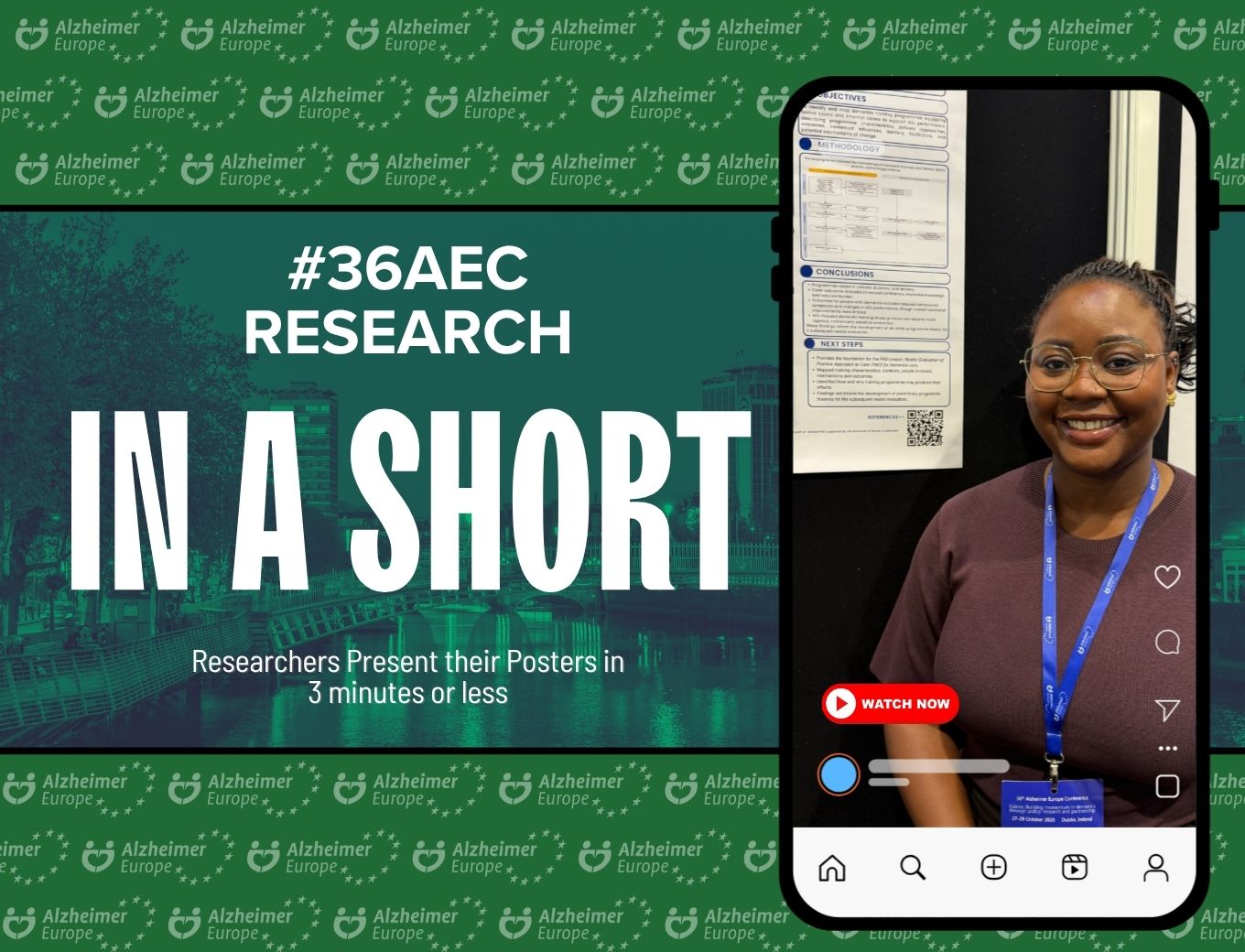
At the 36th Alzheimer Europe Conference in Dublin, we spent time in the poster hall recording short conversations with researchers about their work.
Over three days at #36AEC, we captured 19 poster presentations, each explaining a study in the researcher’s own words, all in 3 minutes or less! We’ve brought them together into a single playlist so you can explore the work being shared on dementia care, policy, lived experience and partnership, in keeping with this year’s theme, “Sláinte: Building momentum in dementia through policy, research and partnership”.

Cómo Barcelona ha creado una red para impulsar a jóvenes investigadores en demencia
How Barcelona built a network to support early-career dementia researchers
Young-onset dementia: one story from every county, linked to local support
Can hospitals help close the dementia diagnosis gap?
Storytelling, identity and dementia: six lessons from the research
Supporting people with dementia who live alone: balancing risk and autonomy
Beyond tokenism: how lived experience shapes dementia research
Partners in Research and RICH Voices: public involvement that works
The dementia training gap in social care, and how to fix it
Supporting care home staff who face racial abuse in dementia care
What makes dementia carer training actually work?
Using scent-based reminiscence to support people with Alzheimer's
Caring for someone with dementia from miles away: who supports distance carers?
Making research information accessible to people with dementia #36AEC
Embedding lived experience in postgraduate dementia education
Can a dance and touch programme improve quality of life in dementia?
How one Italian region is putting people with dementia at the decision-making table
Can music from your own culture help recovery after stroke?
One size doesn't fit all: digital tech support in home care
People with dementia help plan research, but rarely see it through
What You’ll Find
This year’s posters leaned towards care, policy and partnership, and the playlist reflects that.
Many focus on lived experience. You’ll hear how people with dementia are involved as partners in research and where that involvement falls away, how lived experience panels can move beyond tokenism, why personal stories still matter as dementia progresses, and how people living with dementia are now teaching on postgraduate dementia courses. There’s also a strong showing from Scotland, where public involvement groups have co-written a book, a podcast and a guide to clinical trials.
Others look at support at home and in care. Studies explore people with dementia who live alone, carers who live miles away from the person they care for, tailoring assistive technology in home care, what makes carer training work, the dementia training gap in social care, and how to support care home staff who face racial abuse.
There are creative and sensory approaches too, from a dance and touch programme to scent-based reminiscence and culturally familiar music in rehabilitation after stroke.
And some posters take on bigger system questions. These include how hospitals could help close the diagnosis gap, how one Italian region is bringing people with dementia to the decision-making table, a planned people’s registry for young-onset dementia, and how Barcelona built a network to support early-career researchers (with a version in Spanish).
Thank You to Our Presenters
Thank you to everyone who stopped to talk to us: Ankita Bhojwani, David Neal, Grażyna Leja-Franczyk, Lara Zanarella, Dr Yahveth Cantero-Fortiz, Dr Laura Cole, Abigail Moon, Dr Aysegul Humeyra Kafadar, Marine Garcia, Praise-God Adedokun, Dr Kritika Samsi, Becky Robinson, Dr Rosie Ashworth, Briony Harden, Jimmy Lindberg, Rianna Patterson, Esther Loseto-Gerritzen, Will Dean and Dr Carla Obradors-Tarragó. Each video credits the presenter and their co-authors in full.
And a huge thank you to Alzheimer Europe for hosting such a warm, welcoming and brilliantly organised conference.
Why We Recorded These
Poster sessions are where a lot of conversation happens, but they’re also easy to miss.
You might catch a few while walking around, but not all of them. And if you aren’t at the conference, you miss them entirely.
These short videos are a simple way to make that work visible. Each one is quick to watch, and together they give a broad picture of the research being done right now across Europe. If you enjoy them, you’ll find more in our poster talks from ADPD 2026, and if you’re preparing a poster of your own, read our guide on how to design an award-winning conference poster.
Dementia Researcher works alongside events organisers to share their work. If you’re organising a dementia research event and would like us to record or share your plenary talks, posters or share highlights in our podcast, or even support livestreaming to get them open access and to reach a wider audience, get in touch: dementiaresearcher@ucl.ac.uk