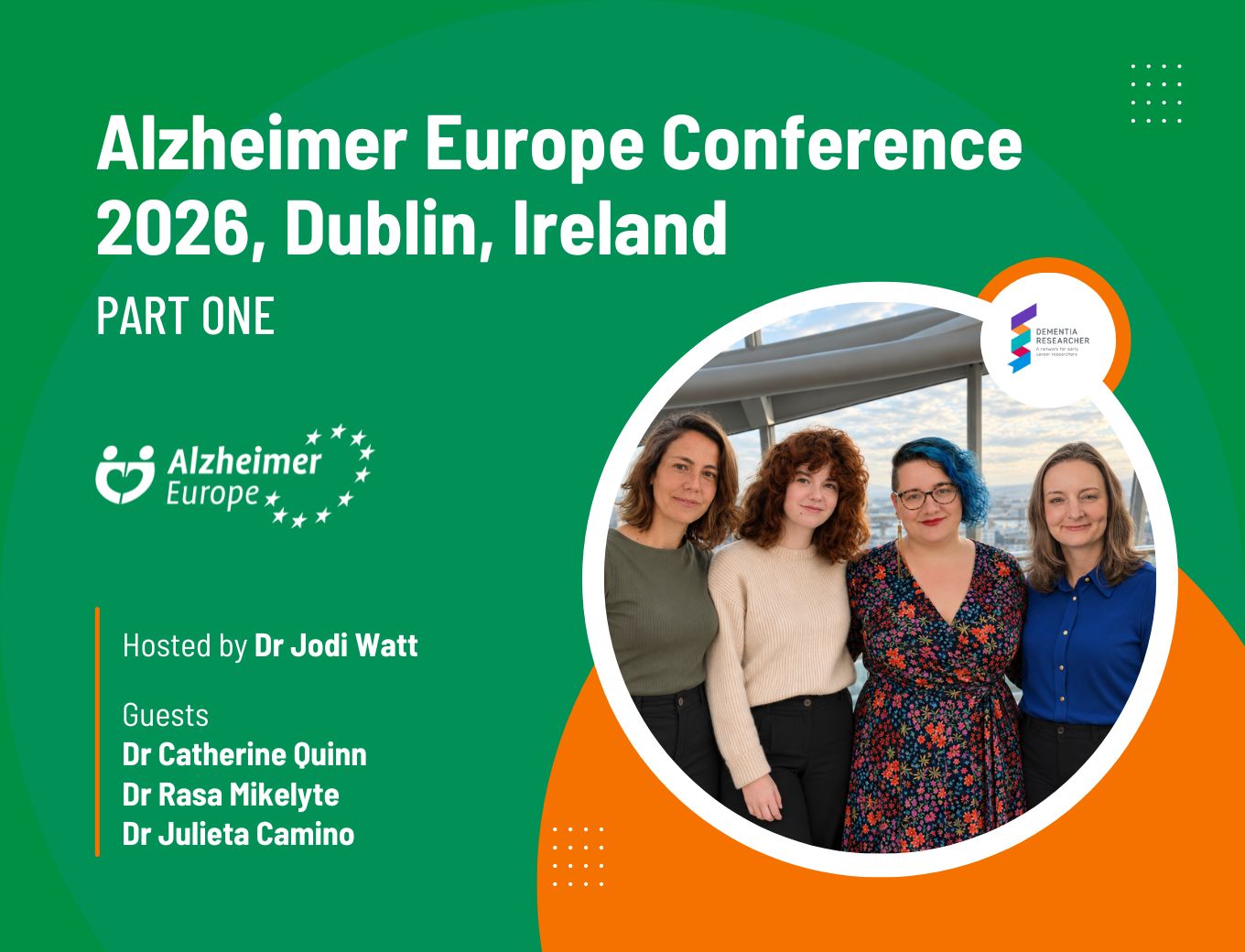
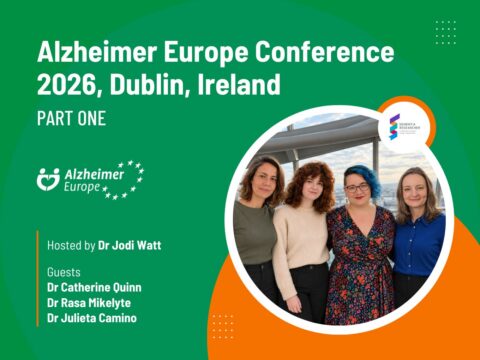
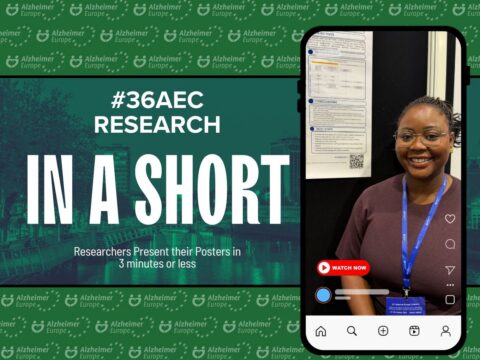
This episode of the Dementia Researcher Podcast comes from the final day of the 36th Alzheimer Europe Conference in Dublin, looking back over three days of research, policy and lived experience.
Hosted by Dr Felicity Slocombe from the University of Bradford, the episode features Professor Andy Northcott from the Geller Institute of Ageing and Memory at the University of West London, Dr Gianna Kohl from UCL and Dr Tiffeny James from the University of Greenwich.
The conversation starts before the conference itself, with an Interdem keynote on ethics in care. It challenged the idea of “therapeutic lying”, and the debate carried on over dinner. From there, the panel talks about psychosocial research taking the plenary stage and what blood biomarkers look like to two qualitative researchers who went along to learn. They also cover specialist seating that eases pain and agitation, and whether having “Alzheimer” in the name of most national dementia organisations helps or hinders people with other forms of dementia. How dementia language travels across cultures comes up too, as does whether the conference venue itself is dementia friendly.
Each guest also talks about their own work at the conference: restrictive practice in hospital care, people with dementia who live alone without family support, relatives caring from a distance, and priorities for urgent and emergency dementia care. The panel closes on the bigger picture. Involving people with lived experience has moved from a standalone panel to part of almost every talk, but including underrepresented groups still has further to go.
In this episode:
- Is lying ever therapeutic?
- Psychosocial research on the plenary stage
- Blood biomarkers for the rest of us
- Why seating matters in dementia care
- Does “Alzheimer” in a name help or hinder?
- Living alone, or caring from a distance
- Emergency care when the paramedic has to leave
- Lived experience moves from add-on to everyday
Narrator:
The Dementia Researcher Podcast, talking careers, research, conference highlights, and so much more.
Welcome back to Alzheimer Europe 2026
Dr Felicity Slocombe:
I'm Dr Felicity Slocombe from the University of Bradford, and I'm guest hosting the second and final highlight show from the 36th Alzheimer Europe Conference here in Dublin. This year's theme is “Sláinte: Building momentum in dementia through policy, research and partnership.” Over three busy days, there's been far too much for any one person to see, so I brought together three delegates to look back on what stood out. Joining me are Dr Gianna Kohl, a research fellow in primary care and population health at UCL, Professor Andy Northcott from the Geller Institute of Ageing and Memory at the University of West London, and Dr Tiffeny James from the University of Greenwich. Welcome, all of you. Let's start by getting to know you. Please tell us a little bit about yourself and your work. Gianna, can I come to you first?
Dr Gianna Kohl:
Yes. Thank you, Felicity. So my name's Gianna Kohl. I'm a research fellow working at UCL on a project called INDEP where we're trying to improve access to care for people with dementia who live alone and don't have family or friends supporting them. That's my current job. Yeah.
Dr Felicity Slocombe:
That's great. Thank you, Gianna. And Andy, yourself.
Professor Andy Northcott:
Hi. So hi, I'm Andy Northcott. As you said, I'm a professor at the Geller Institute of Ageing and Memory. I'm a medical sociologist by background, so I do a lot of qualitative research, primarily ethnographies in hospital. So trying to look at kind of the underseen but important aspects of care, so things like continence and restrictive practise and the kind of mucky stuff that nobody else wants to look at is what I end up doing.
Dr Felicity Slocombe:
Yeah. That's great. Thank you, Andy. And Tiffeny.
Dr Tiffeny James:
Thanks, Felicity. I'm Tiffeny James. I'm, as of the 1st of September, a senior research fellow at the University of Greenwich. Before I got into research, I worked as a home care worker alongside my psychology degree, and then I worked as a dementia advisor with the Alzheimer's Society, and it's kind of that role that led me into research.
Dr Felicity Slocombe:
That's great, and lovely to have such a range of, you know, subject interests and backgrounds here today. So let's turn to the conference. So what's the one talk, session, or poster that has stayed with you the most this week? Tiffeny, shall we start with you?
Is lying ever therapeutic?
Dr Tiffeny James:
Sure. The session that I was thinking of actually happened before the conference started. It was the keynote speech for INTERDEM which is a pan-European network of dementia researchers, and they have their annual general meeting before the Alzheimer's Europe Conference every year. The session was by Professor Kate Irving. She's at Dublin City University, and it was around ethics in care. And she started off with some really nice stories and photos about her mom who was previously living with dementia, and she cared for her for, I think she mentioned, nine years. And I always really like hearing people's personal stories.
And then she talked about the concept of therapeutic lying, so this idea that maybe a person with dementia may think that their own mom is still alive and wants to see them, and what do you do in that situation? Do you say, "Well, don't worry. She'll be here soon," or do you let them know, "Actually, your mom's passed away"? And, you know, it's something that we have to think about a lot in dementia care. And she wasn't saying that she's against lying when it is in the person's best interest around safety, but she had an issue with the term therapeutic lying.
She said no form of lying is therapeutic,
Dr Felicity Slocombe:
Yes.
Dr Tiffeny James:
but sometimes lying can help maintain a therapeutic relationship. So if you break the therapeutic relationship, then it's impossible to give good care. And I just thought it was a really interesting discussion about, yeah, the ethics of lying.
Dr Felicity Slocombe:
Yeah, that is really interesting because I think we come up against quite a lot of different situations in which you don't quite know what the best answer is, and there isn't always a correct best answer. It's what's right in that context and with that person, so, yeah.
Dr Tiffeny James:
Exactly. And it must be, I mean, I don't have personal experience of caring for a relative with dementia, but it must be really hard to know what to do on the spot every time a new situation arises. Yeah, it was really interesting and thought provoking.
Dr Felicity Slocombe:
That's great. Thank you, Tiffeny. And Gianna, what about you? What's your favourite talk or poster that you've seen so far?
Dr Gianna Kohl:
Yeah, so I agree with what Tiff just said, that Kate's presentation on Monday, which wasn't part of the conference but part of the INTERDEM panel, was really moving because there's a lot of personal experience in it, and I think she said she wasn't really part of the dementia research world for the past nine years because she cared for her mom. Other than that, I'm always drawn to personal lived experiences of carers and people with dementia.
So I was in a session yesterday where it was a quick oral presentations, and there were several people with dementia including one spouse of someone with dementia who shared their personal stories, and one that stuck with me was by Willy Gilder who I know through my work. Well, he was a person with dementia, quite an advocate in the dementia world because he was diagnosed with young-onset dementia, I think, he said, six years ago, and, since then...
So his talk was on, should people with dementia be included at conferences, which I think is really important that, you know, Alzheimer Europe is quite inclusive, and that we keep doing that because there's no need to do research for people if we don't ask people what they find important.
So I think what I'm trying to say or my point is that he was very open and said that actually his cognitive problems and his dementia were caused by a heart problem and that he had treatment for that and then that since, like his cognitive problems have really improved to the point, I believe, that he doesn't really have a dementia diagnosis anymore. So I think he was really brave in just sharing that story which I don't think is... You know, there's like so many different forms of dementia, and it just kind of shows that it's also difficult to diagnose someone.
So that's one that stuck with me.
Dr Felicity Slocombe:
Yeah, and that's really interesting. I think there's some more work to be done in the area of kind of misdiagnosis of dementia, and it seems to be coming up more as a topic. I've heard, you know, colleagues that I've been with here this conference talking about that as well, but I didn't catch Willy's talk, so that's really interesting to know that there was discussion specifically about that. So that's, yeah, it's great. Thank you. And Andy, what about your favourite talk or poster?
Psychosocial research on the plenary stage
Professor Andy Northcott:
Yeah, I mean, I'm going to jump back again, and we're not meant to be talking about INTERDEM, are we, but I'm going to talk about INTERDEM briefly again because Kate Irving's talk, yeah, the whole thing about therapeutic lying, it's the sort of thing where I'd always kind of been like, "Yeah, you probably shouldn't do it, but you don't want to remind someone that their wife has died and things. There's grey areas." But after that talk, I then went out for dinner at a ramen restaurant in the city centre, and the entire meal just turned into a debate between four of us that had completely different opinions on whether therapeutic lying or therapeutic communication counted and some very, very strong feelings and different feelings from people and probably all with a correct reason and ethical reason for doing it. So, yeah, it was definitely thought provoking and a bit more of my own thoughts.
In terms of my own highlight, mine was today for this morning's plenary session, and it was seeing, and it's cheating a little bit, 'cause it's one of my colleagues, Emma Wolverson from the Geller Institute, but not just because Emma's talk was great, so she was talking about lots of research that's being done via INTERDEM around points of crisis and how we avoid crisis and recognising when crisis happens, but also to see psychosocial research on the plenary stage, which quite often is taken over by your big guns, your AI, your medical developments, your pharmaceuticals.
And so to see, sort of, our little qualitative research projects and lots of people's little qualitative research projects there and getting recognition, and then, at the end, when the questions came in, they were all towards Emma and the qualitative stuff and not towards the drugs and the biomarkers and all those things that we all know about, and they're really important, but it's good to see the other parts getting shown, and that care and human experience and what it's like to live with dementia or care for someone with dementia was up there on that stage was quite moving.
Dr Felicity Slocombe:
Yeah, I'd absolutely agree with that, Andy. I think it was one of my highlights today as well. Emma's talk was, yeah, at the end of three of really interesting talks but obviously more focused on that biomedical end of the spectrum and to have that, you know, almost, it doesn't sound right to say representation because there's lots of psychosocial and, you know, more social science research, you know, being presented at the conference, but it was really nice to have them on the stage together and to also have the quite a lot of questions afterwards were from people with dementia themselves about, you know, thanking Emma and colleagues at INTERDEM and, you know, all the collaborators at the Geller Institute as well around, you know, the importance of that research and what it means to people actually living with dementia whereas the, you know, more biomedical treatments aren't quite feasible and not quite where they need to be yet for most people with dementia to be able to benefit from them.
Professor Andy Northcott:
The only bad part is I have to share an office with Emma, and she is amazing, and that's just one more thing she's done that's brilliant, and I've now got to go and compete with that when I go back to work. So, yeah, it was really good.
Dr Felicity Slocombe:
No, yeah, I'm sure that can get on your nerves a bit when you're like, "Oh, stop being so amazing," but also really great person to work with, I imagine. That's great. So for this round, we'll do something a little bit different. So if you can think of a smaller talk, a poster, or even something outside your, kind of, usual area of interest that kind of surprised you. So perhaps Gianna, could I come to you first about a smaller talk or something that surprised you from the conference?
Blood biomarkers and dream recall
Dr Gianna Kohl:
Yes, thank you. So, I forgot to mention earlier, I'm a qualitative researcher, so anything that's due with like medical treatment or prevention, I'm not very familiar with. So today I tried to go to some talks that I would kind of learn new things about biomarkers, for example, because I don't know much about them. So I went to a session around noon which was called "Paving the Path to Alzheimer's Prevention" which was, mostly the session was around biomarkers and preventative testing of biomarkers. So I do have to look at my notes. So, it's Dr Marta del Campo, and I think she's based in Spain, and she talked about p-tau217 which apparently is the most useful biomarker. I feel like I'm probably going to talk about things that a lot of people know, but I didn't.
Dr Felicity Slocombe:
No, no.
Dr Gianna Kohl:
And then they did some research to kind of see whether testing in primary care and secondary care, how accurate that is for that biomarker, and it seems to be equally efficient or accurate, which is great because, you know, it could be much easier to do that at the GP surgery than having to go to hospital. And then also that biomarkers are influenced by medical conditions or medications like kidney disease. I didn't know that.
And, yeah, and one thing that she said, because with the biomarkers, of course, you can test for that, and then a lot of people have them but don't develop dementia, so they're working on a study called the ALFA10 study where they're trying to come up with some risk prevention models that are based on not just biomarkers but lots of different information like lifestyle factors, physical, exercise, social connections, all of these, you know, part of those like 14 modifiable risk factors. So that just kind of stuck.
Like she explained it really well how the biomarkers, how that works, and that detecting pathology doesn't mean that you predict dementia. And just to add, as part of that, which I thought was the same session, his name is Dr Pascual Sanchez who mentioned a study on dream recall that they had done which I didn't know. He said people who aren't able to recall dreams have a, I think, is it 45 higher risk of developing dementia? So there's something around creativity and imagination that could be useful for future research. So, that.
Dr Felicity Slocombe:
No, that's really interesting. I missed that session, but a colleague went to it, and she was telling me about the dreams and whether you can remember it or not, and I was like, "Is there any, you know, more detail around..." You know, cause I feel like I can remember sometimes parts of dreams. I'm like, "Does that mean I'm kind of in between those two stages?"
Dr Gianna Kohl:
Yeah, how much do you need to recall? Is it like snippets? Is that all right or just the whole thing?
Dr Felicity Slocombe:
Yeah, for there to be a risk. And I think, like you, I'm very much, you know, a qualitative researcher ordinarily, and I found it quite interesting to be able to learn a bit about the more biomedical side of specifically the blood-based biomarkers and what all of that means because it can feel quite inaccessible to try and read a journal article about it when you don't know any of the underlying terminology. So, yeah, to have someone explain it in a much more, you know, kind of layperson terminology, you know, is helpful and good to come away with that knowledge from the conference. Thank you, Gianna.
Why seating matters
Dr Felicity Slocombe:
Tiffeny, I'd like to come to you next. What's your kind of surprise talk or poster that you've enjoyed?
Dr Tiffeny James:
Mine was on Tuesday. I went to a session on psychosocial interventions which is something I'm interested in. But the first session was, to be honest, something I thought I wouldn't find interesting and is the thing that's really stuck with me from that. It was about appropriate seating for people living with dementia.
Dr Felicity Slocombe:
Mm.
Dr Tiffeny James:
And the presenter was Kirsty Ryan. She's an occupational therapist, and she works at an organisation called Seating Matters, and I think she's doing her PhD connected to that to kind of assess the impact of these amazing chairs that they've developed. So she started with a bit of science, which I didn't know about, in that dementia, different parts of the brain...
I mean, I guess I kind of knew, but I'd never really put what that meant into practise, but different parts of the brain that manage kind of proprioception, do you know, like knowing where your body is in space, when those parts get affected, people can get the sense that, you know, they don't know where they are in space, and so I don't know if you've ever seen people with more advanced dementia or those sometimes in nursing homes or care homes, can be, you know, have like quite clenched fists and knees drawn in, and she was explaining that that can be almost like searching for a sense of like safety and knowing where you are, but that can be really painful staying in those positions for long times, and if people are not in the right seats, they're more likely to get pressure sores, more likely to have falls.
They can kind of slip out of a chair or be slumped over, and so they've developed these amazing chairs, which, you know, they assess people and then they offer these chairs, and the differences were amazing. So, for one thing, people really relaxed, so their muscle tone kind of relaxed because they're quite narrow, the chairs, and high arm rests, so you kind of get a sense of where you are. People were sitting more upright, meaning they could engage socially, which is, you know, really important for people, probably improves wellbeing through that as well.
She also said that there was a reduction, well, reduction in pressure sores, but also a reduction in non-cognitive symptoms, so symptoms like agitation, and I just thought there must be so many people living uncomfortably in care homes or at homes without the right seats, and just that changing the chair can have all these amazing impact. Yeah, it really blew me away actually, and it made me a bit sad that more people don't have access to these.
Dr Felicity Slocombe:
That's really incredible. So is that a chair that they're kind of developing to be able to sell more widely, or is that something that's a prototype at the minute?
Dr Tiffeny James:
No, I think they're on sale now. So the website is Seating Matters. I had a look. There's maybe three or four different models of chair. I don't know how much they cost.
Dr Felicity Slocombe:
No.
Dr Tiffeny James:
But I think they're trying to look at some data about cost effectiveness. So would the cost of buying one of these chairs be cheaper than the cost from maybe having to manage pressure sores or people going to hospital 'cause they've fallen over? And they think it would save money, but obviously they need the research to support that. So that's their next step.
Dr Felicity Slocombe:
Yeah, that sounds incredible though, 'cause I know from my PhD research, I had some video recordings of people in care homes, and often like, you know, like a leather sofa, and you just kind of almost become like a little alien, if you remember the aliens from the noughties where they're kind of in their little egg, and they're all crunched up. And yeah, you can't engage, you can't see what's going on, and it must be incredibly uncomfortable as well. So that's, yeah, really interesting work. So thank you for sharing that. Andy, last but not least.
The Taoiseach and a comic-strip poster
Professor Andy Northcott:
No problem. 'Cause I've gone last, can I cheat and do two small ones? But I'll be quick with them. So my first one was from Tuesday, and the Taoiseach showed up to do the opening talk, and other than that I nearly knocked him over in the revolving doors that you need to go in and out of 'cause I didn't think anyone that important would be there and he was taking up, so I gave it a shove. We won't mention it. But he showed up and gave the talk.
I mean, I'm not going to give away how old I am, but I'm keeping that secret, but I've been coming to this conference for a long time, and you normally always get someone important comes and gives the talk, but it's normally the local mayor, or it's someone important but not that important, but to get the leader of the country coming and showing how important both hosting the conference is but dementia as a topic and as a social issue, I thought it was really powerful.
And then also, from that, speaking to various people from the Alzheimer Society of Ireland, I think I'm getting the title right, they're really on it, and so speaking to them about all their projects and about rights for people with dementia and how they keep reviewing that was, yeah, I was really impressed with, sort of, what Dublin's done and what Ireland is doing for people with dementia. And the small one was a poster that was in this afternoon's session on Thursday. It's from Chris Knifton at De Montfort Uni, and I just liked it because he'd gone full on.
It was like a 50s comic strip, and it was like big, bright colours. And I just think, again, I've been coming to these conferences for too long, so eventually you just get used to walking past a wall of white posters with university logos and then a swish of colour and then some graphs. It's a poster. There's only so much you can do with it. And I'm guessing Chris probably used AI to do it 'cause it looked really good, but it was like a good use of AI.
And, yeah, it was just, you couldn't walk past it and not look and read it, and it was about autism and dementia. And Chris is quite out and forthright when he talks about his own autism, and to see all the issues, it was just really clearly laid out, really striking. Yeah, it just makes me think next time I have to do a poster, I'm probably going to go away from the university logos and see what we can knock up.
Dr Felicity Slocombe:
Yeah, that's really interesting. So it was about caregiving, wasn't it, whilst you've got autism, was it?
Professor Andy Northcott:
It covered a lot. So there was about caregiving while you have autism but also how things you can have with autism like masking to try and look neurotypical and how you can lose that or the sense of doing that if you have dementia. And, yeah, it covered a lot in one poster, but it was quite easy to follow and clear, so yeah.
Dr Felicity Slocombe:
Yeah. Well done, Chris.
Yeah, there's a lot of interest. I don't know a lot about it, but, kind of, there was some research about dementia as a neurodiversity and as a difference in the brain, and I think that's really interesting, and I wonder how that kind of pairs with being able to understand to an extent maybe a bit more if you're caring for a loved one with dementia and you have autism yourself, if you can kind of understand a little bit about some of the things they're going through.
So, yeah, that's a really interesting topic, but, yeah, thank you for sharing that and need to have a look at that poster before it disappears.
Professor Andy Northcott:
They're taking them down already, so you'll have to run [unclear].
Dr Felicity Slocombe:
Oh, no. I'll have to ask Chris to see if he can share it more widely. Oh, that's great. So we're going to keep going round the table just to see if there's anything else that stood out for you. So I'm going to come back to you again, Andy, just, you know, kind of in fairness, because I feel like Tiffeny and Gianna have both come first. So I'll let you go first this time. So what else has stood out for you from the conference?
A shift towards everyday life
Professor Andy Northcott:
I think one of the standouts, and it's kind of going back to my first highlight with the psychosocial kind of sector, is the scope of topics and panels that were, so rather than singling out one, there seemed to have been a move from, yes, you have all the things, your biomarkers and things, but there was so much representation, and there was so many that I couldn't get to all the ones I wanted to go to. There was about sex and intimacy. There was gender. There was LGBTQ.
There was loads and loads of really social important stuff about living with dementia and about neurodivergence that we're just talking about, all these small things rather than... I mean all the other topics are important, and I talk about general care in hospitals and big picture stuff when I tend to present rather than individuals, but there was lots of very grounded things on day-to-day life, everyday living, topics that we wouldn't have talked about 10 years ago. Yeah, and it just felt really progressive and not that...
I don't want to be down on the pharma and the biomedical side of things, but it just felt nice to be moving away that and talking about things that will really affect people in the day-to-day, and even things like the last panel I was in was on home care, which I don't normally go to because it's normally always scheduled against the hospital care one, which I have to go to. But my colleague, Laura Cole, was presenting in that, and I went on.
And even that was really interesting 'cause it wasn't just talking about how you care for someone in the home or a new intervention for how to care for someone in the home. It was on the intersectionalities of how people are cared for, who carers are, where they're coming from, power imbalances. Somebody did a presentation, and I can't remember their name, so apologies to you in advance, but about co-designing an app for selecting a carer, and it was almost, it looked like Hinge, like a dating app, and it was like sliding to find an appropriate carer.
And at first, as it started, I was a bit cringe on, like, "Oh, this is going to have issues." But then the talk actually went into that and how the issues were that unconscious bias through to kind of racism and prejudice means certain people won't be selected, certain people will be picked, and how they're having to change the app to take all of these things in, and it just felt there was something very person-centered about, not just that presentation, but pretty much everything I've been to today. It was, yeah.
Dr Felicity Slocombe:
Yeah. That's great. Thank you, Andy. Tiffeny, any other standouts for you?
Dementia-friendly communities
Dr Tiffeny James:
Yeah, I think the one I'm going to talk about now is cheating a little bit 'cause I didn't make it to the presentation, but I wanted to talk about it because one of the really good things about this conference is meeting new people. And so two years ago, I got talking to some researchers from the Netherlands just because our posters were side by side, and they were in the same theme, so we had some kind of crossover. And over the last two years, they've been developing a questionnaire to assess how dementia-friendly and inclusive cities and communities are.
And so I was able to collaborate with them a little bit on that, helping them validate the questionnaire with, I think, 42 other people from 27 countries. And then they came back this time to present the results. So they've found that this questionnaire has good internal consistency. It's based on the 10 factors of dementia friendliness set out by the World Health Organisation. And then I just met them this afternoon to have lunch and now planning to hopefully validate this in the UK.
So this is a huge piece of work that I wouldn't have been able to do or be involved in if I hadn't come to the conference. So I didn't get to see their presentation, but that's what it was about, and, yeah, I'm just excited to get involved with this.
Dr Felicity Slocombe:
Yeah. And I think you touched on something which is really great about the conferences, that it provides this environment where you can actually make those connections much more easily than you can if you're trying to meet across borders online. And yeah, so that's a...
Dr Tiffeny James:
Exactly. And I do just want to mention that they're from the Hague University of Applied Sciences. It's Loes Verdoes, Jeroen Dikken, and Joost van Hoof, and excuse me if I've said any of your names wrong, but I wanted to, yeah, mention them 'cause they're doing really great work.
Dr Felicity Slocombe:
Yeah, give them a good shout out for their amazing work. That's great. And Gianna, any other standouts for you?
What's in a name?
Dr Gianna Kohl:
Yes, I'd like to mention a poster that I saw during the lunch break that actually Georgina Charlesworth, my former supervisor, asked me to have a look at because there's some overlap in the work that we were doing. So his name is Will Dean, and he had two posters actually.
So, he used to work in digital marketing, and then, when he was 16, his mom got diagnosed with young-onset dementia, so he was quite young, and from that office job in digital marketing, whatever it is that you do in that area, he kind of moved into like a more advocacy role and trying to understand what kind of support is out there.
And he's based in the north of Wales, which I think also kind of affects the work that he's doing now because I'm assuming that, you know, it's a more rural area, there'll be less support for people affected, especially by young-onset dementia, but all of that to say is that he's now doing a master's degree at Bangor University, but he's been doing some work with the Global Brain Health Institute and Trinity College Dublin here in Ireland, and they looked at all of the, like, national dementia organisations worldwide and how they call themselves.
So there's Alzheimer Europe, there's the Alzheimer's Society in the UK, Alzheimer Nederland, which is the Dutch one, and all of them, the majority have Alzheimer in their name. So we talk a lot about there's so many different forms of dementia, and there's rarer forms and forms that need more attention because there's not just Alzheimer's disease, even though that's the most prevalent one. So, yeah, he basically said that... I'm just looking in the poster in front of me, but that, yeah, 8 out of 10 organisations put Alzheimer in their name.
So, just, we're talking a lot about like what you said earlier about LGBTQ+ and sexuality, and, you know, there's just generally more consensus that, you know, every person's different, and we should be broader and be inclusive, and so I think also thinking about how we talk about dementia and the stigma that maybe is in a name is just important to keep in mind.
So I though, yeah, that's really interesting because I don't know what would the alternative be like a rebranding of those organisations that mean so much to so many people, but just something to be aware of that raising awareness about dementia isn't just Alzheimer's disease but many different forms. So, yeah, I thought that was really interesting because I never really thought about it.
Dr Felicity Slocombe:
Yeah, I think that's really interesting because I think that it's something that we've been talking about with colleagues from the University of Bradford whilst we've been here that Alzheimer is like the main term that you see, and it's obviously... I was just in a talk just now on other forms of dementia, and they were talking about how, you know, 30% of dementias are not Alzheimer's disease.
And I think you touched on that really well there, that if the organisation has Alzheimer in the name, it can potentially be a barrier to people accessing support from that organisation if they don't have the knowledge that actually, you know, the Alzheimer's Society in the UK will support you with any other type of dementia, and I guess I feel like there's potentially some issues with, I don't know when things happened in terms of timeline, but we also have Dementia UK in the UK, and, you know, what would Alzheimer's Society, if they were Dementia Society, would it then be quite similar to Dementia UK?
So, yeah, potentially there's some debates that could be had around renaming, and my colleague that I work with, Clare Mason, used to work for the Alzheimer's Society before she was at the University of Bradford, and she won't like me saying how old she is, but she says she remembers a time back when, oh, what's it called? Is it Mencap was called The Spastic Society?
Professor Andy Northcott:
Scope was. Yeah.
Dr Felicity Slocombe:
Oh, is it Scope? Sorry, SCOPE. Thank you for saving me on that. And she was saying how obviously they had to change the name because of the connotations with it being, you know, a really horrible way to describe someone, and, you know, that's not the same really with the Alzheimer's Society or any other. You know, it's not a derogatory term, but some people in different cultures as well, you know, there can be some cultural kind of taboo around using the word Alzheimer's because I think people know what that means more than what they know dementia means, like, publicly without backing that up with any research.
Go on.
Professor Andy Northcott:
Yeah, but that came up in the INTERDEM talk on Monday about how the word dementia translates across different languages and different cultures and all these other things. So, yeah, so language is important. I'm not going to pretend to be an expert on it, but that's definitely been something that wasn't meant to be discussed and then got discussed at quite long length on Monday afternoon.
Dr Felicity Slocombe:
Yeah, no, and I think it always is something that's interesting that comes up because, yeah, it's just language is something that, you know, I went to the, is it Bristol Myers Squibb talk on the universal patient language, and that was really interesting because they were trying to come up with this glossary of terms about dementia that everyone could agree on, and, of course, no one could agree on, like, the same words across cultures, across languages to talk about the same thing because it's, you know, imbued in your culture and in your upbringing in your own story that you can't get that agreement.
Professor Andy Northcott:
Yeah, I don't know if it's true or not, but someone was saying that in Portuguese there isn't a direct word for advocate, and then when people talk about dementia advocates or like carer advocates, it doesn't properly translate.
So they have advocacy, they have advocates, but they don't have a direct... and so it creates issues. When you've got a conference like this where there's people from all over Europe, all over the world, it's yeah.
Dr Felicity Slocombe:
Yeah, no, it can be quite a big issue. So let's go around again. So what else has stood out for you, Tiffeny?
Is the venue dementia friendly?
Dr Tiffeny James:
Well, Gianna actually stole the one that I was going to talk about, but I'm going to talk about it again because there's maybe a different aspect to it. So the talk by William Gilder, or Willy, as he goes by, he talked about, don't know if this, but it basically talked about whether the conference venue is dementia friendly or not. And as I was walking around, actually, even before that talk, I was thinking, I don't know if you've been into the bathrooms, when you want to leave the bathrooms, it's not really clear where the door is.
It looked kind of like an emergency exit or just looked like a wall, and I was thinking, "How many other places in the world, you know, in people's daily lives are there, like this, that are just really difficult to navigate?" So, yeah, I guess it just made me think in my day-to-day life, if I notice things, if I'm in a shop, and I notice a barrier or something that might be challenging, let someone know.
Dr Felicity Slocombe:
Thank you, Tiffeny. And then, Andy, anything else that stood out for you?
First-time presenters
Professor Andy Northcott:
Yeah, I'm going to embarrass and single out a couple of colleagues just because they're not here and I can, and then I'll know if they've listened to it when they tell me off for it later. So I've sort of turned into the grumpy old man stage of academia and research at this point, and I don't always realise, and I take coming to conferences for granted a bit. So it's fun coming to this one.
So we had one of our PhD students Abigail Moon came with us and just the enthusiasm from day one of like watching her, it's like a kid in a toy shop sort of running around and like, "You can't believe who I've met, and I've just seen this talk and this paper," and it was infectious, and it's like, "Oh yeah, I shouldn't be all so jaded and cynical." It is nice to be in a room with all of this expertise and all of this knowledge and, yeah, drive and passion for things.
So, yeah, I'm going to put Abigail's enthusiasm down as a highlight, and my other colleague Meg Wyatt, did her presentation on, she's a arts-based researcher. She does art workshops with people living with dementia too as a form of communication, especially for people who are nonverbal and difficult to reach for co-production, and people still have things that they want to say and want to get out, and, yeah, again, it was just the enthusiasm of seeing someone who doesn't come to the conferences often getting up there presenting, and she presented it so well, so I'm going to give her a shout out. That's, yeah.
Dr Felicity Slocombe:
Oh, that's lovely. And that sounds like they've had great experiences coming and presenting and learning from others. And it does feel like when you read about people's names, and then you see them in person and you see their name on their tag, and you're like, "Oh my goodness, it's them." And you do get a bit of like fangirling over people that you're like, "I really want to speak to them, but I need to work up my courage to go and say hello." But, no, it's been, yeah, really lovely to hear about their first experiences of coming and presenting. Thank you.
Prevalence of dementia in Europe
Dr Felicity Slocombe:
And Gianna, any other highlights for you?
Dr Gianna Kohl:
Well, I feel like, this is about a presentation by Owen Miller who works for Alzheimer Europe. So I feel like I should do something similar to Andy and kind of point out, I don't know, like, I really like that, and I do remember those like being kind of starstruck by certain professors in the past. Anyway, Alzheimer Europe, which I think is quite relevant for us researchers when we're writing up our work is prevalence of dementia.
You know, I remember like that standard first paragraph of a paper is often about the numbers, and so they've updated their "Prevalence of Dementia in Europe Report" from, the last one was 2019, so they have updated that. And Owen also showed that they now have a proper database where you can, so you don't just have to look at the report but can use the database online to look per country, what the prevalence is currently and what it will be in 2050. And you can filter by country, filter by men and women.
Yeah, so I thought that's going to be really useful because, yeah, it's much easier than having to go through the PDF document and find each country. So I thought, "That'll be handy to know that that exists."
Dr Felicity Slocombe:
Yeah, definitely. And I think when we're doing, you know, research across different countries, it's really nice to see like where you are. It's almost not that it's a competition or anything to see where you are in terms of supporting people experiencing dementia, but it's helpful to see, and it's helpful to help qualify like where we are, how far we've come, and, you know, what is still, you know, very important work that needs to be done in the future. Yeah. So that's great.
Our own research
Dr Felicity Slocombe:
Before we finish, I'd like to give you each a minute to tell us a little bit about your own work.
So, Andy, you presented yesterday morning on restrictive practise in hospital care. Can you tell us a bit about it?
Professor Andy Northcott:
Yeah, so that was the results of a big ethnographic study we did 2024 to 2025 using ethnography observation of everyday restrictive practise in hospital care and acute settings and mental health settings. Unsurprisingly, the results weren't that great, and we found that restrictive practise was almost every person living with dementia will experience some form of restrictive practise during a hospital admission, which can often seem quite overt. It could just be putting up sidebars or telling someone they have to stay in bed, but it has a real impact on their experience.
My presentation yesterday was on the legal side of it and what the law actually says and what the guidelines in place are compared to what actually happens and rules around deprivation of liberty. And the legal side of it is kind of my weak spot. So I was really nervous about giving a presentation for the first time in ages, but it seemed to go really well. So yeah, got loads of questions, so I'm taking it as a win.
Dr Felicity Slocombe:
No, that's great. We always have areas we can learn more in, and, yeah, you've obviously, you've done a presentation on it, so I imagine now you know quite a bit about it from-
Professor Andy Northcott:
I can pretend to know a lot about it now.
Dr Felicity Slocombe:
As long as you know more than everyone else in the room, you're good. Thank you, Andy. And then can I come to you next, Gianna? You presented yesterday on supporting people with dementia who live alone.
Dr Gianna Kohl:
Yes. Yeah, so that's the INDEP study that I think I mentioned earlier. Yeah, so that's a two-year qualitative study, and we've been doing interviews with people with dementia who live alone and don't have any informal carers, family members, or friends supporting them. And so we've been doing interviews with them and also with healthcare and health and social care professionals, which is what the presentation was on, and we've had like a really, really lovely response from professionals who wanted to share their experiences of working with people with dementia living alone, quite diverse group of people, like we had GPs, social workers, Admiral Nurses, memory support workers, but, yeah, they just kind of highlighted that it's just really hard to navigate, at least in England, the care system as a person living alone.
So one thing might be you get the diagnosis later in life because there's no one to pick up on symptoms, but then dealing with the condition and also accessing care can be really hard. So a lot of professionals need to like advocate for their clients or patients. And then one thing that I thought was really curious was we had a lot of professionals tell us that they would do home visits, and they have to like be kind of a detective investigator looking for clues in the home environment.
So they would like literally check the refrigerator to see if they have food, and is it still edible? And, yeah, so it's just really important to build a relationship. Like, with any group, it's important to build a relationship, but especially when someone lives alone, it's just, I think, even more important.
Dr Felicity Slocombe:
Yeah.
Dr Gianna Kohl:
So that was the presentation yesterday.
Dr Felicity Slocombe:
No, and I think that's massively important because I think we often assume that people will have, you know, a family member, a carer, a supporter, you know, nearby or living, you know, and sometimes people don't have one at all, and it's how, yeah, the support gap there is massive, so that's really important research. So well done for that. That's great work. And then Tiffeny, can I come to you? Can you tell me a little bit more about what you're working on currently?
Dr Tiffeny James:
Yeah, thank you. It's related in some ways to Gianna's work, and you mentioned there about having someone living nearby. Our project is about when people living with dementia have family members supporting them from a distance, so when it takes an hour or more to travel to their relative. And we've had three posters at the conference. My colleague, Aysegul Kafadar, she's the research fellow on the project, she designed all the posters and brought them with her. And it's an 18-month project. It's the first project I'm leading as principal investigator, which is exciting. I say we. Ayse really has done most of the work. She's amazing.
We've done a kind of situational analysis. So what is the current state of distance care in the UK at the moment? So she's looked at policy and legislation. She's contacted all local authorities to find out kind of well, first of all, what information about distance carers is on their website? Do they provide support to people when they're caring from a distance? She's also done a scoping review of literature in England, and we've just finished qualitative interviews with distance carers, home care workers that are supporting those kind of distance care relationships, and we've managed to speak to one person living with dementia.
I think part of the problem we're finding, well one is that it's an 18-month project, so we didn't have time to get NHS ethical approval. So, yeah, I found in the past that can be a much more effective way of kind of reaching people, but also people need to be receiving home care, and while we're speaking to the distance carers and asking to speak to their relative with dementia, by the time they're having home care, quite often they're saying, "I don't think she'd be able to take part in an interview or would want to take part in an interview." So something to think about for a future project on this.
And the main thing I really want to achieve through this project is to raise awareness of what distance carers are doing because I think a lot of people think, "Oh, if you live far away, you can't be that involved." And actually they're doing a lot, like managing finances, bills, travelling frequently to come and even provide care in person. And, yeah, I think I just want to try and help change that narrative that distance carers don't do anything 'cause they really are doing a lot.
Dr Felicity Slocombe:
Yeah, that's amazing work. Thank you so much for sharing about that, Tiffeny, and I wish you all the luck with getting more participants with dementia, but yeah,
Dr Tiffeny James:
Thank you.
Dr Felicity Slocombe:
that's a challenge. Thank you. And I'm going to take a little bit of time just to talk about my own research and be a bit selfish. So I presented this morning on the EXPAND project that I'm doing with colleagues at Bradford as well as people living with dementia and urgent and emergency care professional, and it's looking at the future priorities for urgent and emergency dementia care. So we conducted a consensus workshop with urgent and emergency care professionals, mainly paramedics and staff who work within A&E departments or, yeah, emergency departments.
Always forget that the A&E is quite a specific British term and try and describe what that means. So, yeah, we did a workshop, and we kind of identified within that, three main priorities, which were around care planning documents, avoiding unnecessary hospital admission, and as well as assessing capacity in emergency situations. And, as well as that, we then conducted interviews with people living with dementia to get their own experiences about, you know, when they've received urgent and emergency care themselves, what's worked well, what hasn't worked well, as well as what they would like to see future research do.
And that's identified a whole host more interesting areas. And we basically did a deductive matrix analysis, which was a new approach to me, and we compared the interviews with people with dementia to the recording of the consensus workshop with the professionals, and then we've identified where the kind of areas overlap as well as some kind of distinct ones which were things that people with dementia only mentioned. And a big overlap was around continuity of care and the environment.
And a large issue that paramedics were talking to us about was that they used to be able to stay with people with dementia for as long as they needed to before they could hand over in a hospital department, and now they have to leave after 45 minutes, and, in some areas, they're now having to leave after 30 minutes, and that means they're sometimes leaving people with dementia, you know, in a corridor without anyone there to help them and without being able to hand over to hospital staff.
So it links that environment in that we don't really have A&E departments and ambulance environments as well aren't kind of set up for people with dementia. And a really important point that Lynne, who is a person with dementia who is working with us on the project, and she said, you know, these are things that aren't just helpful for people with dementia. They're helpful for everyone. You know, not having bright lights, having a quiet room. So that, you know, it's not just that these changes to research would help just one group. They'd help lots of groups.
So, yeah, I think that was a really important point from Lynne.
Big themes and what we're taking home
Dr Felicity Slocombe:
So, final thought, looking back over all three days, what's a big theme that you've noticed, and what will you take home with you? So, Gianna, let's start with you.
Dr Gianna Kohl:
A big theme, I think, is just working together with people with lived experience, policymakers, researchers. I've been to several Alzheimer Europe conferences, and I always feel very energised and enthusiastic to get back to work and feel like I want to change something. So that's, yeah, something that I'll take with me. And, yeah, it's been a really, really nice conference and connecting with people and yeah.
Dr Felicity Slocombe:
That's great. Thank you, Gianna. And Andy, what about you?
Professor Andy Northcott:
Yeah, I mean, I think I'm the opposite in the energy after the conference. After four days of conference, I am drained and ready for a lazy day tomorrow. Might finally get to see Dublin. But I think the general theme is, it just feels positive, like there has been movement. Some years you do come, and it feels like everyone's just presenting, or things haven't changed, but things like PPI and co-production are kind of now almost part of every talk, whereas not that many years ago, PPI would've been its own panel because it was something that was really hard to do and no one was doing it.
And now it's slide two for half of the presentations you see. So I think seeing that real... It's no longer lip service to say that we're doing research with people living with dementia. It's really integral and part of what everybody's doing, and it's really good to see.
Dr Felicity Slocombe:
Yeah, that's great. Thank you, Andy. And Tiffeny, what about you?
Dr Tiffeny James:
Yeah, I really agree with Andy that there's been, even in the four years that I've been coming, a big improvement in the kind of involvement of people affected by dementia in research. One thing that I think hasn't improved very much but is talked about as really important is the inclusion of underrepresented groups, people from minority ethnic backgrounds and maybe LGBTQ+ communities or just people who are not often represented in research.
And I've seen talks of people saying, "We really wanted to include people from different backgrounds, but we just couldn't," but then I've seen talks from people where they've really, you know, they've done a really amazing job, so it's possible. We just need to work a little bit harder. And it does take more work, but we've got to do it.
So I think maybe I'm going to take away some of the learnings that I took from those sessions where they did a really good job involving people from lots of different backgrounds and incorporate that into my own research but also try and spread that a little bit further to my colleagues who might be struggling with that as well.
Dr Felicity Slocombe:
Yeah, that's great. And I think that's what's so good about conferences, isn't it, that if you've been struggling with something, someone does a really good talk and tells you how they, you know, overcame that issue, you can take away and share it with more people. And so the impact from research into practise can start. So that's great. So Gianna, Andy, and Tiffeny, thank you so much for joining me. That brings our highlights from Dublin to a close. Do listen to yesterday's show too. You can find profiles of our guests and more conference coverage at dementiaresearcher.nihr.ac.uk, and catch up on the conversation using #36AEC.
I'm Dr Felicity Slocombe, and you've been listening to the "Dementia Researcher Podcast." Goodbye.
Narrator:
The "Dementia Researcher Podcast" was brought to you by University College London with generous funding from the National Institute for Health and Care Research, Alzheimer's Research UK, Alzheimer's Society, Alzheimer's Association, and Race Against Dementia. Dementiaresearcher.nihr.ac.uk.
If you would like to join a panel or record a podcast on your own area of research, complete our show form. You can subscribe to our podcasts through your favourite podcast app, just search for 'Dementia Researcher' or follow the links in the footer of this page.
Did you know... all of our blogs are also available as podcasts? Find them here on Apple, and here on Spotify
The views and opinions expressed by the host and guests in this podcast represent those of the guests and do not necessarily reflect those of UCL, Dementia Researcher or its funders.
Join our Supporter Programme and subscribe to our channel in YouTube or in Apple Podcasts for exclusive access to bonus shows, and to gain early access to our recordings.
Share your thoughts on this topic in the comments below.
Meet the contributors
 Dementia Researcher

Essential links / resources mentioned in the show:
Dementia Care on Hospital Wards
 Heather Wilkinson