I’ve been going to dementia conferences for about 20 years now. My career has been in healthcare and service improvement, so I tend to sit there listening to the science while wondering how any of it would actually work.
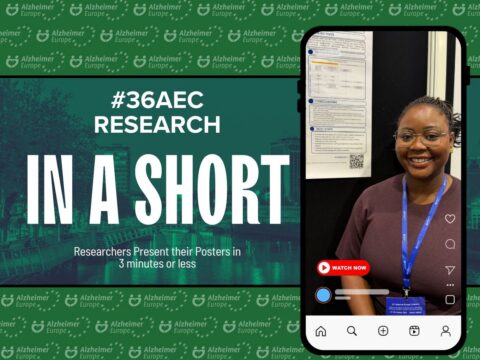
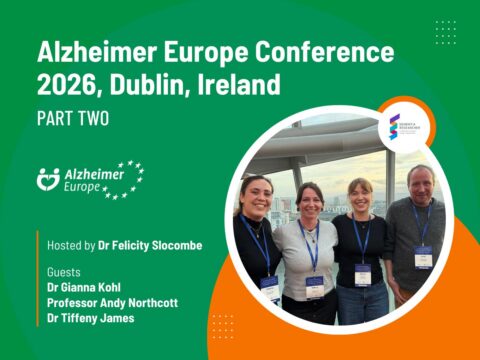
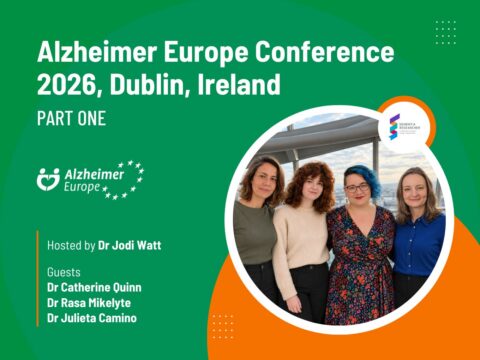
Last month it was the Alzheimer Europe Conference in Dublin. Three days of really good presentations and posters, lots of lovely people, and plenty of conversations over coffee. I always come home from Alzheimer Europe with a full notebook, and this year was no different, particularly for new podcast topics.
But I also came home with a feeling I’ve had before, and this might not be a popular thing to say… much of what I saw, I felt I’d already seen.
Let me explain what I mean, because I don’t want this to read as a criticism of anyone’s work. Alzheimer Europe leans towards care, qualitative research and psychosocial interventions, and that’s a big part of why I go (it’s one of the few events that does, and I can understand the talks). There were new approaches. There was work looking again at things we’ve looked at before, but with a focus on specific people and circumstances, and that matters. I also didn’t get to everything, so there may well have been something brilliant in a room I wasn’t in. But walking round the posters, I kept recognising what I was reading. Continuity of care helps. Carers need practical support and a break. People living with dementia do better with something meaningful to do, and people to do it with. Staff need training, and time.
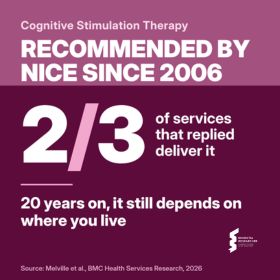
NICE has recommended Cognitive Stimulation Therapy since 2006, yet only around two-thirds of the UK dementia services that replied to a 2026 survey deliver it.
None of that is wrong, and all of it is worthwhile. But it left me asking a question… do we actually already know what good care looks like? And if we do, shouldn’t more of our effort be going into making it happen?
Last year I wrote about the gap between research and implementation from the researcher’s side: the frustration of finishing a study that works and watching it go nowhere. This feels like the other side of that coin. When findings don’t get picked up, we end up studying the same things again, a bit differently, because research funding is often the only money on offer.
Cognitive Stimulation Therapy is a good example. NICE has recommended it since 2006. It isn’t expensive, and it doesn’t need fancy kit. Yet a survey of UK dementia services published this year found that only around two-thirds of the services that replied were delivering it, with delays, staffing and funding all getting in the way. Twenty years on, whether you get offered it still depends on where you live. I’d be surprised if CST is the only example.
Now, if you’ve been around this world for a while, you’ll know the phrase that usually gets wheeled out at this point… knowledge mobilisation. I can just imagine James and Charles on the Wankernomics podcast having a field day with it. But buzzword or not, it’s the bit we’re not getting right.
The timing matters too. A week before Dublin, I was at the World Dementia Council Summit, and afterwards I spent an evening sketching out what I’d do if someone handed me a big pot of money for dementia. Again and again, the best value was in things we already know work. Yes, they could be refined and tested in new places, but mostly they just need delivering. And we’re not in a time of plenty. UKRI has paused grant schemes and held curiosity-driven funding flat, charities are stretched, and the NHS and social care… well, you know. When money is tight, we’re going to have to be strategic about what we choose to fund.
So what would I like to see? I’m an outsider here, so please take this as the start of a conversation rather than a plan.
I think all funded care research should have a clear path to delivery.
That doesn’t mean every study has to end in a new service, because some research needs to ask questions nobody’s answered yet. But it would be good to see applications say who would need to act on the findings, what it would cost them, and how the team will get the results in front of them. If nobody can describe that, it’s fair to ask whether it’s the right study.
I think funders could own more of what they fund. Right now the grant ends, the paper comes out, and the findings are left to fend for themselves. Funders can see across everything they’ve paid for, so they’re in a good position to spot where the evidence has stacked up and back the next step, even if that sometimes means funding fewer new studies.
I think we could do a lot more to connect researchers with the people who decide how care is delivered and paid for: commissioners, integrated care boards, local authorities and care providers. Too often the two groups only meet at the end of a project, if they meet at all.
Last, and probably most important, we need to keep checking that we’re working on what people living with dementia and carers actually want. They rarely ask for another study to confirm something they’ve lived with for years. They ask for the support to turn up.
I don’t think the research being done is pointless. Far from it. Lots of the people presenting in Dublin are already pushing for exactly this, and they know far more about it than I do. I just think it’s time we got on with doing stuff.
I might be wrong, and I’d like to hear from you if you think I am. In the meantime…
Tap every square you’ve seen on a conference poster. Then copy your card and paste it in the comments.
Just for fun, and with love to everyone who’s ever stood by a poster for two hours. Nothing you tick is saved or sent anywhere.
Adam Smith
Author
Adam Smith was born in the north, a long time ago. He wanted to write books, but ended up working in the NHS, and at the Department of Health. He is now Programme Director at University College London (which probably sounds more important than it is - his words). He has led a number of initiatives to improve dementia research (including this website, Join Dementia Research & ENRICH), as well as pursuing his own research interests. In his spare time, he grows vegetables, builds Lego, likes rockets & spends most of his time drinking too much coffee and squeezing technology into his house.
Follow @betterresearch.bsky.social

 Dementia Researcher

 Beccy Owen
 Nature Careers Blog