When most of us think back to the COVID-19 lockdown in 2020, we think of working from home, video calls with friends and family, and our one walk a day. For people living with dementia, lockdown meant something very different.
This is something I experienced within my own family, and it is very close to my heart. It got me thinking about the wider impact lockdown may have had on other people living with dementia. In this blog, I want to explore how the restrictions introduced during the COVID-19 pandemic affected people living with dementia, and what losing familiar routines, social contact and support meant for their day-to-day lives.
There was no single experience
For people living with dementia, lockdown was much deeper than simply being unable to leave the house. It meant losing the social interactions and activities that gave structure to everyday life.
As I started researching this, it quickly became apparent that there was no single lockdown experience for people living with dementia. The impact depended on someone’s individual circumstances, whether they lived alone, or lived with family who could support them.
Someone living with family may have had more social contact and support, but this could also place additional pressure on family carers. For someone living alone, the loss of routine and social interactions could have had a far greater impact, particularly if that individual had not yet been diagnosed with dementia and did not have regular carers in place.
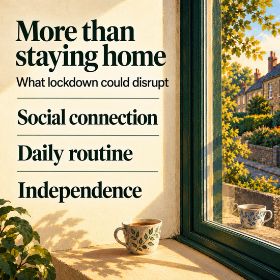
For people living with dementia, lockdown could disrupt far more than social contact. Familiar routines, independence and everyday sources of support could also be affected. Experiences varied according to living arrangements, individual needs and the support available, with additional demands often falling on family carers.
What happens when social contact is lost?
There is a lot of evidence that loneliness and lack of social interaction are associated with cognitive decline later in life, even outside of the pandemic. This raises an important question: what happens when social isolation is suddenly imposed on people who may already be vulnerable to cognitive decline?
This isn’t necessarily as simple as loneliness. Losing social contact can also mean losing routine, physical activity, independence, and the support which comes with everyday interactions.
What might be happening in the brain?
Of course, I couldn’t write this blog without looking at the mechanisms behind this.
Loneliness has been linked to changes in brain structure and function, including areas involved in emotional processing and stress responses. Chronic stress can affect the hypothalamic-pituitary-adrenal (HPA) axis which can have downstream effects on the hippocampus, a brain region responsible for memory formation and consolidation that is affected in dementia. This gives us one possible biological link between prolonged social isolation and cognitive health.
Being confined indoors could mean losing important everyday exercise. Reduced physical activity can have wider effects on physical and cardiovascular health, which are also relevant to dementia risk and progression. Exercise is also associated with better mental wellbeing, so losing everyday activities could have also affected mood as well as health.
Lack of routine can also affect sleep. Sleep disturbances are common in people living with dementia, and changes to daily structure during lockdown may have made a normal sleep routine harder to maintain.
Our sleep-wake cycle is regulated by the circadian rhythm, with the suprachiasmatic nucleus (SCN) in the hypothalamus acting as the brain’s central biological clock. It uses cues such as light and regular daily activity to regulate when we sleep and wake. During lockdown, changes in these daily cues could have disrupted this rhythm and made maintaining a regular sleep pattern more difficult.
Sleep problems in people living with dementia can contribute to a faster progression of cognitive decline, particularly for someone living on their own – without usual social contact to provide structure to their day, this can make maintaining a regular sleep routine much more difficult.
This gives us some biological links between prolonged social isolation and cognitive health. Of course, this doesn’t mean that being lonely during lockdown directly caused dementia or accelerated dementia progression. It does however highlight why the effects of prolonged social isolation are worth considering beyond loneliness.
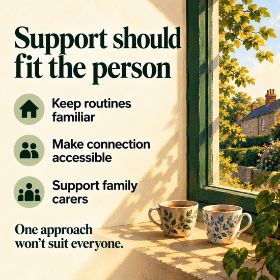
When usual services are disrupted, support needs to reflect the person’s circumstances. Protect familiar routines, offer accessible ways to stay connected and recognise the needs of family carers. Online contact may help some people, but it will not suit everyone. People living with dementia need choices that work for them.
What did this actually look like for people living with dementia?
An interview study (Tuijt et al., 2021) focusing on people living with dementia and family carers looking at the early months of lockdown found that care was largely provided by family carers, and that this sometimes involved changes in living arrangements. For some families, this meant adapting to a completely different way of providing care and support.
People living with dementia often had a basic understanding of the lockdown restrictions but had difficulty translating this into personalised risk. This could make the restrictions confusing, particularly when they prevented people from doing things that would normally be a part of their everyday lives.
The study also found that maintaining simple routines could be beneficial. Getting outside, where possible, was highlighted as something that helped people maintain a sense of normality during lockdown. In contrast, people living with dementia reported negative psychological and cognitive effects during the restrictions, including increased irritability and anxiety, which the researchers linked to lack of social engagement.
What can we learn from this?
It is very difficult to say what could have been done differently – the pandemic was unprecedented. The answer is not simple. Rather than asking the question of what was “right” or “wrong”, a more useful question may be – how can we protect social connection and routine for people living with dementia when normal services are disrupted?
Online social interactions could be a part of this, but there is the other side of the coin to consider – that not everyone wants to, or is able to, use online services to socialise. This highlights just how important it is to consider individual circumstances, and the need for personalised care, rather than assuming that a single solution will work for everyone.
Perhaps one of the biggest lessons from lockdown is that support for people living with dementia needs to look beyond medical care.
Social connection, routine, and independence are such an important part of an individual’s life, and when these are suddenly taken away, the effects can extend far beyond loneliness.
Family carers may also need additional support when usual services are disrupted.
I started to write this blog because of my experiences of this within my own family. Writing this blog made me realise that there are so many factors beyond “staying at home” which could have a huge impact on someone living with dementia. The answer is certainly not clean cut, but understanding the challenges may help us to think differently about how we support people living with dementia when their usual routines and services are disrupted.
References
- Tuijt, R., Frost, R., Wilcock, J., Robinson, L., Manthorpe, J., Rait, G. and Walters, K. (2021). Life under lockdown and social restrictions – the experiences of people living with dementia and their carers during the COVID-19 pandemic in England. BMC Geriatrics, 21(1). doi: 10.1186/s12877-021-02257-z

Beccy Owen
Author
Beccy Owen is a PhD Researcher at the University of Warwick, exploring how tau pathology disrupts neuronal ion channels and brain network activity in Alzheimer’s disease. As part of the Midlands Integrative Biosciences Training Partnership, her work uses electrophysiology to better understand the molecular drivers of neurodegeneration. Originally from the Welsh countryside, Beccy’s passion for dementia research was shaped during her postgraduate studies and through personal experience with a family member living with the condition. She will be sharing her journey, insights, and lessons learned throughout her PhD here on the blog.

 Heather Wilkinson
 Dementia Researcher

 Dr Yvonne Couch


 Beccy Owen
 Bernie McInally

 Dr Chloe Fawns-Ritchie

 Dr Clíona Farrell