 Print This Post
Just to say, any comparisons I make here are purely for statistical purposes, so please don’t berate me with insults for suggesting the cohort I refer to is in any way like a wild, if somewhat cute, animal, this blog is about care home research.
As researchers, can you imagine the outcry if we read a study on the world’s panda population, perhaps investigating eye colour, and the study protocol stated, for no reason other than there being an entrance fee, that all pandas in captivity “need not apply”?
Given that around 20 to 25% of the world’s pandas live in zoos, excluding them would clearly create a significant bias. Any findings would be of questionable value to panda biologists, ophthalmologists, or indeed anyone with a passing interest in pandas.
And the point to this?
Yes, there is one.
For many years, and to some extent still today, we have done something remarkably similar with people living with dementia in care homes.
Feel free to challenge my figures, but in Scotland we have around 35,000 care home beds, and approximately 20,000 of those are occupied by people living with dementia. Given that Scotland has around 90,000 people living with dementia overall, the proportions are surprisingly similar to our panda example. Now don’t accuse me of being Scotland-centric; it’s where I work, and these figures can be easily extrapolated to the UK population.
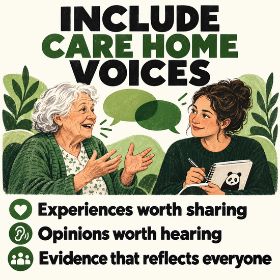
Care home residents have experiences worth sharing and opinions worth hearing. Bernie McInally explains why early career researchers should include them in the research that shapes future care.
So, despite representing a substantial part of the population, care home residents have historically been underrepresented in research. Sometimes they have been actively excluded. More often, they have simply been viewed as “too difficult”.
This is where I think we need to focus more attention on early career researchers.
Because before many new researchers have even set foot in a care home, they have already heard the warnings.
“Recruitment will be difficult.”
“Ethics will be complicated.”
“Capacity assessments take forever.”
“Families might object.”
“The residents may become unwell.”
“The staff are too busy.”
By the time a PhD student or newly qualified researcher has heard all this, they can be forgiven for wondering whether studying volcanoes, shark attacks or asteroid collisions might be easier.
Now, to be fair, none of these concerns are entirely without merit. Care home research does come with challenges.
Residents may have cognitive impairment. Capacity can fluctuate. Health can change unexpectedly. Researchers must carefully balance the value of a study against any potential burden on participants. Staff are busy, relatives are protective, and care homes don’t generally have research departments, research nurses, or a team of people whose job description includes helping academics fill in spreadsheets.
All true.
But here’s the thing.
These challenges are often presented as reasons not to do care home research rather than considerations that need to be managed.
There is a difference.
I sometimes wonder whether we unintentionally scare people away from care home research before they’ve had a chance to experience it themselves. We hand them a list of barriers longer than the average supermarket receipt and then act surprised when they decide to recruit from somewhere else.
Of course, consent and capacity are important issues. For highly intrusive interventions or complex drug trials, additional safeguards are entirely appropriate.
But much care home research isn’t about testing experimental medicines. It may involve interviews, observations, discussions about quality of life, social interactions, activities, dining experiences, or how services can be improved.
In those circumstances, previous wishes, personal values and proportionality matter.
Throughout my involvement in research, I have met very few residents who weren’t delighted to talk about their lives, share their opinions, reminisce about times gone by, or offer a detailed critique of the lunch menu.
In my experience, the biggest risk isn’t residents refusing to talk. It’s arranging a 20-minute interview and discovering 90 minutes later you’ve covered childhood, National Service, seven Prime Ministers, two family feuds and a strongly held view on the decline of proper custard.
In fact, if you’ve ever asked a care home resident a question and hoped for a quick answer, you’ll already appreciate the flaw in that assumption.
Similarly, fluctuating health and capacity are realities that researchers need to accommodate. But good researchers do that all the time.
In every study I have been involved with, I have made it clear at the start of each contact that if a participant becomes tired, distressed, uncomfortable, or simply wants to stop, then the conversation stops. No drama. No pressure. No problem.
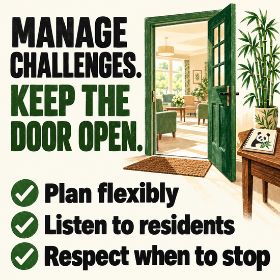
Care home research brings challenges, but they are reasons to plan carefully, not exclude residents. Be flexible, listen and stop whenever someone wants or needs to. That is ethical research.
That is not a barrier to research.
That is ethical research.
What concerns me more is when entire populations are excluded because accommodating them requires a little more thought, flexibility or patience.
The irony is that the very reasons often cited as barriers are precisely why research in care homes is so important.
People living with dementia in care homes are often older, frailer, living with multiple conditions, taking multiple medications and receiving support in environments that differ significantly from community settings. Yet evidence generated elsewhere is frequently applied to them as though these differences don’t matter.
If we don’t include them in research, we shouldn’t be surprised when we lack evidence about what works best for them.
This is why organisations such as ENRICH Scotland continue to champion care home research. It is also why platforms such as Dementia Researcher perform such a valuable role.
For early career researchers, blogs written by people who have actually conducted research in care homes can be far more influential than another guidance document or governance flowchart. They provide practical advice, share lessons learned and, perhaps most importantly, demonstrate that care home research is not only possible, but worthwhile.
For someone contemplating their first dementia study, reading about successful projects in care homes can be the difference between deciding “that sounds interesting” and deciding “that sounds impossible”.
We need more of these stories, not fewer.
Of course, researchers should be honest about the challenges. Capacity assessments, recruitment, family involvement and fluctuating health are real considerations. But they should be presented as challenges to be managed, not reasons to exclude an entire population from research.
Otherwise, we risk creating a self-fulfilling prophecy. Early career researchers hear only about the difficulties, avoid care homes altogether, and then conclude that care home residents are impossible to recruit because so few people try.
The reality is rather different.
Care home residents have experiences worth sharing, opinions worth hearing, and lives that deserve to be reflected in the evidence base that shapes future care. Excluding them because participation requires a little more flexibility is a bit like excluding Scotland from a weather study because it rains too much. It may make life easier, but it rather misses the point.
Care home research isn’t always easy. Then again, neither is raising children, running a care home, or explaining to a panda why it’s being excluded from an eye-colour study. The fact that something is difficult has never been a particularly good reason for not trying.

Bernie McInally
Author
Bernie McInally is a Clinical Studies Officer at NHS Lothian and the Neuroprogressive and Dementia Network. Bernie’s background is in Nursing, working in Mental Health and with Older People. He retired from full time NHS clinical work, and is now back working in Clinical Research supporting delivery of the Enabling Research in Care Homes (ENRICH) Scotland. He is passionate about research delivery, and opening access to people in all communities.

 Dr Chloe Fawns-Ritchie
 Dementia Researcher
 Dr Yvonne Couch
 Alzheimer's Association
 Dr Clíona Farrell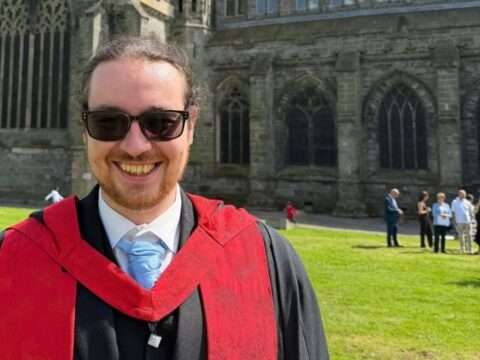
 Beccy Owen
 Rahul Sidhu
 Dr Emma Law