
 Visa rules – The Autumn Budget removes the PhD discount on Skilled Worker salary thresholds from spring 2027. Run the change against this year’s pay spine, and a researcher appointed at the bottom of Grade 7 no longer earns enough to be sponsored at all. If you write grants or hire researchers, the salary line you are costing this autumn is the one that decides it.
The Budget 2026 document, published on 28 October, sets out five changes to visa salary requirements, all of them from spring 2027. Four loosen the system. The fifth is four words long: “removing the PhD discount”.
For a large share of the people who read this site, the fifth is the one that matters.
What the PhD discount does now
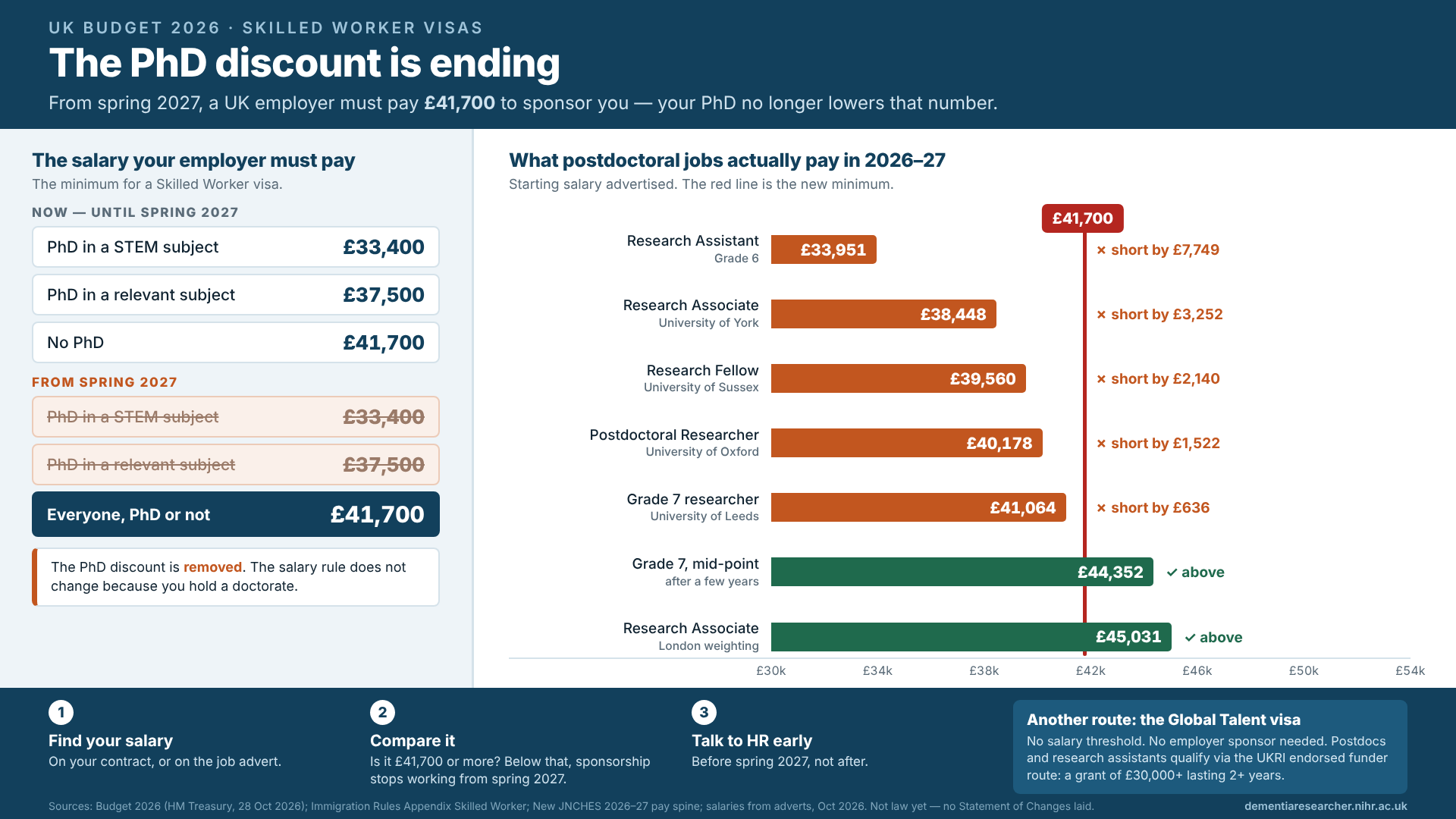
Under the current Immigration Rules, a Skilled Worker has to clear two hurdles at once: a cash salary floor, and a percentage of the published going rate for their occupation code. Holding a doctorate lowers both. A relevant PhD gets you to a floor of £37,500 and 90% of the going rate. A PhD in a STEM subject gets you to £33,400 and 80%.
There is a second concession stacked on top of it. The rules treat a postdoctoral position in the main research occupation codes as a “new entrant” role whatever the applicant’s age, which brings the floor to £33,400 and the going rate requirement to 70%.
Between them, those two provisions are a large part of why a UK university can sponsor a newly appointed postdoc at all.
What changes, and the arithmetic
From spring 2027 the PhD discount goes. Occupation going rates drop from the median to the 25th percentile, which sounds generous. New entrant discounts are levelled into a single figure. The general salary threshold, currently £41,700, will be uprated using 2026 wage data, and no new figure has been published.
The difficulty is what happens when you put those together. The 25th percentile figures for research occupation codes nearly all sit below £41,700 — £35,100 for biomedical scientists, £37,400 for other researchers, £30,700 for biological scientists. Once the going rate falls below the general threshold, the going rate stops being the binding number. The general threshold decides everything.
So the salary a sponsor must pay a STEM-PhD postdoc in a biomedical role moves from roughly £36,720 to £41,700. Under the “other researchers” code it moves from about £34,880 to £41,700. That is five to eight thousand pounds more for the same person doing the same job.
Now the pay side. New JNCHES settled the 2026-27 round at 2% in October, and the resulting spine is published. Grade 7, where most postdocs sit, opens at around £38,448 and runs to roughly £48,800. Research associate and research fellow posts advertised in the last fortnight open at £38,448 at York, £39,560 at Sussex, £40,178 at Oxford and £41,064 at Leeds.
Every one of those opening salaries sits below £41,700. The shortfall runs from £636 to £3,252.
Grade 6 research assistant posts are further adrift, typically by one to eight thousand pounds. Posts carrying London weighting clear the bar comfortably, and so do clinical academic posts. If the 2026 uprating lifts the general threshold above £41,700, every gap above widens with it.
Where this came from
The change follows the Migration Advisory Committee’s Salaries Requirements Review, published in December 2025, which recommended abolishing the PhD discount outright. Times Higher Education reported that the committee found no reasonable rationale for a lower threshold for PhD holders.
The committee’s reasoning is about the labour market as a whole rather than about research. If a qualification does not reliably predict higher pay in a role, it should not buy a lower salary floor. That holds in most of the economy. It holds less well in academic research, where salaries are set by a national pay spine that an individual employer cannot move to suit an immigration rule.
Why this lands hard on dementia research
Around 19% of the UK’s R&D workforce were non-UK nationals in 2024, and roughly a third of academic staff. In the research institutes the proportion is far higher: the Campaign for Science and Engineering found that about 70% of postdoctoral researchers at the Wellcome Sanger Institute are non-UK citizens, and 44% of staff at the Francis Crick Institute are from outside the UK. At the UK Dementia Research Institute, one in three group leaders was recruited from an international university.
Set that against the size of the field. Alzheimer’s Research UK’s Ready for the Cure blueprint, published in July, counted 512 active dementia clinical researchers in the UK, against 6,964 in cancer. It named workforce fragility as one of the most serious risks to the whole dementia research ecosystem, pointing to early-career attrition, short-term contracts and thin succession planning.
The blueprint does not mention visas once. After spring 2027 it may have to.
The route that does not have this problem
The Global Talent visa has no salary threshold, needs no sponsoring employer and needs no job offer. It is also far cheaper: the Royal Society’s 2025 comparison put a five-year Skilled Worker route at several times the cost of Global Talent for a single applicant, most of the difference being the health surcharge, which both routes still pay.
The practical door for a postdoc is the UKRI endorsed funder route, which is often assumed to be for established leaders and is not. It needs a grant from an endorsed funder worth at least £30,000 and lasting at least two years, with the applicant named on the successful application or their job title specified in it, at least half their time on the grant and at least a year left to run. Postdoctoral researcher and research assistant are both named as eligible positions.
The endorsed funder list includes Alzheimer’s Research UK, Alzheimer’s Society, the NIHR, Wellcome and Parkinson’s UK. If you are employed on a grant from any of those, this route is worth asking your HR team about before the Skilled Worker rules change.
If you hire researchers or write grants
Almost all the coverage of this change is addressed to the person being sponsored. Most of the decisions that determine the outcome are not theirs.
The grant you are costing now will recruit after the change. A proposal going to a call that closes this autumn will typically start in late 2027 or 2028. If the postdoctoral salary line in that budget sits at the bottom of Grade 7, the post it pays for will not support sponsorship by the time you advertise, and the applicant pool narrows to people who already have the right to work in the UK. At some research institutes that is a small minority of applicants: the Campaign for Science and Engineering found one organisation where only 10 to 15% of applications for research roles came from UK nationals. Costing the post a point or two higher is a decision taken at writing stage, not at appointment.
Funders will pay for the visa, but not for the uplift. UKRI treats visa costs, the Immigration Health Surcharge and Certificates of Sponsorship as eligible costs for staff spending at least half their contracted time on the grant, and Wellcome allows visa and health surcharge costs for the researcher and their family. Neither, and no other funder we could find, has published anything about raising a salary to clear an immigration threshold. On current guidance that cost sits with the department.
Salary is a compliance matter, not only a budget line. Home Office sponsor guidance requires a sponsor to tell UKVI within 10 working days if a sponsored worker’s salary falls below the level stated on their Certificate of Sponsorship. If the revised salary no longer meets the requirements, the sponsor has to stop sponsoring them. Paying below the certificated salary without reporting it is listed as a ground for revoking a sponsor licence. A salary line that looks flexible stops being flexible once someone is sponsored against it.
One thing you can do now, at no cost. The Global Talent endorsed funder route turns on whether the applicant is named on the successful grant application, or their job title is specified in it — and, for someone recruited later, on an HR director confirming they were appointed through open recruitment. Writing the post into the application in those terms costs nothing at submission, and may hand a future hire a route with no salary threshold at all.
What advisers are saying, and what nobody has said. No employer guidance has come from UCEA, Universities UK, UKRI or the NIHR since the Budget. Immigration firms are telling employers to plan on the discount going, not to change sponsorship decisions yet, and to go back through any case that currently depends on it. Pinsent Masons adds that employers should not assume the overall cost of sponsorship will fall.
What is not settled
No Statement of Changes to the Immigration Rules has been laid, so none of this is law yet, and the current rules apply until it is.
Transitional protection is the large unknown. When the general threshold jumped in April 2024, the rules kept a grandfathered set of salary options for people already sponsored, reduced PhD rates among them, open to anyone granted permission under the earlier rules who has held it continuously since, on applications made up to April 2030. Whether anything equivalent arrives for spring 2027 has not been said. The Budget is silent on it, no Statement of Changes has been laid, and none of the immigration firms writing this week could tell their clients either way. For a postdoc already here who will need to extend after spring 2027, that is the question that matters most, and the honest answer today is that nobody knows.
A different deadline, four weeks away. Separate from the Budget, but worth knowing while you have this open: researchers previously sponsored as Tier 2 (General) migrants, who have held Skilled Worker permission continuously since, can on applications made before 1 December 2026 count guaranteed allowances such as London weighting towards the salary requirement with the same sponsor, and use reduced going rates for some science and higher education occupation codes. If that describes you, or anyone in your group, it is worth raising with HR this month. The uprated general threshold figure has not been published. The Budget also extends the Graduate visa to two years for graduates of “high compliance” universities, but neither the rating nor the list of universities has been defined, and PhD graduates keep their existing three years either way.
For now the useful thing is to know your own number. Find the salary on your contract, or on the advert you are about to apply for, and compare it with £41,700. If it sits below, and your route into the country is Skilled Worker sponsorship with a PhD discount, that is a conversation to have with your department and your HR team well before spring 2027 rather than after it.
Work out where you stand
The two tools below do the arithmetic for you. The first checks your own salary against the minimum, now and from spring 2027. The second is a quick test of whether the Global Talent route is open to you.
Check your salary against the new minimum
Enter your salary. See where you stand now, and from spring 2027.
Put in the gross annual salary on your contract or on the job advert, before tax. Then choose your PhD subject.
This checks the cash minimum only. A Skilled Worker salary must also meet a percentage of the published “going rate” for the job’s occupation code, which your HR team can look up. The £41,700 general threshold is also due to be uprated using 2026 wage data, so the spring 2027 figure may end up higher. No Statement of Changes has been laid yet, so the current rules still apply.
Could you use the Global Talent visa instead?
Three questions on the UKRI endorsed funder route.
This route has no salary threshold and needs no employer sponsor. Postdoctoral researchers and research assistants can qualify.
1. Are you paid from a research grant or award?From an endorsed funder. The list has around 127 of them, including Alzheimer’s Research UK, Alzheimer’s Society, the NIHR, Wellcome and Parkinson’s UK.
2. Is that grant worth £30,000 or more, and does it last two years or longer?The grant as a whole, not your own salary.
3. Are you named on the successful application, or is your job title written into it?If you were recruited later, your HR director can confirm you were appointed through open recruitment instead.
Answer the three questions above.
You also need to spend at least half your working time on the grant, with at least one year still to run. This tool is a rough guide, not advice. Check the endorsed funder list and the full criteria on GOV.UK, and speak to your university’s immigration or HR team before applying.
We would like to hear from researchers this affects. If you are an international postdoc working out what it means for your next contract, or an immigration adviser already fielding these questions, get in touch.
You can find current vacancies on our jobs board and open calls on our funding pages. For related reading, see our guide to PhD pay across 29 European countries and our piece on career uncertainty in academia.
The figures above come from Budget 2026 (HM Treasury, 28 October 2026), the Immigration Rules Appendix Skilled Worker, and the New JNCHES 2026-27 pay spine. Salaries are taken from adverts published in October 2026.



 LSE Impact Blog



 Nature Careers Blog




 Alzheimer's Association