
 Print This Post
 Somewhere in your contract there is a date. You know it without looking. Most people in this position can tell you the month, a good number can tell you the day, and some have worked out exactly how many pay cheques are left. It sits underneath everything else you are doing and it gets louder in the quiet parts of the week. That is what career uncertainty in academia feels like day to day, long before anything actually happens.
If that date is inside the next six months you are probably already applying for things, and finding that a full-time job and a full-time job search do not fit into the same week. If it is inside twelve, you may still be telling yourself there is plenty of time. Either way, the thing you are actually dealing with is not the date. It’s the not knowing what sits on the other side of it.
We cannot fix that. Nobody can hand you a contract from a website. What we can do is set out how career uncertainty in academia actually works: what is genuinely within your control, what your rights are, what the timeline should look like, and what to say to the person down the corridor who is going through it and pretending they are fine.
This is not a piece about staying positive. Plenty of these situations do not turn out alright. People leave the field who should have stayed, and good research stops halfway. Pretending otherwise is insulting to anyone who has lived it. What is true is that the outcome is often better for people who started early, knew their rights, and were not doing it alone, and those three things are available to everyone reading.
In brief
If your contract or funding ends within the next twelve months, the single most useful thing you can do is start now rather than in six months time, because almost everything that helps takes longer than you think. Get your end date and notice period confirmed in writing. Find out whether your institution has a redeployment policy and how to get on it, because most do and most people never ask. Work out your continuous service, since two years with the same employer changes your legal position considerably, and from 1 January 2027 the qualifying period for unfair dismissal drops from two years to six months.
Run your Plan B in parallel with your Plan A, not after it. A fellowship application and a job search are not sequential, and treating them as such is what turns a difficult six months into a bad three.
Career uncertainty is not a personal failing and it is not evidence about the quality of your work. Across all academic staff in UK higher education, 29% were on fixed-term contracts in 2024/25, but for research-only staff the figure is roughly two thirds, and it has barely shifted in a decade. The system produces this outcome by design, and it produces it for excellent researchers as reliably as for anyone else.
And if you are reading this because of somebody else, skip to how to help. The short version: ask once, offer something specific, and stop asking whether there is any news.
On this page
We have written this in the order the situation usually unfolds. It starts with what the uncertainty actually is, which matters because people spend a lot of energy fighting the wrong thing. Then a timeline from twelve months out to your final week, the job search on top of a full workload, and waiting on a grant decision, which is its own distinct misery.
After that, how to stay reasonably sane, and what happens if your visa is tied to the job, which is the most urgent section here for anyone sponsored. Then the two things people leave too late: your rights when a fixed-term contract ends, which are better than most researchers realise, and the money, which is the part people avoid until it is urgent.
It finishes with what happens if it does not work out, where to start if the whole thing feels too big to pick up, and two sections for other people: how to help someone going through this and what to do if you are the PI. There are answers to common questions at the end.
Jump to whatever you need. Nobody is expected to read all of this in one go, least of all at midnight.
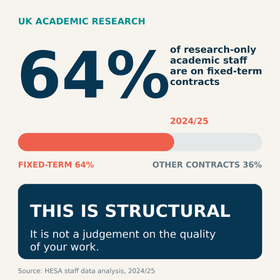
Nearly two thirds of research-only academic staff in UK higher education were on fixed-term contracts in 2024/25, showing that academic career uncertainty is structural rather than personal.
What career uncertainty in academia actually is
Career uncertainty in academia is really three separate problems, and they get tangled together, which is part of why the whole thing feels unmanageable.
The practical problem is that you need income and a job from a date you already know. This one is solvable, or at least workable. It responds to lists, deadlines and other people.
The waiting problem is different. You are not able to act on the decision that matters most, because a panel meets in March, or a PI is waiting on a costing, or an outcome letter is somewhere in a queue. Waiting is not the same as working towards something, and it drains people who are otherwise very good at hard work. The remedy is not patience. It is having something else genuinely in motion so the wait is not the only thing happening.
The identity problem is the one that catches people out. Research is not a job you do, it is a thing you are, and most of us said so out loud at interview. When the contract ends, it is hard not to hear it as a verdict. It is worth separating the two early, because the job market in this field is not a quality assessment. It is a function of how much money is in the system this year, which programmes happen to be recruiting, and whether the grant that would have employed you landed on a good day with a panel.
Dr Yvonne Couch has written about this more honestly than most, including the part where you go into an empty office and cry, in her blog on resilience. If you have not read it, read it before you read the rest of this. She makes a point that took most of us years to accept: it is largely luck and timing, and accepting that is not the same as giving up.
It is also worth knowing the actual shape of the thing, because it is easy to assume you are the unlucky one. HESA’s staff record puts 29% of all academic staff in UK higher education on fixed-term contracts in 2024/25, which sounds manageable until you separate out the research-only workforce. UCU’s Support for Research Staff report found 66% of research-only staff on fixed-term contracts, a figure the union says has changed little in a decade, and more recent analysis of the HESA dashboard puts it at 64% for 2024-25. At individual institutions it goes much higher.
The same UCU work, based on freedom of information requests to 103 institutions, found some things worth carrying into any conversation with your own employer. Nearly a third of universities could not say whether research staff had been redeployed at the end of a contract, because they did not track it. Where institutions did answer, redeployment rates ranged down to zero. Only one employer offered enhanced paid notice periods to research-only staff on fixed-term contracts, and most paid only statutory redundancy pay. UCU also notes that some employers use open-ended contracts that carry an identifiable “at risk” or funding end date, which do not appear as fixed-term in the statistics but offer most people little practical benefit over one. If that describes your contract, treat this article as applying to you.
This is not new, and it is not you. Dr Kamar Ameen-Ali has written repeatedly about academic job insecurity and precarity, including facing redundancy from a permanent post, which is a useful corrective to the belief that a permanent contract is the finish line. The Perpetual Postdoc series and the discussion on breaking the cycle cover the structural picture, and Academic precarity: moving the discussion forward sets out what universities could do differently if they chose to. Our partner blog on why rejection in academia is structural rather than personal makes the same case with the evidence attached.
None of that gets you a job. It does mean you can stop spending energy on the question of whether you deserve this, and put it into the parts that move.
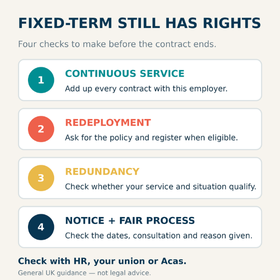
A fixed-term contract still carries employment rights. Researchers should check their continuous service, redeployment policy, possible redundancy entitlement, notice and the process being followed.
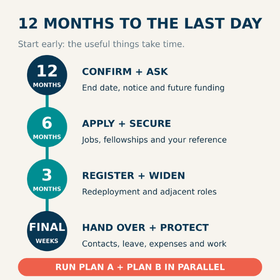
The timeline: twelve months to the last day
Most of the advice people give is correct and given too late. Here is what to do and roughly when.
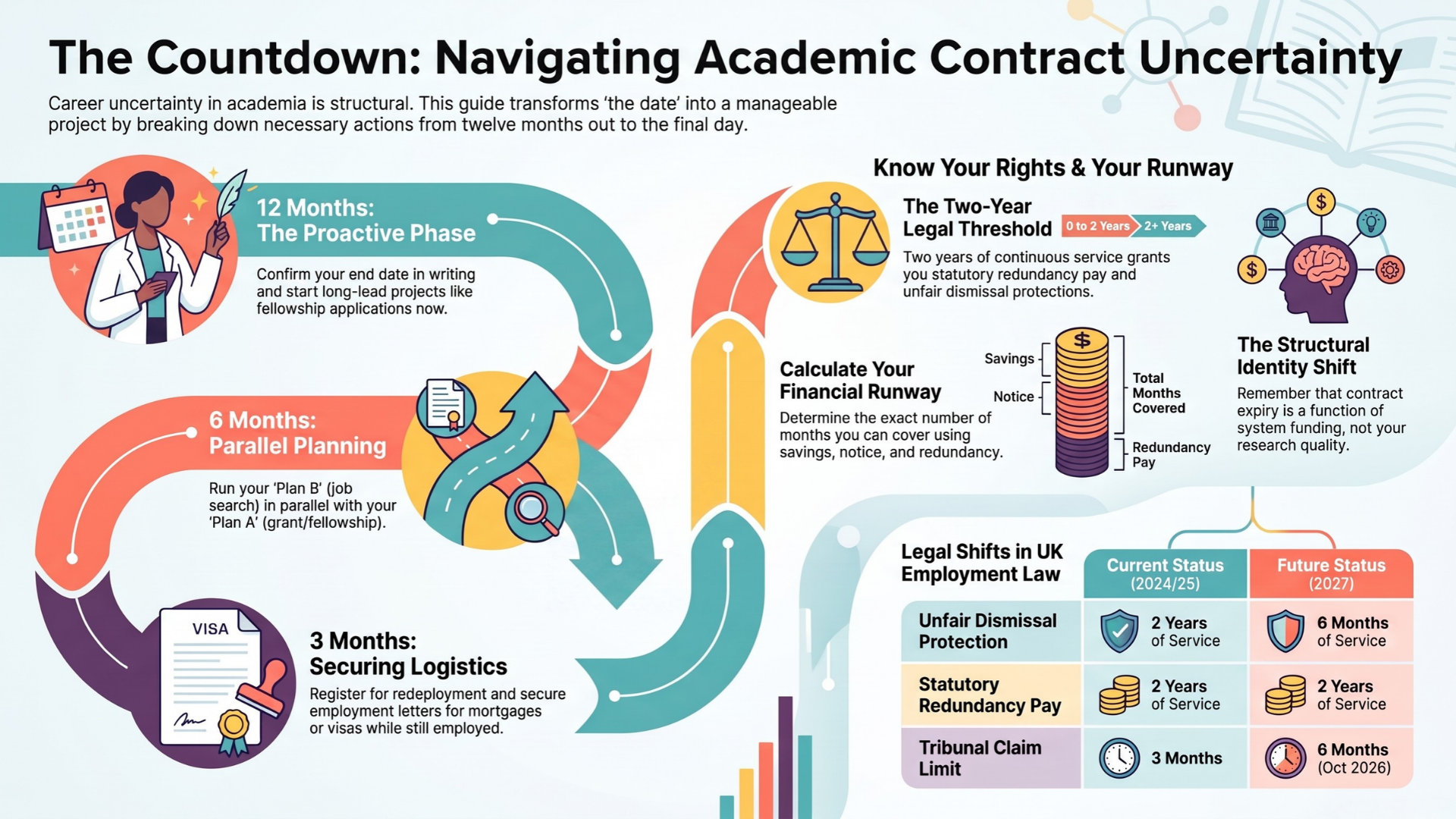
Twelve months out
This is the strong position, and very few people use it, because twelve months feels like ages and the current project is going badly and there is a paper to finish.
Confirm your actual end date in writing, along with your notice period. Not what somebody said in a meeting. The contract.
Ask your PI directly what they expect to happen. The useful phrasing is a question about the money, not about you: “Is there funding to extend this post beyond June, and if not, when would we know?” You are not being disloyal by asking. Any PI worth working for expects the question and will be relieved you asked early.
Find out whether your institution has a redeployment register or policy, who runs it, and what triggers your access to it. Most UK universities have something. It usually kicks in when notice is issued, and it usually requires you to actively register. It will not find you.
Start anything with a long lead time. A fellowship application is a six to nine month project, not a six week one, and it needs institutional costing, letters of support and a host who has agreed to have you. If a fellowship is the plan, this is the month to start, and our guidance on knowing when you are ready to apply, what the panel is looking for and Becky Carlyle’s fellowship writing and interview tips are the place to begin. If a lectureship is more likely, our podcast on fellowship versus lectureship is a straight conversation about pay, workload and whether permanent really means secure.
Do the slow CV things now. A submitted paper, a small pilot grant, a teaching contribution, a public involvement role, a committee seat. These take months to appear and they are the difference between two otherwise identical applications.
Tell people. Not a public announcement, just the quiet version, to five or six people who know your work: “My contract ends next summer, I am looking, keep me in mind.” Most research posts are filled by people who were already known to somebody on the panel. This is not corruption, it is how a small field works, and being invisible is the only way to lose from it.
Six months out
Have the conversation with your PI again, this time asking for an answer with a date attached. If the answer is genuinely unknown, ask when it will be known and put that date in the diary.
Ask for your reference now, while you are still in post and the person still has your project fresh in mind. Ask for it in writing and ask what they will say about your independence, because that is the sentence panels read.
Check your continuous service. Add up every contract you have held with this employer, including short extensions and gaps of a week or less. This number determines your legal position and it is often longer than people assume. See your rights below.
Start applying properly. Not browsing. Applying. Our jobs board carries UK and international posts across discovery science, clinical research, care and social science, and the funding calls listing covers fellowships and smaller awards. Beth Eyre’s blog on how to find a postdoc job covers the part nobody explains, which is that a good proportion of posts are arranged by approaching a lab before anything is advertised.
If you need a visa, this is late rather than early. See the visa section.
Three months out
Notice should be issued around now, depending on your contract. When it is, read it and check the date, because administrative errors are common and hard to unpick later.
Register for redeployment the moment you are eligible. Ask HR to confirm in writing that you are on it.
Apply widely, and widen what “widely” means. This is the point at which restricting yourself to posts that are a perfect continuation of your current work stops being ambition and starts being a risk. If you’re tied to a particular geographical location, you may find getting a new job harder, and may need to consider alernative areas or may event need to get creative e.g. Have you considered industry? Charities? How about teaching? Don’t panic, but consider your options and look around.
Sort your paperwork while you still have a payslip. If you need a mortgage, a tenancy reference, a loan or a visa, get the employment letter now. Landlords and lenders treat “employed until June” very differently from “unemployed since June”, and the letter is free while you are still there.
Get your own record straight. Your publication list, your ORCID, your conference talks, your teaching, your code, your protocols. Note that data, samples and institutional records are not yours to take, and the rules on that are genuinely strict, but your own CV evidence is. Take a copy of anything you wrote that you are entitled to keep, before your account is closed at midnight on your last day, which is a thing that happens.
The last few weeks
Hopefully by now, you have funding, a new job or some certinity. If you haven’t, it is time to agree the handover in writing, so that what you did survives you and so that nobody can later claim you left a mess.
Sort out anything you are owed. Untaken annual leave, expenses, and statutory redundancy pay if it applies.
Get personal contact details for the people you want to stay in touch with, and give them yours. Institutional email disappears fast.
Ask about honorary or visiting status. Many departments will grant it, it costs them nothing, and it gives you library access, an affiliation for papers still in review, and a route back in. It is one of the most useful things to ask for and almost nobody asks.
If a paper is still in progress, agree now who does what, in writing, including authorship. Do not agree to finish it unpaid on the assumption it will be quick. It never is. There is a good blog on how the unpaid limbo period quietly excludes people who cannot afford to work for free, and it is worth reading before you volunteer for it.
Worth remembering
Almost everything in this timeline is a thing you can do on a bad day when you cannot face writing an application. Confirming a date, sending an email to HR, asking for a reference, updating ORCID. On the days when the job search feels impossible, do one of those instead. It still counts.
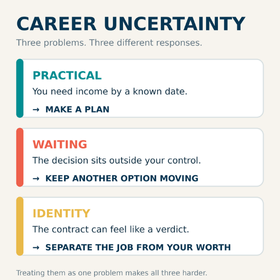
Academic career uncertainty combines three distinct problems: practical pressures, waiting for decisions and the effect insecurity can have on a researcher’s professional identity.
Searching while still doing the job
The practical difficulty is that the job search arrives on top of a full workload, and the workload does not shrink out of sympathy.
Two things help more than any others. Time-box it, so that applications happen in a fixed slot rather than colonising every evening and then not happening at all. And build one strong application document that you adapt, rather than starting from nothing each time. Your fifth application should take a third as long as your first.
Widen the search deliberately, in three directions.
Sideways within research. Trial coordination, data management, research delivery, biobanking, imaging cores, methods support. These posts are frequently longer, better funded and more secure than the discovery post you are leaving, and they keep you in the field.
Sideways within the sector. Charities, funders, NHS research delivery, policy, regulators, publishing, science communication, PPIE and research management all employ people who understand research from the inside, and they struggle to recruit them. Our feature on leaving the lab but not the field profiles four people who did exactly this.
Out. Industry, biotech, data science, consultancy, health tech, the civil service. Sam Moxon’s blog on the academic exodus and Yvonne Couch on the great academic resignation are worth reading, as is Hannah Hussain on stepping outside academia and what to do if you want to leave and do not know what is out there. We keep everything on this together under the leaving academia tag.
On applications themselves: name what you can do rather than what you have studied. Outside academia, “I ran a longitudinal study across four NHS sites, managed a £180k budget and supervised three staff” lands better than a thesis title. Inside academia, the sentence panels look for is evidence of independence.
For interviews, our long list of real academic interview questions is the most-used careers page we have, for good reason.
One more thing, and it is the awkward one. You will apply for things you do not get, repeatedly, while already feeling fragile. Fiona McLean’s podcast on what grant rejection taught four researchers and the older show on dealing with failure and imposter syndrome are both worth an hour, mostly because hearing senior people list their own rejections recalibrates what normal looks like.
The particular hell of waiting for a funding decision
Waiting on an outcome is different from job hunting, because there is nothing to do and the thing you are waiting for would solve everything.
Three rules, learned the hard way by a lot of people.
Run the alternative in parallel. Not as a sign of no confidence in the application, as basic arithmetic. If the decision comes in April and your contract ends in July, a rejection in April leaves you three months, which is not enough time to start. Applying for jobs while you wait costs you nothing if the grant lands.
Find out the actual timeline and the actual next round. When does the panel meet, when are outcomes communicated, when is the next call, what is the resubmission policy. Ask the funder’s programme team, who are usually helpful and are used to the question. Knowing “if this fails, the next deadline is October” converts an open-ended dread into a plan.
Decide in advance what you do on the day it is rejected. Write it down now. Something like: take the evening off, read the feedback in two days not two hours, send it to your mentor, decide about resubmission the following week. People who have decided in advance recover in days. People who have not can lose a month.
And when it does go wrong, the feedback is worth reading properly once the sting has gone, even the unhelpful sort. Getting a grant funded: a view from the panel explains how the room actually works, which makes reviewer comments considerably easier to interpret.
Staying reasonably sane
We are wary of writing this section, because most wellbeing advice written for researchers is either patronising or suggests you take up mindfulness during the worst six months of your career. So, only the things people actually tell us worked.
Separate what you control from what you do not, on paper. Applications sent, conversations had, skills built, references secured: yours. Panel composition, funding rates, whether the department’s business case gets approved: not yours. The stress of the second category is entirely wasted and it is genuinely possible to spend a whole month there.
Keep a done list rather than a to-do list. In a period where outcomes are all external and mostly negative, a record of effort is the only honest evidence that you are doing something. Rahul Sidhu’s blog on imposter syndrome is good on why the internal account of your own competence stops being reliable in periods like this.
Protect one thing that is not work and not the job search. One evening, one club, one long walk on a Sunday. The people who come out of this in reasonable shape are almost always the ones who kept something.
Tell three people the truth. Not the whole department, three people. Isolation is what turns a difficult period into a bad one, and everybody’s instinct is to hide it until it is resolved, which can be a year. Jodi Watt’s blog on navigating challenging conversations in academia is good on why this is hard and worth doing anyway.
Watch the drift into overwork. The instinct is to work harder to prove you should be kept, and it does not work, because the decision is almost never about your productivity. It does reliably cost you sleep and health. The podcast on burnout in academia covers this well.
Get help if it is more than stress. If you are not sleeping, not eating properly, or the low mood has stopped lifting when something good happens, that is worth taking to your GP. Most universities have an Employee Assistance Programme with free confidential counselling, and most staff never find out it exists. Your union can also help with the work side. If things get really dark, Samaritans are on 116 123, free, any time.
Our community has a lot of people in the same position, which is worth something at midnight when it feels like it is only you.
If your visa is tied to the job
If you are sponsored, read this before anything else on the page. The timelines here are unforgiving, and they override every other deadline in this article.
If you are in the UK on a Skilled Worker visa, your permission is tied to your sponsoring employer. Your employer must report the end of your employment to UK Visas and Immigration, normally within ten working days, and the Home Office then usually curtails your permission to 60 days, or to your existing visa expiry date if that is sooner. Within that window you need to find a new sponsor, switch to another route, or leave.
Four things about this that people get wrong, and they are expensive mistakes.
The 60 days do not start on your last day at work. They start when the Home Office issues and serves the curtailment decision, which may be weeks later. That sounds like a bonus, and it is not, because the decision can be served to your UKVI account “on file” and the clock runs whether or not you have read it. Keep your contact details current.
You cannot keep working once the sponsored employment ends, including any supplementary work, and including for the employer you have just left.
Your dependants’ permission is tied to yours, so a curtailment affects the whole household.
The gap is shrinking. Practitioners reported through 2026 that the Home Office is acting considerably faster than it used to. Do not plan on the historic delay.
Moving to a new employer needs a new Certificate of Sponsorship and a new application, and you should not start the role before permission is confirmed. See the government guidance on changing job or employer.
Three practical points on top. Not every university post is sponsorable, and the salary and skill thresholds have been tightened, so check before you invest weeks in an application. Your institution’s international staff or immigration compliance team is a better first call than HR generally, and they deal with this constantly. And build in far more time than feels necessary, because the immigration timeline, not the job timeline, is what determines whether you can accept an offer. If you are anywhere near this situation, take proper immigration advice rather than relying on a careers article.
If you are considering a move abroad rather than within the UK, our guide to moving abroad as a PhD student and the piece on transitioning to a new lab cover the parts that do not appear in the offer letter.
Start preparing 12 months before a fixed-term research contract ends: confirm the dates, begin applying, register for redeployment and organise the final handover while running Plan A and Plan B together.
Your rights when a fixed-term contract ends
Researchers routinely assume that because a contract has an end date written on it, nothing else applies. That is wrong, and it is expensive to get wrong. This is a general summary for the UK and not legal advice, so check your own position with your union, your HR team or Acas.
The end of a fixed-term contract is a dismissal in law. Under section 95(1)(b) of the Employment Rights Act 1996, the expiry and non-renewal of a fixed-term contract counts as a dismissal, even though you knew the end date from the first day. It is not an administrative event and your employer should not treat it as one.
Two years of continuous service changes things. With two years or more with the same employer, you are generally entitled to statutory redundancy pay (your institution may improve this, but few do) where the post ends because the work or funding has ceased, and to a fair reason and a fair process. Continuous service accrues across successive contracts with the same employer, so several back-to-back postdoc contracts usually count as one continuous period. Gaps matter, but short ones often do not break it.
From 1 January 2027, the qualifying period for ordinary unfair dismissal drops from two years to six months. This is one of the changes in the Employment Rights Act 2025, and anyone who already has six months’ service on that date gets the protection immediately. The cap on the compensatory award is also removed from the same date. For a workforce employed largely on short contracts, that is a meaningful shift. The qualifying period for statutory redundancy pay is a separate thing and remains at two years. Acas has a plain-English summary of what is changing and when.
There is a four-year rule. Under regulation 8 of the Fixed-term Employees (Prevention of Less Favourable Treatment) Regulations 2002, an employee continuously employed on successive fixed-term contracts for four years or more is treated as permanent on any further renewal, unless the employer can objectively justify continuing the fixed term. Two caveats matter. It makes you permanent in the role you are already doing, not entitled to a different or better one, which tribunals have been clear about. And it is not automatic in practice, because employers do argue objective justification and sometimes succeed. If you are approaching four years, that is a conversation to have with your union rather than a rule to assume applies.
You have a right to be told about vacancies. Regulation 3(6) of the same Regulations gives fixed-term employees the right to be informed by their employer of available vacancies, specifically so that they have the same opportunity as permanent colleagues to secure permanent employment. This is a small right and almost nobody uses it, but if internal posts in your department are being filled through conversations you are not part of, it is worth knowing it exists.
Time limits for tribunal claims are getting longer. From 1 October 2026, the time limit for most employment tribunal claims increases from three months to six, with the equivalent change for breach of contract claims in Scotland on 9 November 2026. That is more breathing space than people have had, but it is still short, and the clock does not wait for you to feel ready.
Redeployment is usually a right in policy, not just a courtesy. Many universities commit to seeking suitable alternative employment before a fixed-term post ends. Some give redeployees priority consideration or guaranteed interviews for posts they are qualified for. Ask for the policy document by name. If you are on it, keep checking it yourself rather than waiting to be contacted.
Pregnancy, maternity and disability protections apply in full and do not depend on length of service in the same way. Non-renewal that is influenced by pregnancy or maternity leave is a serious matter, not a grey area.
Join the union before you need it. This is the single most common regret we hear. UCU membership costs very little on a research salary, and the value is not in the politics, it is in having somebody who has read your institution’s redundancy procedure fifty times and can come to the meeting with you. Nobody has ever told us they wish they had joined later.
The money conversation you should have with yourself
People put this off because looking at it makes it real. Looking at it early is what gives you options.
Work out your runway. Not a vague sense of it, an actual number: how many months you can cover with what you have, plus notice pay, plus any redundancy payment, plus untaken leave (remember you will not pay tax on all of your redundancy payment). That number is your decision-making horizon. It tells you whether you can hold out for the right post or whether you need income by a specific date, and those are two very different job searches.
Find out what you are entitled to while out of work, because researchers routinely assume they will not qualify for anything and never check.
New Style Jobseeker’s Allowance is contribution-based rather than means-tested. It depends on having paid enough Class 1 National Insurance as an employee, usually across the two most recent complete tax years, and your savings, your capital and your partner’s income do not affect it. Nor, usefully, does a redundancy payment. It is paid fortnightly for up to 182 days, and you need to be working fewer than 16 hours a week on average and actively looking for work. Your own pension income can reduce it.
Universal Credit is the means-tested one. It does take account of savings, capital and a partner’s income, and a redundancy lump sum can affect it. You can claim both together, in which case the JSA counts as income for the Universal Credit calculation.
Check your National Insurance record on your personal tax account before you need to, because that is what determines the first one, and claims take time to process.
Do not make big irreversible financial decisions in the first fortnight after bad news. Do not cash in a pension, do not take a high-interest short-term loan, and do not accept a much worse contract out of panic in week one when you have five months left.
If you are on a research pension scheme, deferring is normal and your contributions do not evaporate. Get the paperwork before you leave.
And be honest with whoever else this affects. A partner who finds out in month five that the money runs out in month six is dealing with two problems, one of which you created.
If it does not work out
Sometimes there is no post. The department restructures, the grant fails, the sector has a bad year, and none of it had anything to do with you.
A few honest things.
Leaving research is not a moral failure, and the field is smaller and less interesting for treating it as one. Plenty of the people who now run programmes, fund the work, deliver the trials, shape the policy and communicate the science came out of exactly this moment.
Leaving academia is not the same as leaving dementia research. The charities, the NIHR infrastructure, industry, the NHS, publishers and the funders are all full of people who were postdocs once and are still contributing to the same problem, usually with a pension and a mortgage they can plan around.
Going is not permanent. People come back, especially into applied and clinical research, and time spent in industry or the NHS is frequently an advantage rather than a gap.
And there is no version of this where a year of your work disappears. The papers stay published, the skills stay yours, and the people who know your work still know it.
If you are weighing this up properly rather than in a panic, start with the leaving academia collection and Nature’s piece on moving from academia to industry.
Where to start
Everything above is keyed to how long you have. This is the bit that is not, because these eight things are worth doing whether your end date is next month or next summer, and none of them depends on knowing what happens next. That is the point of them. Done roughly and quickly, they beat done properly in three months’ time.
- Confirm your contract end date and notice period in writing, from the contract, not from memory.
- Add up your continuous service with this employer across every contract, and find out whether you have passed two years.
- Email HR and ask for the redeployment policy by name, and ask what triggers your eligibility.
- Ask your PI one direct question about funding, with a date attached to the answer.
- Work out your runway number, and check your National Insurance record while you are at it.
- Ask for your reference now, in writing.
- Tell five people in the field that you will be looking.
- Join the union, if you have not.
How to help someone going through this
Most people reading this will know somebody in this position right now, and most of them are doing nothing because they do not know what would help. Here is what people tell us actually did.
Ask once, properly, then stop asking. “How are you doing with the contract thing?” is a good question the first time. Asked every time you pass in the corridor, it becomes a weekly reminder that they have no news and everyone is watching. Say instead: “I am not going to keep asking, but I am here, and tell me when there is something.”
Offer something specific, with a date. “Let me know if I can help” puts the work back on them. “I will read your fellowship draft this weekend if you send it by Friday” is help. So is “I will do the Thursday lab meeting for you”, “I will introduce you to my old PI at Newcastle”, and “come round for dinner on Saturday”.
Say their name in rooms they are not in. When you hear about a post, an extension, a bit of money, a project that needs somebody, name them. This is the single most valuable thing a colleague can do and it costs an email.
Send jobs only if they have said they want them. Ask first. Unsolicited job links can read as agreement that they are finished, and some people find it crushing. Others want everything you have. It takes one question to find out which.
Do not reassure them it will be fine. You do not know that, they know you do not know that, and it ends the conversation. “That sounds really rubbish and I am sorry” is better and truer. If they want to problem-solve they will start.
Do not compare it to your own worst year, and do not tell the story about the person who got a lectureship two days before their contract ended. Survivor stories are not comforting when you are the one waiting.
Keep including them. People in this position drop off invitations, partly from money, partly from not wanting to be the one with bad news. Keep asking anyway, and be the person who suggests something free.
If they are your friend rather than your colleague, the useful offers are practical and unglamorous. Proofread the application. Mind the kids for an afternoon so they can write. Drive them to the interview. Feed them.
And if you are their partner: the thing most people say they needed was for someone to take the household admin off them for a couple of months, and for the question “any news?” to not be the first thing said at the door.
If you are the PI or the line manager
You have more influence over how this goes than anyone, and the two failures we hear about most are both failures of timing.
Start the conversation twelve months out. Not three. Say what you know, say what you do not, and say when you will know more. “I do not know yet, and I will tell you the day I do” is a perfectly good answer and vastly better than silence. People will forgive uncertainty; they will not forgive finding out from a departmental email.
Give them the date, then keep it. If you say you will know by the end of March, come back at the end of March even if the only news is that there is no news.
Write the reference now, while the work is fresh, and tell them what it says.
Protect their time to apply. An afternoon a week to write applications is the most valuable thing you can give somebody whose post is ending, and it costs the project very little compared to the cost of them leaving mid-way with nothing arranged.
Put their name on things. Authorship, the grant application, the talk at the conference, the acknowledgements. Visibility is currency and you control a lot of it.
Know your own institution’s redeployment process before you need it, so you can tell them rather than sending them to HR.
Keep their job description current. When roles get matched against a new structure, the starting point is usually the paperwork on file, not what someone actually does day to day, so this is worth sorting well before a restructure is ever announced.
Do not ask them to finish the paper unpaid, and do not let the culture of your group assume that they will.
And say something human. It is astonishing how many people go through this and report that their PI never once acknowledged it was happening.
Common questions about academic career uncertainty
Is the end of a fixed-term contract a redundancy?
Often, yes. Where a fixed-term contract expires and is not renewed because the funding or the work has ceased, that is usually a redundancy situation. In law, the expiry and non-renewal of a fixed-term contract is a dismissal under the Employment Rights Act 1996, even though the end date was known from the start. Whether you are entitled to statutory redundancy pay depends mainly on having two years or more of continuous service with that employer.
Does my service carry over between contracts?
Usually. Continuous service accrues across successive contracts with the same employer, and short gaps generally do not break it. This matters more than most researchers realise, because three consecutive eighteen-month postdoc contracts at one university normally add up to continuous service rather than three separate starts. Check your dates and get HR to confirm the figure in writing.
How much notice should I get?
Whatever your contract says, subject to statutory minimums, which increase with length of service. Read the contract, and if the notice you are given looks short, ask your union before you agree to anything. Generally you should expect things in writing no later than three months before the end of your contract.
What is the four-year rule?
Under the Fixed-term Employees (Prevention of Less Favourable Treatment) Regulations 2002, an employee employed on successive fixed-term contracts for four years or more generally becomes a permanent employee unless the employer can objectively justify keeping the contract fixed-term. Employers do sometimes justify it. If you are approaching four years, take advice rather than assuming either way.
Is it true that unfair dismissal rights are changing?
Yes. From 1 January 2027, the qualifying period for ordinary unfair dismissal reduces from two years to six months under the Employment Rights Act 2025, and the cap on the compensatory award is removed. Anyone with six months’ service on that date is protected immediately. The two-year qualifying period for statutory redundancy pay is separate and is not changing.
Should I tell my PI I am applying elsewhere?
If your contract is ending and there is no funded extension, yes, and early. It is not disloyalty, it is the expected consequence of the post ending, and you will need a reference. The situation is different if you are leaving a post that would have continued, in which case wait until you have a firm offer.
How far in advance should I start applying?
Six months minimum for a job, nine to twelve for a fellowship. Recruitment in universities is slow, offers are subject to checks, and start dates can be months after interview. People who start at three months are not doing anything wrong, they are just running out of runway.
What is a redeployment register and how do I get on one?
Most UK universities operate a process for finding suitable alternative employment for staff whose posts are ending. It typically gives you access to internal vacancies, sometimes with priority consideration or a guaranteed interview where you meet the essential criteria. It is usually triggered when notice is issued, and it usually requires you to register actively. Ask HR for the policy and ask them to confirm in writing when you are on it.
Can I claim benefits between contracts?
Probably more than you think. New Style Jobseeker’s Allowance is contribution-based, so it depends on your Class 1 National Insurance record rather than your savings, and neither your capital nor a partner’s income affects it. A redundancy payment does not affect it either. It runs for up to 182 days. Universal Credit is the means-tested one and does take account of savings, capital and household income. You can claim both together. Check your National Insurance record early, because claims take time to process.
What happens to my visa when my contract ends?
If you are on a Skilled Worker visa, your employer must report the end of your employment to UKVI, normally within ten working days, and the Home Office will usually curtail your permission to 60 days or your existing expiry date, whichever comes first. Critically, that 60 days runs from the date the curtailment decision is served, not from your last day at work, and it runs whether or not you have actually read the notice. You cannot work during that period, and your dependants’ permission is tied to yours. Speak to your institution’s immigration compliance team as early as possible and take proper immigration advice, because this timeline governs everything else.
Should I keep working unpaid to finish a paper?
Be very careful with this. It is extremely common and it quietly excludes anyone who cannot afford to do it. If you agree to it, agree in writing what is being finished, by when, and what your authorship is, and set a limit. Better still, ask whether a short paid extension, an honorary contract with library access, or a named contribution from a colleague finishing the work would achieve the same thing.
Should I ask for an honorary or visiting position when I leave?
Yes, and almost nobody does. It costs the department nothing, and it gives you an affiliation for papers still in review, library and journal access, and an ongoing relationship with the group. Ask before your last day.
How do I explain a gap on my CV?
Plainly and in one sentence. “My contract ended in June 2026 when the project funding finished” is a complete explanation and every panel in this field understands it. Do not apologise for it, do not pad it, and do not leave it unexplained, because unexplained gaps get imagined as worse than they are.
Does leaving academia mean leaving dementia research?
No. The charities, NIHR infrastructure, NHS research delivery, industry, funders, publishers and policy bodies are full of people who trained as researchers and are still working on the same problem, frequently with more security and better pay. Our leaving academia collection has first-hand accounts from people who made that move.
What should I say to a colleague whose contract is ending?
Ask once, sincerely, then say you will not keep asking but you are there. Offer something specific with a date on it rather than an open-ended offer of help. Say their name when opportunities come up. And do not tell them it will be fine.
The main lesson: start earlier than feels necessary, and do not do it alone
Nothing on this page changes the funding rate, the number of posts, or the fact that a system this dependent on short contracts will keep producing this outcome until somebody fixes it. That fight is worth having, and we will keep publishing people who are having it.
What is inside your control is smaller but not small. Twelve months instead of three. A conversation instead of a guess. Knowing what you are legally entitled to instead of assuming the end date settles it. A runway number instead of a vague dread. Three people who know rather than nobody.
And if you are the one watching somebody else go through it, you are more useful than you think. Ask once, offer something specific, and put their name in rooms they are not in.
This article is general information about the UK context and not legal or financial advice. Employment law, benefits and immigration rules change, and individual contracts differ, so check your own position with your union, your HR department, Acas or a qualified adviser. Checked against UK sources available in August 2026.

 Nature Careers Blog

 Harriet Greene

 Dr Yvonne Couch


 Rebecca Williams
 Dr Clíona Farrell
 Dr Kamar Ameen-Ali
 Dr Jodi Watt
 Adam Smith