 Print This Post
Ask most researchers when they last read their own academic job description and you’ll get a shrug, or a laugh, or “before I signed the contract, I think.” It sits in a PDF somewhere, filed and forgotten, until something forces you to look at it again: a restructure, a regrade application, a dispute over who’s doing what, or a pay conversation that goes nowhere because nobody can point to what the job is actually meant to be.
That’s a shame, because an academic job description is one of the more consequential documents in a research career, and almost nobody treats it that way. It isn’t admin. Your grade is built from it, your contract holds you to it, and in a sector going through as much structural change as UK higher education currently is, employers increasingly make decisions against it.
We’re writing this for two audiences at once, because it’s the same document seen from two sides. If you write job descriptions — as a PI, a line manager, or anyone drafting a role for recruitment — the first half of this is for you. If you have a job description sitting somewhere you haven’t looked at in years, the second half is for you. Most people reading this will find themselves in both halves at different points in their career, sometimes in the same year.
In brief
A job description in UK higher education isn’t just a recruitment formality, it’s usually the document your pay grade is evaluated from, most commonly through a scheme called HERA. If it understates what you actually do, you may be paid against a job that isn’t quite the one you’re doing. Job descriptions are almost always edited from an existing template rather than written from scratch, which is sensible, but it means outdated duties and broad catch-all clauses often ride along unexamined for years.
That catch-all “other duties as reasonably required” line is legitimate and necessary, but UK employment law only allows it to be used reasonably, not as licence to redefine a role indefinitely. If your JD is wrong, the fix usually starts with your line manager, not HR, and it’s a different conversation from asking for a pay rise. If you’re a UCU member, this is exactly the kind of thing your branch can help you word and evidence.
On this page
We’ve set this out in the order it’s most useful to read. It starts with what a job description actually is and why most are edited from a template rather than written from scratch, which matters for what comes next: the “other duties” clause, explained properly, including what UK employment law actually says about it.
Then why all of this matters, for pay, for restructuring, and for who gets to apply for a role in the first place. After that it splits by audience: writing a good job description if that’s your task, and auditing your own if you’re the one holding the job. It finishes with what to actually do if it’s wrong, including where a union can help, and a short section for PIs and managers.
Jump to whatever’s useful. There are answers to common questions at the end.
What an academic job description actually is
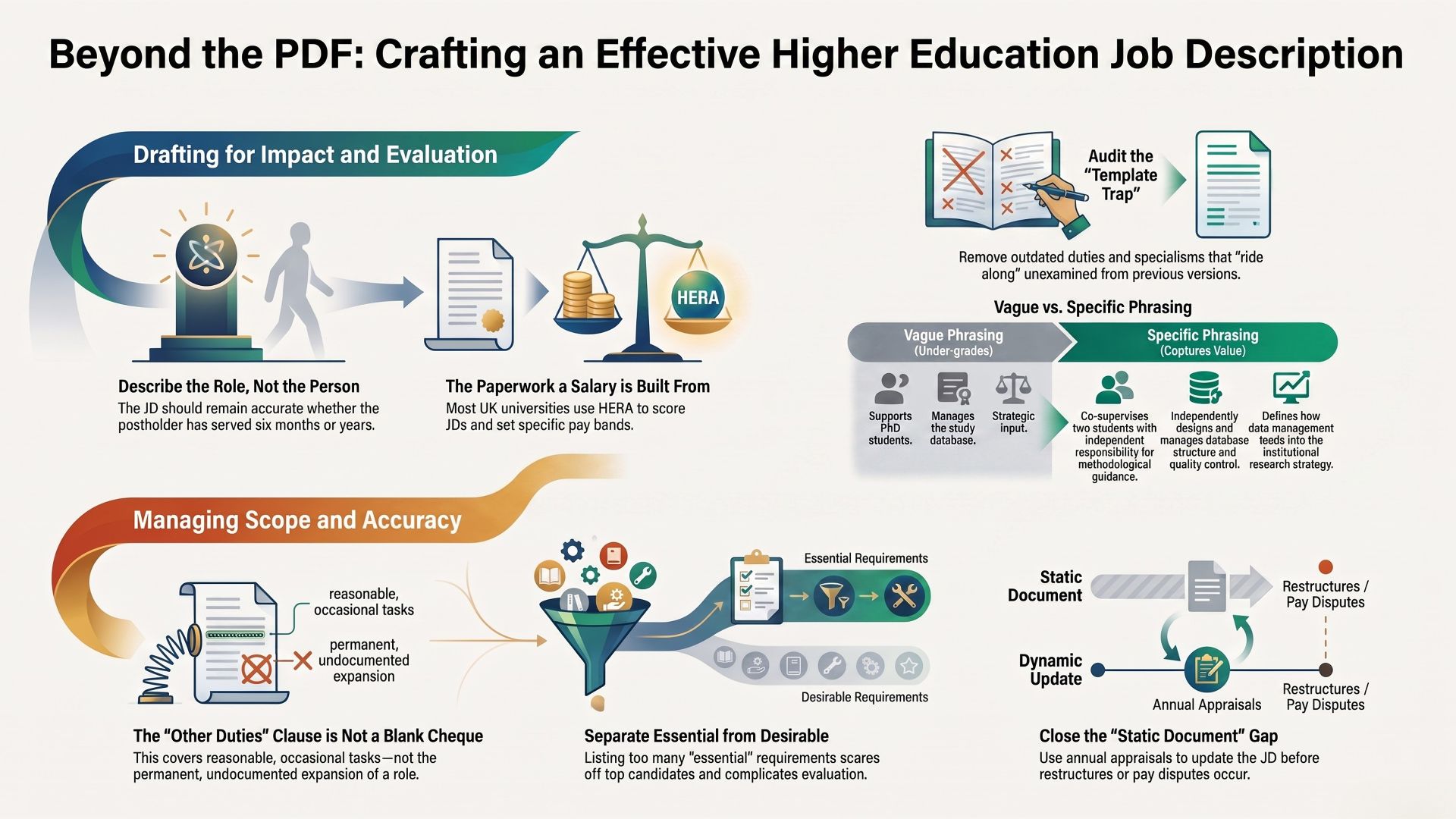
An academic job description sets out a role’s purpose, duties, responsibilities and the level at which it operates, independent of whoever happens to be doing it at any given time. That’s the part worth sitting with: a good JD describes the job, not the person. It should read the same whether the postholder has been there six months or six years.
The HERA link to pay
In UK higher education a job description does more work than in most sectors. Almost every UK university runs some form of formal job evaluation to set pay grades, and most use a scheme called Higher Education Role Analysis, or HERA. HERA scores the job description itself against a set of competencies: decision-making, communication, analysis, team development, and so on. A trained analyst reads the JD, sometimes alongside an interview, and produces a points score. That score sets the grade. The grade sets the pay band.
So the JD isn’t a formality that happened once, at recruitment, and can now be forgotten. It is, quite literally, the paperwork a salary is built from.
What else it does
Beyond pay, a JD typically does several jobs at once:
- It sets the basis for what someone can reasonably be asked to do, and what falls outside their role
- It’s the reference point in appraisal, probation and performance conversations
- Managers usually check it first when they match roles against a new structure during a restructure
- A disciplinary or grievance process refers back to it if there’s a dispute about expectations
- Candidates read it before they apply, so a bad one costs an employer good applicants before a single CV lands
Most people only encounter their own JD twice in an entire post: once when deciding whether to apply, and once when something has gone wrong. That gap is really what this piece is trying to close.
Most job descriptions aren’t written from scratch
Here’s something to be honest about. The vast majority of job descriptions, in academia and everywhere else, start life as an edit of one that already exists. A department has a template for “Research Associate,” a PI opens the version used for the last post, or HR hands over a standard form for the grade, and the new JD gets built by amending what’s already there rather than working out from first principles what this particular role actually needs.
That’s not laziness, and it isn’t a problem in itself. Reusing a template keeps language, format and evaluation-friendly phrasing consistent across a department, and writing every JD from a blank page isn’t realistic for anyone recruiting regularly. Most UK institutions actively encourage it, through standard templates held by HR or People Services, precisely so JDs stay consistent enough to evaluate fairly.
The catch is what rides along unexamined. A duty that made sense for the previous postholder, who happened to have a particular specialism, sits there unquestioned three appointments later. Evaluation language pitched for a role at a different level lingers because nobody checked whether it still fits. And, most relevantly here, broad catch-all clauses get copied forward from JD to JD, generation to generation, without anyone stopping to ask what they actually commit the postholder to.
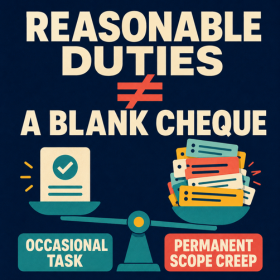
The catch-all clause allows reasonable, occasional flexibility—not the permanent expansion of a role without review.
The “other duties” clause: useful flexibility, or a blank cheque?
Almost every job description in the UK ends with some version of “and any other duties as may reasonably be required.” It’s worth understanding what that line is actually for, because it genuinely cuts both ways, and it’s the part of a JD most likely to have been copied forward without anyone thinking about it since.
Why the clause exists
There’s a real reason it exists. No job description can anticipate every task a role will involve, and without some flexibility built in, a PI or manager would technically need to renegotiate the JD every time something reasonable but unlisted came up: covering for a colleague, helping out with an unexpected deadline, picking up a short-notice task that doesn’t fit neatly into the bullet points. For anyone running a small team on a fixed-term grant, that flexibility is genuinely necessary to run a lab or project sensibly, not a bureaucratic formality.
Where it goes wrong
Problems start when the same clause gets used, deliberately or just by drift, to justify loading a much wider or higher-level set of duties onto someone than their grade reflects: treating “any other reasonable duties” as licence to mean anything at all, indefinitely, without ever revisiting the JD or the grade attached to it. At that point it has stopped being flexibility. It has become scope creep with a legal fig leaf.
What UK employment law actually says
It isn’t as open-ended as it looks on paper. Acas’s own guidance on flexibility clauses in employment contracts is clear that employers can only rely on this kind of clause to make changes that are reasonable, and that using it to push through an unreasonable change can leave an employer in breach of contract even where the clause appears to allow it. Acas specifically expects consultation before a flexibility clause is used for a significant change, and notes that persistent misuse can support a claim for breach of contract or constructive dismissal. In other words, employers never intended “other duties as required” as a blank cheque, and legally it isn’t one. It’s meant to cover reasonable, occasional, roughly-equivalent-level tasks, not a standing licence to redefine the job.
Who ends up doing this work
It’s also worth naming who tends to absorb this kind of undocumented work in practice, because it isn’t random. Research on “office housework” and non-promotable tasks — work that keeps a team functioning but rarely appears in a JD or gets credited at appraisal — consistently finds it lands disproportionately on women, and the pattern shows up specifically in academia: a well-cited study of US faculty (Guarino and Borden, 2017) found women academics carry a heavier service load than men, in effect “taking care of the academic family” on top of their formal role. Harvard Business Review’s research on non-promotable tasks found something similar in the wider workforce: women are asked to take on this kind of work 44% more often than men, and say yes 76% of the time against 51% for men. None of that shows up anywhere on a JD, which is rather the point. If duties keep landing on the same person through “any other reasonable duties” without ever reaching the JD, it’s worth asking, honestly, whether that pattern is evenly spread across a team, not just whether any single task was reasonable.
What to actually do about it
For anyone writing JDs, the practical upshot is keeping the catch-all clause, but not leaning on it to avoid updating the document when duties genuinely and permanently change: that’s exactly what the clause was never meant to paper over. For anyone on the receiving end, a single ad hoc task under this clause is normal and not worth a fight. A pattern of duties well outside your role or grade, especially one that’s gone on for months rather than days, is exactly the kind of thing worth raising, and the audit further down this piece gives you the evidence to raise it properly.

In UK higher education, your job description is commonly evaluated to determine the role’s grade and pay band.
Why it matters more than people think
The pay link is direct
It’s worth returning to the HERA point, because it changes how you should think about your own JD. Job evaluation schemes exist to guarantee equal pay for equal value, a real and important protection, but the mechanism only works if the JD is accurate. Understate what you actually do on your JD, and an evaluator will assess and pay you against a job that isn’t quite the one you’re doing. Most UK institutions publish their grading structures and evaluation policies openly, and it’s worth ten minutes with your own institution’s version so you know precisely how the link operates where you are.
Duties drift, JDs don’t update themselves
Jobs in research rarely stay still. A colleague leaves and their public engagement work lands on you without anyone deciding it should. A PI’s grant expands and you pick up line management you were never evaluated for. An ethics amendment needs someone to own it, a piece of fieldwork or lab safety responsibility becomes “your thing” because you did it once competently, or you end up effectively co-supervising a PhD student without it ever being written down anywhere formal. You become the person who “just handles” the data management plan, because you’re good at it and someone has to be. None of this shows up on paper unless somebody deliberately puts it there. That’s scope creep, and it’s completely normal: jobs evolve. The actual problem isn’t that duties change, it’s that JDs are static by default and only change when someone actively asks.
Restructuring raises the stakes
UK higher education is going through a lot of institutional restructuring at the moment, and one detail is worth knowing without needing to dwell on it. When a restructure matches, maps or places roles against a new structure, managers usually start from the job description on file, not from their private knowledge of what someone actually does day to day. If a JD has drifted a long way from the real role, that’s the moment it can bite. It’s one more reason an accurate JD is worth having in good times, rather than trying to fix it under pressure once a restructure is already underway.
It shapes who applies, too
Anyone writing JDs should remember the audience isn’t only the postholder. A vague, jargon-heavy or unrealistic job description doesn’t just create problems down the line, it puts off strong candidates before they apply. Job-seekers use a JD to self-select, to work out whether they’re a genuine fit, and an unclear one either scares off people who’d have been excellent or attracts people who are a poor match, wasting everyone’s time at shortlisting.
Writing a good academic job description
Writing an academic job description? A few habits separate one that works from one that just gets filed.
Write for the role, not the person
Write for the role, not the person filling it. That’s what keeps it usable once they leave, and it’s the quickest way to catch a JD that’s drifted into describing a person rather than a job.
Be concrete about level
Be concrete about level, not just tasks. This is where most JDs under-sell the role without anyone noticing. Take a fairly ordinary research duty and look at the difference specificity makes:
| Written vaguely | Written properly |
|---|---|
| “Manages the study database.” | “Independently designs and manages the study database, with autonomy over structure and quality control, escalating only significant changes to the PI.” |
| “Supports PhD students.” | “Co-supervises two PhD students, including independent responsibility for day-to-day methodological guidance.” |
Same tasks, but the right-hand column is evidence: independence, technical ownership, a defined escalation point. That’s the kind of language HERA-style evaluation actually scores against. The same applies to anything described as strategic, where the evaluator needs to know what strategy it feeds into and how, not just that the word “strategic” appears. Vague verbs under-grade real responsibility; specific ones capture it.

Check whether your job description reflects your actual duties, independence, management responsibilities and resource oversight.
Keep it honest, inclusive and current
Separate essential from desirable, honestly. A JD that lists forty “essential” requirements isn’t ambitious. Nobody can evaluate it fairly, and candidates trying to work out whether to apply can’t either. And watch the language itself: research on job adverts consistently finds that words like “competitive,” “dominant” or “ambitious” skew applications male, while more collaborative language broadens the pool. That isn’t about softening expectations, it’s about not accidentally filtering out good candidates before they’ve even applied. Drop internal acronyms too, or explain them, since a JD is often the first thing an external candidate reads about your institution.
The single biggest failure mode is a well-written JD nobody ever touches again, not a badly written one. Build a habit, annually, at appraisal, or whenever a role changes materially, of asking whether the JD still matches reality. If you’re stuck for format, most UK institutions have a standard JD template through HR or People Services. Use it rather than reinventing one from scratch each time, for all the reasons in the section above.
Auditing your own job description
Now the other half. If you’re the one holding the job rather than writing it, here’s a straightforward way to check whether yours still reflects reality.
Find it first. It’s usually in your original offer paperwork, on your HR self-service portal, or your line manager or HR team can send a copy. Then actually sit with it, rather than skimming.
- Does it list what you actually spend your time on now, not what you did in year one?
- What are you doing that isn’t written down anywhere: line management, committee work, informal mentoring, co-supervision that was never made official, being “the person who handles” something, however minor it feels?
- Is the level of responsibility described accurately, given the autonomy, budget or resource oversight, or number of people relying on your decisions today?
- When did you last genuinely read it, rather than skim it at interview?
- Does it match your contract or offer letter, and your actual line management structure? Discrepancies here are worth flagging early, before they compound.
It’s worth keeping a running note as things change through the year, a live record of what you actually do, rather than trying to reconstruct it from memory when a regrade conversation comes up. It also makes appraisal, and any future job hunt, considerably easier, since it’s effectively a running record of your own responsibilities.
If it’s wrong, what you can actually do about it
This is the part people avoid, mostly because it sounds like a fight. It doesn’t have to be.
Start with your line manager, not HR
In almost every UK institution, the process for reviewing or updating a JD begins with agreement between you and your manager, usually with a tracked-changes version of the current JD showing what’s changed and why. “I want to make sure this reflects what I’m actually doing” lands very differently from “I want a pay rise,” and it’s the more accurate framing anyway, since the two things aren’t the same request.
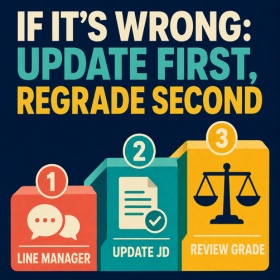
Start with your line manager, update the job description using evidence, then consider a formal grade review.
A JD update and a regrade are two separate things
Updating a JD to reflect reality doesn’t automatically trigger a higher grade, since most institutions build some flex into each grade band precisely so a role can expand a little before it tips into the one above. A significant, permanent change can justify a formal re-evaluation, though, and most HR teams run a specific process for exactly this: a regrade, or job re-evaluation request. Cambridge, UCL and Exeter, for example, all publish their regrading procedures openly, and while every institution’s process differs in the detail, they follow a broadly similar shape: an updated, tracked-changes JD, line manager sign-off, then a formal evaluation.
Evidence matters more than feeling busier
The single most common reason evaluators turn down a regrade request is that it describes someone working harder, not doing a different job. Evaluators are looking for permanent, structural changes to duties, autonomy or scope, not temporary overload, and not performance either: doing your existing job brilliantly is a conversation for a different pay mechanism, like a contribution award, not a regrade.
Be realistic about the outcome
A fair case doesn’t guarantee a higher grade. Worth knowing before you start: a formal re-evaluation can occasionally show a role sits at the correct grade already, or even, rarely, above it. If you’re unsure, most institutions let you have an informal conversation with a job evaluation adviser before committing to a full application, which is usually the sensible first move.
Name it if duties were added without a review
Most institutions expect changes in duties to trigger a review, not to just accumulate silently, so a manager who’s been layering on responsibility without ever discussing an update to the JD is the actual problem here, more often than any individual task.
Where a union can help
This is also the kind of situation a union is useful for, not just for disputes that have already gone wrong. UCU represents academic, research and academic-related staff on pay and conditions in most UK institutions, and local branches routinely help members word a JD update, work out what evidence a regrade case actually needs, and, if it comes to it, attend the meeting with you. None of that requires things to have already broken down. Getting the wording right on a JD update before you submit it is a far easier ask of a union rep than untangling a dispute after a panel has already turned a case down.
Process and timing vary by institution, so check yours specifically. Some universities review annually, some only on request, some require senior sign-off before a case even reaches a panel, and outcomes can take months. There’s no real shortcut beyond finding your own institution’s job evaluation or grading policy, usually on the HR or People Services intranet, and reading it before you start.
What this means for PIs and managers, too
If you manage people, a periodic JD check isn’t paperwork for its own sake, it protects the person doing the job. Reviewing a JD with a team member, even briefly, even informally, before a restructure lands, before an appraisal, before duties pile up unnoticed, is one of the more useful and low-cost things a manager can do for someone’s career security. It costs half an hour. Leaving it can cost someone a fair grade, or worse, leave them exposed if their actual role and their paperwork tell two different stories. It’s also worth knowing what pay and permanence actually look like on the other side of a role change, and our podcast on choosing between a fellowship and a lectureship is a straight conversation about exactly that.
Common questions about job descriptions
What is an academic job description?
An academic job description is a formal written statement of a role’s purpose, duties and responsibilities, and the level at which it operates, independent of whoever currently holds it. In UK higher education it also typically forms the basis for job evaluation and pay grading.
What does “other duties as may reasonably be required” mean?
It’s a standard clause giving an employer flexibility to ask someone to do reasonable, occasional tasks not explicitly listed in their JD, without needing to renegotiate the contract each time. Under UK guidance from Acas, it only covers changes that are reasonable; using it to permanently and substantially expand someone’s role without review can amount to a breach of contract.
How do I get my job description changed if it’s wrong?
Start with your line manager, not HR, and bring a tracked-changes version of your current JD showing what’s actually changed. This is a separate step from asking for a regrade: the JD update comes first, since it’s the document any later pay case is built on. If you’re a union member, your branch can help with wording and evidence before you submit anything formally.
What’s the difference between a job description and a person specification?
A job description sets out the duties, responsibilities and purpose of the role itself. A person specification lists the skills, qualifications and experience needed to do it. They’re usually issued together but serve different functions: the JD describes the job, the person spec describes the ideal person for it.
Does my job description form part of my contract?
Usually, yes, either directly or by reference, since most UK contracts of employment refer to the JD as setting out your duties. That’s exactly why accuracy matters. It isn’t just descriptive, it’s often the legal basis for what you can be asked to do.
How often should a job description be reviewed?
There’s no universal rule, but many institutions suggest an annual check, often folded into appraisal, plus a review whenever duties change materially: a new line management responsibility, a change in grant scope, or a restructure.
What is HERA, and does every UK university use it?
HERA, Higher Education Role Analysis, is a job evaluation scheme designed specifically for the sector and used by well over a hundred UK institutions to assess job descriptions and assign pay grades consistently and fairly. Not every institution uses HERA specifically, some use other analytical schemes, but the underlying principle, that pay grade is derived from an evaluated job description, is close to universal in UK higher education.
Can updating my JD lower my grade?
In rare cases, yes, if a formal re-evaluation genuinely finds a role sits at a lower level than currently graded. Most institutions apply salary protection for a period if this happens, so pay doesn’t drop overnight, but it’s a real possibility worth knowing about rather than being surprised by.
I’ve taken on extra duties informally. Should I ask for more money, or a JD update?
Usually the JD update comes first, since it’s the document any pay case gets built on. Talk to your line manager about getting the JD to reflect reality, then use that updated document as the basis for a formal review if the change is significant and permanent.
What if my manager won’t update my JD?
Escalate through your HR business partner or People Services team, who can usually advise even if your manager isn’t engaging, or speak to your union rep if you’re a member. Keep your own written record of what’s changed and when, since this becomes useful evidence either way.
Does a good job description really affect who applies for a job?
Yes. A clear, honest, well-structured JD helps the right candidates self-select in, and puts off people who’d be a poor fit, saving time for everyone at shortlisting and interview. A vague or overloaded one does the opposite.
Is it worth asking to see a role’s JD before I apply?
Absolutely, and it’s a completely normal thing to request if a full JD isn’t included in the advert. It tells you far more about the actual expectations of a role than the advert copy usually does.
What happens to my JD during a restructure?
It’s typically one of the first things checked when roles are matched, mapped or placed against a new structure, which is exactly why it’s worth having an accurate one on file well before a restructure is ever announced, rather than scrambling to update it once one is.
This article is general information about the UK context and not legal advice. Employment law, job evaluation schemes and institutional policies change, and individual contracts and grading structures differ, so check your own position with your line manager, your HR or People Services team, your union or Acas. Checked against UK sources available in September 2026.