
 Print This Post
 From student assessments, peer review reports to funding and job applications, rejection is an increasingly common feature of academic life. Tara-Lyn Camilleri and Ed Ivimey-Cook argue that unlike other high-profile professions with limited positions, academia treats rejection as personal judgement and has failed to create ways of talking about rejection that takes into account its structural nature.
This article is shared from the LSE Impact blog the article gives the views and opinions of the authors and does not reflect the views and opinions of the Impact of Social Science blog (the blog), nor of the London School of Economics and Political Science or Dementia Researcher. Shared under the Creative Commons Attribution 3.0 Unported (CC BY 3.0) the orginal publication can be found at https://blogs.lse.ac.uk/impactofsocialsciences/2026/06/17/rejection-in-academia-is-structural-not-personal/
Rejection is now sufficiently routine in academic life that it has acquired the status of a rite of passage: the rejected manuscript, the near-miss grant, the job application that disappears into the ether.
It is therefore unsurprising that much of the counsel offered to academics has become psychological in tone. We are taught to endure rejection with composure, to build resilience, and to use the disappointment to shape disciplined habits of revision and reapplication.
Advice about coping treats rejection as an individual experience to be managed; but we are interested in why the system produces such intense rejection, and why we keep interpreting it as a signal of intellectual merit.
Incentive structures in academia keep steering attention back to personal self-correction. Even when many participants privately recognise the structural nature of the problem. Our argument is descriptive rather than accusatory: a system can generate predictable harms through incentive structures, even without intending to do so.
Academia is different from other prestige-bottleneck professions
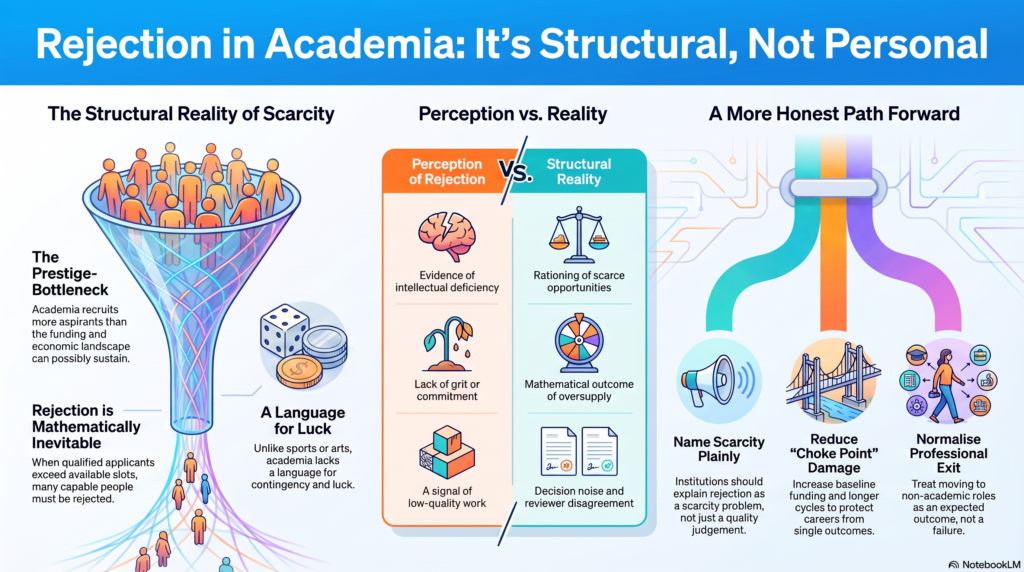
It helps to situate academia in a wider class of labour markets that might be called prestige-bottleneck professions. The arts, law, professional sport, journalism and politics: these fields share a common architecture. They recruit more aspirants than they can possibly sustain in the current funding and economic landscape. They offer a small number of stable, high-status positions at the top; and they depend on a long period of apprenticeship in which large numbers compete for a future that only a minority can attain.
The key features are oversupply, scarcity, and funnelling. By “funnelling” we mean a system that draws in far more people at early stages than it can retain at later ones. This means that rejection and exit are bound to happen.
Once we see academia in this light, then rejection is not, in the first instance, a judgement on a person’s merit. In an oversubscribed system, it is often mathematically inevitable. If the number of qualified applicants for grants or jobs exceeds the available slots by a large margin, then many capable people must be rejected regardless of effort or talent.
This framing also prevents a familiar form of academic exceptionalism. Academia is not uniquely afflicted by scarcity, nor uniquely populated by people pursuing highly competitive prestige under uncertain odds. What is distinctive is the stories we tell about rejection and scarcity.
In many prestige-bottleneck fields, there is at least a language for luck. A sportsperson can lose “on the day” without denying that they belong at the top level; artists and writers can speak, sometimes ruefully, of taste, or timing. Those stories can be hard, but they at least acknowledge limited spaces as part of the explanation.
Academia, by contrast, has a strong tendency to frame rejection as a judgement: the work is not good enough, the argument is not rigorous enough, the proposal is not compelling enough, the candidate is not sufficiently excellent. Outcomes are treated, implicitly and sometimes explicitly, as signals of intellectual merit, and therefore as evidence about the person’s capabilities.
This cultural pattern is reinforced by the incentives, and it persists even when people consciously know better. Many academics will say, in conversation, that grant panels disagree, and that hiring pools are impossibly large. But often rejection is then turned back into a lesson for the individual: try harder, publish more, and demonstrate grit.
In that sense academia lacks a settled language for contingency. It possesses, instead, a very powerful language for deficiency.
When there are more qualified people than places
Funding bodies, faced with scarcity, are often required to make fine distinctions between proposals that are all plausible, well-crafted, and above a reasonable quality threshold. Panels must rank, score and create cut-offs, even when the difference between success and rejection may depend on timing, topical fit, reviewer disagreement or panel composition.
This matters because rejection becomes less informative as success rates fall. If many applicants meet the relevant standard, but only a small proportion can be funded, then many qualified candidates must be rejected. Selection is still applying standards, but it is also rationing scarcity.
Grant outcomes for example begin to resemble a lottery (or in some cases even are lotteries), even as they continue to be framed as judgements of quality. We attach moral meaning to rejection that becomes conflated: we are expecting signals of quality that the current acceptance rates make almost impossible.
The same incentives shape individuals’ behaviour. Because academic careers are built around repeated selection, academics often adopt the language of resilience and pushing themselves harder, even when they know the problem is structural.
These pressures can also shape the research itself. In a publish-or-perish system, academics may be rewarded for producing work that is fast, fundable and visible, rather than slow, risky or carefully cumulative.
For early-career researchers especially, questioning that script can be risky. It can make someone seem bitter or unwilling to perform. The result is a culture that encourages people to endure conditions that can lead to burnout, all the while treating that endurance as evidence of commitment to the profession.
This helps explain why the meritocratic story persists even when it is difficult to sustain empirically. A prestige-bottleneck profession depends on people continuing to believe that effort will eventually be recognised.
If academia admitted how much rejection depends on chance and scarcity, rejection would become harder to treat as a personal lesson. Resilience language helps turn a structural problem into something individuals are expected to manage.
What does being more honest about rejection look like?
Being more honest about rejection does not mean lowering standards or abandoning selection. It means communicating reasons for rejection more accurately.
First, institutions should name scarcity plainly. There is a difference between failing to meet a quality threshold and losing out because there are too few places. When success rates are very low, rejection should be explained as part of a scarcity problem, not simply as a judgement of merit. Acceptance rates, reviewer disagreement and decision noise should be made more visible.
Second, we should reduce the damage caused by single outcomes. One rejected grant should not be able to jeopardise an entire career. That means more baseline funding, longer funding cycles and fewer repeated choke points where individuals are forced to keep staking their livelihoods on low-probability wins.
Third, we should stop moralising persistence. Survival in academia’s funnel is shaped by privilege, wealth, health, caregiving responsibilities and timing. It is not a clean proxy for superiority. It is often a proxy for who has enough support, security and luck to remain in the funnel.
Finally, exit should be treated as normal. Movement into non-academic roles should be understood as an expected outcome of an oversubscribed system, not as failure. A system that routinely produces exit but speaks of it as defeat will predictably generate shame. Often, rejection it is simply evidence that there were more qualified people than places. What needs to change is the language around rejection: less automatic talk of deficiency, grit and personal improvement, and more honest recognition of scarcity, contingency and limited space.
 Enjoying this blog post? Sign up to our mailing list and receive all the latest LSE Impact Blog news direct to your inbox
About the authors
Tara-Lyn Camilleri is a writer and researcher working at the intersection of biology, psychology and the social sciences. She holds a PhD in evolutionary biology and has ongoing research affiliations with the University of Oxford and Monash University. Her work examines how belief and behaviour are shaped by biological, historical, and social constraints.
Ed Ivimey-Cook is a lecturer in The School of Biological Sciences at the University of East Anglia. His research interests include the evolution of ageing, life histories, and the inter- and transgenerational effect of diet and age. He is also a committed open science advocate and past president of the Society for Open, Reliable, and Transparent Ecology and Evolutionary Biology (SORTEE).



 LSE Impact Blog

 Harriet Greene
 Beccy Owen