Print This Post
 The offer email lands, and for a day or two it's all congratulations. Then the questions start. What actually happens in a PhD? Who checks you're on track? What's a PhD confirmation review, will you have to teach, and what on earth happens in a PhD viva? Most people start a doctorate with only a hazy idea of the stages of a PhD between "you've got a place" and the cap and gown.
This guide is the map we wish we'd been handed: what to expect from a PhD, stage by stage. It walks through the stages of a PhD in the UK, from the moment you accept an offer to graduation day, in blocks of roughly three to six months. It won't tell you how to do your research. Your project, your supervisors and your field will shape that. What it does is explain the milestones everyone goes through, the practical bits nobody mentions at interview, and the things worth thinking about at each point.
It's written for anyone starting out, whether you're coming straight from a masters or an undergraduate degree, or returning to university after years in clinical practice, social care or another career. It's based on the UK PhD process. Universities set their own rules, so names, timings and paperwork vary, and a lab-based project in neuroscience will look different day to day from a qualitative study in care homes. But the backbone is the same almost everywhere, and that's what we've set out here.
In brief
A UK PhD usually takes three to four years full-time, or around six part-time. Whatever your subject, you'll pass through the same broad stages of a PhD: settling in and planning, getting approvals, a formal confirmation (or upgrade) review, a long middle of data collection and analysis, writing up, submitting your thesis, an oral exam called a viva, corrections and, finally, graduation. This guide explains each stage, the formal checkpoints along the way, and the practical side of doctoral life, from stipends and leave to teaching and wellbeing. There are notes for people coming from clinical and care roles and on issues specific to dementia research, plus answers to common questions at the end.
The stages of a PhD at a glance: a typical PhD timeline
A PhD is a research degree. There are no exams to pass along the way and, in most programmes, little or no taught content you're graded on. You're judged on a single piece of work, your thesis, and how well you defend it. The Quality Assurance Agency, which sets out what UK degrees should mean, describes the common thread of every doctorate as an original contribution to knowledge, whether through new research or applying existing knowledge in a new way.
That freedom is the best and hardest thing about it. Nobody sets you weekly tasks. Instead, the PhD process is held together by a handful of formal checkpoints that keep you, your supervisors and your university honest about progress. Here's a typical PhD timeline for a full-time student starting in October. Part-time students do the same things over a longer period.
| When (full-time) | What usually happens |
|---|---|
| Before you start | Accept the offer, read your funding terms, sort visas and practicalities |
| Months 0–3 | Induction, mandatory training, a training needs analysis, first supervision meetings |
| Months 3–6 | Literature review, research questions, methods and a project plan |
| Months 6–12 | Ethics and other approvals, pilot work, first data, often a first-year progress review |
| Months 9–18 | Confirmation, upgrade or transfer review: a report and a short oral exam |
| Months 18–30 | Main data collection and analysis, conferences, perhaps teaching, a second annual review |
| Months 30–36 | Finishing analysis, writing chapters, a third annual review, planning what's next |
| Months 36–48 | Writing up, examiners appointed, thesis submitted (funding often ends around 3.5 years) |
| After submission | The viva, then corrections and final deposit of your thesis |
| The finish line | The degree is formally awarded, then graduation day |
This PhD timeline is typical, not fixed. Most universities expect a full-time student to submit within three or four years of starting. The University of Reading, for example, sets an expected three years full-time and a maximum of four, and five to six years part-time. Some universities allow longer for part-time study. Your university's research degree regulations are the rulebook, and it's worth skimming them in your first month. Nobody does, and everybody wishes they had.
If you're still weighing up which kind of doctorate to do, our explainer on DPhils, PhDs by publication and professional doctorates covers the differences. This guide focuses on the traditional PhD by research, which is what most people in dementia research do.
The words you'll hear
- PGR or doctoral researcher. Postgraduate researcher. Many universities now say doctoral researcher or doctoral candidate rather than PhD student.
- Supervisory team. Usually a primary supervisor and one or two others. Some universities add a thesis committee or advisory panel who sit outside the team and review your progress.
- Doctoral college or graduate school. The central office that runs training, regulations and the paperwork.
- Confirmation, upgrade or transfer. The formal review, usually in the first 18 months, that confirms you're on track for a PhD.
- Annual review or progress review. A yearly check on how things are going.
- Viva (viva voce). The oral exam on your thesis at the end.
- Corrections. The changes examiners ask for after the viva before the degree is awarded.
- Writing-up, completing or continuation status. A period at the end, after your main registration, when you're only writing. It often carries a reduced fee.
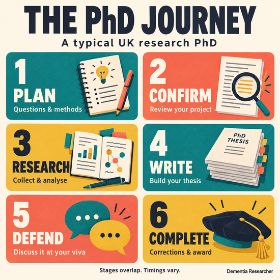
From planning your project to completing corrections, these are the broad stages of a UK research PhD. Stages overlap, and timings vary.
Stage 1: Between the offer and day one
The first of the stages of a PhD starts before you arrive. There can be anything from a few weeks to six months between accepting an offer and starting. Use some of it for the practical stuff, and some of it to rest. Arriving exhausted doesn't earn you anything.
Read your funding terms properly
Your offer or award letter tells you what you'll be paid, for how long, and what happens if you're ill, have a baby or need a break. Read it now, while nothing's gone wrong. A PhD stipend isn't a salary. It's a tax-free maintenance payment, so there's no income tax or National Insurance to pay, and usually no pension contributions either. For students funded by UK Research and Innovation (UKRI), the minimum stipend from 1 October 2026 is £21,805 a year, or £23,805 with London weighting. Many charities and universities match the UKRI rate. Some pay more, some pay less. Our look at what doctoral candidates are paid across Europe puts the UK figure in context.
Check how long the funding lasts. UKRI studentships commonly run for three and a half years full-time, but awards vary. If your funding ends before your registration does, you'll need a plan for those final months, and it's much easier to make one in year one than in year four.
Look at the leave rules too. UKRI-funded students are entitled to at least 30 days of annual leave a year, including bank holidays, and keep their stipend while on leave. Since October 2025, UKRI's terms have also allowed up to 28 weeks of paid sick leave in any 12-month period, with medical leave capped at 52 weeks over the whole studentship, as the Grand Union doctoral training partnership explains. There's paid parental leave too. Other funders set their own terms, so if you're funded by a charity, a university scholarship or a grant, ask what yours are.
Sort the practicalities
- Visas. If you need a Student visa, start early. Some subjects also need security clearance through the Academic Technology Approval Scheme (ATAS) before you can apply. Your university's international office will tell you if yours does.
- Disability support. If you're disabled or have a long-term condition, contact the university's disability service before you arrive. UKRI-funded students aren't eligible for the national Disabled Students' Allowances, so support comes through your university and UKRI's own arrangements instead.
- Money. Find out when the first payment arrives. Some universities pay monthly, some quarterly, and the first one can come later than you'd like.
- Where you'll work. Ask whether you'll have a desk, a lab bench, a laptop, and which buildings you'll need access to.
Get in touch with your supervisor
A short email or call before you start helps. Ask what they'd like you to read, when they'd like to meet in the first week, and whether there's anything you should do in advance, such as online training. Don't let anyone talk you into starting the PhD unpaid before your registration date. Light reading is fine. Running experiments isn't.
Coming from clinical practice or care
Nurses, allied health professionals, doctors, psychologists and social care staff often bring exactly the experience dementia research needs. The switch can still be a jolt. A few things to sort early:
- Salary or stipend? Clinical doctoral awards, such as the NIHR's Doctoral Award (which replaced its doctoral fellowships) or an MRC Clinical Research Training Fellowship, often pay a salary rather than a stipend. If you're moving to a stipend, work out what it means for your take-home pay, pension and mortgage before you sign.
- Keeping your registration. Check how you'll keep up professional registration and revalidation, and whether your award includes protected clinical time.
- A different pace. Clinical work is fast, with clear tasks and instant feedback. Research is slow and open-ended. Feeling unproductive for the first few months is normal, not a sign you've made a mistake.
- Your clinical identity. Many clinicians say the hardest part is stepping back from a professional identity they've spent years building. Our career stories from Janine Lane, who moved from dementia nursing to a PhD, and Paul Newman, who went from chief executive to doctoral researcher, show it can be done.
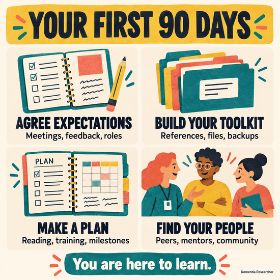
You don’t need everything figured out in your first term. Start with clear expectations, useful systems, a realistic plan and people you can turn to.
Stage 2: Months 0–3, finding your feet
The first term is mostly about arriving well. You'll be busier than you expect with things that don't feel like research, and that's fine.
Induction and mandatory training
Expect a university induction, a department or lab induction and a pile of online modules. Common ones cover research integrity, data protection, information security, equality and diversity, and health and safety. Lab-based students will also have building, equipment and safety inductions before they can work alone. If you'll work with animals, you'll need training for a personal licence under the Animals (Scientific Procedures) Act before you do any regulated work. Get these done early. They're often a condition of later milestones.
A training needs analysis
Most universities ask you to complete a training needs analysis or development plan in your first few months. It's often built around the Vitae Researcher Development Framework, the UK's standard description of the skills researchers need. Vitae refreshed it in 2025, but many universities still map their training to the original 2010 version, which sorts skills into four areas: knowledge and intellectual abilities; personal effectiveness; research governance and organisation; and engagement, influence and impact. In plain English, that's what you know, how you work, the rules you work within, and how you share your work with others. Take it seriously. It's how you get access to courses, and it's a useful record when you write job applications later.
Get supervision working
Your relationship with your supervisors will shape your PhD more than almost anything else. Agree the basics early:
- how often you'll meet, and who sets the agenda
- how quickly they can usually give feedback on writing
- how they like to be contacted, and what counts as urgent
- who does what if you have more than one supervisor
- whether you'll keep a record of each meeting (do, and send it to them afterwards)
Many universities provide a form or checklist for this conversation. If yours doesn't, ask for one. Supervisors aren't mind readers, and neither are you. Our blog on supervision versus mentorship explains why you'll want people beyond your supervisory team, too.
Set up your systems
Now is the time to set up a reference manager, a sensible folder structure, a backup routine and a research notebook or lab book. It sounds dull. It will save you weeks in your final year. Our guide to free research tools for PhD students has suggestions, and there's more in research habits I wish I'd started earlier in my PhD.
What to think about now
- Who are the other PhD students in your department, and where do they have lunch?
- Which seminars and journal clubs should you go to?
- What does a normal working week look like for you? Our piece asking whether a nine-to-five PhD is a myth is worth reading before bad habits set in.
Stage 3: Months 3–6, reading and planning
This is when you turn a project title into a plan. Some people arrive with a tightly defined project and a funded protocol. Others have a broad topic and are expected to find the question themselves. Either way, by six months you should be able to explain what you're doing, why it matters and how you'll do it.
The literature review
Most PhDs start with a deep dive into what's already known. In many fields this becomes a formal review, sometimes a systematic or scoping review that you publish as your first paper. It's easy to get lost here. Set yourself a deadline, write as you read, and talk to your supervisors about when "enough" is enough. You'll keep reading for the whole PhD anyway.
Questions, methods and a plan
Work with your supervisors on your research questions, the methods to answer them and a realistic timeline. A Gantt chart or simple project plan helps, even if it changes every few months. Our blog on bringing project management into your PhD shows how. Build in slack. Recruitment, approvals and experiments nearly always take longer than planned.
What to think about now
- Which approvals will your project need, and how long do they take? (See the next stage.)
- Do you need training in a method you've never used, such as a statistics package, an imaging technique or interviewing?
- If you're feeling lost, you're in good company. Read feeling lost in year one of your PhD and 27 things we wish we'd known when we started our PhDs.
Stage 4: Months 6–12, approvals and first data
For many projects the second half of year one is about permission. You can't recruit participants, use patient data or start animal work until the right approvals are in place, and these processes run to their own timetable, not yours.
Ethics and governance
- University ethics. Most research with people needs approval from a university research ethics committee.
- NHS research. If your study involves NHS patients, staff, sites or data in England or Wales, you'll apply through the Integrated Research Application System (IRAS) for HRA and Health and Care Research Wales approval, and often a favourable opinion from an NHS research ethics committee. You'll need a sponsor, usually your university, and HRA guidance says students shouldn't normally act as chief investigator, so that's usually your supervisor. The HRA's student research toolkit walks you through what applies to you. Scotland and Northern Ireland have their own arrangements. NHS sites then confirm they have the capacity to take part.
- Animal work. Procedures must sit within an approved project licence, and you'll need your personal licence in place.
- Data access. Applying for data from resources such as UK Biobank, cohort studies or brain banks can take months.
Don't underestimate the time. A first submission rarely sails through without questions, and amendments add more. Ask your supervisors and department how long similar studies have taken, then add some.
Things to plan for in dementia research
- Capacity and consent. Plenty of dementia studies involve people who can't consent for themselves, or whose capacity may change partway through. In England and Wales that brings in the Mental Capacity Act 2005, and in Scotland the Adults with Incapacity (Scotland) Act 2000. Both change what your ethics application has to cover, including who you'll consult on the person's behalf. Work this out before you draft the protocol, not when a committee asks. If someone's capacity could fluctuate between visits, expect to be asked what you'll do when it does.
- Public involvement. Funders and ethics committees expect people living with dementia and carers to help shape research. Involving them early, in your questions, materials and recruitment plans, makes approvals smoother and the research better.
- Recruitment. Recruitment is often the slowest part of a dementia study. Services such as Join Dementia Research can help connect you with volunteers. Talk to your supervisors about it before you finalise your protocol.
- Tissue and data. Brain bank tissue and large cohort datasets come with their own application processes and access agreements. Find out what they are early.
Your first progress review
Many universities hold a first-year progress review, sometimes separate from the confirmation and sometimes rolled into it. It usually involves a short report, an updated plan and a meeting with someone outside your supervisory team. It's a check-in, not a test. Use it to raise problems while they're still small.
What to think about now
- When is your confirmation review due, and what exactly does it need? Find the guidance now, not two weeks before.
- Is there pilot work you can do while you wait for approvals?
- Have you taken any annual leave yet? You're entitled to it, so use it.
Stage 5: Months 9–18, the PhD confirmation review
The PhD confirmation review is the first big formal hurdle in the stages of a PhD, and it worries people more than it needs to. Depending on your university it's called confirmation, upgrade, transfer or a progression review. Its purpose is the same: to check that your project is viable, that you're working at doctoral level and that you can finish in a reasonable time.
Why it exists
At many UK universities, new doctoral students are first registered for an MPhil, or for "MPhil/PhD", and only move to full PhD registration once they pass this review. UCL, for example, requires full-time students to be registered for at least nine months before they can upgrade, and part-time students for at least 15. Passing the upgrade doesn't award you an MPhil. It just moves you on to the PhD. Other universities register you for a PhD from day one but still hold a confirmation review at a similar point.
When it happens
Usually somewhere between nine and 18 months into a full-time PhD. At Warwick's English department it falls in the third term of the first year. At Royal Holloway, one department sets the first attempt within 18 months for full-time students. For part-time students, it's later.
What you'll do
The format varies, but most confirmation reviews include:
- A written report. Typically your literature review, research questions, methods, any results so far, and a plan and timeline to completion. Some departments ask for a draft chapter or a paper instead.
- A short oral exam or presentation. Often two academics, at least one independent of your supervisory team, question you about your work. Think of it as a mini viva.
- Supporting paperwork. A supervisor's report, a record of training and sometimes evidence of completed mandatory modules.
Possible outcomes
If the panel isn't satisfied, you'll usually get feedback and a second attempt within a few months. Exeter, for example, allows two attempts, normally no more than three months apart. If it still isn't working, a panel can recommend you continue towards an MPhil rather than a PhD. That's a real possibility, and it's far better to find out now than at the end.
The best way to approach confirmation is as free, expert feedback on your project. The panel wants you to succeed. If they spot a hole in your plan, that's a gift at month 12 and a disaster at month 40. FindAPhD has a useful guide to the upgrade with typical questions.
What to think about now
- Ask a friendly postdoc or senior student to give you a practice run.
- Be honest in your plan about what could go wrong, and what you'll do if it does.
- Once you've passed, celebrate. It's a real milestone.
Stage 6: Months 18–24, the long middle begins
Confirmation done, you're into the heart of the PhD: collecting data, running experiments, doing interviews, analysing. This is often the most productive of the stages of a PhD. It can also be the loneliest, because the structure of year one has gone and the finish line is a long way off. Some people describe a second-year slump, so don't be surprised if motivation dips.
When things don't work
Experiments fail. Recruitment stalls. A dataset turns out to be messier than promised. None of this means you're failing at a PhD. Working out what to do when research doesn't go to plan is a large part of what the degree trains you for. Tell your supervisors early, and come to the meeting with options, not just the problem. Our blog on staying ahead of the PhD panic curve is good on this.
Conferences and your first presentations
This is a good time to start presenting your work, perhaps as a poster at a department day or a national meeting, then as a talk. Ask your supervisor which conferences matter in your field, and check what travel funding you have. Many studentships include a research training support grant, and societies and charities offer travel bursaries. Nervous about presenting? Read our blog on overcoming conference presentation anxiety.
Will I have to teach?
Possibly. Many PhD students teach or demonstrate, usually in undergraduate labs, seminars or small-group tutorials, and help with marking. It's normally optional, paid on top of your stipend and limited so it doesn't swamp your research. UKRI says your university can't ask you to do work that isn't part of your studentship in return for your stipend. Some studentships, often called graduate teaching assistantships, build teaching in as a condition of the award, so check your offer.
Universities set their own limits. The University of Manchester's medical faculty, citing UKRI guidance, doesn't expect PhD students to teach more than six hours a week. Its humanities faculty works to 180 hours a year, including preparation and marking. If you're on a Student visa, you can't do more than 20 hours of paid work a week during term time, whatever the university allows.
Teaching is good experience, especially if you're thinking about an academic career. Most universities offer training before you start, and with enough experience you can apply for Associate Fellowship of the Higher Education Academy (AFHEA), a recognised teaching qualification. Just keep an eye on the hours. Preparation and marking take far longer than the session itself.
What to think about now
- Is there a paper in what you've done so far? Our piece on how many papers you really need during a PhD sets expectations.
- Would an internship or placement outside academia be useful? Many funders and universities support them, usually by pausing your studentship for a few months.
- Have you volunteered to review for a journal, or helped a colleague with theirs? Our guide to peer reviewing a paper for the first time will help.
Stage 7: Months 24–30, analysis, papers and the second review
Around the two-year mark, data collection should be well under way or finishing, and analysis takes more of your time. You'll usually have a second annual progress review, which tends to focus on whether you're on track to submit on time and what still needs doing.
Start writing, properly
If you haven't started writing thesis chapters, now is a good time. Methods chapters are often the easiest place to begin, because you've already done the work. Some people write their thesis as a collection of papers, others as a traditional monograph. Ask what your university allows. Our blog on why you should write your PhD thesis backwards offers one approach.
Your first paper and peer review
If you're submitting your first first-author paper around now, be ready for a long process, and the first set of reviewer comments can sting. Our guide on how to respond to peer reviewers walks through it step by step.
What to think about now
- What does the final thesis need to contain? Sketch the chapter plan and the story it tells.
- Is the scope still realistic? Cutting something now is far less painful than cutting it in year four.
- Are you still taking breaks? Our post on PhD student guilt is for anyone who feels they should be working every weekend.
Stage 8: Months 30–36, finishing the research and planning what's next
For full-time students the third year is when the research winds down and the writing ramps up. You'll usually have a third progress review, often with a detailed timeline to submission.
Draw a line under the data
There's always one more analysis or experiment that would be nice to do. At some point, with your supervisors, you have to decide what's in the thesis and what's for the next paper. Set a date to stop collecting data and stick to it.
Think about life after the PhD
Start looking at jobs and fellowships now. Postdoc posts tend to be advertised closer to their start date, while fellowship schemes run to fixed annual deadlines that can fall long before you'd begin. Talk to your university's careers service, which supports researchers as well as undergraduates. Our article on PhD career support and our blog on writing a first fellowship application are good starting points. If you're an international student, doctoral graduates can apply for a three-year Graduate visa, and the cut to 18 months for other graduates from January 2027 doesn't apply to PhDs.
What to think about now
- When does your funding end, and when does your registration end? If they don't line up, what's your plan for the gap?
- Who might examine your thesis? Your supervisors will lead on this, but it's worth discussing early.
- Have you checked your university's thesis format rules, including word limits?
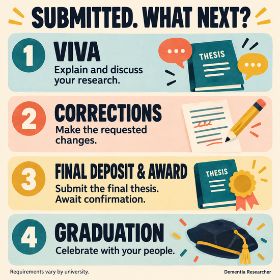
Submission is a milestone, followed by the viva, any required corrections, final thesis deposit and formal award. Graduation is the celebration that follows.
Stage 9: Months 36–48, writing up and submitting
Writing up is one of the stages of a PhD in its own right. Some people do most of it in the last six to nine months. Others write steadily throughout and only have to stitch it together. Either way, the final months are intense.
Writing-up status
Many universities have a formal writing-up period at the end, after your main registration. Hull, for example, describes three years of research plus up to 12 months of thesis finalisation for full-time students, with a continuation fee. During this time you're usually expected not to be collecting new data. It's often unfunded, which is why planning for the end of your stipend matters so much.
How long is a thesis?
Picture two PhD students at the University of Glasgow, both submitting this year. One is in the College of Medical, Veterinary and Life Sciences, where the thesis can't go over 80,000 words, and references and appendices don't count towards that. The other is in Arts and Humanities, where it has to come in between 70,000 and 100,000 words with everything included. Same university, very different rules. Yours are in your university's research degree regulations. Looking them up takes ten minutes now, and saves a nasty surprise in the month you submit. If you're under the limit, good. Nobody gets extra credit for using every word.
Getting it over the line
- Agree a timetable for drafts with your supervisors, including how long they need to read each chapter. Everyone else's thesis is due at the same time of year.
- Give notice of intention to submit. Many universities ask for this a few months ahead, so examiners can be appointed.
- Leave time for the boring bits. Formatting, references, figures, abstracts, acknowledgements and declarations take days, not hours.
- Check plagiarism and AI rules. Most universities run theses through similarity-checking software and have policies on using AI tools. Know what yours says.
Then you submit. These days that's usually an electronic upload rather than bound copies, though some universities still want print copies for examiners. Mark the day. It's a huge achievement in its own right. Our blogs on the rocky road to PhD submission and the hidden work of finishing a PhD are honest about how it feels.
Stage 10: The PhD viva
You've pressed submit, and for the first time in years there's nothing left to fix. Meanwhile, two people you may never have met are reading every page. Each examiner writes a report on your thesis before the viva, so by the time you walk in they've already formed a view. How long you'll wait varies a lot between universities, so ask your doctoral college. Take the first week or two off properly. Then pick the thesis back up.
Who's in the room
A UK PhD viva is usually a private exam with at least two examiners: an internal examiner from your university and an external examiner from another. If you're a member of staff at your university, there are often two externals. Your supervisor is rarely an examiner. Some universities let them sit in if you agree, usually without speaking. Many appoint an independent chair to make sure the process is fair.
What happens
There's no fixed script. Examiners often start with a broad question, such as asking you to summarise your thesis or explain why you chose the topic, then work through it chapter by chapter. The aim is to confirm that the work is yours, that you understand it deeply and that it meets the standard for a doctorate. Vivas commonly last between one and a half and three hours, though some are shorter and a few longer. You can usually take a copy of your thesis in with you.
It's normal to be nervous before a PhD viva. It's also normal to come out feeling it went worse than it did. One of our bloggers wrote about surviving a viva that felt bad, even though she passed with minor corrections. For preparation, try our free course Viva Success: Mastering Your PhD Defence and our podcast on acing your thesis defence. Ask for a mock viva, too.
The possible outcomes
Wording varies between universities, but the outcomes usually include:
- Pass with no corrections. Rare.
- Pass with minor corrections. The most common result. You fix typos, clarify points and make small changes, typically within a few months.
- Pass with major corrections. More substantial changes, often given around six months. Your examiners check them before the degree is awarded.
- Revise and resubmit. The thesis needs more work and will be examined again, sometimes with a second viva.
- Award of an MPhil, with or without amendments, if the work is good but doesn't meet the PhD standard.
- Fail. Very rare.
UK universities don't publish national figures, but the best available picture is reassuring. An analysis by DiscoverPhDs of 26,076 candidates at 14 UK universities who sat a viva between 2006 and 2017 found that just over 96% passed. Of those who passed, around four in five had minor corrections and about one in six had major ones. Nearly all of the 4% who didn't pass were awarded an MPhil instead. Combining this with older national data, DiscoverPhDs estimates the bigger risk comes earlier: about one in six students leaves a PhD before reaching the viva at all. That's one reason the earlier stages matter so much.
Corrections are normal. They don't make your PhD any lesser, and nobody will ask about them in a job interview.
Stage 11: Corrections and final submission
After the viva you'll get a written list of corrections and a deadline. Minor corrections are usually checked by the internal examiner; major ones may go back to both. Work through the list systematically, keep a table of every change and where you made it, and send that table back with the revised thesis. If the list is unclear, ask, through your supervisor or the doctoral college.
Once the examiners are happy, you deposit the final version, usually in your university's online repository. Its details will then appear in the British Library's EThOS index of UK theses, which returned in 2026 after being offline following a cyberattack. You can usually ask for an embargo if, for example, chapters are under review at journals or there are commercial reasons to delay.
Stage 12: The award and graduation
The last of the stages of a PhD has two finish lines, and they rarely fall on the same day. The one that counts comes first, and it may arrive as nothing more than an email. Your university's senate or awards board confirms the degree, and from then on you can use the title Dr. Change your email signature that afternoon if you like. The ceremony comes later. Depending on when your university holds them, it could be a few weeks away or more than a year.
Doctoral graduates usually wear a distinctive gown, often in the university's colours, and in many universities a soft bonnet or cap rather than the mortarboard. You'll normally hire your gown through the university's official supplier, and booking opens a few months before the ceremony. Bring the people who got you through it. They've earned the day as well.

Stalled research, competing demands and isolation can make the middle of a PhD difficult. Raise problems early, agree priorities and stay connected.
What runs through all the stages of a PhD
Some things don't belong to any one stage. They matter all the way through.
Wellbeing and mental health
A PhD is demanding, and the evidence says it can take a toll. A UK study of 3,352 doctoral researchers, published in 2021, compared them with educated working professionals. The PhD students reported significantly more anxiety and depression, and the difference wasn't explained by pre-existing problems. More than a third had considered ending or pausing their studies because of their mental health, and many saw poor mental health as a normal part of doing a PhD.
It shouldn't be. Look after the basics: sleep, time off, people outside your research, and a life beyond the lab or the laptop. If you're struggling, talk to your supervisor, a mentor, your university's wellbeing or counselling service or your GP. Taking a break from your studies is allowed, and many funders now pay you through periods of sickness. Our own survey with ISTAART of early career dementia researchers found that imposter feelings were strongly linked with poorer mental health. Read our summary of mental health challenges in dementia researchers and our guide to how to overcome imposter phenomenon.
The picture isn't all bleak. The 2025 Postgraduate Research Experience Survey, completed by more than 35,000 postgraduate researchers at 93 institutions, found that 83% were satisfied with their experience overall, the highest figure in more than a decade. Supervision was highly rated. Research culture and a sense of community still lagged behind, which is why finding your people matters. Our blog on why PhD teamwork matters makes the case.
When life happens
Illness, caring responsibilities, pregnancy, bereavement and money worries don't wait for your PhD to finish. Universities let you suspend or interrupt your studies, change from full-time to part-time, or extend deadlines when there's good reason. Keep a record of any leave as it happens. UCL, for example, says it can't extend a studentship without a record of the leave. Our posts on balancing a PhD with two young children and doing a PhD alongside a full-time job come from people who've been there.
When the supervision isn't working
Most supervisory relationships are good, but not all. If yours is struggling, raise it directly first if you can. If that doesn't work, talk to your second supervisor, your department's postgraduate research lead or the doctoral college. Changing supervisor, or even lab, is possible. Read how to change labs gracefully during your PhD.
Part-time PhDs
Part-time students go through the same UK PhD process and the same stages of a PhD, spread over a longer period. Confirmation comes later, annual reviews still happen every year, and the maximum registration period is longer. The challenge is keeping momentum and feeling part of a research community when you're not there every day. Make an effort to join seminars, writing retreats and online groups.
A final word on the stages of a PhD
A PhD isn't a test of how clever you are. It's three or four years of learning to do research by doing it, moving through the stages of a PhD with formal checkpoints along the way to make sure you're on track. Almost everyone who reaches the viva passes. The ones who struggle tend to do so in the long middle, on their own, without telling anyone. So the most useful thing you can do at every stage is talk: to your supervisors, to other students, and to the people who've done it before you.
And if you're reading this in the gap between the offer and day one: congratulations. You've got a place. Now you know what to expect from a PhD, and roughly what's coming.
Further reading
For more on the stages of a PhD in the UK, these are the resources we'd start with.
- The QAA's characteristics statement for doctoral degrees, which sets out what a UK doctorate should involve.
- UKRI's guidance on studentships and your rights as a funded student, including stipends and leave.
- The Vitae Researcher Development Framework, for planning your training and development.
- FindAPhD's guide to the MPhil to PhD upgrade.
- Our explainer on types of doctorate, and our guide to choosing a masters in dementia if you're not there yet.
- If you're thinking of leaving, or need to finish while burnt out, read I'm burnt out and leaving academia. How do I finish my PhD?
The PhD journey.
From offer to Dr.
An interactive field guide to the 12 stages of a UK research doctorate. Follow the milestones, understand the decisions and see what comes next.
01 / The journey map
Choose a stageFrom offer to day one
Before the research starts, get the practical foundations sorted.
Accept your place, understand your funding, arrange any visas and establish contact with your supervisor.
Read your funding and leave terms. Check the payment date, registration arrangements and available support.
Funding and registration may end on different dates. Plan for that possibility.
02 / The checkpoints that matter
Show that your research plan is viable and meets doctoral expectations.
Check your work, timeline and support needs.
Submit your original research in the required format.
Discuss and defend your thesis with academic examiners.
Make any requested changes and deposit the final thesis.
The degree is confirmed. Graduation may happen later.
03 / Check your knowledge
Question 1 of 4What is the purpose of the confirmation or upgrade review?
Illustrative timeline for a full-time UK PhD. Stages overlap and university requirements vary. Part-time study follows a longer timetable.

"The importance of the relationships you have with other people – whether that’s your direct team (supervisor, colleagues), friends, family, and even online in communities or social media. For me (working in clinical research), that’s extended to participants and patient and public contributors too. You may find your biggest supporters and biggest motivators in unexpected places, and they will keep you going (and importantly, laughing) when things get tough."

"It's normal to end up in the "valley of shit"! Accept that this is part of the process - it doesn't mean you can't do the PhD. Get support from others and write about the experience of the deep, dark valley if this is helpful - you never know it may form part of your final thesis. Your PhD will never be perfect so don't aim for perfection, keep yourself well, take breaks when needed and aim for progress instead.
Don't compare yourself to others... their PhD is different, they have different circumstances, come from different backgrounds and have different methodologies. Learn from others but do your PhD your way, it will help with the original contribution and make the journey more meaningful."

"I’d say one thing I wish I knew before I started my PhD is that research is not a straight line. It can be tough coming from undergraduate and master's projects - where everything is more structured, and experiments and goals are clearly set out for you, it can be a big adjustment. It is so normal in a PhD to have times when you get loads of great data, and equally sometimes weeks or months when you’re troubleshooting when it feels like you're not getting anywhere. I have found that the key is to keep your main goal in perspective, and remember why you started a PhD in the first place."


 Nature Careers Blog


 Alzheimer's Association