 Print This Post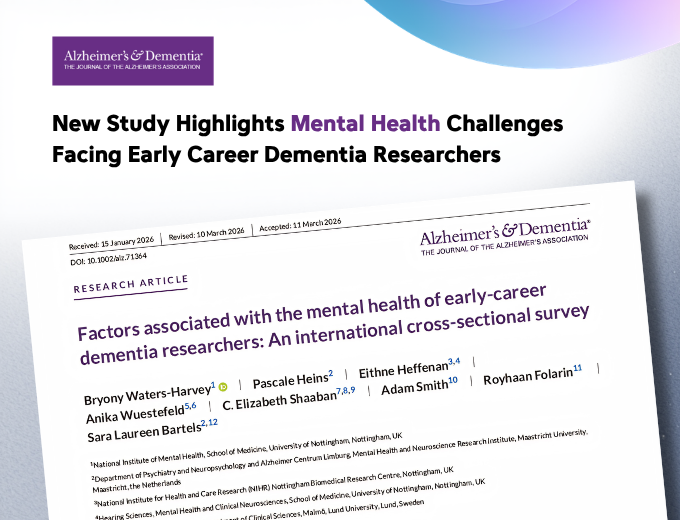
A new international study led by Dr Bryony Waters-Harvey, alongside Dr Pascale Heins, Dr Eithne Heffenan, Dr Anika Wuestefeld, Dr.C. Elizabeth Shaaban, Adam Smith, Dr Royhaan Folarin, and Dr Sara Laureen Bartels, has explored the mental health of early career dementia researchers.
This is the third paper to be published, drawing on survey data collected through a collaboration between Dementia Researcher and ISTAART. The study provides one of the first detailed analyses of wellbeing in this global research community.
The paper, “Factors associated with the mental health of early career dementia researchers: An international cross sectional survey,” analysed responses from 283 researchers across 31 countries.
A clear signal from the data
The findings show that nearly 60 percent of respondents reported experiencing a mental health condition, with anxiety and depression among the most common.
This reinforces wider concerns about academic working environments, while highlighting pressures specific to dementia research.
What is driving these challenges
The study identifies several key factors associated with poorer mental health:
- Imposter syndrome, which showed the strongest association
- Financial problems, linked to funding instability and short term roles
- Age, with those aged 25 to 34 at greater risk
- Sexual orientation, with LGBTQAI plus researchers reporting higher vulnerability
Together, these findings point to a mix of structural pressures and personal experiences shaping wellbeing.
More than an individual issue
While many researchers rely on support from peers, mentors, friends, and family, formal institutional support was often seen as limited.
The study highlights how academic culture including long hours, job insecurity, and competition for funding continues to contribute to stress and burnout.
Supporting the future workforce
Early career researchers play a central role in driving dementia research forward. The authors highlight the need for targeted action, including:
- Improved financial security and funding pathways
- Support to address imposter syndrome
- Stronger mentoring and peer networks
- Greater inclusion and support for underrepresented groups
These changes will be essential to sustain the workforce needed to tackle one of the biggest global health challenges.
Waters-Harvey B, Heins P, Heffenan E, et al. Factors associated with the mental health of early-career dementia researchers: An international cross-sectional survey. Alzheimer’s Dement. 2026;22:e71364. https://doi.org/10.1002/alz.71364

 Dr Lindsey Sinclair